 In june I did my first ‘week’, called the Bourbon Week. Lot’s of Bourbons yes, but not all were actually Bourbons. I threw in the odd Rye as well. After the success of that week, and I have to admit, the fun I had by doing such a ‘week’, I thought it was time to do another week. So here is the first day of the Japanese Whisky Week! Again I’ll try to review seven Whiskies in seven days, and this time they are all from Japan. I thought that Japan was untill now a bit underexposed on Master Quill’s pages having reviewed none! But that’s about to change…
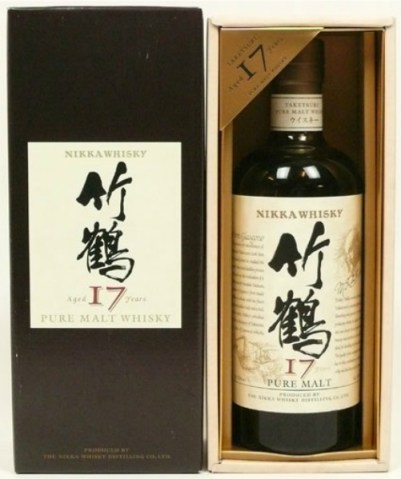 In 1918 one Masataka Taketsuru went to Scotland to learn the whisky trade at Longmorn, Ben Nevis and Hazelburn distilleries. During this time he met his soon to be wife Rita, and both returned to Japan. There Taketsuru founded Nikka with the building of Yoichi Distillery on Hokkaido Island in 1934.
Yoichi was built on the north island of Hokkaido considered by Taketsuru to be close to the natural environment of Scotland. Also copied was the way of distilling, two times in copper pot stills. In contrast to their Scottish counterparts is the use of new wood and slow-growing Japanese oak.
A lot of years later the Nikka company named a small series of pure malts after it’s founder. The series comprises of a 12yo, a 17yo and a 21yo. All Pure Malts are made up of only two components. Yoichi and Miyagikyo. The latter was founded in 1969 in Honshu. Both singles are great, so this Taketsuru should be no lemon.
Color: Full Gold (slightly pink).
 Nose: Musty gravy. Nice slightly burnt wood. Sweetish fruits with pineapple. Sweat ánd men’s cologne. Powdery, almost like sawdust. Greenish. It smells a bit like those hard candies made out of fruity powder pressed into little pills. Sometimes a whiff of soap. All in all, very nice.
Taste: Spicy esters. Toast and a hint of tar. Tastes a bit dirty actually. Grainy with vanilla ice cream. Reminds me a bit of vodka. Greenish hints here too. Definitively not as sweet as the nose predicted. Half long sour wood finish which is a bit unbalanced. The toast and tar stay on for the, therefore bitter, finish. Alas too low in ABV.
Although this is quite a nice Pure Malt, for the money you can get a Yoichi or a Miyagikyo, that are (marginally) better. Still I do like this Taketsuru, and combining the two is an experience of its own. Just beware, because there is talk about batch variations.
Points: 85
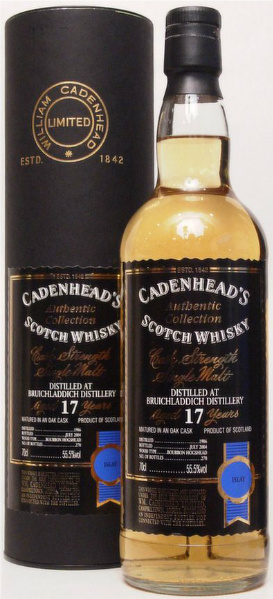 Also from 1986 but several years younger, a 13yo to be precise. Even though it was younger, this bottle showed more character to it. The 13yo was almost empty and maybe these Bruichladdich’s need a lot of air. Let’s have a look in my controlled environment and using my glass of choice, how this Bruichladdich really is. (This bottle, just open).
 The other day, I reviewed a reduced
  that means this Tormore was bottled around the time previous reviewed Tormore was distilled (1996). Both Tormore’s are about the same age too. Let’s see if thís Tormore is any feminine.
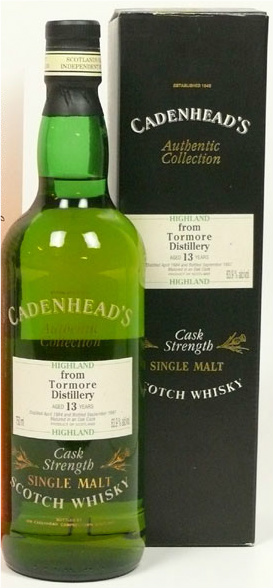 Color: White wine.
 In 1984 the heating system for the stills was converted, so that it could be heated with… woodchips to heat the stills. Officially only a 10yo was released, later replaced by the current 12yo. For a short while also a 5yo and a 15yo existed. So mostly independent bottlers issue Tormore Single Malt today. Still, over the years not a lot was issued this way, nor does it usually score very high. I guess it’s time to have a look into Tormore. First a Tormore bottled by Dutch bottlers
  Color: White wine
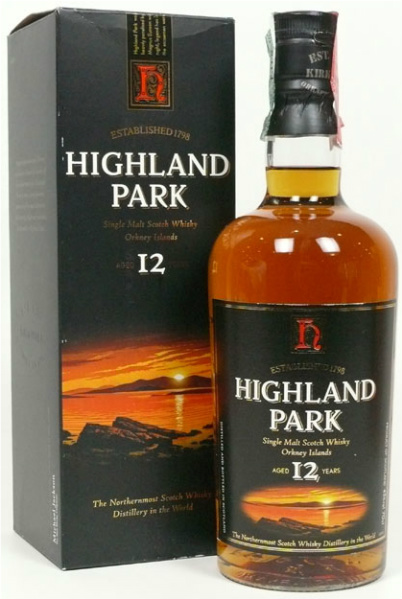 Remember this one? Before this came the nice broad-shouldered bottle with the big knob cork. And somehow they changed it into this. We hated the looks of it back then, but looking at it today it doesn’t look that bad. Well this version of the bottle is also no more and again they changed the looks completely into something that looks oval from above.
 The last reviewed beer,
 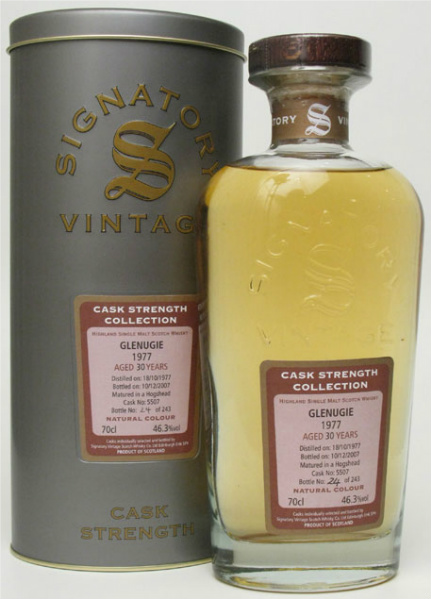 Color: White wine.
 It’s a rainy day today, grey and bleak and I am a little bit under the weather too. Luckily I have some notes lying around I can work with. Otherwise not actually a nice day to go out and have a smoke. But a nice day to put some Art Blakey on. I have A Night in Tunesia & Moanin’ to warm me up and write something about Le Hoyo du Maire.
 Hoyo de Monterrey Le Hoyo du Maire (30 x 100mm, Entreacto, Small Panatela, Box code FR NNSR)
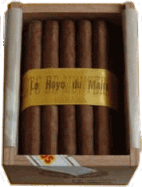 Taste: Oily wrapper and salty on the lips. Just lit and it tastes immediately great. Very woody, but a great overall taste. The wood becomes a little bit sour but the cigar still has good balance. The draw and the smoke are good. It’s a sour-woody and spicy cigar. Ash is light grey with some whites. As often, ash has tiny white spots. It’s very thin so it is stronger than your usual Hoyo. A cigar to ‘sip’, otherwise it will burn too hot. Sometimes you do get small whiffs of…fireworks. The development is linear, still it does have a lot of character for such a small cigar. The draw diminished in the second half, but rolling it between my fingers solved this minor problem.
 Lots of times I witnessed situations where an ‘old’ bottle from Gordon & MacPhail was opened and we all started guessing how old the whisky was, since only a distillation year was printed i.e. “1970”. I fondly remember the discussions when a particular bottle was bottled because the bottle had a ‘nipple’. Another situation could be when a particular bottle was distilled and/or bottled, because only the age of the whisky was printed i.e. “30yo”. Very annoying when you taste a Strathisla 25yo by Gordon & MacPhail that was made for several decades with the same label and different batches are very different. Lots of those ‘old’ bottles don’t have such information, or do they?
 In the case of Gordon & MacPhail, since 1988 a laser Code can be found somewhere on the bottle. Usually printed on the back of the front label, or on the back of the bottle, near the bottom, for newer releases. As can be seen on the picture to the left. Here an enlarged view through the back of the bottle, through the whisky. The code is IB/ABD.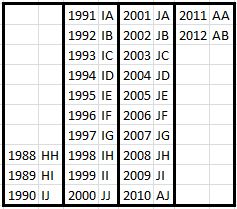
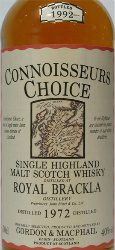 Of interest are the first two letters. IB in this case. The code used is like this: A=1, B=2, C=3, D=4, E=5, F=6, G=7, H=8, I=9 and J=0. IB therefore is 92. The bottle is very probably from 1992! The second series of letters are probably a batch code. On the right is a picture of the same bottle from the front, and indeed it is bottled in 1992.
 Sometimes the first part of the code comprises of three letters instead of two. This is very rare and when this happens two of the three letters match the table given here.
 In this case too there is a neck label with 1991.
 My good friend of “I think about beer” did a
  Westmalle is one of six Belgian breweries that are ‘protected’ by the Authentic Trappist Product logo. Achel, Orval, Chimay, Rochefort and Westvleteren are the others. The logo was presented to discern the trappist beers from the more and more widely available ‘abdij beers’ of Belgium and other countries. (Abdij = Monastery). Most of those beers aren’t even brewed near a monastery, but commercially brewed under a licence. Still, it’s the same style of beers. Usually with a blond beer at normal strength, a dark “Dubbel” and a heavy blond “Tripel”. occasionally a very heavy “Quadrupel” exists.
 It is not only beer that falls under this logo, and not only Belgian beer to boot. Here is a list of all products that fall under this logo.
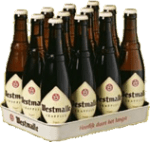 Nothing for the novice. The bitterness is quite a bit of the character. Beware because ageing makes this beer less fruity and more deep and bitter. The label, the bottle, the iconic WA-logo, the smell of it all. It breathes a time long forgotten, pré WW I. You consider yourself back in the thirties. A high score, but not necessarily your easy, every day choice. This is a classic.
 Master Quill