Just like Deanston earlier, Glen Moray was another distillery that showed up on my radar rather late. Glenmorangie was there from the start, but I wasn’t a fan of their general output I knew up to then. Later I was reading about how Glenmorangie (Bill Lumsden) was using Glen Moray as a testing ground for Glenmorangie, well you get why I wasn’t really interested early on, not being a fan of Glenmorangie itself. Over time I also got the chance to try a lot of official releases of Glen Moray, which are, and still are quite affordable, yet also not very exciting. This is now the fourth Glen Moray on these pages and oh dear, the tree bottles that went before this one didn’t even manage to get a score in the 80 point range. All three quite disappointing. However a wise man from Belgium once said to me, every Whisky distillery is able to make a good or great Whisky, so the fun lies in finding one of those (and when you find a good one, the challenge shifts into finding (or at least assessing) the best possible expression of said distillery. Adelphi is an independent bottler that has an above average output quality-wise. I believe I actually never had a bad one, not saying there aren’t any, but I would bu surprised of they do. When a 22yo Glen Moray bottled by Adelphi popped up on an auction, I snapped it up, curiosity eventually killed the cat, being only the second Glen Moray I ever bought, and I still haven’t bought one since. Let’s see if I should.
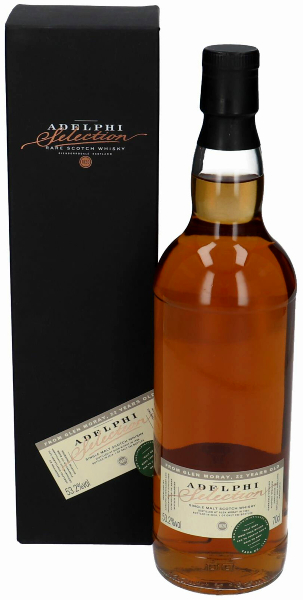 Color: Copper gold.
Nose: What a welcome smell after all that peat of the past reviews. Right now, I just love the possible variations of Single Malt Whisky. Funky Sherry, very fruity, nutty and waxy. Lots of nice organics ever so slightly meaty, like in cold gravy. Leather and jute, in this case a very expensive smell. Quite sweet and fruity, dried apricots mixed with a more minty aroma. Sometimes this smells like a Bourbon or even more like a Rye Whiskey, so not like a Whisky matured in a Bourbon or Rye cask. This also didn’t mature in an ex-Bourbon cask, but it probably did mature in a Sherry cask made of American oak in stead of European oak. Dry oak planks, you can almost smell the vegetal bitterness this has. It’s smooth and creamy. American oak has more vanillin and European oak has more tannin’s, which would be a hard thing to smell actually. Maybe we’ll encounter tannin’s when assessing the taste. I don’t smell sulphur per se, but the (rural) organics this nose has, definitely are based around one or more compounds containing the element of S (sulphur). However I have to say, the S-element gains in strength with some extensive breathing of this Whisky, but that is all way back, so this is not really a sulphury Whisky. The creaminess stays, and mixes a bit with a toasted (Sherry) cask aroma. You can add almonds and a little bit of cardboard to the leathery aroma mentioned earlier. Borderline dusty. Even though I believe this is from American oak, the overall the nose is well behaved, very well balanced and with an somewhat older style Sherry feel to it. Not a Sherry bomb like for instance a dark 1971 Longmorn nor like an old skool Sherried Malt. After even some more breathing, the fruit moves into the realm of apples now. Calvados. So it starts like a Rye Whiskey, with the body of a Single Malt and finishes off like a Calvados, how that for a change! Remarkable though that every time I pour this it never starts with the apple note.
Taste: Lots of fruit, but more of the overripe tropical kind. Buttery and creamy, almost custard like. Very tasty. Sweet and waxy, with only a slight bitter edge to it initially. It’s so big on fruit and its half-sweetness, that this more astringent, bitter bit integrates very well. I would day, wood and ear-wax. The wood has a bite. Nevertheless, highly drinkable and quite tasty, but also a bit hot initially. Sipping more brings out more bitterness, but it still doesn’t really hurt the Whisky, even though it does increase in intensity. Next a very nice burnt wood note that really blends in very well with the fruit. On all accounts this Malts shows its strength in balance. After sipping this, even the nose is starting to show more wood. On the palate we are now moving into the realm of toffee and caramel and right after this the wax from the nose comes back in as well. So even though it has this dry wood bitterness, the sweetness is never far away. This late in the tasting, the sweetness also shows us a tiny amount of integrated tar. I do have to mention that I do pick up more on the wood and bitterness with a tired palate, after dinner and/or late in the evening. Earlier in the day, (or even before breakfast, which is a time of day that is not uncommon for a reviewer of distilled spirits), the fruit is more prominent. Never forget that you as a taster are (highly) subjective, you change a lot during the day, or from day to day, so try to keep that in mind. If you tried a Whisky once, you may have an idea about the Whisky you tasted, but you really didn’t have the chance to really get know it, so proceed with caution with occasional tastings.
See, after all these, mediocre at best, Glen Moray’s I reviewed before, this time a very nice Glen Moray found its way into my glass and onto these pages, and I’m glad for it. Already based on the nose alone I was already very happy getting this one and even though it has this bitter edge, I’m also quite happy with the taste of it. Definitely a score into the eighties this time. Well done!
Points: 88
 Color: White wine.
 Color: White wine
 So there are quite a lot of official Wine finishes by Glen Moray themselves. Now Ian MacLeod decided to add their wine finish of their own, or maybe bought it straight from the distillery.
