 Today we’ll have a Grappa made by Sibona. Looking at the picture below you might think it doesn’t look like much, but holding the adorable half litre bottle in your hand, makes you want to have a whole row of bottles like this, with Grappa’s made from every single grape variety that grows in the Piedmont region of Italy. The bottle itself has markings, warning you when another 10 cl has gone, and has a little extension preventing you from dripping the precious liquid, so not a drop gets lost. For this “Linea Graduata”, the label looks like someone typed it in his shed. Looks fantastic though. Even without tasting, I would like to have them all!
Barbera is a red grape variety that has grown very common to Italy. It is the most planted grape variety just after Sangiovese and Montepulciano. Sibona hails from the Piedmont region, and over there, Barbera is the most used grape variety. Both Sangiovese and Montepulciano are not (really) planted in the Piedmont at all.
 Color: Light citrus yellow, straw.
Nose: Lots of hay, warm, basking in the sun. In the distance crickets are chirping and you are living the live of a God with an Italian beauty by your side. At least you are enjoying yourself very much. Hay, dry grass, dust, cereal, honey and some deep fruity notes and some nice citrussy notes as well. With some time, creamy notes develop with hints of vanilla coming from the oak ageing. Black tea, with a flowery note to it as well as some black fruits. Dry and very well-balanced. Hints of rural organics. Maybe not at first, but this has become a dream to nose.
Taste: The hay and dry grass return big time in the taste as well as some virgin oak. A sappy and tannic bitterness with grape skin aroma. It would be funny now, to say this isn’t sweet enough, but yes, it is on the dry side, which won’t make it your daily drinker, nor will it be a Grappa for everyone (starting to drink Grappa). Nevertheless, I’m glad this hasn’t been ruined by sugar. Having said that, apart from the honey, there is some hidden sweetness to this Grappa, and it is sugary in quality, not saying that this is sweet at all. So slightly sweetened black tea it is. The more it breathes the more black (and red) fruits emerge. very appetizing. A connoisseurs aperitif I would say. It’s far to elegant or subtle to function as a digestif even though Grappa is really a digestif, and this particular example is quite powerful. With extended breathing the naturally occurring sweetness becomes more and more noticeable.
I remember when I opened the bottle I didn’t like it very much, because all of the hay and it seemed not to be pleasant to smell as well. But even then, I had the feeling I would grow into it. At this point in time I really don’t know for sure which of us has changed, me or the Grappa, which got some air into the bottle to breathe and develop. This is a high quality Grappa showing off a single grape variety from the Piedmont. Not an easy Grappa, and something to savour once in a while. But when you need it, it’s great. The role the wood played is easily discernible. The Barbera has been aided by some ageing in oak, in fact, this is the darkest of all the Grappa’s from the “Linea Graduata”.
Points: 81
 Day four, a.k.a. the middle, or the pivotal point in a week. We’re halfway through. We started out with three distillery bottlings of Laphroaig. An older 15yo, it’s replacement the 18yo, although not in its latest guise, and yesterday we had a look at a travel retail only bottling from last year: An Cuan Mòr. Up untill now Laphroaig hasn’t failed me yet. Today we’ll venture into more unknown territory. The territory of the independent bottler. Today we’ll have a look at a Laphroaig, Erik Molenaar got into his hands a while back. The market is rapidly changing. In 2011 Erik could get (part of a Sherry Butt) for a reasonable price. Today he probably would still be able to source such a Whisky, but unfortunately only at an unreasonable price. So even when this is from 2011, it can still be considered…well you catch my drift. So without further ado…
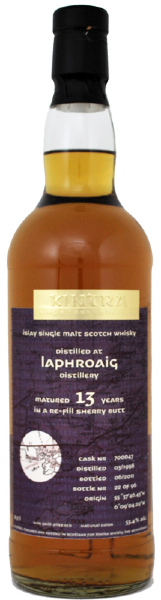 Color: Gold.
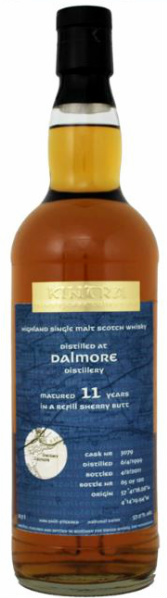
 Color: Full gold, almost orange.
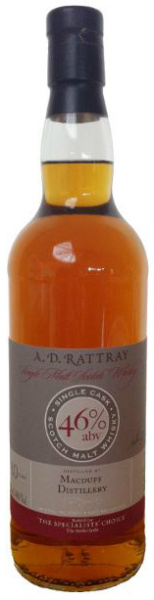 Finally a younger expression of Macduff. Not one I predicted in
  From 1955 through 1956, the distillery is again completely rebuilt, this time because of economics, not disaster. In 1966 the distillery is equipped with six stills, but are not configured in the expected three pairs which a normal double distilling distillery would have. Benrinnes have two groups of three stills which makes for a partial triple distilling configuration (sounds a bit like Springbank doesn’t it?).
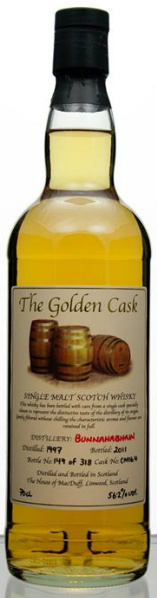 Another House of MacDuff bottling and yes, another Bunnahabhain from this independent bottler. The one I reviewed earlier was distilled in 1972 and bottled at 40 years of age! This again is a fairly light-colored malt, so it seems like a not so active cask. Still, knowing who picks the casks I still have high hopes for this one. It can’t be bad. It seems to me that Bunnahabhain is a very popular distillery for this independent bottler since they have managed to bottle already five Bunnhabhains, this one from 1997 was their first.
 Color: Light gold
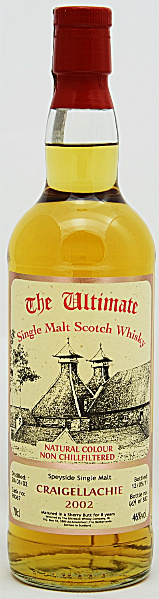 Color: Light gold
 Master Quill