This is the latest Inverleven bottling of the now defunct Inverleven Distillery by Gordon & MacPhail. Gordon & MacPhail still have casks of Inverleven lying around, but have told me since Inverleven is a closed distillery, and the whisky more and more rare, this is the last time Inverleven was bottled in this series. Next time it will be issued in a ‘higher’ series (and hopefully at a higher strength). Inverleven is a whisky made in two Copper Pot Stills on the premises of the Dumbarton Grain Distillery. Whisky was made in these stills between 1938 and 1991, when the Stills were removed. Grain Whisky is still made here in a Column Still. For a while even a Coffee Still was in operation making the very rare “Lomond” Whisky (from 1959 to 1991). By the way, this is not Loch Lomond Whisky, that actually is only a few kilometres away, far enough to be a Highland Whisky. Dumbarton is the home of Ballantine’s blended Whisky.
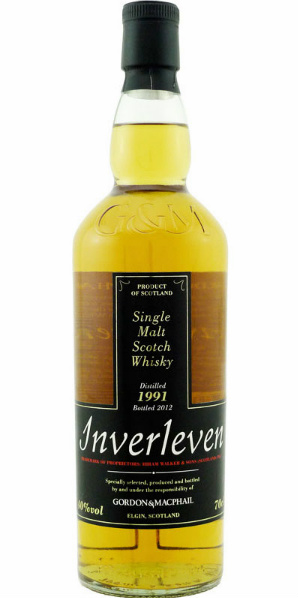 Color: Gold.
Nose: Very fresh, citrussy and creamy. Dry leaves in the autumn. So, lots of lemon and vanilla ice-cream. Very nice, slightly sour and spicy wood. Wood in wet earth. Never overpowering. Elegantly spiced, but all the spice is from the wood. Fresh air. This seems to me, based on the nose alone to be a great summer or autumn Whisky. For a Lowlander ánd a Whisky at this strength, this has a very rich nose and very good balance. I can only hope the whisky tastes as great as this nose does.
Taste: Well the first sip I took was quickly gone. So quick that the only taste that came to mind was sweet pineapple and after that I already tasted the spicy bite of the wood, which again is not overpowering, but firmly present. From the second sip I have some vanilla, caramel and even later on a dried grass element. It’s not quite hay. The initial sweetness, dries out quickly. Malty.
Quite a lot of wood in this one. And the first time around I found the finish to be short. Second time around, when the Whisky had some time to breathe the finish became a wee bit longer. Still, the nose is very nice and the wood shows itself in the nicest of ways. After breathing the woody part got bigger as well, but the finish got a little bit unbalanced. Maybe this got reduced too much? Let’s hope that the next 1991 Inverleven get’s a better chance at 46% (and maybe more…).
Points: 85
Thanks to Stan and Alistair for the sample.
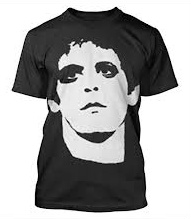 Lou Reed’s Transformer on the record player and the new Tomatin 30yo OB in my glass, what can go wrong? As I already mentioned
 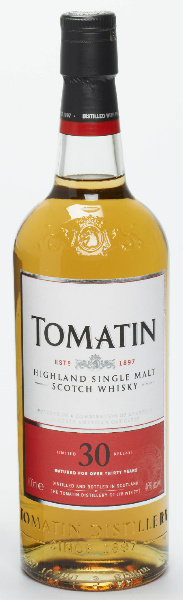 The new 30yo was introduced in 2011, replacing the 25yo that still can be found. It’s reduced to 46% ABV, to fit neatly in the ‘standard’ range which now comprises of the 12yo, the 15yo, the 18yo and now the 30yo. The 21yo I reviewed earlier is a limited release and higher in ABV (52%), so it’s not part of the standard range. Still it looks like a huge gap to me between the 18yo and the 30yo. And a new 21yo or 25yo would be nice. For now, mind the gap…
 Can’t imagine this was colored. It’s so light in color. That would be great, since we don’t like people messing with our drams, don’t we? Both the nose and the palate are neatly balanced. I really love these kinds of whiskies. One I thoroughly enjoyed. Imagine a great 30yo whisky and what they ask you to dish out these days. Considering this, this one is a steal (in some markets) and deserves a following. It’s 46% ABV and very nice, this makes it almost too easily drinkable and there is a possibility that this bottle will be empty in no time, so beware. The 2011 batch was also very good, still this one from 2012 scores one point higher, since it’s even more fruity.
 Dominiek Bouckaert is known for being the billionth ICT guy that does something in whisky. When I started with whisky I was an ICT guy myself and of course was introduced to the stuff by another ICT guy. In fact I was introduced to Whisky by two of them. One was partial to Laphroaig (eventually my first self bought Single Malt), and the other was more into Talisker (I’m something of a Talisker-collector now).
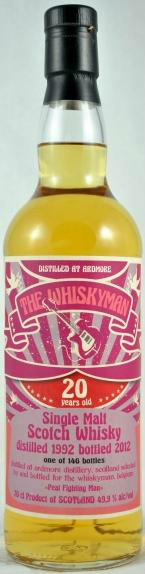 Besides ICT, Dominiek took it upon himself to dabble a bit with distribution of the Malts of Scotland (A german bottler) and play a bit with Luc Timmermans doing their Hand Written Labels. and last but not least, Dominiek has his own label now. The Whiskyman. Nice psychedelic colorful labels with a wink, wink, nudge, nudge to music. Beatles and Stones to start with, and this is an example of the latter called peat fighting man.
 And here is Ardbeg. Last of the Islay whiskies to feature on Master Quill. The first Ardbeg is also the last one being released. Ardbeg Galileo. A Whisky that in part was matured in Marsala Casks.
 Galileo Galilei was born on February 15th, 1564 and departed from this earth on the 8th of January, 1642. Galileo was an Italian physicist, mathematician, astronomer, and philosopher who played a major role in the Scientific Revolution [
 I hate to say it, but aren’t “Ardbeg” putting more money into marketing than in the actual Whisky? Don’t get me wrong, I love Ardbeg, just look at my
  Old Bothwell is a company from Bothwell, Lanarkshire Sur near Glasgow Scotland. It’s a company that specializes in bottling their own stock of wines and spirits with the possibility of personalized labels. In the whisky-world they became quite famous for bottling a series of great Port Ellen’s. Alas Old Bothwell just bottled their last cask of Port Ellen, so now they will move into other whiskies. First up are a Tormore 1988/2012 and Macduff 1980/2012.
 Master Quill