
 The last reviewed beer, Westmalle, was a Trappist beer. This Tongerlo is an example of an ‘Abdijbier’ or Abbey beer. Thus linked to a monastery, yet commercially brewed by Haacht. So no Authentic Trappist Product then, but still a beer in the same style. But hey, this beer has an official hallmark too. It’s a “recognized Belgian abbey beer”.
It turns out this hallmark is issued by the union of Belgian brewers and it seems there are some rules. The hallmark was issued for the first time in 1999 and the rules are slightly different for Abbey beers from before that time, and those that applied afterwards. Some rules are pretty obvious. There are more rules but here are a few: There has to be a link with an Abbey. Part of the proceeds must go to this Abbey and the beer has to be brewed there before (history taken in to account). In this case we are talking about the “Norbertijnen abdij” from 1133! Well my kind of marketing I guess.
Before we move on I (again) have to say that my beer is aged a little and has a best before date of 27/5/10. But this bottle can lie in your cellar much longer.
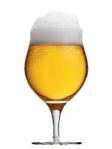
Color: Clowdy gold.
Nose: Fresh, lemons and oranges. Sour fresh. Not a lot of depot, only some hints of yeast. Still this has undergone a third fermentation stage inside the bottle.
Taste: Oranges and medium bitter. Despite the elevated bitterness also a very nice and fresh and sour note, that makes this extremely drinkable. Appetizingly fruity and it doesn’t even seem to be 8% ABV. Slightly sweet with hints of banana.
A very good beer. I like it a lot. Extremely drinkable Tripel with a very good balance. I would like to have another one please?
Points: 87
 My good friend of “I think about beer” did a
  Westmalle is one of six Belgian breweries that are ‘protected’ by the Authentic Trappist Product logo. Achel, Orval, Chimay, Rochefort and Westvleteren are the others. The logo was presented to discern the trappist beers from the more and more widely available ‘abdij beers’ of Belgium and other countries. (Abdij = Monastery). Most of those beers aren’t even brewed near a monastery, but commercially brewed under a licence. Still, it’s the same style of beers. Usually with a blond beer at normal strength, a dark “Dubbel” and a heavy blond “Tripel”. occasionally a very heavy “Quadrupel” exists.
 It is not only beer that falls under this logo, and not only Belgian beer to boot. Here is a list of all products that fall under this logo.
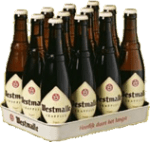 Nothing for the novice. The bitterness is quite a bit of the character. Beware because ageing makes this beer less fruity and more deep and bitter. The label, the bottle, the iconic WA-logo, the smell of it all. It breathes a time long forgotten, pré WW I. You consider yourself back in the thirties. A high score, but not necessarily your easy, every day choice. This is a classic.
 La Guillotine, a heavy beer, is made by
 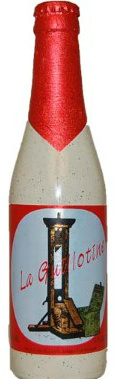 Color: Orange Gold with lots and lots of yeast.
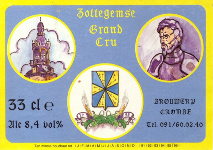 Some time ago I reviewed
 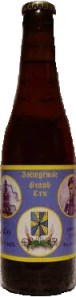 Color: Murky gravy-brown.
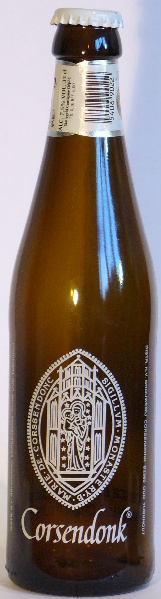 Let’s try another Tripel.
  As you know life is hard. For this review I had to drink three bottles of the Corsendonk Agnus. I bought a couple of bottles a long time ago that were brewed in august 2006. I tried one of those earlier when it was around three years old, and this time I’m trying two, of the same batch, that are now six years old. Yes you can drink Tripels well past their dont-drink-or-you’ll-die-of-food-poisoning-date. Finally I also bought a new one that was brewed in february 2012. Following notes are for the aged ones:
 Well first of all, after the prolonged ageing period, the beer turned a lot darker, than the same batch at a younger age. Originally it was radiant gold, now it turned a lot more copper. The meaty part on the nose disappeared, but it gained a lot of fruity esters. With this it gained a lot of complexity. The three-year old one was more refreshing (more lemon), but this still is refreshing. It gained more depth, but it didn’t even change that much, tastewise. It is easily recognizable as a Corsendonk Tripel. Personally, I find six years of ageing a bit too long. I think it is at it’s best, around three years old. The new batch was, in comparison, very light and really easy to drink, with an aftertaste you only know of your standard beers. After seeing it’s potential I would recommend ageing your bottles for three years. But if you’re interested, longer can be quite fun too. Drinking this right after you bought it is a waste of your money. Put it in your cellar and be patient!
 After the fabulous
  It’s all right. An example of a typical Tripel. I prefer other Tripels, which will be reviewed eventually. After the Pale Ale this is a bit disappointing. Maybe I had too high expectations for this? It reminds me a bit of a Duvel, but Duvel is better (for me). Don’t get me wrong, this still is a pretty decent beer, but for me it doesn’t add anything to the world of the Tripel. Actually, maybe this isn’t even an Abbey-style Tripel. But a heavy Blond Ale with a third fermentation in the bottle (which a lot of people call a Tripel). It just has to decide which one of the two it really is.
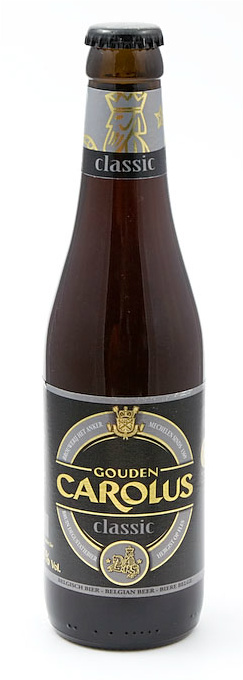 Gouden Carolus, once, only one beer, but since then a lot more versions of Gouden Caroli hit the market. Actually there was an emperor’s beer before 1960, but this is the year the name Gouden Carolus was given to it.
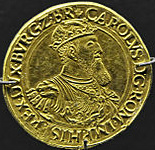 emperor Charles V on it, who spent his childhood in Mechelen. This beer is also from Mechelen, what a coincidence! It is even a protected regional product from Mechelen.
 What catches the eye with this beer is the statement: “bier met smaakevolutie” thus stating that this is a beer with an evolution in taste. Great! I love that in my drink. Evolution.
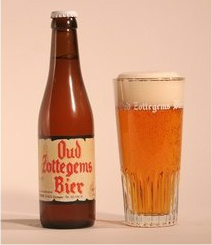 Color: Murky brown, not much foam.
 I would say. Drink this beer! It’s very nice ánd nearly extinct. It has become a very regional beer and deserves a lot of attention. Losing this would be a shame. I’m definitively buying this again, but sure am curious for the Grand Cru version of this. So thumbs up and a well-earned:
 And now for a completely different beer. This time something from the oldest brewer in Britain. Sheperd Neame from Faversham, Kent founded in 1698. Spitfire is a cask conditioned bitter that came onto the market in 1990 to commemorate the Battle of Britain. This bottle of britain is named for the famous fighter aircraft from the second world war. The beer also has a different
  kind of advertising than we are used to of which I only give you a few, but there’s a lot more. Let’s move on to the beer, shall we?
 Nose: Fresh, it almost has no scent at first, certainly malt but after that we’re in the twilight zone. Hard to tell what else there is.
 Taste: Thin (probably the low ABV). Fresh, summery ánd bitter. This bitterness once tasted, never leaves and dominates even the finish. The body is light, hoppy and malty. The middle and the finish make this less summery, although I guess this will do well as a thirst quencher on a terrace looking at people passing by.
 In the end I found this to be very easy, not to say very simple. For me even though it isn’t very bitter, still the bitterness dominates the light palate. Maybe that’s why they call this a bitter.
 Still nice weather and too hot for writing blogs, so hereby I apologize to my readers that it took a few days for a new review. This time a review of beer brewed by Bavik in Belgium called Petrus Aged Pale. This beer was initially intended only for the US market, hence the typical warnings on the label, even though I bought this bottle in
 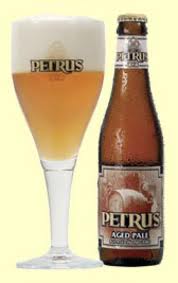 Color: Gold
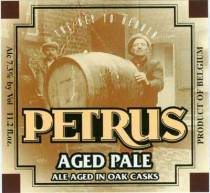 this simple beer let’s you know it has a lot more going for it. It awards you with a lot more complexity than you would say at first. It is close to a Rodenbach but in my opinion, better balanced and way more complex. You just have to work it a bit. For me this is better than the classic Rodenbach, but I’ll have to give the Rodenbach Grand Cru a go. This Petrus could be an acquired taste, but one I like a lot.
 Master Quill