After the Chivas Regal 12yo, a Blended Whisky from a big company, let’s see what the little, more independent, guy can do. A guy with a passion for blending. Obviously I’m talking about John Glaser, and his Compass Box Whisky Company. A company that all Single Malt aficionado’s seem to love. We’ll have a look at an early “Asyla” here. Asyla is part of Compass Box’s signature range, or core range for us normal folks. A quick look at the website of Compass Box learns us that Asyla is the lightest of the signature range, calling it delicate and sweet.
Only Whiskies from first fill used American oak casks were used, for vanilla purposes obviously. The Malt’s used are Linkwood (30%), Glen Elgin (10%) and Teaninich (10%) and the Grain comes from Cameronbridge (50%). Sometimes Longmorn is also named as an “ingredient” for this blend, because the Compass Box website mentions that the Malts for this blend hail from the towns of Longmorn and Alness. Looking at the map you can say that Linkwood and Glen Elgin come form the town of Longmorn, so I’m not sure that there is any Longmorn in this blend. Since Asyla is around for quite some time, maybe the Malts that go into this blend differ from time to time. For now I’ll stick to Linkwood, Glen Elgin and Teaninich though. Before I forget, the other four offerings from the signature range are: “Oak Cross”, “The Spice Tree”, “The Peat Monster” and “Hedonism”. Of course outside of the signature range, a plethora of other bottlings exist.
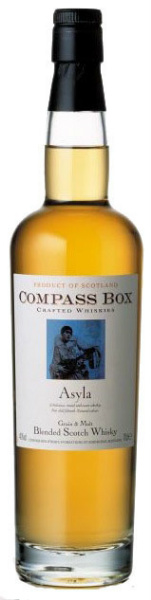 Color: Light gold.
Nose: Grainy, light, yet perfumed. Floral at first but also fruity, with a tiny hint of pineapple and green sour apple skin. Sometimes I even get a trace of lavas. Heaps of vanilla shoveled on top, and given some time even some spicy wood. More than a hint of Calvados, an Apple Cider distillate from Normandy or Brittany. Dry and powdery. Sweetness is mentioned by Compass Box themselves, but for me the nose doesn’t carry a promise of sweetness, in any way or form. Elegant and light, but alas also a bit thin and anonymous.
Taste: Paper and grain come first, after that a blend of sweetness and (virgin) oak, although no virgin oak was used for this one. The vanilla presents itself after the paper and grain, and a slight bitter note, fade out. Not a lot of development going on, and you’re probably not surprised this doesn’t have a long finish as well. The finish itself seems to be a bit unbalanced, due to some acidity from the oak. The oak seems a bit fresh, as in not used for a long time when it contained Bourbon (or Tennessee Whiskey).
To be honest other bottlings of Compass Box made me expect more from this. Something in the order of a variant of Delilah’s. It should have been more creamy and even more towards the vanilla note so vehemently advertised.
Sure. Whisky is the product of spirit and wood (amongst others), but the bitterness it could do without, and as I said, it should have been more creamy. If you can find it, get a Delilah’s by the same bottler, and you’ll know what I mean.
I do like a lot of Compass Box Whiskies, but this one is not entirely for me, and that’s a surprise, because I expected this would be better than the Chivas Regal 12yo. Maybe age does matter?
Score: 72
 Color: Gold.
 This Blend was made by John Glaser with the help of Mike Miller, the owner of Delilah’s. On The
  Color: Gold.
 Not a lot of books like that existed back then, and it opened a world for me. I almost wore the book out. In hindsight I liked his book on Belgian Beers better, due to its thorough research and obvious love and passion for the subject. The Whisky Companion itself started to gather some dust since a lot of the scores in the book weren’t very realistic to say the least. Just look at the scores for the Macallan Traveller Series to name but four. In 2009, the Whisky Magazine and Berry Bros & Rudd blended the remains of his collection of open bottles together and other Whisky was added to “correct” the result. A proportion of the profits raised with this bottling was donated to The Parkinson’s Disease Society, an illness Michael suffered from, for more than a decade.
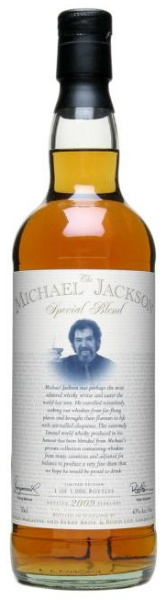 Color: Dark Gold.
 Merry Christmas everybody! In 2013 Cadenheads released a home-made blend called Cadenhead Creations (Rich Fruity Sherry). This first batch had an age statement of 20yo and was bottled in 2013. The blend was made with two casks of Single Malt and two casks of Single Grains. Samples of those casks are pictured here on the right. From left to right: Mortlach 1992 (cask #7848), Bruichladdich 1993 (cask #1648), Cameronbridge 1989 (cask #22804) and Invergordon 1991 (cask #39006). Since then two more Cadenhead Creations were released. A 21yo (black label, silver stripe, Blended Malt made with Ardbeg, Bowmore and Caol Ila) and a 17yo (white label, yellow stripe, another Blended Whisky made with Ardmore, Auchroisk, Caperdonich, Clynelish and Invergordon).
 Color: Full Gold.
 This time we’ll concentrate on the biggest and best known of the New Zealand Whisky producers, al be it under a lot of different names, and also under quite some different management.
 First Warren Preston bought the Distillery and some 600 ageing casks of amongst others Lammerlaw Malt Whisky and starting a firm called The New Zealand Malt Whisky Company (NZMWC). The Casks were laid down in Oamaru. Some 150 of those casks were bottled (under the Milfort brand name, but also Blended Whisky under the Preston’s brand name). Alas NZMWC went bankrupt and in 2010 the Forward looking entrepreneur Greg Ramsay (leading a consortium of investors) took over and renamed the firm The New Zealand Whisky Company (NZWC). Mr. Ramsay bought the last 450 casks of Whisky of which half were Lammerlaw Malt Whisky (18 to 24yo) and the other half Wilson’s Whisky (at least 12yo). By 2012 some 90 casks were bottled for the current range, so by now only 360 casks are left. In the grand scheme of things and the good promotion for the Whisky being carried out, I guess that the whole stock will be sold by the end of 2016. So be quick, because, this New Zealand whisky is rapidly becoming extinct!
 Color: Red copper.
 Master Quill