Hoyo de Monterrey Le Hoyo du Prince

Hoyo de Monterrey LogoThe year 2015 passed, without even one Cigar review. How is that possible? Did I quit smoking? No way, but I do have to admit I never started smoking either. Cigarettes are not for me. From the start it was always about Cigars. I smoke for taste I used to say and I never smoked a lot. The place I write from, The Netherlands, is not a tropical country, and I do have to find me a spot for smoking and reviewing Cigars somewhere, since I don’t want to smoke inside the house. As long as I don’t have a place for smoking, I’ll have to wait for some nice weather, and especially time. I need to be left alone with my Cigar for as long as it takes, and that is maybe the real problem here.

Getting the Cigar part of Master Quill back on track, we’ll start with another Hoyo du Monterrey. Hoyo du Monterrey has been featured before on these pages with the Epicure No. 2 and Le Hoyo du Maire. As I said before Hoyo de Monterrey is known to be a light Cigar yet meant for the connoisseur, aren’t we all? I do like Hoyo de Monterrey, untill now they have always been full of aroma, well-built and all smoked very good. I like the blend of tobacco used for this brand. The Cigar I’m about to review is and old one. Aged for a long time. The band you see in the picture was introduced around 2005, and mine doesn’t have that, and no, it hasn’t been removed. I bought a batch of old Hoyo’s quite some years back. Today this Cigar is only released in an SLB 25 (Sliding Lid Box, containing 25 Cigars).

le Hoyo du Prince

Hoyo de Monterrey Le Hoyo du prince (40 x 130mm, Almuerzos, Corona, Box code unknown)

Color & Looks: Light brown, with small veins and very straight. Tightly packed.

A cru: Light chocolate. Leafy with some nice leather notes. Still smells young and leafy. Grassy even. Fresh mown grass. Well I didn’t expect that from this old Cigar.

Taste: For a tightly packed Cigar this still had a reasonable draw. Starts out nice and friendly, not hitting you over the head like some Bolivars. Creamy. Doesn’t produce a lot of smoke, yet tastes great. Warming and creamy and is and goes together well with my coffee. What a great smell. Even second-hand smoke smells great. Becomes slightly spicy with young wood. The leather aroma is young and fresh. A freshly made and oily saddle. Great. The wrapper turns into white ashes and inside it turns black and grey. It’s just a shame it is a bit plugged, and I have to work at it so hard. Maybe this needs to be smoked at a lower humidity. This one here, has a RH (relative humidity) of around 70%.

After 1/3 the wood becomes more serious. Sandalwood and definitely less creamy. Hints of menthol on my lips. Since this is plugged, the smoke gets channeled and flows rather fast and hot. The whole experience gets dryer and more herbal. Half way through, the creaminess surprisingly reappears keeping the whole rather tasty and keeping it relatively mild. Second hand smoke is still great with added mint. That is what ageing will do. The great taste stays untill the very end when you almost burn your lips. It doesn’t become harsh at all. After putting it down I taste some thyme in the back of my throat.

Very tasty and accessible Corona. Definitely worth trying out. I loved it, even this tightly packed one.

Points: 84
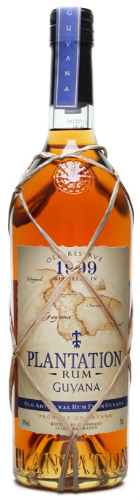
Plantation Guyana 1999 (45%, Old Reserve, 2009, Guyana)

Walk into a spirits shop which sell quite a few Rum’s, you have a big chance to find at least a shelf worth of Plantation Rums. I don’t know if this is true in all the corners of the world, but here in Europe it is. There are several reasons for this. They look quite interesting, quite a lot of Rum producing countries are available, and the price is quite nice. Especially if you are a novice it ticks all the boxes you care about. Having tried some of those, I can also say that they seem to be not bad.

Who is Plantation? Plantation is the Rum brand of Cognac Ferrand. Cognac Ferrand being the mother company that has quite a few brands in its portfolio. If you punch in Cognac Ferrand in your browser, you are quickly transferred to Maison Ferrand and there you can see that Ferrand is definitely more than Cognac alone. Back to Plantation Rum then. Plantation buys casks of Rum and ages them where they have found them. At the end of maturation, the casks are transferred to France, where they receive a second maturation for up to 18 months in small oak casks. Although it is not said that the cask previously held Cognac, we do assume that’s the case most of the time.

Here, we’ll be looking at one of the vintage releases from the Plantation Old Reserve. This particular example comes from Guyana, but according to the website there are six more Old Reserves available: Barbados, Grenada, Jamaica, Nicaragua, Panama and Trinidad. I don’t know if they discontinued some versions, but I do have a St. Lucia version as well. All are vintage releases, so there are multiple vintages available. I have tried several of the vintages of the Jamaican version and found that not only is there some batch variation between the vintages, but also that there can be more than one batch of only one vintage. Jamaica 2000 comes to mind…

Plantation Guyana 1999Color: Full Gold

Nose: Big, fatty and yet not entirely Demerara (yet). Initially, and momentarily, it has this high ester quality and funkiness like a Jamaican Rum, but in a slightly different way. With some more breathing this becomes more like a Demerara and the funkiness disappears completely, or is this my nose getting used to it? Quite fruity and has a very mild acidity to it. Is this the Cognac? Yes, maybe. The slightly off-acidity reminds me a bit of standing in the produce section of an outdoor market in the cold. Hmmm, never saw that before in a tasting note, Crazy Quill. Since these bottlings have seen wood that previously held Cognac, I’m guessing, that must be its origin. Slightly dusty with some paper-like qualities and yes some wood obviously. Hot oak. Old oak planks, yet freshly sawn. Soft. Hints of orange juice (the acidity mentioned above) and maybe banana (it does have a deeper layer, close to concentrated banana aroma). Dry soft wood and old toned down sawdust. yes, its dusty. Black, slightly sweet, tea and hints of licorice. The fruity notes start to integrate better after prolonged breathing and move back a bit, giving way to a more thicker, nutty, funky and waxy toffee character. Ok, letting this breathe seems to be the crux.

Taste: Wood, nutty, fruity and extremely syrupy (syrupy, not necessarily only sweet) at first. Yellow fruits on light syrup, so not thick or cloying. Sugar and burnt sugar (nice) and more nutty notes. A bit hot. Chewy and tasty, in a complex way. It’s not typically toffee of caramel, more like a combination of earwax and toffee. Slightly bitter. It’s in there but its more complex than that. Fresh oak notes and some licorice. Now its (sweetish) Demerara. The second Cognac cask maturation suits the original Rum. Wax with bitter notes of burnt sugar and burnt wood. The body is thick and in your face, but towards the finish that loses ground. It breaks down a bit in the finish, which otherwise has quite some length to it. It feels like a cloaking effect of added sugar. Nice note of almond in the aftertaste and the more breathing, the bigger the licorice note. Not bad, but Demerara can be better, but you will be hurting your wallet these days to try some really good ones. At this price point, it might be hard to find a better deal, but definitely not impossible. Even the El Dorado range of the 12yo, the 15yo and the 21yo do come to mind. Which also has some sugar added, but probably to a lesser extent than the Plantations.

This Plantation offering is in no way perfect, does have a good drinkability, and seems fairly priced. Good ABV as well (at 45%). Not every Plantation Old Reserve is bottled at 45% ABV though. This is an older bottle, from, April 9, 2009 (laser printed on the bottle), and has a slightly different look from current bottlings, which have a thicker glass base and a different icon on the shoulder. It’s also slightly higher in ABV (45% ABV). I fear that subsequent releases may be a bit sweeter than this one, I have already tasted some of them, and 42% ABV. might be the new strength.

Points: 84


Glenfarclas 21yo (43%, OB, Circa 2006)

Following up on the 15yo I reviewed last, here is the 21yo Glenfarclas from the standard range that was around in 2006. Trying the 15yo I was in a way amazed how the feel was “different” from the more modern malts that are around today. There seems to be an old way funkiness to that Malt. I’m quite curious now, how this 21yo will do.

Glenfarclas 21yo (43%, OB, Circa 2006)Color: Full gold.

Nose: Funky and somewhat waxy and sweet. A different profile from the 15yo. Lighter in color and fuller in a different kind of way. It almost smells chewy! Maybe more Bourbon aged Whisky went into this 21yo. Smells funky and organic. It’s like being licked by a dog which earlier licked some spilled honey (don’t ask). I love it. Hints of wood, and especially sawdust. Chocolate and some acidic fruits. This is more a creamy and woody Glenfarclas. Dusty vanilla pudding. It’s almost like his is more fruity than it shows. It just doesn’t come out of the liquid for us to smell. Encapsulated by some ice-cream notes. Great nose, and it has not a lot of the florality the 15yo had.

Taste: This starts with cardboard we know from the 15yo, and a lovely dried apricot fruitiness as well as some Calvados. Definitely lower in ABV than the 15yo. Waxy and before the wood comes this persistent cardboard and paper note, I don’t particularly care about. The finish is accompanied by the same burnt note the 15yo has, but in a softer more gentle way. Just like the 15yo, again not overly complex. Extremely drinkable. This is a Whisky I fear will be gone soon. By the way, this one does have a bit of soap in the finish, as well as in the aftertaste, which also carries some bitterness.

Although this starts well, the finish and aftertaste let it down a bit. Again a very specific Glenfarclas, and just like the 15yo, it’s hard to imagine they still can make it like this. I really have to get me a new version of one of those “standard” Glenfarclasses, or is it Glenfarcli? If you ask me I’d probably go for the 25yo, although the 17yo is also a fan favorite. But, you also might want to consider this one, which fits the same profile and I liked it very much.

Points: 84

Glen Scotia 6yo 1999/2006 (52.7%, The Whisky Fair, Heavily Peated, Bourbon Barrels #541 & #542, 464 bottles)

How ’bout another Glen Scotia then. One in its youth. This heavily peated Glen Scotia has a mere 6 years under its belt. Yes you read it right, a heavily peated Glen Scotia, move over Longrow? This is a Glen Scotia that was bottled for the 2006 Whisky Fair in Limburg, Germany. Most definitely a festival you shouldn’t miss. I like the label of this Whisky Fair bottling, since it looks similar to other Glen Scotia’s from that time. Lets have some peat then…

Glen Scotia 6yo 1999/2006 (52.7%, The Whisky Fair, Heavily Peated, Bourbon Barrels #541 & #542, 464 bottles)Color: White wine.

Nose: Soft elegant peat alright, but also very grassy. Lots of grass, dry grass, and hay. A confectionary sweetness, like warm icing sugar, but mixed with a little milk chocolate and the grass, peat and sweet ashes. Cocos macaroon with more than a hint of almond. This is already wonderful smelling after the mere 6 years in cask. Although this is from Bourbon barrels, I do encounter some sulfury compounds. Still grassy and some typical vanilla, with lemon freshness. Typical for Bourbon Barrels. Barrels are 20% smaller than (remade) hogsheads, so in theory the spirit ages more quickly, but not twice as quick, since nobody wold argue with you if you claimed this to be 12yo. Quite some active barrels. Nice.

Taste: Sweet barley, yup sweet barley. Diluted lemon curd. Altogether quite lemony. Where the nose was quite complex and didn’t show its age, the taste is much simpler and seems young, but not alcoholic. A sweet and creamy rounded off taste. Some prickly peat but not a lot. I wouldn’t call this heavily peated, at least it doesn’t seem heavily peated. Sweet barley and sweet yellow fruits, but none in particular. I guess dried apricots are the closest. Sweet Earl Grey tea with a hint of honey and a lot of lime. Medium to short finish and the same goes for the aftertaste. Which is about young soft peat added to warm diluted lemon curd.

Even though this tastes quite nice, I’m a bit disappointed that the taste didn’t live up to the promise of the nose. I was quite surprised at first in what the nose achieved in 6 years. Still an experience and a nice surprise. I wonder how this would have turned out with some more age to it.

Points: 84

Willett Family Pot Still Reserve (47%, OB, Single Barrel #82028, 283 bottles)

Just like the Noah’s Mill I reviewed earlier, Willett is a brand name of Kentucky Bourbon Distillers from Bardstown, Kentucky, or KBD for short. At first not really a distiller, but an independent bottler sourcing barrels of Bourbon from other parties and in some cases for other parties. In written media about the subject the name of Heaven Hill keeps popping up, especially since Heaven Hill is a few blocks down the road from KBD. However, on the 21th of January 2012 KBD started tests distilling at their Willett Distillery in Bardstown, so in the end KBD finally became a distiller again. I say again, since the Willett distillery was already founded in 1935 by A.L. Willett and the decommissioned distillery was already bought in 1984 by Even Kulsveen (the founder of KBD).

The Pot Still Reserve I’m about to review come from single barrels, said to be 8 to 10 years old and reduced to 47% ABV, so all are slightly different. Well, they might be from different distilleries altogether as far as I know. Remember that the Whiskey is older than the three years that have passed since starting up the distillery, so these Willetts are still made elsewhere.

Willett Pot Still ReserveColor: Orange gold.

Nose: Waxy, latex paint with lots of new wood influence. Honey. Very vegetal with hints of many plants, even lavas and dry grass. Heavy note of bad morning breath, but also dusty and smooth. Hints of old dried orange skins. The whole isn’t very “big”, although full of aroma.

Taste: Sweet entry, woody, and dry right after that and spicy. Big note of watered down honey (as to say that it is not too sweet). Again quite sappy new wood and very warming. Sawdust from wet wood. Chocolate. Great balance. The ABV works very well for this Whiskey. Slightly bitter and soapy finish, but I guess we have to live with that, since I feel the Bourbon has been designed for its entry and body. A Bourbon with a bite.

For some it may be a bit to raw, harsh and outspoken, like unsanded wood. If that’s the case I can steer you towards more polished Bourbon’s like Woodford Reserve and Bulleit. I really like this Bourbon. Sure, the finish let’s it down a bit, but the rest of the experience is a very nice one. For the time being I can live with it. It is what it is.

Since this is a single barrel product, it is very much possible, other bottles are (slightly) different and have another finish. We’ll see over time when I get to taste other Willett pot Still Reserves, because I’m already looking forward to the next one.

Points: 84

Evan Williams 10yo 2003/2013 (43.3%, OB, Single Barrel #654)

Whisk(e)y certainly is a very global thing. Just read back a few posts and we have already been in Speyside, Scotland, Bangalore, India, and for this review we’ll cross another big Pond to have a look at a Bourbon called Evan Williams Vintage 2003 from Kentucky. This is a single barrel bottling. The barrel was filled on the eleventh of february 2003 and bottled on the last day of July 2013. Evan Williams himself, was a character who at the time of choosing the name, was supposedly the first person to distil Whiskey in Louisville Kentucky. In the end we may never know who was the first since not a lot is known from that time. Evan Williams Straight Bourbon Whiskey is made by Heaven Hill Distillery in Louisville, Kentucky, but bottled in Bardstown, Kentucky. Today the range consists of a Black Label, a Bottled in Bond (White Label) a 1783 (small batch) and we will have a look at this 2003 vintage single barrel. In the past also a special 23yo was released.

Evan Williams Vintage 2003Color: Light orange gold.

Nose: Nicely sweet and toffeed. Good wood notes. Nutty and organic. Very spicy, balanced with quite some vanilla from the virgin oak. Pencil shavings, sawdust and quite a lot of honey and hot bees wax. It also carries hints of grass and cherries. Smells strict and modern.

Taste: Initially light and vegetal. Dry leaves, soft oak, but quickly followed by a nice mixture of wood and sweetness, with a hint of licorice. Very appetizing and likeable. Short finish, and the its way to light too. The watery finish drowns the plethora of aroma’s that are still there. Bummer. Luckily it does leave a pleasantly sweet, sawdust and honeyed aftertaste.

What baffles me the most is the strangely low ABV for a super premium bottling Bourbon, especially since there are quite a few other expressions of Evan Williams around that are also low proof. Maybe this is Heaven Hills low proof Bourbon brand? This is a very nice Bourbon, but still seems to be marketed as an easy drinking Bourbon for the masses despite its super premium status. I would like to see a single barrel bottling like this, (with this mashbill and ageing plan), to be bottled at barrel strength. Not necessarily replacing this reduced version though. I would like to see it as an addition.  I’m hoping that cask strength vintage Evan Williams can be really a stunner. Sure Heaven Hill has other brands, but I like the taste and the flavor profile of the Evan Williams and would like to try it at cask strength. Please?

Points: 84

Cragganmore 1988/2002 “Distillers Edition” (40%, OB, Double Matured in Ruby Port Wood, CggD-6553)

As could have been expected by reading the last review here is the Cragganmore Distillers Edition, and just like the 12yo this particular bottle, was also bottled in 2002. Cragganmore is seen by many as a top Whisky. Blenders see it that way, and especially Diageo see it that way too. Although it has been part of the original Classic Malts range from 1988, it never was the most popular of the six. I don’t have to spell them out for you don’t I? Well OK, the original six were: Lagavulin (Islay), Talisker (Skye: Islands), Oban (marketed as West-Highlands), Glenkinchie (Lowlands, which many thought it would be Rosebank, but economics decided otherwise), Dalwhinnie (Highlands) and Cragganmore (Speyside). Still some aficionado’s are very keen on Cragganmore because Cragganmore is said to be a complex malt by using hard water and have stills with flat tops. History also teaches us that Cragganmore used a lot of Sherry casks.

Cragganmore 1988/2002 "Distillers Edition" (40%, OB, Double Matured in Ruby Port Wood, CggD-6553)Color: Copper gold.

Nose: Creamy and waxy, this time with a winey note, which makes it instantaneously more interesting than the 12yo. Fresh air with licorice and black and white powder. The yellow fruits from the original 12yo have been replaced by the red (berry) fruits from the Port finish. Tiny hint of Calvados. Red apple skin. Creamy vanilla is still here though. Hints of Sinaspril (a children’s headache medicine I remember from the seventies). Fruity candy powder (synthetic).

Taste: Seems spicier, but still a bit too light. Watered down Ice-cream. Quite sweet. Sugar water with a tiny amount of forest fruit syrup. If this would have been cask strength, the harshness you get from Ruby Port finishes probably would have been easily noticeable. Instead, the reduction and the sweetness are able to keep the Ruby Port in check. Just like the 12yo I reviewed last, this has a pretty weak again and it has a finish with some cask toast thrown in for good measure, but it helps. Up untill the body, the Whisky has quite some good aroma, and then the finish comes which has the length of a snuffed out candle. It’s alight for one moment and gone the next. This really needs to be slightly higher in strength, as well as the 12yo. If 46% ABV is too much, at least adopt 43% as a minimum strength for Single Malt Whisky. Sure in the olden days a lot of Malts were 40% and held their ground, but today’s yield driven more modern Malts seem to need a higher strength than that…

Personally I find the choice for Ruby Port always very tricky. Whereas Tawny Port is easier to use and gives usually better results, because Ruby Port finishes can be very harsh and are easily overdone. Luckily here the finish seems to be OK. The 12yo was quite simple, fruity and sweet, but for me this Distillers Edition has something more to say, especially on the nose. Concerning the taste, the Port is not always good match for the sweetness of the Cragganmore Malt. The first time I tried it, it didn’t work, the next day I liked it, but maybe that’s saying more about me than the Malt. It still is an easy peasy Malt, not all that complex. It is quite interesting and I do quite like it. I prefer it over the 12yo.

Points: 84

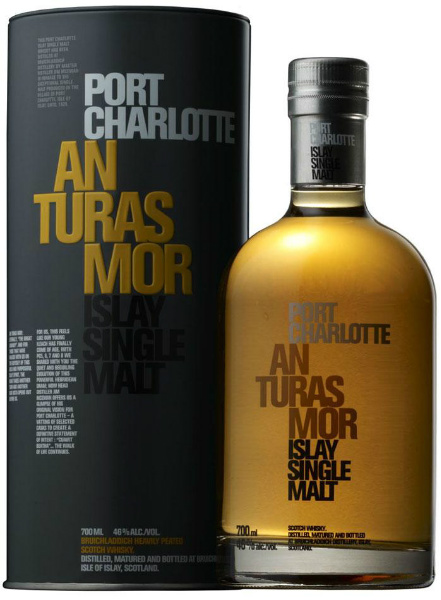
Port Charlotte “An Turas Mor” (46%, OB, American Oak Casks)

In 2000 Murray McDavid bought Bruichladdich for £6.500.000 (from Jim Beam, current owners of Bowmore and Laphroaig). After acquiring the distillery guess what was the first distillate made? Yes! Port Charlotte, not the unpeated Bruichladdich itself. The guys behind Murray McDavid are no fools. We all know Mark and Jim to be very shrewd guys. So the first stuff they wanted to make with their new distillery was peated Whisky. On the 29th of May 2001, the first Port Charlotte was made. The first Bruichladdich under new ownership was somewhat later distilled in July. (2001 which was also the year the first newly bottled Bruichladdich was released; the 10yo I just reviewed, the 15yo and the 20yo). Finally on the 23rd of October 2002 the first Octomore was distilled.

Port Charlotte "An Turas Mor" (46%, OB, American Oak Casks)Color: Pale gold.

Nose: Mild, fatty vegetal peat, with butter and vanilla, pepper and salt. It smells like lavas was one of the plants that makes up the peat. Quite soft and unobtrusive. Some smoke and a tiny hint of burnt plastic and traces of soap. Sappy licorice twig. Wood lying around in the forest. Fresh (air) and un-complex. Dry kippers with hints of tar. Dusty vanilla and some paper. Nice to smell. The nose is worth the price of admission.

Taste: Sweet and peat. Sugar water with slightly bitter peat. Sweet licorice and black and white powder (yes, licorice again). Slightly warming. Licorice and licorice twig. Very tasty (the sweetness helps it along), but not very complex, but who cares when it’s so drinkable. Reduced, brooding peat that resembles coffee a bit. After a decent body, comes alas a sort of weak finish. A finish full of paper, barley, hints of soap and sweet licorice, but I guess we can blame its youth for that.

Lots of young Whisky is noticeable in An Turas Mor, but it shows a lot of potential though. This will become a great peated Islay Whisky when it becomes of age. I feel that Port Charlotte is a sweet Whisky that can be high on aroma, but struggles a bit with its length when it’s young. Highly drinkable, likeable and definitely worth its money. Get it, it’s not as expensive as the PC’s.

Points: 84

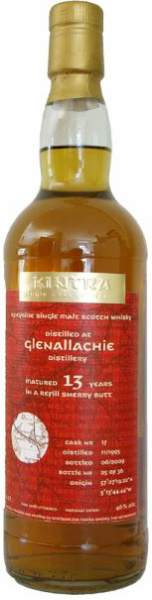
Glenallachie 13yo 1995/2009 (46%, Kintra, Refill Sherry Butt #17, 36 bottles)

Rummaging through the unsorted part of my sample collection I found this Kintra from 2009. Another Glenallachie and that’s great! Kintra’s big cheese, Erik started releasing Kintra Whiskies in 2009 so this is one of the first bottlings, and who knows, maybe even the very first. 2009 saw the release of a 1996 Ben Nevis, a 1997 Clynelish, a 1984 Macduff and in June, this 1995 Glenallachie.

A mind boggling amount of 36 bottles were released of this Glenallachie, so this is a collector’s item for sure! I don’t think this was from a small cask, probably only part of a cask, just like the Ledaig he bottled in 2010.
Color: Gold.

Nose: Fatty and fruity. Some butter and wood smelling like jasmine. Thus quite floral and spicy. Fresh air. Hints of white pepper and again and again this florality whiffs by. Pencil shavings come next. A lovely nose. Nice added depth from the Sherry cask, not only giving it some mustiness, but also some fruit. When smelled more vigorously, whiffs of toned down peppermint pass by, but also some hay, dry raisins and cardboard. If I would hazard a guess, I would say Fino Sherry?

Taste: Spicy first but quickly turning into sugar water sweetness. Dare I say it has some peat to it? The spice and the sweet balance each other out, so it’s not overly sweet. Warming going down. Hints of milk chocolate and a slightly burnt note. Still, lovely stuff, but also a bit unbalanced. Highly drinkable and enjoyable nevertheless. The sweetness makes way for a more woody, and acidic, dryness towards the finish. The finish itself is of medium length and pleasant, but doesn’t leave a great aftertaste, since especially a weak wood and cardboard note stays behind for a short while.

This is one of those highly drinkable Whiskies, where the weakest link is the finish, and especially the aftertaste. To get past that you tend to take another sip, and yet another sip, and yet another, so you’ll finish your glass rather quickly and after that you ask yourself where has the bottle gone? Maybe not my favourite Kintra bottling, but still very good and entertaining.

Points: 84

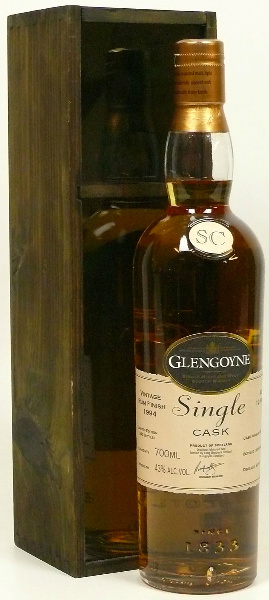
Glengoyne 12yo 1994/2006 (43%, OB, SC, Rum Finish, Cask #909310, 348 bottles)

Just like the 10yo Edradour I just reviewed, Glengoyne also has a 1994 vintage, which was used for a lot of different cask finishes. Claret, Madeira, Manzanilla, Muscatel, Cornalin and a lot of Rum finishes were released between 2005 and 2008. Some were bottled at cask strength, and some were reduced to 43% ABV. All the other Rum finishes have a cask number of 5 digits, so this one was probably cask #90931. Maybe they have added an additional “0” to distinguish this bottling from the rest since this is the only one that has been reduced. Maybe an administrative mistake was made…

Glengoyne 12yo 1994/2006 (43%, OB, SC, Rum Finish, Cask #909310, 348 bottles)Color: Gold.

Nose: Excellent full-on Rum smell. Spicy, fatty dirty. I’m guessing high ester Rum. Jamaican? Hard to tell. Sugar cane and very leafy. For some this may be finished too long, but I’m not one of them. I love the synergy between Rum casks and Single Malt Whisky, but I may have said that before. Extremely deep. What a nice combination of smells. Wonderful depth and a wealth of complexity with lavas and balsamic vinegar. Where did that come from? The Whisky, The Rum or the wood? If it’s the wood, the wood turns to a more cleaner oaky note. Fresh windy forest and some warm butter on toast (not burnt). Even a slightly soapy note.

Taste: Well this is less complex than the nose is. Where the nose explodes with aroma, the taste is much simpler. Most definitely a sweet Whisky. Sugar water and yes, some nice leafy wood influence. Paper and floral cardboard, whatever that is. The taste is built around some different wood flavours, sugared tropical fruit, dried orange skim and cold black tea. The finish is quite long, but again pretty simple a bit bitter and buttery.

Not so long ago I reviewed a few Rum finished Whiskies and I said I have always liked them. This one is no different. Fantastic nose, and the taste is good. However, this one is not a daily drinker. For that it is too fatty and sweet.

Points: 84 (but with a 90’s nose, if you like Rum)

Thanks go out to René for providing the sample (a while back).