Just before Christmas I reviewed a young Tamdhu bottled by The Ultimate (Van Wees, The Netherlands). That one was only 8 years old and I dared to mention in that review that at 8yo that Whisky was maybe bottled to late, since a lot of wood was present in that bottling. Luckily the wood gave the Whisky a lot of character, but I hoped it would have been a wee bit sweeter. Now look here. I’ve got an even younger Tamdhu bottled by The Ultimate. This time I’ll have a look at a 6yo Tamdhu from 2004 (the second of the six, bottled in 2011), and have a look how the two compare. How was your Christmas, by the way?
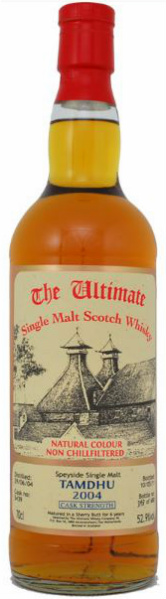 Color: Pale gold.
Nose: Definitely a less full on nose. Less powerful, dryer and somewhat more floral than cask #347. Again nice woody notes, but less prominent. Still a lot of pencil shavings though. This one needs a little breather. I just opened the bottle. Good balance and again a very likeable smell. Appealing. Somewhat cleaner this one is (thanks Yoda). When smelling these two H2H, is think this younger example is even more complex, since the 8yo is all wood.
Taste: Sweet and creamy and delayed pepper, but overall a weaker body than the 8yo. Now you all are going to think that I’ve lost it, but this 6yo Tamdhu is more complex than the 8yo I reviewed before Christmas. On the taste lots of nice aromas have lined up and come through one after the other instead of all at once. Black and white powder, vanilla pudding, elegant wood, licorice, and some yellow fruits even. What a treat. The finish isn’t longer, but has some more aroma’s and this one is heavy on cask toast and a little bit of sulphur, but again not dominant, so adding to the character. A nanosecond of sweet on the entry, than quickly into wood and then the workings of layers when the Whisky is swallowed. These young Tamdhu’s are hidden treasures!
The whole is more toned down compared to cask #347, but this one has some more going for it. It is a bit sweeter (as I hoped), but the sweetness is a bit funky, so I’m glad is isn’t sweeter than it is. The Whisky is only 6yo, but still it seems to be more complex than it’s older sister. I like the finish better too, although it has some sulphur, but that gives it even more character. As I said, more going on in this one. Time will tell what extra air will do for this Tamdhu. For the time being, a well urned:
Points: 88
 Color: Light gold.
 As I said, lots of discussion, since all casks are good, didn’t cost a lot and have some differences. So nice whisky to compare to each other. I still have some Sherry Butt #72315 left, so I can compare it to this Sherry Butt #72319. Word in the grapevine is that the first one (Sherry Butt #72315) is the “worst” of the three, all are very clear about that. Some consider Sherry Butt #72318 to be the best and some Sherry Butt #72319.
 Color: Copper Brown (less red/orange in color than Sherry Butt #72315)
 Here we go again. Another monstrously long title, again a Single Malt of which the distillery name is not on the label, but we know it’s a Bunnahabhain. So three in a row, this being the third Bastard Malt in a row, reviewed here on these pages. The Creative Whisky Co. Ltd. is non other than David Stirk. Fellow Rush lover and Whisky bottler par excellence, or should I say Exclusive Whisky bottler?
 This Bunna is pretty dark in color so my guess would be a Sherry cask. Since David didn’t specify what (kind of Sherry) the cask previously held, we can only speculate what this is. Maybe a Sherry Hogshead, or maybe a Butt that was shared with others, or only half the Butt was bottled? My guess would be the former (a Hoggie). It looks like a Oloroso or PX Sherry Hogshead to me, so we’ll have to try, to make another guess at it…
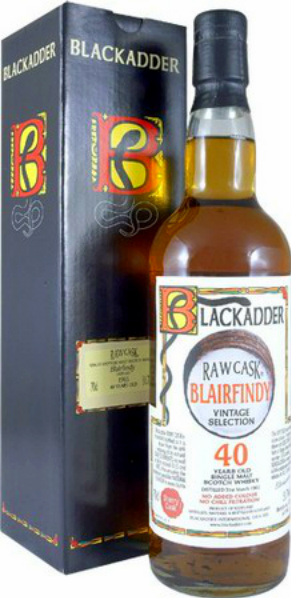
 Well hello Blairfindy! Wait a minute, Blairfindy isn’t a real distillery is it? As far as I know, there isn’t a Blairfindy distillery, and there never was one too. No, Blairfindy turns out to be “another” name for Glenfarclas, used, when the bottlers weren’t allowed to use the real distillery name on their labels. Something like Tactical for Talisker, Leapfrog or Laudable for Laphroaig and so on. Blairfindy, amongst others, was the name of the farm, the Grant family (of Glenfarclas fame) originated from. Although the Glenfarclas name isn’t on the label, it most definitely is a Glenfarclas, and an old one to boot…
 Color: Copper gold.
 and is said to be even better than cask #72315. Alas Cask #72318 sold out rather quickly too, so Van Wees bottled a third one: #72319. That one should still be available, but already I heard a fourth cask is being bottled. If my information is correct there still are two casks left from this series, to make six in total. Let’s have a look at the series first one, cask #72315.
 Color: Full gold
 At this point I must give off a little warning. I was in a beer shop recently and overheard some clients talking about pouring the big bottle of Rodenbach Vintage down the toilet. The big bottle should even be better than this Grand Cru, but this is a Flemish Red Brown beer, it’s acidic, so probably not for everyone…
 This is the first Tobermory on these pages and the Whisky itself comes from the Island of Mull. This distillery was founded already in 1798 and was originally called Tobermory. Tobermory closed in 1930 and was turned into a power station. It stayed closed as a distillery, untill it reopened in 1972, but this time as Ledaig. Ledaig’s history, from its reopening was a rocky one, with a lot of buying and selling of the distillery with production stops to match. The current owner is Burn Stewart (which itself is/was owned by an insurance company (since 2002), that again was rescued by the government of Trinidad & Tobago in 2010. You don’t want to know…)
 Back to Tobermory (or Ledaig). Ledaig was sold to Burn Stewart in 1993, and they decided to give back its original name: Tobermory. In 2005 Tobermory issued three 32yo from 1972. These were Oloroso Sherry finished Whiskies. One with a black label, one with a red label and this green label reviewed here. Purists mention an additional brown labeled version for sale at the distillery. Also 32yo and 1972, but “put on bottle” in 2010, so it must have been kept in stainless steel tanks of on glass from 2005 to 2010 to stop further ageing. Not a lot is known about this bottle…
 Color: Brown
 sometimes seems thinner than the other two.
 Yet again we have one of the many 1991 Lochsides, and one of the many that were issued as a Gordon & MacPhail Reserve. This one was picked by Dutch retailer Van Wees. Gordon & MacPhail code for this one is JI/ACAC. The spirit was distilled on September 18th, 1991 and eventually bottled on October 15th, 2009. Picked by Van Wees in July 2009. Those of you that meticulously read this blog probably had a Deja Vu experience. We know this bottle, we know this lay-out. Well yes and no. February 4th 2013, I published a review of quite a similar Lochside, opened by Master Quill’s Apprentice (like this one). That was
  Color: Gold (ever so slightly fuller in color)
 Master Quill