And here is a very old Macallan, a Macallan from the days we all thought, this is Macallan and it’s never gonna change. They sort of promised us that on the back label: For reasons not even science can wholly explain, whisky has always matured best in oak casks that have contained sherry. Due to increasing expense and scarcity, other distillers no longer insist on sherry casks, The Macallan directors do. After this they went on to produce the Fine Oak Series, a ‘blend’ of sherry and bourbon casks. A cunning move, why? Was it to scarce? Was it too expensive? Did they think they should use their big name to uncharter a new market? Because the sales proves it, Fine Oak does well and ís hip. It just isn’t Macallan anymore…
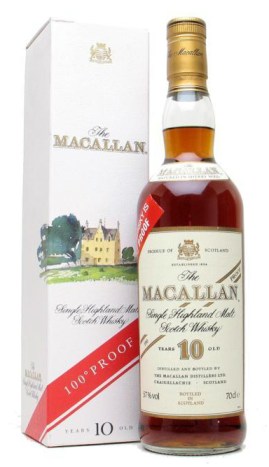 So for my generation, The Macallan was something like the bottle you see here. Nice brown/orange whisky made from Oloroso Sherry (and who knows some PX).
Color: copper brown. (it’s not dark brown, and it doesn’t have a red tinge to it, so it’s not mahogany, as I often read).
Nose: Yeast, nuts and caramel, typical Oloroso Sherry nose. Fresh like seaspray. Strong, full and creamy (this is what we want in a cigar). Chocolate and some wood and spices. This has oomph and a lot of depth. Nicer and less harsh than the A’bunadh. It’s like comparing an Aston Martin to a Hummer. (Both have their merits though. Would you drive your Aston in a war zone?) Did I just call drinking whisky a war zone? wow!
Taste: Thick and sticky. Tar and smoke. A hint of pepper and mocha. Dust. Strong Oloroso Sherry. Oak and liquorice. Hot (it’s 57%). Even an exotic note like curry. Oak and the hint of curry are predominant in the finish. Still it’s not and old whisky. It’s only 10 years old, but so different from the Hummer mentioned before. Why are there so much sherried Glendronachs around, and why aren’t there a lot more of these types of Macallan around?
 Well this is old skool whisky. This may not be very complex, but just try to ‘get’ the steam locomotive in these kinds of whiskies. The tar, the coal and the steam. I’m very sorry these Macallans aren’t around anymore. They were very classy, and if you can find them now, they are very expensive. If you have a chance, try this, it’s a piece of history.
Points: 89 (for now)
 A’bunadh, as it’s called, has no age statement (NAS) on the bottle, but is believed to be between 8 and 10 years old, and comes solely from Spanish Oloroso Sherry Butts. Well, if you could smell it now, or see it’s colour you would know this is true.
 Even though it’s young, strong and harsh I still like this neat. Water takes away the little sweetness it has and makes it a bit more harsh. Drinking this at cask strength, makes me happy. It’s a bit of a drug that way. Recommended. There are a lot of batches which have their differences. More than you would have thought. So it can be a lot of fun comparing different batches from different years. Some are less harsh, or more sweet or…You guessed it, come back often to A’bunadh, and you’ll be welcomed back every time by a very nice whisky. By the way, who said there weren’t any good sherry casks anymore, and who said those sherried whiskies aren’t affordable anymore?
 I’m a big fan of old Strathisla’s. When I taste some from the 60’s or 70’s, I’m in heaven. With some old sherry cask bottles around, you can’t go wrong with Strathisla (and Longmorn, and Macallan, and…). Even 60’s bourbon casks are fantastic. So for this one, I certainly had high hopes and I paid some good money to get one. When I bought it at an auction, I thought it would be older than it turned out to be. Just look at that label with its 70° Proof and 26⅔ FL. OZS. The glass code on the bottom of the bottle (SD133) makes it from circa 1990.
 Color: Full Gold (Caramel?).
 Now we move on to Inchgower, since it’s Inchgower that’s inside of the bottle. If you want to see how Raymonds operation looks like, and how this particular Inchgower was bottled, here is a
 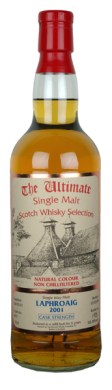 Color: White wine.
 Color: Full Gold with a hint of copper.
 Color: Light Gold
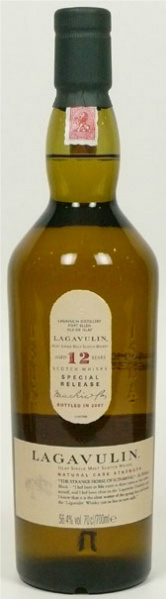 Luckily, more recent bottlings are doing well again. Still, in 2002 the people at Diageo thought is was time to revive the 12yo as a ‘Special Release’ at cask strength this time. A release that is up ’till now, annual. Let’s try one, shall we.
 Color: Light Gold
 Master Quill