Why not try another Springbank. This one does have an age statement. It’s 10 years old. Just like the “CV” I reviewed earlier, this one was bottled (late) in 2010.
 Color: Pale orange gold.
Nose: Clay and spicy. Fruity, creamy and nutty, almonds. Toasted wood. Smallest hint of coal and old dried orange peel. Compared with the CV this definitely has seen some ex-Sherry casks. Nice nose with lots more balance than the CV. Here we also have a papery note. Not only fruity, but also floral, more of everything and a lot extra. Floral part smells a bit like soap, and after that the fruitiness shines through. Lovely.
Taste: Clay, balanced and pretty sweet, with a small woody bite. Nutty again and definitely some peat. Good stuff this is, maybe a bit too heavy on the sugared fruits. Definitely sweeter than I expected. Toffee and cream, and where the nose and the CV have some rough edges, this 10yo if far more polished. Velvety. Good stuff, but I would have liked this even better if the taste matched the nose a bit more. Hints of petrol, we’re moving in the right direction again. Sweet and sweat. Lovely.
Unique stuff and there is nothing like Springbank. Yes this may not be for everybody, so if you are the regular hotel bar drinker or are only into Glenlivet, Glenfiddich, Glenmorangie and Balvenie, this may not be for you. You might not like this, but if you aren’t, this is something special. You must try Springbank. Maybe not the best expression, but for this price and with this heritage you can’t go wrong. Probably one of the best 10yo around (with the Benromach 10yo).
Points: 85
 Color: Pale gold
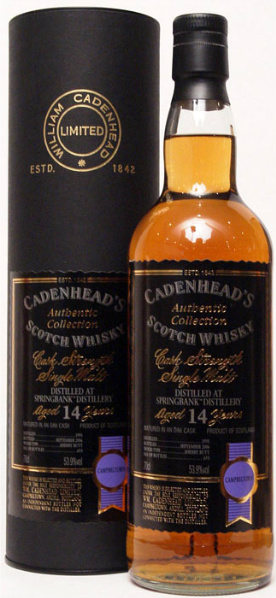 Color: Copper Gold
 After reviewing one of the most popular official releases by Springbank, the
  Later some mint and furniture wax. Nice throat coating finish.
 Springbank, the strongest survivor of Campbeltown, and one of the few family owned distilleries. Once a great center for whisky, and once a region of its own, it still is, but barely.
 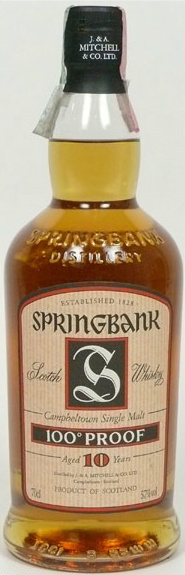 The people behind Springbank do their utmost best to let Campbeltown survive as a region. Glen Scotia is intermittently operated by the crew of Springbank, and of course Springbank themselves are responsible for Longrow, Hazelburn and Kilkerran (Glengyle Distillery). All names from a distant Campbeltown past. Founded in 1828 by the Reid family, who were married into the Mitchells. In 1837 the Mitchell’s bought the distillery. In 1897 J. & A. Mitchell Company Ltd. is founded, the company that is still on the label today. Since 1969 J. & A. Mitchell is also owner of Cadenhead’s. Between 1979 and 1987, Springbank was closed. And since 1989, production is again as it should be. Almost nobody malts themselves these days, but Springbank take the remarkable step to reopen the maltings in 1992. Springbank is a cult malt has a great following, and is by far the most popular malt on Wall Street.
 Yes it’s “Snickers” in a bottle. Slightly unbalanced by the soury woody, and peaty, finish. The finish also leaves a minty sensation on the tongue. Sweet mint as in “After Eight”.
 Master Quill