Talisker 1989/2002 “Distillers Edition” (45.8%, OB, TD-S: 5DP)

Since the 2002 Distillers Edition of Lagavulin was such a success, I managed to unearth the 2002 Distillers Edition of Talisker as well. This 2002 version is the direct successor of the 2001 I reviewed a few years ago. This is only the fourth Distillers Edition since with there wasn’t a Talisker DE released in 1999. Both the Talisker and the Lagavulin DE’s were first released in 1997. In 1999 the Second Lagavulin was released and since 2000 both were released annually.

Talisker DE 2002Color: Light copper orange.

Nose: Compared to the Lagavulin this can be called elegant, which is obvious, since Talisker is peated to a lower level and the Whisky itself is much younger. Lightly peated, more fruity and fresh. Fresher, younger and livelier. Slightly grassy. Creamy overall feel. Hints of pudding and vanilla. Nice soft wood. Although this has been finished in a Sherry cask, the finish is quite sparse. It’s typical peatiness is recognizable as a Talisker. Slightly oily and waxy, like an elegant distant relative of Springbank. Hints of old herbs from an old wooden grocery shop. Tiny hint of Islay-esk tarry rope. Hints of yellow fruits even. Sometimes this reminds me of white peach in sweet yoghurt, with some soft, slightly burnt wood added to it. Where the Lagavulin was very in-your-face, this Talisker is not. It’s even less so than the 10yo (from 2002).

Taste: Here the wood comes first after which a toned down little peppery attack announces it’s a Talisker all right. Fatty soft peat. Lovely. Cute almost. With some air, quite nutty. Again a slightly burnt note, which must be from the inside of the Sherry casks. Towards the finish a more smooth and sweet note appears, which I feel is not completely right for Talisker. Creamy towards the finish. Sure the peat is here, but most if it seems hidden by the unexpected sweetness. Medium finish with indeed a fishy part, and alas not much going on in the aftertaste…

Where Whisky buffs will almost always prefer Oloroso Sherry casks over PX Sherry casks. Just look how quickly the Oloroso versions of the vintage Glendronach’s sell out before the PX-versions. In the wine world, Oloroso is not considered the best of Sherries. The PX finish for Lagavulin seems to be a perfect match and nobody would even wonder, at least I didn’t, how a Oloroso finished Lagavulin would be. (Alright, plenty of them around), but for the DE-version at least, I didn’t wonder. For this Talisker however, I’m less happy about the choice of Sherry cask. For me it’s slightly off, so I’m wondering now how other finishes would have worked for Talisker in the DE-series.

Points: 85

Same score as “Neist Point” and a quick comparison between the two warrants the score of both. If offered at the same price, I would go for the Distillers Edition.

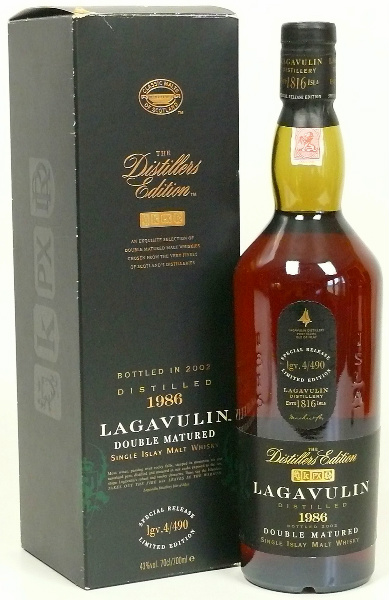
Lagavulin 1986/2002 “Distillers Edition” (43%, OB, lgv. 4/490)

Lagavulin is one of my all time favorite distilleries. It’s almost impossible to encounter a bad Lagavulin. I can’t believe this is just the third review of Lagavulin on these pages the other two being the other two from the current standard range. The 16yo and the 12yo. The 16yo is the modern classic (It used to be the 12yo with the cream label) and right at the time there was a rumour the 16yo would be quite scarce, the new cask strength 12yo was released. As I said, the current standard range is the 16yo, this distillers edition I’m about to review, and the 12yo cask strength version. The latter two come to us as “annual releases”. Just like Springbank, this means that there is some batch variation. A wanted batch variation, to buy more of the same and compare them to other releases, identified by  bottling year.

Just like NAS today, batch variation was always a dirty phrase, it’s not a word isn’t it. But marketing turned that around, just as they are trying with NAS. For me NAS means younger, less matured Whisky, so less contact with wood and as Gordon & MacPhail so aptly put it: “The wood makes the Whisky”. I’m not really happy about NAS, but I never disliked batch variations (again, look at Springbank), unless if the only way seemed to be down. There always has been a lot of discussion about our very Lagavulin 16yo, losing power, balance and character, but I hear the latest batches are becoming better and better again. Today Laphroaig seems to suffer from that…

This is the fifth Lagavulin Distillers Edition (DE). The first was distilled in 1979, the second in 1980, the third in 1981, and the fourth in 1984. Just like all the other distillers Editions, this Lagavulin has undergone a second maturation (a finish) in Pedro Ximénez (PX) casks.

Lagavulin DE 2002Color: Copper orange.

Nose: Fantastic peat. Lagavulins from the eighties can have this excellent peat, I never get tired of. Peat, tar, seashore, you name anything maritime and its in here. Sure the more recent DE’s are still pretty good, but they don’t smell like this. That’s why Whisky lovers still pay a great deal of money for these older bottlings. Smoke comes next and it smells a bit electrical. It has vanilla and a slight fruity nose. You know it’s there, but so hard to distinguish what it is. Ahhh lots of smoked (dry) sausage and slightly dried out onions and pear. Excellent, what a combination. Where have you smelled that last in a Whisky? This Lagavulin is all about balance (again some kind of dirty word for some). The whole is so fantastic, and goes on and on. Wonderful. Hard to put down. With time the fruit, still distant, finds it’s place in the whole and adds a more fresh and fruity part to the whole. Just smelling it is quite the experience, and still getting better. Lagavulin is such a big aroma, that even the thick and sweet PX can’t overpower it, just add a little something. I guess the finish was done intelligently. I’m putting off tasting it for just a while longer to put on my fisherman’s sweater…

Taste: …in the end it would be a shame not to taste this, so here goes. Well somewhat less special than the nose is the first thing that comes to mind. The PX is more upfront as well. It starts out chewy. Nice licorice, black and white powder and a thick sweet Sherry without most of its sweetness. Does that even make sense? Waxy and again very coastal and raw. Masculine. Puffer’s smoke. Burning hay. Fishy, as it should be. Smoked fish of course. Smearing tar on the hull of a boat. Get yourself something like this, because modern peated Whiskies are nowhere near this profile. I wouldn’t add water to it, because reducing it to 43% shortened the finish already. Big body, with only a medium finish. In the aftertaste the balance is slightly gone. It could have been even better than it already is! Wow.

It’s been a while, but I do understand why Whisky lovers in general pay lots of money for Whiskies like this. This is great and they sure can’t make them like this anymore. Drinking this put you in a different place and time altogether. It changes you as a person (for a while). Sure it puts you back a few hundred euro’s pounds or dollars, but try to imagine what a trip to Islay in 1986 would cost you now. It’s a time-machine and time-bomb in one. A must have.

Points: 91

Clynelish 1997/2014 “Cayenne Cocoa Bean” (46%, Wemyss Malts, Hogshead, 373 bottles)

You get only one chance to make a first impression, and that is what he did, William Wemyss. Carrying around my bottle of Strathisla I ran into William in London and I offered him a dram. Talking about the Whisky Business in general and Wemyss in particular, he sniffed it for a while, and sniffed it some more, talked a bit, and then…chucked the whole stuff in a spittoon claiming that it was great stuff. He probably had to drive home later or was late for a meeting or something. People around me were shocked a bit, but I know this is how memories are made. Maybe just not right away!

Wemyss is known for naming their Whiskies. The Clynelish I’ll be reviewing today is called Cayenne Cocoa Bean, since it reveals bittersweet cocoa beans mingled with cayenne pepper.

Cayenne Cocoa BeanColor: Somewhere in between white Wine and light gold.
Nose: Sweetish and fruity. Definitely some barley, but also a dry grassy note. The color gave it away a bit, this is from a refill hogshead, so it lacks the in your face vanilla and toasted cask aroma’s. It’s more refined. It has a creamy and fatty element. Vanilla pudding, but it is all very restrained and well-balanced. Fatty not waxy, what it usually the marker for Clynelish. Dusty oak. Dry old vanilla powder. Dried peach and pineapple. Semi sweet black tea. Leavy and hints of a dying out small garden bonfire. Burning off old branches. The sweetness throughout is toffee not sugar. Lovely stuff.

Taste: Nice thick fruit with toffee. The toffee substituting the wax you’d expect to find in a Clynelish. It starts out almost chewy. The whole it held up by a toasted wood note, with the faintest hint of bitterness and tree sap. On entry very good, from the start a lot is happening. After that a mixture of mint, sugar and a small amount of licorice. It is big and holds up. Finish starts prickly, and swiftly whiffs away, only the toffee stays behind as well as some warmth. Medium finish with a warming aftertaste. A good Clynelish and I’m guessing for those of you who didn’t like it as much, the leafy quality is a bit off, and the finish is a bit too short. So it has its flaws and weaknesses. But it has its big aroma and the start is almost spectacular. The body starts well, but breaks down too soon. The finish should be better and the aftertaste has some pineapple but not much more. It is reduced to 46%, and maybe that’s the culprit for the finish and aftertaste. The beginning is great, and for that part of the experience the 46% ABV seems just about right.

I’ve encountered quite a lot of people on festivals who say they don’t like these names. They say it creates a certain expectation and with that they can’t taste it objectively anymore. A very anorak-y statement from people lacking humor? I for one, like the names, it gives them an identity, even though I might not encounter the aroma’s from the name in the Whisky. Everyone tastes differently, depending on time of day, upbringing and associations with tastes. Clynelish is an excellent example. I like Clynelishes just as the next guy, but I always seem to like different Clynelishes. When I was a member of the Malt Maniacs, I really liked a 12yo Clynelish bottled by Adelphi. I didn’t know it was a Clynelish, since it was part of a blind competition we know as the Malt Maniacs Awards. At another blind tasting session, at least a year later, I tasted another wonderful Clynelish, which turned out to be the sister cask of the first Adelphi Clynelish. I mention those since, a lot of people didn’t care for those two Clynelishes. Same with this Wemyss expression. I first encountered it at a Wemyss tasting, led by Ginny, and I absolutely loved it, where most of the public preferred other Wemyss expressions. So never take anyone’s word for it, make up your own mind, although I have to say that all the Clynelishes I mentioned above, were casks picked by Charles MacLean, even this Wemyss one…

I managed to forget the name during the writing process. I did get the bittersweet part, but couldn’t say if it’s from cocoa beans. Definitely didn’t get the cayenne though, but I still like the name. It’s only a name, nothing more.

Points: 85

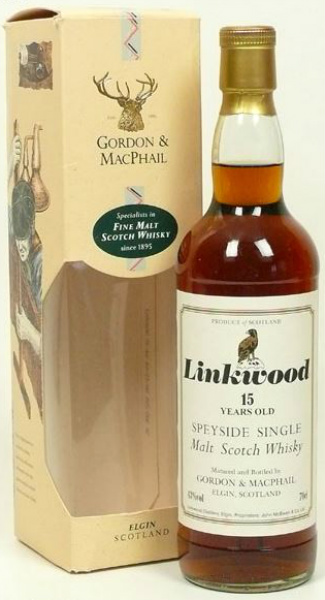
Linkwood 15yo (43%, Gordon & MacPhail, Distillery Label, First Fill & Refill Sherry Casks, Circa 2006)

Gordon & MacPhail release Whiskies in many series. Gordon & MacPhail Reserve, Gordon & McPhail Cask Strength, Gordon & MacPhail Exclusive to name but a few. Whisky Geeks call the series like this Linkwood the “Licenced Bottlings”, but I have heard the people of Gordon & MacPhail calling it the “Distillery Labels”, though both names aren’t anywhere to be found on the label. Bottlings in this series consist of Whiskies, where there isn’t (really) an official bottling of, again, like this Linkwood, and to a lesser extent Strathisla and Longmorn, like the 1971 I reviewed not so long ago, of which an official bottling did exist, although not many. If memory serves me correctly, Whiskies in this series were always reduced to 40% ABV and later 43% ABV.

Linkwood 15yo G&MColor: Light copper gold.

Nose: Dusty and funky Sherry. Slightly raisiny. Deep, dark and brooding. Nutty not fruity, so lacking the Sherry cherry of fresh and fruity Whisky. This is all but lively. Its darker and more brooding than I’ve come to expect. Very old calvados. It is apply but in a dense and syrupy kind of way. It’s some kind of hybrid between old Calvados and raisins. It is quite old and unusual smelling and definitely does not smell like a distillate from the early nineties. Hints of charred oak and vanilla powder. Nice, deep and complex. Oily baking paper. Dull brown sugar and some soft wood spices, and sometimes a short whiff of old soap.  More a sort of floral note than a real soapy note.

Taste: Paper and wood, again deep and all but fresh. Old raisins. Dried apples. Red apple skins and definitely from Sherry casks. Quite restrained. This does not shout out its presence, it more sort of sits in the corner quietly. Distant burnt note. Apart from the (burnt) woody (paper) and Sherried traits, this is also has qualities of refined sugar without being very sweet. Does that make sense? Hidden sweetness overpowered by the aroma’s described above? Second half lacks a bit of development and the finish concentrates around the wood and paper notes, with hints of old Sherried Whiskies ending in a medium walnut bitterness and of medium length. It end with the finish, there is no noteworthy aftertaste.

Actually this particular bottling, and beware there are more batches of this, is quite restrained and is unlike many of the Whiskies that are on the market today. This also makes it less likely choice for a daily drinker. Although it is alright at 43% ABV, I wouldn’t have minded some extra 3%, just to carry and strengthen the aroma’s that are presented to us.

Points: 83

Millstone 8yo “100 Rye” (50%, OB)

Millstone 100 is a small batch Dutch pot still distilled Rye Whisky (without an extra “e”). This is a review about one of the earlier bottlings, because by now the look is different. The glass bottle is the same, but the label is now black, more in line with the rest of the Millstone Whiskies, although across the line some different shapes of bottles are used. The new black label informs us of the many different guises of the number “100”. The whisky is a minimum of a 100 months old and is bottled at 50% ABV. (The American 100 proof), and the Whisky is made from 100% Rye and only filled into new American oak only (100% again). The use of the American proofing system and the use of American new oak casks makes it obvious what kind of style of Whisky to expect. 100 Rye is made from 49% malted Rye and 51% unmalted Rye.

Zuidam Distillers was founded in 1975 by Fred van Zuidam under the name Baarle International. Earlier, Fred worked some twenty odd years at De Kuijper in Schiedam after which it was time to start for himself. He bought a piece of land in Baarle Nassau and built his distillery there, starting with a range of high quality liqueurs, basing his recipes on the best ingredients he could buy. Next step was the distillation of the traditional Dutch drink: Jenever, the spirit Gin was derived of, both sharing juniper berries as an ingredient. 

Today the distilling is done by Patrick van Zuidam, the son of Fred. Gilbert, the other son is handling the business end of the distillery. Patrick had a passion for Jenever and Korenwijn and from that started experimenting with his dream drink: Whisky, resulting in the Millstone line of Whiskies. By now a lot of Millstone expressions have seen the light of day, of which this 100 Rye is a very succesful one.

Millstone 100 Rye 8yoColor: Copper orange brown.

Nose: Sweetish and thick in its aroma, straying away from the American Rye’s which for ma always have a sort of florality in the nose. This one is very clean and closer to a fruity nose. Initially maybe even sweet, with a lot of wood influence. Pencil shavings. The wood is easy and in no way overpowering. Small hint of soap. Well integrated aroma’s, but not very complex. The thick aroma from the starts dissipates a bit and dries out the whole, but memories of it come in and out. If smelled for a prolonged time, it reminds me a bit of Rum, or Rhum Acricole. Dry Rum obviously, including hints of red fruits and a fresh citrussy note. Lime and some delayed mint. Deep and fruity altogether.

Taste: Starts with wood and some sugary sweetness. Quite hot on entry with a nice bite. Here a little soapy florality is present. Rye it is then! Nice dusty wood. Sawdust and nuts. For those of you that also have tasted Patrick’s Jenevers and Korenwijn, there is some of that in here too, unmistakable. For me this Whisky has a special effect as well. After the big body, the finish seems a bit weak at first, but after that a bigger aftertaste emerges. And a very tasty aftertaste it is, with some sweet orange, nice. Over time the finish grows bigger too. This Whisky need some time to breathe to grow a bigger finish, but I have to say that more air also hurts the balance a bit, since the dryness and the wood really take over and the florality stays soapy.

Ain’t this something. It has hints of Jenever and Korenwijn, smells a bit like a Rum, but is a Rye Whisky with quite some evolution over time. Well done, I have to try a newer bottling to see if Patrick has dealt with the soapy florality, then again, maybe it’s just me.

Points: 81

Bushmills 12yo “Distillery Reserve” (40%, OB, Oloroso Sherry Casks, Circa 2006)

1608. The Old Bushmills distillery got its licence in 1608! It was King James I who then issued the licence to distill to Thomas Phillipps. As most of you very well know, this makes The Old Bushmills distillery the oldest licensed distillery…in the world (Jeremy Clarkson voice-over). Try to imagine how long the distillery may have even existed before that. Since then the distillery was in and out of production many times.

More recent history then: Diageo bought the distillery in 2005 for £200 million, only to trade it with José Cuervo (Tequila) for their 50% share in Mexico’s Don Julio Tequila brand, making Diageo the sole owner of Don Julio. Don Julio was founded in 1942 and is the eleventh largest Tequila brand in Mexico. For the time being I prefer 1608 over 1942…

Bushmills 12yo Distillery ReserveColor: Full gold, slightly “red”

Nose: Creamy with lots of vanilla ice-cream soaked into some shiny cardboard. You must know Vanilla ice-cream from a paper cup. Cheap milk chocolate or fake milk chocolate. Give it a minute and a more fruity note appears. Red forest fruit. Mint infused warm chocolate. Weak after eight. The mint fondant nose stays on. Hint of funky red Sherry. The whole is very restrained. It almost because the glass won’t let it go, or smelling the spirit through a neutral cloth. Molten ice-cream, weak milk chocolate and mint fondant, that this nose in a nutshell. Oh, and some cardboard…

Taste: Fruity and quite sweet. Fruity toffee, which should have been sticky, but tastes watery here. Again a Whisk(e)y that should have had a higher ABV. Remnants of fortified wine. Red berries and black currants I also get from Redbreast 15yo. Here also quite some vanilla. Tiny hint of burnt wood, but also the big paper note from the nose. Recognizable as an Irish Whiskey, but for me it’s also a bit flawed. It has a great side to it, but also a not-so-great side. Paper disturbs me, and takes away from the pleasure of drinking this. It wants to be a Redbreast 15yo or a Jameson’s 18yo, but falls rather short. Equally annoying is the finish, or lack thereof.

If you concentrate a bit, you can taste the sheer potential of this Whiskey. It could have been great since there are many likeable notes in here. Alas some off notes (paper) and the weakness of the whole ruin it for me. I hate to play the where-is-the-finish game. A damn shame, for I believe a potentially great Whiskey was ruined.

Points: 77

Glenfiddich 18yo “Ancient Reserve” (40%, OB, Circa 2003)

Glenfiddich. Often scoffed at, but never really disappoints. I’ve tried quite a few and all are decent daily drinkers. Older expressions (expensive!) can be really stellar. Sure, Glenfiddich is often reduced to the max, 40% ABV, but sometimes, some more alcohol is possible too, like the Distillery Edition that was bottled at 51% ABV. The higher alcohol, transports the flavours well, so I’m a firm believer in upping te ABV with Glenfiddich to show people with a prejudice against Glenfiddich, that it actually is not that bad. Sure, often not a super-duper malt as well, but surely nothing to scoff at. Today we’ll be looking at an 18yo that is no longer with us, but should still be available if you look closely enough. The 18yo “Ancient Reserve” is blended from Whiskies from Sherry and Bourbon casks, but in this case also from virgin oak casks. The tree are married in a large Solera Vat, using the Solera system.

Glenfiddich 18yo Ancient ReserveColor: Full Gold.

Nose: Waxy and extremely creamy, with definitely quite some Oloroso Sherry influence. Smells quite good. Traits of all casks are clearly noticeable. Vanilla and creamy Bourbon wood and some thick Sherry. Candied apples. I can’t say if the Sherry is from European oak or not. Not a lot of tannins happening on the nose. Sweet peach yoghurt. All aromas are nice and creamy and integrate very well. Waxy fruit. Candied fruit mixed with a hint of yoghurt like acidity and some fresh air. A mere hint of toasted cask in the background and even a tiny hint of waxy apple skins. With air it becomes more dusty and dry. Creamy vanilla holding it’s ground. Not the most complex of noses, but very pleasing nevertheless.

Taste: Very smooth and waxy again, but that dissipates quickly. Well even before I can write down what else I taste, it’s already gone, as is the finish as is the aftertaste. Wow, quickest Malt I have ever tasted, and no it’s not a bad sample. Will this be another story about reduction? Well let’s take another sip, and another, better keep focussed now before it’s all gone. Waxy, nutty and woody. The wood is slightly acidic. Sherry influence, and … Wait a minute, it’s gone again, will have to take another sip. Bare with me. Creamy Sherry and an instant of sugar. Sweetish, Sherried and fruity. The wax carries a woody bitterness towards the end. Smells better than it tastes, although the taste isn’t bad, mind you. Vanilla powder, candied fruit, dried apricots. Nice development. But very weak going into its finish. Funny enough, in the aftertaste some bitterness appears. New wood?

40% ABV is to low for this profile. For the US market this was bottled at 43% ABV. Still quite nice, and better than the current 18yo. Alas this Ancient Reserve was discontinued in 2008. If I could find it for a decent price, I would get it, but I fear it would also be quickly gone. A real shame this got discontinued, especially since the current 18yo is no match for this one.

Points: 85

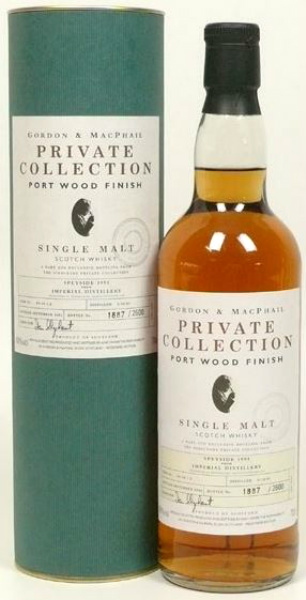
Imperial 9yo 1991/2001 “Port Wood Finish” (40%, G&M, Private Collection, Cask #99/48 1.2, 2600 bottles)

Back to some Whisky. This time around we’ll have a look at a distillery not only closed, but also torn down and already replaced. That happened quickly. In 2012 Imperial ceased to exist and just a few years later a new distillery was finished occupying the same very site. Many have thought that the new distillery would be called Imperial as well, when in fact it is called Dalmunach after a nearby pool of the river Spey. Imperial wasn’t hugely popular as a Whisky hence the new name maybe, but Pernod Ricard (the owners) never ceases to amaze us, by installing new stills replicating those of Imperial. Well in some time we can taste the replicated taste of Imperial, but for the time being let’s taste the original, shall we?

Imperial 9yo 1991/2001 Port Wood Finish (40%, G&M, Private Collection, Cask #9948 1.2, 2600 bottles)Color: Full gold with a slight pinkish hue.

Nose: Winey and candied red fruits. Easily recognizable as a Port finish. Barley, paper. New oak and some pencil shavings. Fresh-air notes, with some sugary sweetness following suit. Nice creamy vanilla mixed with fruity acidity. Typical American oak (the cask it was in before it was finished) but also some sandal wood. The Port integrated well and is used well. In those days experiments with Port finishes often went wrong since the Whisky was left in the Port cask for too long. The whole however is pretty simple and young. What you smell is what you get. Don’t expect a lot of development, if any, but keep in mind that even with the Finish, this Whisky is only 9 years old. Fruity Whisky. Smells nice. ’nuff said.

Taste: Sweet creamy vanilla and candy sweetness. Hard raspberry candy and sugar. A chunk of toffee, molten ice-cream and nice toasted cask that gives it a back bone. Milk-chocolate. Actually pretty tasty. You can taste the potential harshness of the Port. Winey yes, a bit, followed by a somewhat burnt synthetic aroma. The slightly burnt note from the Port cask stays around. If this was finished much longer it would have been over the top. It was arrested in its development just in time, which was quite unusual in those days, but I may have said that already didn’t I? Soft, smooth and tasty young stuff with a pronounced weakness in the finish-department.

Simple yet well tasting stuff. If only the finish would have been stronger. I mean the finish of the Whisky itself, not the Port finish. Still, even for a Port finish from the start of the new millennium, there is nothing wrong with this. Buy a bottle of this and expect it to be empty quickly. This time also nothing wrong with the low ABV of 40%. A higher ABV may have lengthened the finish a bit, but I’m OK with it as is…

Points: 81

Glenrothes 1992/2004 (43%, OB)

Yeah, a Glenrothes cannonball! I may have mentioned earlier, but when I got into Whisky a long time ago, I really liked the looks of this. Didn’t care for the box though, just for the bottle. Second they are issued as vintages, like wines, so we have here an example of the 1992 vintage. Anyone remember how the summer and the harvest was in Scotland back then? So I quickly bought me something like this, and was a bit disappointed. Now many moons later I have tried quite some of these Glenrothes vintages, like this 1989, or this 1979, but somehow there never was one that really grabbed me.

Glenrothes 1992/2004 (43%, OB)Color: Gold

Nose: Creamy and funky. Definitely some Sherry influence. Vanilla and some disconcerting fruity acidity and spice. Weird combination, not all that well-integrated. Aroma of apples, Calvados. Every time you move the Whisky in your glass, the Calvados pops out first. Mild wood, hardly noticeable. More paper and lots of dust. Coffee creamer. The Sherry influence is also quite dusty and not entirely pleasant. Hints of burnt cask mixes with the Sherried funk. Meaty and ever so slightly smoky. Leaves. cold wet green tea leaves. When I let it breathe, some component, but not all, are coming together a bit. In the end not one of the best noses from planet Glenrothes.

Taste: Sweet and toffeed, quickly followed by woody spice, which combine rather well. No trace yet of the fruity acidity the nose suffers from. Dish water with some fresh coriander leaves and sweet dried basil. Paper and licorice. Medium finish with hardly any aftertaste. Although the taste of the toasted Sherry cask does remain for quite a while as well as some soapiness. A bit strange this one.

Where the nose had its faults, the taste is more likeable, but also rather simple. A typical everyday Glenrothes. Nothing special, faulty but with some good points too. A bit too simple on the taste and lacking some development. Since this is an older bottle, bottled almost twelve years ago, it manages to fetch quite some money at auctions, but that can only be collectors. Those people are definitely not paying that kind of money because this is so great or that special.

Points: 79

Aberlour 13yo 1989/2003 “Warehouse No 1” (58.7%, OB, Single Cask Selection, First Fill Sherry Cask #13330)

Yes, it’s still not over. Just like the 2003 Bourbon Cask Aberlour, I have also a Sherried one. The 1995 16yo Sherry was impressive, let’s see how this 1989 13yo compares…

Aberlour 13yo 1989/2003 Warehouse No 1 (58.7%, OB, Single Cask Selection, Sherry Cask #13330)Color: Mahogany.

Nose: Wow! This is more like it. This smells of proper Sherry cask. From proper European oak. Whisky from the old days. Wonderful wood and dry leafy quality. warm milk chocolate, no raisins. The Sherry is extremely well-integrated and immediately make the right connections in my mind. Wonderful (there is that word again!). Hints of tar and black coal. Remember this from the dark 1971 Scott’s Longmorns? Hints of warm machine oil. Warm steam locomotive, but not as strong as the aforementioned Longmorns. Dry and dusty wood. Old wood, just stripped of 50 years of paint. Wonderful dry fruit. Black berries and such. I love a Sherry profile like this. I just hope it tastes just as good…

Taste: Wow, it starts with wood and the high ABV. Careful. Extremely smooth. Here, there are some raisins put in the chocolate mix. Earwax and nice powdery wood. Cough syrup and wonderfully deep. Thick and cloying. A tad sweeter than the nose lead me to believe. Lacks the tar and black coal from the nose. In itself that’s a shame, but the overall taste and the sheer balance make up for it. This cask had much to give, that they were right to bottle it after 13 years. It would have been over the top with wood if would have aged a few years longer. Stellar aftertaste as well. Near perfect stuff.

I just finished my bottle of a heavily Sherried 1989 Mortlach, but Aberlour also had something going for them in 1989. Tasted blind I might have gone with a Japanese Whisky. I wish I visited Aberlour Distillery in 2003…

Although the Bourbon Aberlour’s are nothing to scoff at, the Sherries are the way to go. Aberlour and Sherry are a made for each other. This 13yo Aberlour is better than all the A’bunadh’s I’ve ever tasted.

Points: 93