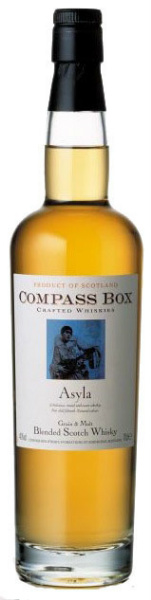
Compass Box “Asyla” (40%, OB, Circa 2006)

After the Chivas Regal 12yo, a Blended Whisky from a big company, let’s see what the little, more independent, guy can do. A guy with a passion for blending. Obviously I’m talking about John Glaser, and his Compass Box Whisky Company. A company that all Single Malt aficionado’s seem to love. We’ll have a look at an early “Asyla” here. Asyla is part of Compass Box’s signature range, or core range for us normal folks. A quick look at the website of Compass Box learns us that Asyla is the lightest of the signature range, calling it delicate and sweet.

Only Whiskies from first fill used American oak casks were used, for vanilla purposes obviously. The Malt’s used are Linkwood (30%), Glen Elgin (10%) and Teaninich (10%) and the Grain comes from Cameronbridge (50%). Sometimes Longmorn is also named as an “ingredient” for this blend, because the Compass Box website mentions that the Malts for this blend hail from the towns of Longmorn and Alness. Looking at the map you can say that Linkwood and Glen Elgin come form the town of Longmorn, so I’m not sure that there is any Longmorn in this blend. Since Asyla is around for quite some time, maybe the Malts that go into this blend differ from time to time. For now I’ll stick to Linkwood, Glen Elgin and Teaninich though. Before I forget, the other four offerings from the signature range are: “Oak Cross”, “The Spice Tree”, “The Peat Monster” and “Hedonism”. Of course outside of the signature range, a plethora of other bottlings exist.

Compass Box AsylaColor: Light gold.

Nose: Grainy, light, yet perfumed. Floral at first but also fruity, with a tiny hint of pineapple and green sour apple skin. Sometimes I even get a trace of lavas. Heaps of vanilla shoveled on top, and given some time even some spicy wood. More than a hint of Calvados, an Apple Cider distillate from Normandy or Brittany. Dry and powdery. Sweetness is mentioned by Compass Box themselves, but for me the nose doesn’t carry a promise of sweetness, in any way or form. Elegant and light, but alas also a bit thin and anonymous.

Taste: Paper and grain come first, after that a blend of sweetness and (virgin) oak, although no virgin oak was used for this one. The vanilla presents itself after the paper and grain, and a slight bitter note, fade out. Not a lot of development going on, and you’re probably not surprised this doesn’t have a long finish as well. The finish itself seems to be a bit unbalanced, due to some acidity from the oak. The oak seems a bit fresh, as in not used for a long time when it contained Bourbon (or Tennessee Whiskey).

To be honest other bottlings of Compass Box made me expect more from this. Something in the order of a variant of Delilah’s. It should have been more creamy and even more towards the vanilla note so vehemently advertised.

Sure. Whisky is the product of spirit and wood (amongst others), but the bitterness it could do without, and as I said, it should have been more creamy. If you can find it, get a Delilah’s by the same bottler, and you’ll know what I mean.

I do like a lot of Compass Box Whiskies, but this one is not entirely for me, and that’s a surprise, because I expected this would be better than the Chivas Regal 12yo. Maybe age does matter?

Score: 72

Chivas Regal 12yo (40%, OB, 2012)

After two highly specialized, anorak type of Glen Scotia’s, because, besides us, who in the world has ever heard of Glen Scotia? It’s time to move on and get back to basics again. Back to Blended Whisky even. This time we will have a look at Chivas Brothers Chivas Regal 12yo. This is something you might encounter in almost every hotel bar around the world, as well as any Whisky selling supermarket. It’s been around since the beginning of the twentieth century. Blends have homes and the “home” of this blend is the Strathisla Distillery.

Chivas Regal 12Color: Gold.

Nose: Barley with funky honey sweetness. Quite fruity too. Lemon, apple skins and apricot water, because it has quite a watered down nose. Vanilla powder and distant hints of charred oak. For a 12yo, this has remarkable little wood aroma, but I have to say that the whole is rather thin and light. Apart from that, the nose seems to be designed to have a certain composition. This composition is there all the time. No development whatsoever. Is that typical for a blend like this, a blend from a big company, blends we al know as well as our ancestors?

Taste: Sweet and honeyed, but not thick, and very likable, just like a lemonade in the summer. Lots of grainy elements, but before you can make your mind up if you like this grainy element it is already surpassed by the fruit, (peach and banana), and a delicious sweetness. Very rounded out, like you get from caramel colouring. When the sweetness slowly travels down your throat a more bitter note is left behind in my mouth. Here’s the wood, and here is maybe the age, I guess. This lingers on for a while, fruity sweet yoghurt, which is nice. The end of the body and the finish are the same. The bitterness fades out and there hardly is any aftertaste. Just an echo of the body, which is good, because you don’t want the slight bitterness to be the note that stays behind. So not a very long finish and the aftertaste lets it down a bit.

This is actually not bad. Love the taste, and do concentrate on the taste, since in no way you’ll get the “12yo”, and there isn’t any noteworthy development going on in the glass as well. So, not bad, but would you go for “not bad” or should we expect some more from our blends these days? Sipping along, yes, its nice initially, but I also get bored quickly with this. After a glass of this, which I enjoyed, I wouldn’t pour me a second one soon. So my pick from the hotel bar would be Glenfiddich 12yo, since it always sits next to this Chivas Regal.

Points: 74

Glen Scotia 6yo 1999/2006 (52.7%, The Whisky Fair, Heavily Peated, Bourbon Barrels #541 & #542, 464 bottles)

How ’bout another Glen Scotia then. One in its youth. This heavily peated Glen Scotia has a mere 6 years under its belt. Yes you read it right, a heavily peated Glen Scotia, move over Longrow? This is a Glen Scotia that was bottled for the 2006 Whisky Fair in Limburg, Germany. Most definitely a festival you shouldn’t miss. I like the label of this Whisky Fair bottling, since it looks similar to other Glen Scotia’s from that time. Lets have some peat then…

Glen Scotia 6yo 1999/2006 (52.7%, The Whisky Fair, Heavily Peated, Bourbon Barrels #541 & #542, 464 bottles)Color: White wine.

Nose: Soft elegant peat alright, but also very grassy. Lots of grass, dry grass, and hay. A confectionary sweetness, like warm icing sugar, but mixed with a little milk chocolate and the grass, peat and sweet ashes. Cocos macaroon with more than a hint of almond. This is already wonderful smelling after the mere 6 years in cask. Although this is from Bourbon barrels, I do encounter some sulfury compounds. Still grassy and some typical vanilla, with lemon freshness. Typical for Bourbon Barrels. Barrels are 20% smaller than (remade) hogsheads, so in theory the spirit ages more quickly, but not twice as quick, since nobody wold argue with you if you claimed this to be 12yo. Quite some active barrels. Nice.

Taste: Sweet barley, yup sweet barley. Diluted lemon curd. Altogether quite lemony. Where the nose was quite complex and didn’t show its age, the taste is much simpler and seems young, but not alcoholic. A sweet and creamy rounded off taste. Some prickly peat but not a lot. I wouldn’t call this heavily peated, at least it doesn’t seem heavily peated. Sweet barley and sweet yellow fruits, but none in particular. I guess dried apricots are the closest. Sweet Earl Grey tea with a hint of honey and a lot of lime. Medium to short finish and the same goes for the aftertaste. Which is about young soft peat added to warm diluted lemon curd.

Even though this tastes quite nice, I’m a bit disappointed that the taste didn’t live up to the promise of the nose. I was quite surprised at first in what the nose achieved in 6 years. Still an experience and a nice surprise. I wonder how this would have turned out with some more age to it.

Points: 84

Glen Scotia 14yo 1991/2006 (61.6%, Adelphi, Refill Hogshead #1071, 258 bottles)

After two more Wheated Bourbon’s it’s only a short hop across the pond to land in the west of Scotland. Campbeltown to be precise. Today we’ll spend some time with a Whisky from the “other” distillery from Campbeltown Glen Scotia. Well. it used to be the “other one”, But today Springbank isn’t just Springbank anymore, with their Glengyle distillery producing the excellent Kilkerran. Here we have an almost 15 year Single Malt Whisky that managed to stay at 61.6% ABV, quite a feat. Let’s see where this will take us…

Glen Scotia 14yo 1991/2006 (61.6%, Adelphi, Refill Hogshead #1071, 258 bottles)Color: Very light gold.

Nose: Spicy, smoky, grassy and extremely fruity. Warm in its appearance, maybe because of the cookie dough? Lots of barley and a hint of rubber. Not your ordinary Bourbon matured Whisky. Very nutty and waxy, but again a kind of industrial waxy rubber. Rubber bands mixed with gravy. Next is a lemony fresh fruitiness wich in turn mixes with the smell of a freshly printed newspaper, warmed up a bit on the radiator. Hints of warm water you used to cook mussels in. Dis I say this was a bit unusual? I did? All right. Salty and sweet barley I imagine with a snuff of white pepper, ashes, and smoke. Warm custard, but very restrained. Quite complex and special.

Taste: Lemony paper. Warm Chivas Lemon Curd. Lots of sweet barley and here too a whiff of rubber passes by. Band aid I would say. The taste is definitely less unique that the nose was, but still not your usual suspect from a Bourbon Hoggie. Hints of nuts and lemon, and a little bit of cookie dough. Hints of rettich and a tiny, tiny amount of woody bitterness in the aftertaste.

An excellent nose you almost never come across. It’s easily understood, why this Glen Scotia got selected by Adelphi. Especially the nose is quite complex. Balanced stuff, the nose matches the taste. They belong together although the nose was more complex. Not everything from the nose was to be found in the taste. The beauty lies in the detail with this one. And I’ve said this before, give this time to breathe.

Points: 86

Four Roses 12yo “Single Barrel” (52.8%, OB, 2012 Limited Edition, SN 81-2R, 174 bottles)

Four Roses seems to be a very transparent producer of Bourbon. First of all they let you know everything about the ten recipes they make and how they are used in their expressions. For those of you who don’t know, There are 2 different mashbills and 5 different yeast strains, giving ten recipes. Apart from the ten recipes, the portfolio seems rather logical too. Starting off with the Four Roses “Yellow”. It is their entry-level Bourbon and is made in large quantities. Next comes a small batch and after that only single barrel expressions, the first of which is reduced to 50% ABV and the rest bottled at cask strength.

As I wrote in the last review of the “Yellow”, they can use all of the ten recipes to get the consistency you want for a bulk product, although most of it is OBSK and OESK, where B is 60% corn, 35% rye, and 5% malted barley and E is 75% corn, 20% rye and 5% malted barley. The “K” Yeast strain gives light spiciness, light caramel and a full body.

It gets really interesting when you have one of the Single Barrel expressions at hand since they can be made with only one of the ten recipes. Earlier I already reviewed the 50% ABV single barrel version which is a OBSV, where the “V” yeast strain gives light fruitiness, light vanilla, caramel and creamy notes, and “B” is the high Rye mashbill.

Today we’ll have a look at a limited edition single barrel expression bottled at cask strength and made with the OESK recipe. E is the low Rye mashbill, so I expect it to be sweeter than a “B” and the “K” yeast strain gives light spiciness, light caramel and a full body. So it should be a full-bodied, sweeter, more classic Bourbon than the 50% ABV expression.
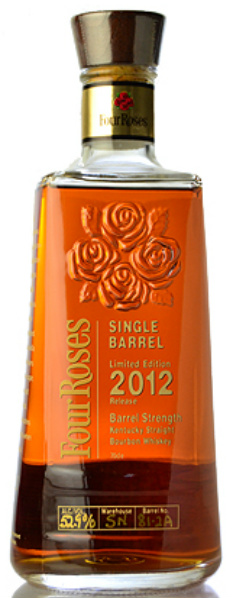
Four Roses Single Barrel 2012Color: Dark gold copper, marginally darker than the 50% ABV expression.

Nose: Creamy and sweetish, already less woody and strict than the 50% ABV expression. It starts off with notes of hay and dry grass. Wax with a hint of leather. An old, well maintained saddle maybe? Hints of dried yellow fruits. Apricots I would say. Quite some honey after breathing, but soon after that more dry and dusty (and slightly acidic). Bad morning breath, wow.

Taste: Starts with toffee sweetness, but like the nose, the sweetness soon steps aside to let the wood through. Quite spicy and wood. The wood gives it spice, but also a more nutty and slightly acidic profile. At 12 years old this Bourbon had a lot of time to interact with the wood. The wood leaves, vanilla cinnamon and a hint of honey, but also a slightly soapy and slightly bitter finish. The finish itself starts as an attack, is long, but stays with the woody notes. Even the sweet mashbill can’t do nothing about that. Besides this, I also feel the end of the, somewhat simple, body, and the especially the finish lack a bit of balance. It’s not completely harmonious. I guess this one may have been in the cask too long. The wood won a battle with the sweetness and obviously won, where there shouldn’t have been a battle in the first place.

By the way, the picture here is of another, similar looking 2012 limited edition. The picture is for the 52.9% ABV version from barrel 81-2A, which is a sister cask of our 81-2R. Both come from the same warehouse: SN.

So what’s the verdict about our super premium limited edition? It’s a nice special edition, and a learning experience for the aficionado. I understand the pick and it most certainly is an interesting experience. So should you try it? Yes, should you buy a bottle and drink it by yourself, not really! This one is for sharing, discussion and comparing the other recipes of Four Roses.

Comparison to the 50% ABV expression is easy. That one is sweeter and more easily likeable. The difference in ABV is small, but the age probably made the difference, making the 12yo more about wood. Both are not very complex, but the 50% ABV is definitely more drinkable and better balanced, but also slightly weaker in taste. The limited edition also brings quite a lot of heat to the table. I’m trying both head to head but none is better than the other, although very different. It’s a tie!

Points: 83
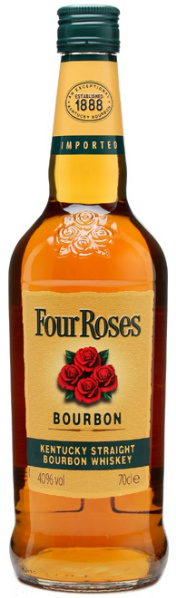
Four Roses (40%, OB, 2011)

After the highly specialized Octomore, let’s get back to basics with this Four Roses Kentucky Straight Bourbon Whiskey aka Four Roses Yellow, since it has, and you’ve guessed it, a yellow label, although with every revamp of the look, the yellow label gets less yellow. The one I’m about to review, is one that was released a few years ago, but since this is the entry-level best known product of the distillery, I expect a lot of consistency exists between different batches. Four Roses is a bit of a tricky Bourbon for me. Four Roses have their ten recipes and it depends of the usage of these recipes in blending the Bourbons if I like them or not. For instance, if you have read my review of the Single Barrel expression, you know I found the new 50% ABV version quite good, whereas I didn’t like the older 43% ABV version as much. For me it was too floral. Don’t get me wrong. It’s about the taste, not the amount of alcohol in the finished product. I understand that this yellow labelled Bourbon I’m about to review is around 6 years old and can contain any of the ten recipes Four Roses makes, although most of it is OBSK and OESK. If this means nothing to you, please have a look at my other Single Barrel review.

Four Roses YellowColor: Orange gold.

Nose: Smells young, and slightly alcoholic. Light and creamy. Even some yeast and quite some honey. Dusty, with charred oak and whiffs of the new oak underneath. It has more to do with oak than the florality of the old single barrel expression. It seems a bit closed to me, since it is a bit hard to get all of the aroma’s out of my glass from the start. Maybe it’s reduced a bit too much. Another layer shows us some cardboard and a leafy, grassy note. Dry grass mixed with the slightly spicy note that has to do with the toasted oak. The honey note quickly disappears, making it less sweet and somewhat more spicy. Otherwise quite light and yes, simple. Bourbon tea.

Taste: Cardboard, wood and sugary sweet. Waxy paper. Sugar water sweetness and a very nice oaky note. New oak, with again a grassy, spicy and soapy note. There are some good flavours in this and even has enough character for an entry-level Bourbon. The wood and cream give it its initial likeability and backbone. It maybe a bit simple, but it’s very nice as an unoffensive entry-level bourbon should be. Nice body, medium finish.

Start with something like this, share a bottle with mates, get to know it. Compare it to several other entry-level Bourbons, like Jim Beam (white), Evan Williams (black), Buffalo trace and others. Quickly move on from there, if you’re an adventurous person. My review may seem a bit harsh, but it’s actually not that bad at all. This Bourbon is pretty decent, has some nice aroma’s and is very drinkable and buying this, won’t scare your wallet at all. With the age comes also a rather simple body with a not too long finish. I hope it’s strong enough for mixing, but I couldn’t say. I’m no mixologist.

Compared to the aforementioned single barrel expression, the single barrel has more depth to it, seems better balanced and benefits greatly of its higher strength (50% ABV), although it has a tad more of the feared florality. Luckily it’s not enough to spoil it for me.

Points: 78

Octomore 5yo “Edition 02.1 / 2_140” (62.5%, Bruichladdich, Ochdamh-mor, American Oak, 140 ppm, 15.000 bottles, 2009)

After the sweet and weak Glenfiddich, time for a potential beast. This Octomore, the brainchild of Jim McEwan was, when it was released, the most heavily peated Whisky in the world. Today we look a little bit differently at 140 ppm, since Octomore 06.3 is peated to a level of 258 ppm! Octomore 06.3 is a lovely Whisky and shows quite some fruits and the peat doesn’t even seem that heavy as it sounds. But time to rewind a bit and have a look at Octomore 02.1 that was already released in 2009. The first Octomore that was released is known to the world as 01.1, peated to a level of  131 ppm and bottled in 2008. The first ever Octomore distilled by Jim has never been released, but a small group of people had the chance to try it at the Whisky Show 2015 in London earlier this month, and Jim has probably brought it with him elsewhere too. The first ever Octomore was distilled in 2002 and peated to a level of 80.4 ppm. Filled into a first fill Oloroso butt and bottled at 62.3% ABV. I didn’t take notes since I was listening to Jim, but managed to score it 91 Points.

Octomore Edition 02.1 / 2_140 (62.5%, Bruichladdich, Ochdamh-mor, American Oak, 140 ppm, 15.000 bottles)Color: Very light gold.

Nose: Fatty peat and hints of red fruits, mostly berries. Peated barley and slightly medicinal, iodine. Smoky. Actually this smells like a lot of Whiskies from Islay do. In nothing you get that it is more than heavily peated. When you let it breathe for a while, a more (yellow fruity) sweetness emerges. Altogether for this to reach a more balanced state, you must give it some time. More meaty, smoky, tarry and salty aroma’s emerge. Burning off dry plants. Licorice, sweet wood and smoke in the mist. Wait even longer and hints of menthol and lemon can be smelled. the whole gets even softer. Old furniture and even creamy. Vanilla Ice cream with pepper and salt. Old paint and some nuttiness emerge late. Cotton candy. If you handle it well, if you are patient with it and use a glass that can handle air well, you’ll be rewarded. Wonderful nose which keeps on giving and giving.

Taste: Again  very creamy. Peppery and lots of it. Peppery attack with lots of licorice and sweet wood. Matches the nose perfectly. Quite sweet, but the rest of the aroma’s are pretty “there” as well so it handles the sweetness perfectly. Hints of old wood integrated with the licorice. Lots in common with Port Charlotte (obviously). Taste is very balanced, but less complex than the nose. It will be great to see Octomore (and Port Charlotte) mature.

Excellent example of a Whisky you have to work hard for, to be rewarded. It needs a lot of time and air to be at it’s best and show you all it’s got. Use the wrong glass or being impatient with it, will degrade this to nothing special at all. This is a wonderful yet modern spirit, which already is great if you know where to look. Lots of potential. The aroma’s are so big it even hides the high strength. I didn’t try it with water, but I’m sure it will take water well. Pour yourself a dram and then drink something else first, come back to this later.

Points: 87

Glenfiddich 19yo “Age of Discovery” (40%, OB, Madeira Cask Finish)

After an (alas imaginary) short break on the beaches of Barbados, back to Scotland again. From the oldest Rum brand in the world we now focus our gaze at the Whisky that started it all for Single Malts, Glenfiddich. Up ’till now lots of Glenfiddich have found their way onto these pages. The Whisky at hand is the first of three “Age of Discovery” bottlings. All three are accompanied by little stories about traveling and discovering new territories by usage of tall sailing ships. This particular Madeira cask finished Glenfiddich is about discovering the isle of Madeira (and Madeira Wine). The other ones are about sailing up the rivers of America for Bourbon casks (not a Bourbon finish, but wholly matured in Bourbon casks) and finally a Red Wine finish with the story of Darwin visiting the wine making regions of Argentina. Let’s not get ahead of ourselves and have a look at this Madeira finished one first.

Glenfiddich 19yo "Age of Discovery" (40%, OB, Madeira Cask Finish)Color: Full gold.

Nose: Funky and acidic. Where is this going? Some wood, rotting wood. Barley and grainy in fact. Waxy.  I’m getting a lot of wax lately, so maybe that’s just me. Luckily with time the aroma’s start to gel a bit. Started out very unbalanced, but the balance returns. Still the whole doesn’t seem to be very complex and obviously is very light. Maybe it wasn’t such a good idea to reduce it to 40% ABV. Mint & toffee come next. Unbelievable how malty this is after 19 years.

Taste: Sugar water with mocha, toffee and more sugar-water. So yes, quite sweet and appealing. Did the Madeira do that? Lots of vanillin from the American oak. Creamy. Pudding. Custard. Caramel, Toffee. After that it falls flat on its face. Short finish and hardly any aftertaste save for some creamy sweetness. Sure it’s nice and very, very easily drinkable, but hey, where is the development, where is the complexity? It’s a shame this got reduced so much because it tastes like nothing special now. It’s nice, but it is in no way better than a good Malt that costs much less than this one does.

I don’t know if this was meant for travel Retail? A lot of those big box Whiskies that are meant for travel Retail are 40% ABV. Why? Is the industry afraid the traveller at hand will open and drink the bottle on the spot? On the ferry or on the plane? Well, if that’s so, a traveller will get pretty plastered drinking a bottle at 40% ABV as well. So no need to put so much water into the Whisky bottle I would say. I guess you pay for the packaging this time. It’s nice, but could have been so much more. Expect to finish this bottle very quickly, because it drinks like lemonade, but alas also has the complexity and length of a lemonade.

Points: 81

The Benriach 17yo “Septendecim” (46%, OB, Peated, 2013)

Last summer I already reviewed The 18yo Benriach “Dunder”. A peated Benriach finished in high ester Rum casks. This “Septendecim” is a 17 year old peated Whisky. Well, I may be wrong, but maybe this “Septendecim” is the basis for all those 18yo Limited production’s of late? Up untill now there are already three releases in this series. It started with “Albariza” which was finished in PX Sherry casks, the second was the aforementioned “Dunder” and last month the Benriach “Latada” was released. Again a peated Whisky finished this time in Madeira casks.

The Benriach SeptendecimColor: Gold.

Nose: Fatty, fatty, thick peat. The peat is instantly recognizable from the Dunder I reviewed earlier. Bonfire in the woods. Tiny hints of electrical fire and molten plastic. Sounds terrible, but it doesn’t harm the overall smell, so easy yourself back into your chair. Quite clean and smoky. Kippers, salty and tarry. But it’s not Islay I’m getting. I still get a secondary feeling of a forest. Clairvoyant? Who knows. After some air, the whole gets even more cleaner, smokier and shows hints of citrus. Lemon, not lime. Quite nice. I would have never given this 17 years if I had tasted it blind. Hints of coffee, but not dark roasted stuff, more Cappuccino. Last one to show itself is the wood. Fresh oak.

Taste: Sure, fatty, a bit fruity and obviously peaty, but also much lighter on aromatics. Cold chocolate milk and coffee again. It has some sweetness too, but that is more hidden. Just like the nose, I wouldn’t have given this 17 years. Even at 46% ABV. it doesn’t seem to be heavy on the alcohol, I’m actually amazed how light this actually is. The lightness (and the coffee with milk) makes this dangerously drinkable for a richly peated Malt. I keep wanting more, and want to sip it more. Having said that, It would have been nice to try this one at 50% ABV and see a bit more complexity at this age. Medium finish with a buttery, vanilla and smoky aftertaste.

The “lightness” in the taste made me believe this is the Whisky they use as a basis for the “Limited Production Series”, especially when its 17 years old and that leaves some room for finishing.

Points: 85

The Glenlivet 12yo (40%, OB, 2012)

About a year ago I already reviewed The Glenlivet 12yo, but that one was bottled around 2005. Now I stumbled upon an example of the same stuff, this time bottled in 2012. We all know the big boys want consistency, so now we have a chance to find out. For those of you who don’t know already. Due to the enormous rise in popularity of Single Malt Whiskies, a distillery can’t afford anymore, to wait 12 years to make an entry-level Malt. This 12yo will be replaced in most markets, apart from Asia and the USA, where I’m informed, the consumers like “numbers” more than the consumers in other markets. The replacement is The Glenlivet “Founders Reserve”. Yes, a Whisky described by only letters, no numbers anymore for us Europeans.

The Glenlivet 12yo (40%, OB, 2012)Color: Gold.

Nose: Malty with sweet fruit and quite some wax. Nice aroma. One thing if for sure. The aroma of the 12yo never holds back, its vibrant and wants you to drink it. Definitely not a closed spirit. Vanilla and oak, parts of it even new oak, since the wood smell is a little bit sharper. Sweet and candied. Fruity. No pineapple this time, but I do get some apricots. Powdered coffee creamer (the initial smell of it, not the fatty part). At least this nose lives up to its earlier brothers (or sisters if you like).

Taste: Strange enough, this starts with wood, partially bitter and partially burnt. Then a quick passing by of some (sugared) fruit and some soapy (ear) wax, which is quickly overtaken by paper. Diluted red fruits and the bitterness never moves an inch. Not as sweet as the older versions. Quite a difference from the 2005, 12yo, I mentioned above. Not a long finish and the aftertaste isn’t all that pleasant as well.

When reviewing the 2005 version and comparing that to the new “Founders Reserve” I was quite shocked by the difference in taste. The “Founders Reserve” tastes as a very young and immature Whisky, almost as if it wasn’t ready, but the marketing department wanted it out anyway. Now that I have tasted this 12yo from 2012, and do remind yourself how much the Whisky world has changed between 2005 and 2012, the difference in quality isn’t all that great, although the taste is quite different. My advise would be, get yourself an old 12yo, but do not pay too much for it, and be surprised how nice it was.

Points: 76