Here at Master Quill, when writing about whisky, we foremost are keeping up busy with the Scottish version of the tipple. However in the early 19th century lots of Scots moved across the world and settled in New Zealand. Finding a lot of Scottish (Whisky) heritage in New Zealand is not all that unusual. Even today a lot of small or micro-distilleries do pop up in the country. (like Southern, Hokonui and Thomson, to name but a few).
 This time we’ll concentrate on the biggest and best known of the New Zealand Whisky producers, al be it under a lot of different names, and also under quite some different management.
In December 1969 the Baker family started distillation in Dunedin (on the south Island, to the south of Oamaru). They named their distillery “Willowbank”. The Whisky was released under their Wilson’s brand name since 1974. By 1974 The distillery was named after it’s Whisky “Wilson Distillery”. In 1981 the giant Seagram’s bought the distillery. Seagrams made a “minor” contribution by replacing the copper necked stainless steel stills for more traditional whole copper stills. Seagram’s released their Whisky as Lammerlaw. Lammerlaw being a nearby mountain range, but also the source of water for Whisky production. The distillery was mothballed in 1995 and Seagram’s sold the distillery to Foster’s in 1997, who had it untill 2002. The two copper stills and the four column grain still were eventually sold to Fiji to distill rum, but the gin still remained in New Zealand. It is now located in pieces at the McCashin’s Brewery in Nelson, and may be used again in the future.
 First Warren Preston bought the Distillery and some 600 ageing casks of amongst others Lammerlaw Malt Whisky and starting a firm called The New Zealand Malt Whisky Company (NZMWC). The Casks were laid down in Oamaru. Some 150 of those casks were bottled (under the Milfort brand name, but also Blended Whisky under the Preston’s brand name). Alas NZMWC went bankrupt and in 2010 the Forward looking entrepreneur Greg Ramsay (leading a consortium of investors) took over and renamed the firm The New Zealand Whisky Company (NZWC). Mr. Ramsay bought the last 450 casks of Whisky of which half were Lammerlaw Malt Whisky (18 to 24yo) and the other half Wilson’s Whisky (at least 12yo). By 2012 some 90 casks were bottled for the current range, so by now only 360 casks are left. In the grand scheme of things and the good promotion for the Whisky being carried out, I guess that the whole stock will be sold by the end of 2016. So be quick, because, this New Zealand whisky is rapidly becoming extinct!
Plans are to build a new distillery (or two). Obvious choices for new sites are Oamaru, but also Dunedin. Less obvious choices would be Auckland and Nelson, both Auckland and Nelson showed more interest than Oamaru and Dunedin in being the home of a new New Zealand Whisky distillery.
 Color: Red copper.
Nose: Fresh and woody at first, and a little bit winey, well that’s a surprise! Spicy and a little bit of sweet, toffee-like wood. It does have a sweet side to it, but overall pretty dark, with already hints of grain whisky. Maybe some cask toast and influences (tannins) from the wine. Spicy Syrah? Next, the grain whisky starts to play its part. This is spicy and definitely smells like a volcanic red wine, so I got even some terroir in this (Syrah again). That’s not completely strange since the Red Wine finish was done for a whopping 4 years, whereas others finish their whiskies for mere months. (I understand that there also is, or was, a 15yo Double Wood that was finished for 10 whole years in Wine casks!) This one is dark and brooding after the initial freshness right out of the bottle. Very appetizing.
Taste: Less woody than one might think, half-sweet cookie dough and nicely fruity. Slightly acidic at first, but quickly taken over by the sweet red fruits. Not even a lot of Wine to this, so the 4 years in Wine barrels didn’t do the Whisky any harm. Maybe the grain balances the Whisky out? That said, it doesn’t mean the wine didn’t impair a lot of taste onto the Whisky, because it did (sweet fruits, red fruits, plums, Merlot?), especially after some breathing. The Whisky just doesn’t taste like Wine, although some markers are definitely there. Seems to me that the 70/30 ratio of malt and grain is pretty much spot on. Nice and half-long, warming and sweetish finish, with some hints of oak. Very well made, likeable and drinkable blend.
Yes, this is a blended Whisky, the NZWC itself calls it a Master Blended Whisky. With 70% Single Malt this really is a sort of super premium luxury blend. Stuff that the Scots these days put into expensive crystal decanters. Nice aroma’s and pretty different and bold. For the Whisky it is, this is bottled at the right ABV. Recommended!
Points: 84 Points
Thanks go out to Cyril and Greg for the Whiskies and the additional info!
 As I said, lots of discussion, since all casks are good, didn’t cost a lot and have some differences. So nice whisky to compare to each other. I still have some Sherry Butt #72315 left, so I can compare it to this Sherry Butt #72319. Word in the grapevine is that the first one (Sherry Butt #72315) is the “worst” of the three, all are very clear about that. Some consider Sherry Butt #72318 to be the best and some Sherry Butt #72319.
 Color: Copper Brown (less red/orange in color than Sherry Butt #72315)
 Color: Copper
 Here we go again. Another monstrously long title, again a Single Malt of which the distillery name is not on the label, but we know it’s a Bunnahabhain. So three in a row, this being the third Bastard Malt in a row, reviewed here on these pages. The Creative Whisky Co. Ltd. is non other than David Stirk. Fellow Rush lover and Whisky bottler par excellence, or should I say Exclusive Whisky bottler?
 This Bunna is pretty dark in color so my guess would be a Sherry cask. Since David didn’t specify what (kind of Sherry) the cask previously held, we can only speculate what this is. Maybe a Sherry Hogshead, or maybe a Butt that was shared with others, or only half the Butt was bottled? My guess would be the former (a Hoggie). It looks like a Oloroso or PX Sherry Hogshead to me, so we’ll have to try, to make another guess at it…
 Color: Copper Brown.
 Well hello Blairfindy! Wait a minute, Blairfindy isn’t a real distillery is it? As far as I know, there isn’t a Blairfindy distillery, and there never was one too. No, Blairfindy turns out to be “another” name for Glenfarclas, used, when the bottlers weren’t allowed to use the real distillery name on their labels. Something like Tactical for Talisker, Leapfrog or Laudable for Laphroaig and so on. Blairfindy, amongst others, was the name of the farm, the Grant family (of Glenfarclas fame) originated from. Although the Glenfarclas name isn’t on the label, it most definitely is a Glenfarclas, and an old one to boot…
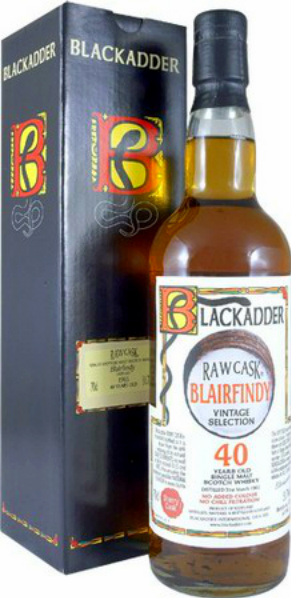 Color: Copper gold.
 Color: Light Gold
 Color: Light White Wine.
 and is said to be even better than cask #72315. Alas Cask #72318 sold out rather quickly too, so Van Wees bottled a third one: #72319. That one should still be available, but already I heard a fourth cask is being bottled. If my information is correct there still are two casks left from this series, to make six in total. Let’s have a look at the series first one, cask #72315.
 Two months ago I reviewed the
  The Chablis by Louis Moreau was pretty good, so let’s have a look, what
  Master Quill