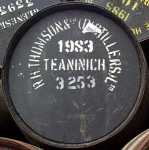
 Teaninich isn’t amongst those superstars of Single Malt Whiskies around, but it has a fanatical following with certain enthusiasts. Well I’m one of them. Almost every time I taste a Teaninich, blind or not, this always tickles my fancy. I connect with it. It suits my palate. Dare we say: “For reasons not even science can wholly explain…”
 Teaninich was founded in 1817. In 1970, yes a small jump in time, a whole new six still ‘distillery’ was built alongside the current one, consisting of four stills. The new one was called the A-side (The old stuff was therefore called the B-Side). They worked together as one distillery. In 1984 the old distillery was mothballed, and 15 years later, demolished.
Not a lot of officials around. A 10yo Flora & Fauna bottling, three and a half Rare Malts editions, one 17yo Manager’s Dram, and one 1996 Manager’s Choice. That’s it. Luckily there are a lot more independents, which brings us to our whisky of the day: A Gordon & MacPhail Teaninich from 1983, which can be from The A or B-side.
Color: Copper Gold.
Nose: Fresh, citrussy, and toffee. Vegetal, woody spiciness. Perfumy and hints of smoke and licorice. Great balance. The nose has body. I’m bonding with my Teaninich again.
Taste: Sweet, fruity, cherries and apricots. Nice body, luckily not reduced to death. Fantastic, that in 2003 it’s already 46% ABV and not less. It has wood, but without the sourness. Lots of esters. Great!
A long time ago I gave this 88 points. Not being a fan of ‘modern’ Connoisseurs Choice bottlings, since they could be all the same, and having the same color, and so on, but this one is great and deserves at least 88 points.
Points: 88
P.S. the picture is for the 2004 version. I tasted the 2003 version, but both look the same.
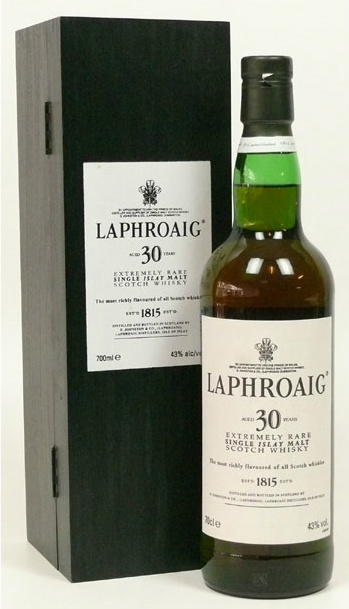 Time for a nice old Laphroaig. The
 The Old Train Line series is probably the series with the most beautiful labels I know. The series is bottled by German bottler Jack Wieber based in Berlin.
 Founded in 1843 by William Mathesen, but whisky was distilled on site as early as 1703 (or 1738). Glenmorangie is now known for their stills with very tall necks that ensure a very light and clean spirit that had to reach incredible heights. Glenmorangie are also known for their Dr. Bill Lumsden, a man who doesn’t fear innovation and experimentation with his grains and woods.
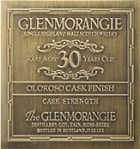 The whole is pretty balanced. It’s easy noticeable that this is from light spirit. The nose is great, and the taste is very nice. The only two things that let this down is its lightness. And a Glenmorangie should be light, that’s one of their pillars. Personally I like a bit of body to it, like yesterdays
 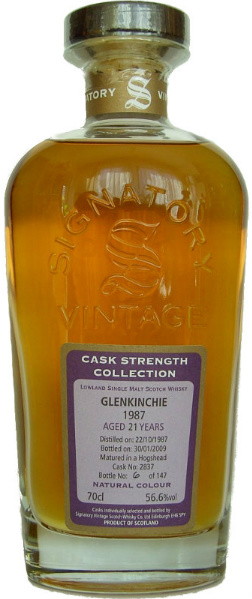 Glenkinchie, a rarely seen Lowland distillery within the ranges of independent bottlers. Founded in 1837, Glenkinchie is foremost known for the closure of Rosebank. When Diageo set up their range of classic malts they chose Glenkinchie over Rosebank. As you might know, Rosebank is known to have a huge following, so this decision wasn’t welcomed at all. Now Rosebank is no more, we’ll have to see if this Glenkinchie is worth your money. Instead of a regular Diageo bottling, let’s try an independent one.
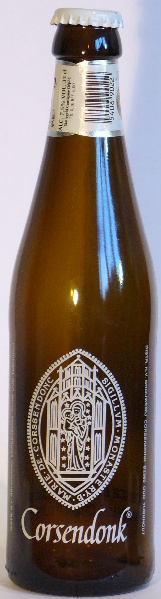 Let’s try another Tripel.
  As you know life is hard. For this review I had to drink three bottles of the Corsendonk Agnus. I bought a couple of bottles a long time ago that were brewed in august 2006. I tried one of those earlier when it was around three years old, and this time I’m trying two, of the same batch, that are now six years old. Yes you can drink Tripels well past their dont-drink-or-you’ll-die-of-food-poisoning-date. Finally I also bought a new one that was brewed in february 2012. Following notes are for the aged ones:
 Well first of all, after the prolonged ageing period, the beer turned a lot darker, than the same batch at a younger age. Originally it was radiant gold, now it turned a lot more copper. The meaty part on the nose disappeared, but it gained a lot of fruity esters. With this it gained a lot of complexity. The three-year old one was more refreshing (more lemon), but this still is refreshing. It gained more depth, but it didn’t even change that much, tastewise. It is easily recognizable as a Corsendonk Tripel. Personally, I find six years of ageing a bit too long. I think it is at it’s best, around three years old. The new batch was, in comparison, very light and really easy to drink, with an aftertaste you only know of your standard beers. After seeing it’s potential I would recommend ageing your bottles for three years. But if you’re interested, longer can be quite fun too. Drinking this right after you bought it is a waste of your money. Put it in your cellar and be patient!
 After the fabulous
  It’s all right. An example of a typical Tripel. I prefer other Tripels, which will be reviewed eventually. After the Pale Ale this is a bit disappointing. Maybe I had too high expectations for this? It reminds me a bit of a Duvel, but Duvel is better (for me). Don’t get me wrong, this still is a pretty decent beer, but for me it doesn’t add anything to the world of the Tripel. Actually, maybe this isn’t even an Abbey-style Tripel. But a heavy Blond Ale with a third fermentation in the bottle (which a lot of people call a Tripel). It just has to decide which one of the two it really is.
 …some sunshine, and another chance to finally review another cigar that is with me for quite some time, and thus had the chance to age properly.
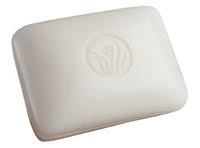 The soapyness gets more and more “there” and is something you’ll want to “away”. Fortunately since this didn’t go well with coffee, it goes well with carbonized water. (This time I had some de-ironed mineral water from France). I won’t be running out to buy a new box of these. There isn’t a lot happening, but what’s there is nice. The build is very good and the draw turned out to be very easy. It didn’t weigh a lot and therefore it burned pretty quick. The black band was glued to the cigar and can’t be removed without ruining the cigar. Unfortunately this band sat quite high, so the end came even sooner. Short spicy, woody and alas soapy smoke.
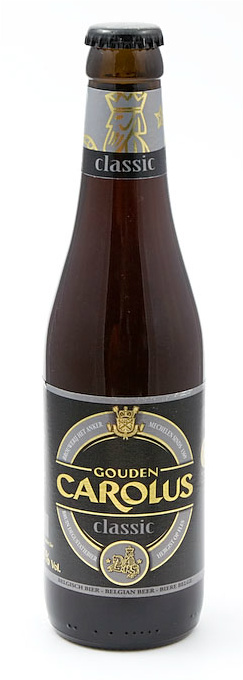 Gouden Carolus, once, only one beer, but since then a lot more versions of Gouden Caroli hit the market. Actually there was an emperor’s beer before 1960, but this is the year the name Gouden Carolus was given to it.
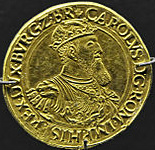 emperor Charles V on it, who spent his childhood in Mechelen. This beer is also from Mechelen, what a coincidence! It is even a protected regional product from Mechelen.
 Springbank, the strongest survivor of Campbeltown, and one of the few family owned distilleries. Once a great center for whisky, and once a region of its own, it still is, but barely.
 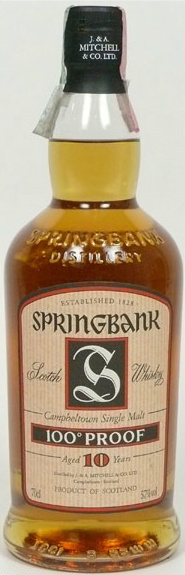 The people behind Springbank do their utmost best to let Campbeltown survive as a region. Glen Scotia is intermittently operated by the crew of Springbank, and of course Springbank themselves are responsible for Longrow, Hazelburn and Kilkerran (Glengyle Distillery). All names from a distant Campbeltown past. Founded in 1828 by the Reid family, who were married into the Mitchells. In 1837 the Mitchell’s bought the distillery. In 1897 J. & A. Mitchell Company Ltd. is founded, the company that is still on the label today. Since 1969 J. & A. Mitchell is also owner of Cadenhead’s. Between 1979 and 1987, Springbank was closed. And since 1989, production is again as it should be. Almost nobody malts themselves these days, but Springbank take the remarkable step to reopen the maltings in 1992. Springbank is a cult malt has a great following, and is by far the most popular malt on Wall Street.
 Yes it’s “Snickers” in a bottle. Slightly unbalanced by the soury woody, and peaty, finish. The finish also leaves a minty sensation on the tongue. Sweet mint as in “After Eight”.
 Master Quill