 Here is a cigar that’s with me for a long time. I bought this box seven or eight years ago, so this had a good chance to age well. Still, this is a Panatela, usually a cigar people buy to smoke quickly and do not give it a chance to let is age. Hey, but I did! Rafael González is a very small brand, that has always been known for a very good Lonsdale or Corona Extra. Now only this Panatela Extra, a Petit Corona and a Perla are made. All small cigars.
 Cuban Rafael González Panatela Extra (36 x 127mm, Vegueritos, Short Panatela, Box Code ORE JUN 04)
Color and Looks: Colorado with a big green spot. (It was the only one in the box with a green spot). One larger vein, otherwise smooth surface and no frays. Feels firm.
A cru: Nice ‘old’ smell. Well aged. Nothing overpowering. The foot smells great. With cedar, leather and old books.
 Taste: Draw was ok, a bit heavy at first. Great smoke that’s a bit sour. Woody and well rounded out, very balanced. Ageing did this cigar well. Mild smoke. Draw now ok. Mocha, milk chocolate mousse. Firm white ash. Easy, uncomplicated smoke. Again the second-hand smoke smells great. Still it’s not overly complex. Ash falls off rather quickly. The whole taste is on the dry side, woody, cedar, it would have been nicer if it had a creamy component.
Almost halfway its grassy, cool and I detect something chemical, but I can’t put my finger on it. Predominantly white ash with some grey thrown in. After the halfway point the wrapper started to crack. Later I found out that the binder was locally folded and wanted to unfold itself. All this without any problems in draw. The cigar keeps giving you a lot of smoke.
 Than the last third, and boy what a turn! When the first part of the cigar is very mild and tasty, the last third is extremely strong. It does have its merits but if you are an inexperienced smoker, this part is the part that turns you green! (I’ve seen it happen to someone at work, with this cigar when it was younger). The strength is well countered by a good coffee, but without is it is extremely drying and a bit harsh. Heavy on nicotine. The ash turns brown so you’ll even have a visual aide in recognizing the last third…
This cigar tastes great with double roasted coffee and also does very well with water. I didn’t try it with anything alcoholic, because the cigar doesn’t call for it. It doesn’t need anything really, it does very well on its own. Beware of the last third! I’m writing this the next day and I still have the taste of the last third firmly embedded in my mouth.
76 Points
P.S. Both guys are really called Rafael González. If you turn out to be one of them, I hope you let me use these pictures.
 And here is another whisky from my lectern. This time an old (bottled in 1999) Craigellachie from Scott’s Selection. The people who brought us the fabulous Longmorns from 1971. Therefore I always have a soft spot for these guys. This Craigellachie was opened on our
  Color: White wine.
 This should turn out to be a very interesting review. If not for you, than certainly for me. Mr Bladnoch, Raymond Armstrong has a lot of fans, just have a look at the
  After giving the whisky some time to breathe it gets somewhat more balanced and friendlier, some nice spices shine through, with just the right amount of wood. It just doesn’t shed its new-make-and-wood finish.
 Points: 77
 What catches the eye with this beer is the statement: “bier met smaakevolutie” thus stating that this is a beer with an evolution in taste. Great! I love that in my drink. Evolution.
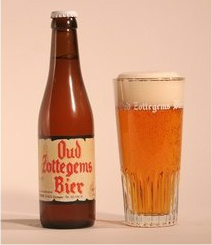 Color: Murky brown, not much foam.
 I would say. Drink this beer! It’s very nice ánd nearly extinct. It has become a very regional beer and deserves a lot of attention. Losing this would be a shame. I’m definitively buying this again, but sure am curious for the Grand Cru version of this. So thumbs up and a well-earned:
 And now for a completely different beer. This time something from the oldest brewer in Britain. Sheperd Neame from Faversham, Kent founded in 1698. Spitfire is a cask conditioned bitter that came onto the market in 1990 to commemorate the Battle of Britain. This bottle of britain is named for the famous fighter aircraft from the second world war. The beer also has a different
  kind of advertising than we are used to of which I only give you a few, but there’s a lot more. Let’s move on to the beer, shall we?
 Nose: Fresh, it almost has no scent at first, certainly malt but after that we’re in the twilight zone. Hard to tell what else there is.
 Taste: Thin (probably the low ABV). Fresh, summery ánd bitter. This bitterness once tasted, never leaves and dominates even the finish. The body is light, hoppy and malty. The middle and the finish make this less summery, although I guess this will do well as a thirst quencher on a terrace looking at people passing by.
 In the end I found this to be very easy, not to say very simple. For me even though it isn’t very bitter, still the bitterness dominates the light palate. Maybe that’s why they call this a bitter.
 Still nice weather and too hot for writing blogs, so hereby I apologize to my readers that it took a few days for a new review. This time a review of beer brewed by Bavik in Belgium called Petrus Aged Pale. This beer was initially intended only for the US market, hence the typical warnings on the label, even though I bought this bottle in
 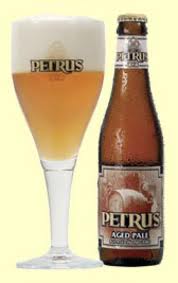 Color: Gold
 this simple beer let’s you know it has a lot more going for it. It awards you with a lot more complexity than you would say at first. It is close to a Rodenbach but in my opinion, better balanced and way more complex. You just have to work it a bit. For me this is better than the classic Rodenbach, but I’ll have to give the Rodenbach Grand Cru a go. This Petrus could be an acquired taste, but one I like a lot.
 And here’s yet another Speysider and not just any Speysider but an example of Speyside’s finest distillery…probably. Just consider the statement for a moment (maybe not if you’re called Luc). There’s also Macallan, Longmorn and Strathisla in Speyside. I know there are others, but I didn’t want to make this list too long. Glenfarclas isn’t mentioned on the label, but let me tell you this is a Glenfarclas, and a very old one too. I have tasted several very old Glenfarclas, and sometimes they tend to be very woody, but that’s also because there are a lot of very old Glenfarclas around, and 42yo is a long time to spend in a cask. I’m 42 now and I wouldn’t want to spend my whole life in a cask.
 To the whisky then. Glenfarclas is still a family owned operation that started legally in 1836. In 1965 it was bought by John and George Grant. Since then there were a lot of Georges and John Grants. Very popular names indeed in that family (and The Beatles for that matter). Sometimes they have extra letters for identification purposes.
  Next time I’ll be up at Glenfarclas, I’m dying to meet Ringo S. Grant! Good to see a still family owned distillery surviving competing with the big conglomerates like Diageo. There are several more like Bladnoch for instance. Power to them!
 Here’s something else to put in your mouth!
 Rodenbach Original or Classic is blended from aged (1/4) and young beers (3/4) and married for two years. There is also a Rodenbach “Grand Cru” (6%) wich also is blended from aged (2/3) and young beers (1/3). Besides these two, some less known special editions are released. The vintage 2009 springs to mind.
 This one is all right and could be savoured any time. It’s probably at its best on a terrace in the summertime. Really refreshing, thirst quenching. It has its place, and in comparison with other Belgian beers it shure is unique, but if you like more depth and more…well everything, you should go for the Grand Cru. This still is pretty decent and fresh, classic Rodenbach.
 And here’s already the second Strathisla by Gordon & MacPhail. This one has bottlecode SC999 and Gordon & MacPhail used these bottles roughly between 1981 and 1987. But if I would have a guess, this seems to be closer to 1981 than 1987. And thus this would be a late fifties distillate! (And the previous 15yo Strathisla, one from the mid seventies). That’s quite a difference and will probably be evident in the taste and smell. Also note that this 25yo is notably darker. Like the 15yo, this bottle was also bought for a
  Just have a go at this standard G&M, 25yo Strathisla, and find yourself a sweater made from those fabulous looking Strathisla sheep!
 Another fine day to have a quiet smoke on the porch, but not in front of the house but in the back. I know, I know, this is very important information for you. This time it was very easy to pick a cigar from my humidor. I delved somewhat deeper into my humidor to surpass the Robustos and other shorter cigars, to find a candidate among the Lonsdales, Coronas and Double Coronas. This one beckoned, and again it’s a San Luis Rey. It’s a very well aged cigar, it has aged for maybe ten years. Also some sad news. This Lonsdale was discontinued in 2006, since SLR isn’t a main brand anymore, and the tobacco is needed for other brands.
 Cuban San Luis Rey Lonsdale (42 x 165mm, Cervantes, Lonsdale, Box Code Unknown)
 Why isn’t it perfect then? I recon it could have evolved some more. The last part is rather bland and does nothing for the cigar. It also lacks some complexity. I’ll do another test. This time I’m going to try it with a Bourbon. I chose a Four Roses Single Barrel (the new 50% one). Like the coffee tasted creamy, this Four Roses tasted sweet. Still something unexpected happened. The first sips of Four Roses were done in the second part of the cigar, but when the cigar became bland in its final stage, the Bourbon started to taste better. The cigar’s final stage announced itself with dying down tastes and an addition of menthol. It never became harsh or sharp, but you just know the end is near. Also the ash became darker, even black. Since the Lonsdale is a long cigar, the weaker end wasn’t such a problem.
