J.M 11yo 2002/2014 Vieux Rhum Agricole “Millésime 2002” (46.3%, Bourbon Cask Matured, Martinique)

Reviewing the dirt cheap La Mauny “1749” already opened my eyes to Rhum Agricole from Martinique, but especially after reviewing the J.M XO, I started to really like the stuff. Followed quickly by the La Mauny XO. There is a difference in ABV though, the La Mauny is bottled at 40% ABV, and suffers from it, the J.M XO is bottled at 45% ABV, which seems to be a much better strength. Apart from the difference in ABV, I somehow clicked more with the taste of the J.M. Soon after, I went out and bought this 11yo J.M Millésime 2002. (Two of them actually, since I had high hopes for this one, and I got a pretty good deal on them as well). Aged in Jim Beam Bourbon casks, just like the XO, but almost twice the age. Having already tried the 2002, this time it’s not about comparing it to the XO, because both earn a place in any drinking collection. You know, a collection of bottles destined to be drunk, bottles that will be actually opened to be enjoyed. The XO is younger, has less depth but is also a high quality Rhum Agricole. Having said all that, I have to warn some people. A lot of (sweet) Rum drinkers are a bit put off when starting with Rhum Agricole. Its different. Just like heavily peated Whiskies differ from Bourbons and so on. Proceed with caution, acquire the taste, and if you put some effort into it, you’ll be rewarded with some great Rhums (If you choose wisely).

J.M 11yo Vieux Rhum Agricole Millésime 2002 (46.3%, Bourbon Cask Matured, Martinique)Color: Full gold.

Nose: Fresh, half sweet and industrial. Wax. Red fruit sweetness and acidity. Cherries, dust and toffee. Soft wood and old leather. With some air more fresh leather combined with a little bit of clear glue. Ground roasted coffee that has been around for a while. Pecan nuts with a hint of cola, brown sugar and cane juice. Hints of menthol which leaves a long minty feel in your nose and throat (already after smelling, I haven’t tasted it yet). Hints of good oak aged Calvados.

Taste: Brown sugar and slightly burnt sugar and maybe even some cask toast. Starts with a small amount of sugary sweetness, but it quickly becomes more dry. Warm apple juice and Calvados (de Querville, the older ones). Leather and more notes of apple. Hints of licorice towards the end. Although this wasn’t reduced, the ABV is natural cask strength, this doesn’t have a very long finish. Medium finish which concentrates around the burnt sugar note combined with some bitter wood. Although the Rhum as a whole is very good, the finish lets it down a bit.

Wonderful Rhum with lots of complexity which releases layer upon layer. It great, but even better if you are patient with it, since it develops a lot in the glass. Great balance too. I have to say that the way I perceive the bitterness of the finish, has also a lot to do with me and the moment when I drink it. It’s more a digestif than an aperitif. The bitterness is less obvious in the evening, than it is in the morning, so don’t let this put you off, since the bitterness is in no way overpowering.

Points: 87

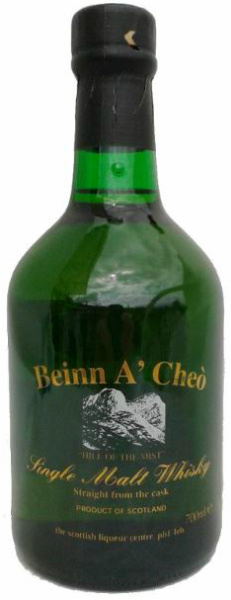
Glenallachie 11yo 1995/2007 (59.4%, The Scottish Liqueur Centre, Beinn a’Cheò, Bourbon Hogshead #33, 273 bottles)

And here is already the third Glenallachie of 2015. Earlier contenders for the Glenallachie award were a 2007 distillate of Dewar Rattray (83 Points), and not so long ago an 1995 offering from Kintra (82 Points), so both scoring low 80’s, which makes them nice, but not great in my book. This time around we’ll have a look at a Glenallachie bottled by The Scottish Liqueur Centre. Yes I know, they are not the most widely known independent bottlers around. The Scottish Liqueur Centre is owned by Morrison & Mackay. Still no bells ringing? What about one of their other brands: Carn Mor, surely you have heard about that! More recent bottlings of Beinn a’Cheo (mountain of mist) no longer have The Scottish Liqueur Centre on their labels, making Beinn a’Cheo a true brand of Morrison & Mackay, just like Carn Mor is.

Glenallachie 11yo 1995/2007 (59.4%, The Scottish Liqueur Centre, Beinn A'Cheò, Cask #33)Color: White wine.

Nose: Spicy and fruity and lots of other traits you know from typical Refill Bourbon casked high strength Whiskies. Remember all those Cadenhead bottlings? Fresh and slightly soapy. Old lavender soap, which only adds to the nose, not disturbing it. Whiffs of rural organics. And nice warm barley. Typical oak. Hints of vanilla from the American oak. When all that is out-of-the-way and the Whisky settles down in my glass, some nice fruits emerge along with a nice fatty creaminess. I won’t say it’s simple, but it is typical, well and it’s not really complex either. Not bad though. The oak really gets out when you warm it up in your hand. Wait a minute, warming it in your hand and giving it some time to breathe it really opens up. Finds balance. Nice fruit agian, but the sweeter fruits are now accompanied by citrus fruits. Sometimes this nose reminds me of Angostura 1919, a Rum.

Taste: Sweet. with almonds and fruit. Quite a surprise after the “typical” nose. This goes to show, that nosing isn’t everything. It’s sweeter than usual, but never crosses the line. However it’s sweet enough never to make it your daily drinker, the ABV is too high for that anyway. The wood is here too. Bit mocha and oak, milk chocolate. The wood forming a spine for the big sweet fruity body of the Whisky. Lovely stuff. I also like the almond that returns for the finish, although the oak plays a bigger part, turning herbal with air. After the heat passes your throat. The finish is nothing more than the fruity sweetness, some paper and overall “shortness”. The finish is definitely the weak part of this Glenallachie. Not a lot remains.

There is a lesson to be learned here. This is no spectacular Whisky when freshly opened. It’s closed and seems very simple. This is maybe thé example to let a Whisky breath to unlock its full potential. If you do, this ugly duckling turns out to be quite special after all.

Points: 86

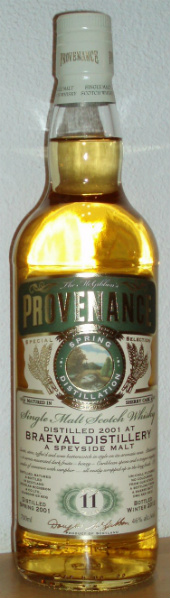
Braeval 11yo 2001/2012 (46%, Douglas McGibbon, Provenance, Spring/Winter, Sherry Cask, DMG 9312)

You don’t have to polish your glasses. So soon after the other Braeval and Braes of Glenlivet Whiskies I reviewed, yet another Braeval graces these pages. Yes, another independent bottling of Braeval. This should come as no surprise since the owners Pernod Ricard (Chivas Brothers) don’t do a lot with this brand either. More or less the same situation as Strathisla, which is owned by the same company. It seems to me all their energy flows into The Glenlivet and Aberlour and not a lot of faith exists in marketing Single Malts from these lesser known distilleries. Bacardi (John Dewar & Sons) which owns Aberfeldy, Craigellachie, Aultmore, Macduff, and Royal Brackla, have recently decided to market the Whiskies of all their distilleries with an age statement. Lets hope Pernod Ricard will follow suit.

Braeval 11yo 2001/2012 (46%, Douglas McGibbon, Provenance, Sherry Cask, DMG 9312)Color: White wine. Not too pale.

Nose: Sweet, Bourbony and malty. Sweetish and pretty clean. Vanilla and pleasant oak. Spicy and leafy. Whiffs of latex paint and even slightly perfumy. Sometimes even vanilla ice-cream and Cappuccino. Becoming grassy over time, combined with a breath of fresh air. Not very outspoken though. 46% ABV is a decent strength, and since all aroma’s aren’t that outspoken I guess this didn’t benefit from reduction. Still a very agreeable nose.

Taste: Spicy and slightly (new) woody. Sweetish and lots of vanilla. American oak Sherry cask? Good balance. Good strength, but I’m sure this would be better undiluted, maybe that way it was too hot or just to plain strong for some. After some time the new wood and leafy note stays and combines with a little bit of barley with vanilla, mocha and vanilla ice-cream. Fresh forest after a rain shower, including the wet forest floor and mushrooms. Nice, innocent and anonymous.

Unlike both other examples of this distillery I reviewed before, this one has been reduced to 46% ABV. This example is also from this very decade and a bit younger than both others, so what does that do for this distillery? Well hard to tell actually since this isn’t a very complex malt. As all other Braevals, this is pretty good, yet this example is a bit anonymous. Reduction places it into the path of maybe less experienced drinkers, who still are a bit cautious with cask strength Whisky.

Points: 82

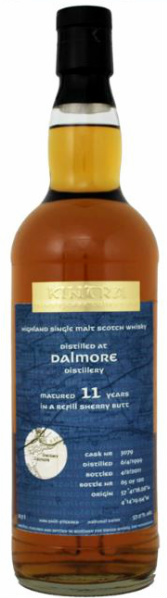
Dalmore 11yo 1999/2011 (57.2%, Kintra, Refill Sherry Butt #3079, 120 bottles)

Dalmore then. Not so long ago I reviewed the official Dalmore 12yo and rummaging through the ever-growing stock of samples, I found this almost 12yo Kintra bottling. If it was only given two extra months and two extra days, this too would have been 12 years old!

Dalmore was founded in 1839 by Alexander Matheson but the Sunderland’s start distilling there. Soon after the MacKenzie brothers, Charles, Andrew and Alexander start to run the distillery. When Alexander Matheson dies in 1886, his successor sells the distillery to the MacKenzie brothers (1891). In 1917 the Royal Navy takes over and use the facility to make mines! After three years the Navy moves out and in 1922 the distillery is again up and running. In 1960 The MacKenzie brothers merge with White & Mackay and in 1990 White & Mackay were bought by American brands. In 2001 White and Mackay were sold again and called Kyndal spirits but the White & Mackay name returns a year later. In 2007 it is sold yet again to the United Breweries Group, an Indian conglomerate.

Dalmore 11yo 1999/2011 (57.2%, Kintra, Refill Sherry Butt #3079, 120 bottles)

Color: Light ocher gold

Nose: Big. Vanilla ice-cream and light wood, with some light menthol cigarette as well. Powdery and dusty. Cherries and Licorice. Horseradish. The wood is very perfumy. Definitely floral and perfumed soap. Strong aroma from a high strength Whisky. Half sweet, salty toffee with funky Fino or Manzanilla Sherry notes, but not as much as in other Fino matured Whiskies, so this might not be one. Red fruit hard candy drops and it does have a salty edge. Animalesk (cow dung) and soft wood. So enough happening on the nose.

Taste: Nice burn and quite sweet actually. Spicy sugared oak with white pepper, but also a sour oak note which turns into ripe black fruits. Quite a lot of wood. Coconut and maybe some peach. The horseradish returns and here it is less sharp but more sweet. Ahhh how nice it is to have a cask strength Whisky again. A breath of fresh air. Vanilla ice-cream returns for the finish. Otherwise the black fruits stay on so the funky sourness is there to stay too. Nice example to analyze like this. But the a word say it all. It is a Whisky you have to work with. If taken casually you won’t fully appreciate it, and maybe even won’t like. This needs your full attention and time.

Quite a nice development. It starts out pretty sweet, after which the wood shows itself. After that, the body collapses a bit to reform behind the lines to come back with a nice finish. Although not without its faults, the whole is quite nice and absolutely an experience. Nice how easy the development can be followed. The more it breathes the better it gets. Very nice pick Erik!

Points: 85

Clynelish 11yo 1994/2005 (58.9%, The Single Malts of Scotland, Sherry Butt #4011, 367 bottles)

Clynelish is a very popular dram. There are several reasons why. First of all it’s a sister of Brora, which maybe the best malt of all. Second. Clynelish has a unique waxy personality and it’s spirit is always of high quality. It’s very hard to find one that is not up to par.

Color: Full Gold, almost Orange.

Nose: Clean. Paper and wood. Spice and white pepper. Oranges with almonds and toffee. Leafy, waxy and coastal fresh with some added sherry mustiness. Later on some vanilla ice cream, cardboard and dust. It stays spicy throughout. Perfumy and a beautiful balance.

Taste: Spicy and definitively from a sherry cask. Wood, beer and spice again. Sweet and tarry. Shortbread and gingerlike. Turkish delight and has some traits of a Riesling wine. Full bodied. Slight sour wood and licorice on the finish.

I think it’s a bit of a shame this got bottled so soon. It’s good now, but what would this have been when it wood be several years older. Nothing here suggests its over the top or even near the full potential it could have reached. Nice Clynelish, always worth checking out.

Points: 86