The day before yesterday I reviewed the first Braeval on Masterquill.com, the domain I was finally able to acquire. Today we’ll have another first, this time the first Braes of Glenlivet. Well not really since both are one and the same distillery.
Braes of Glenlivet was founded just in 1973, so it’s not thát old. At that time Seagram’s was a company with only two distilleries: Strathisla (I love Sherried Strathisla’s from the 60’s and 70’s) and Glen Keith (equally so). Both distilleries are next to one another by the way. Chivas needed more capacity, due to huge demand of the Chivas Regal 12yo blend in the States and was looking for a distillery to take over. When that didn’t work, plans were made to “build” five distilleries in the same amount of time. Braes of Glenlivet was the first in 1973 and Allt-a-Bhainne the second a year later. The next three distilleries were brought into the portfolio by acquisition in 1978: Glenlivet, Longmorn and Glen Grant (now owned by Campari since 2006). Other noteworthy facts are that the name of Braes of Glenlivet changed to Braeval in 1994 (to allow Glenlivet to be The Glenlivet, as in “there can be only one”). Breaval was mothballed between 2002 and 2008 and is the highest situated distillery in Scotland. 1665 feet.
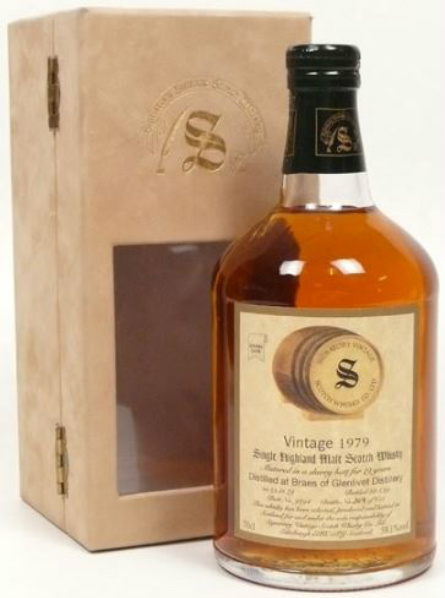 Color: Copper Gold.
Nose: Musty and a high quality Sherry note. Not a big heavily Sherried nose (hence the color). But dry and meaty. Slightly smoky (char) and vegetal (fern). Nicely oaky but also pencil shavings, which usually isn’t oak but cedar. Perfumy. This needs some air to balance itself out. Again the wood is playing a big role in this Braes/Braeval, just like the one I reviewed before. The vegetal part is developing into what I can only guess is a Japanese tea kind of note. Not floral, so it’s not the perfumy part of the nose, but very deep, profound, but also elegant and light. Having said that, next up is a hint of Velpon or Uhu (clear glue). Great herbal and earthy complexity (surely not only from the wood?), with a tiny hint of new make spirit. This is a very nice one to take deep breaths of. Stuff for connoisseurs I guess, so maybe not everybody’s cup of tea.
Taste: Strong, sweet and dry at the same time. Very nice. Lot’s of Beer and Hops, and not really Sherried for me. The hops doesn’t make this all that bitter. Quite some masked sweetness and again quite woody too. The bitterness is really a hoppy one. Interesting. Just like it’s younger brother, it’s coming undone a bit in the finish. The alcohol is really prominent, so most definitely a force to deal with. Finish with tea and wood, a hint of soap and rather drying. Beer and soap who would have guessed? The complexity of the nose isn’t really here in the taste. And I really miss the high quality Sherry I smelled initially. Beer and Sherry who would have guessed?
What really caught me by surprise were the similarities between the 1991 Braeval bottled by The Whisky Mercenary and this particular expression from 1979. Especially on the nose. One was distilled in 1991 and this one in 1979. Both have a similar full on smell and a woody part that plays a big role in the bigger picture. This Signatory has a more pronounced Sherry derived full and sweetish body, whereas the 1991 was more fruity.
Points: 85
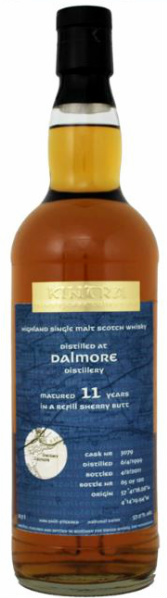
 Jürgen’s version was quite strong and with a cask picked by John McDougall I again have some high hopes for this Dailuaine. Let’s see if this light Dailuaine packs some punch, and does it also have some cannabis I picked up in several other Dailuaines?
 Color: Much paler than the 2002 Colheita. Pale red and less viscous than the 2002 reviewed earlier.
 Kintra is no stranger to these pages but up untill now, all Kintra products were Single Malt Whiskies, but this time Erik Molenaar surprises us with a Rum, and not just any Rum, but one form Caroni, a Rum distillery sadly closed for over a decade.
 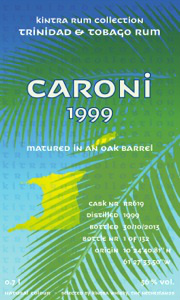 Taste: Again a lot of oak, but as with the nose, this Rum can cope with the wood. The whole is quite dry and very aromatic, but very balanced. yet less complex on the palate. It does resemble Rye Whiskey a lot on the palate. Just cancel out the burnt sugar note and some other slight markers that are typical of Rum… The oakiness is well masked, but it really shows itself on the slightly bitter, waxy and drying finish.
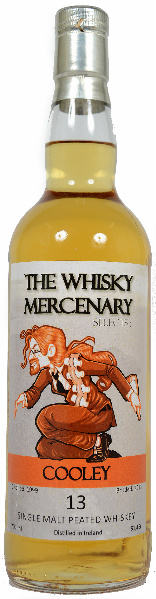
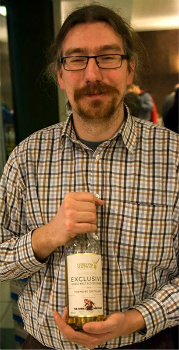 Cooley! How cool is that! As the label states, this is peated Cooley so probably spirit that was made to become a Connemara. But what is Cooley?
 After selling Cooley to Beam Inc. Teeling bought Diageo’s recently closed Great Northern Brewery in Dundalk with a group of investors and is converting it into a distillery. Great Northern made Harp Lager, Smithwicks, and Carlsberg (for the Irish market) and Diageo moved the production of these beers to their Guinness St. James Gate brewery in Dublin. Production of Teeling Whiskey should commence after the summer of this year. Today Teeling Whiskey is already on the market, obviously sourced from another distillery.
 And here is Ardbeg. Last of the Islay whiskies to feature on Master Quill. The first Ardbeg is also the last one being released. Ardbeg Galileo. A Whisky that in part was matured in Marsala Casks.
 Galileo Galilei was born on February 15th, 1564 and departed from this earth on the 8th of January, 1642. Galileo was an Italian physicist, mathematician, astronomer, and philosopher who played a major role in the Scientific Revolution [
 I hate to say it, but aren’t “Ardbeg” putting more money into marketing than in the actual Whisky? Don’t get me wrong, I love Ardbeg, just look at my
  And here is another whisky from my lectern. This time an old (bottled in 1999) Craigellachie from Scott’s Selection. The people who brought us the fabulous Longmorns from 1971. Therefore I always have a soft spot for these guys. This Craigellachie was opened on our
  Color: White wine.
 Let’s see if this rings a bell. Are you one of those people who own some whisky books? Do you have one of those coffee table books that cover everything? Isn’t it true that almost every time you pick up the book, you skip the first part that’s about the whisky history? Usually dry and boring stuff about which you already know everything that’s written down there and in every book like this, the same things are mentioned. You know of Uisge Beatha, you know who friar John Cor was and you know everything about the collapse of Pattison Elder & Company (in 1899). If I asked you: “how many bolls of malt…?” Wouldn’t you know the answer?
 Well that’s all ancient history and well covered in almost every whisky book. But where is the modern whisky history? Where is the picking of the brains of people who made the whisky that’s in the oldest bottle you have at home? Here Gavin comes in. He talked with those people, he asked them interesting questions and writes down the answers which are even more interesting. Gavin is also the man who gathered the pictures of those times, and was brave enough to issue them in a reasonably priced book.
 I’ll come back later to review the book about the whisky memoires, where the really interesting history is (Wort, Worms and Washbacks, 1999), but first the book with the pictorial history. In fact both books work well together. Just read the one and keep the second one at hand, to get a feel for what you’re reading.
 I really like this book and I would have Gavin sign my books if I had the opportunity. I’m a fan of Gavin’s because he’s great, easy to read, has humor and is able to write a different kind of whisky book. Recommended!
 Color: Light Gold
 Master Quill