 First of all, the picture below is a picture of a similar bottle that was bottled at Cask Strength for Switzerland a year later. The picture is for cask #4726. Glenfarclas is great, it’s family run and most of the make is going into Single Malts, so no room for error, everything must be good. Second, it’s at its best as a Sherried Whisky and even in these times the Grants are able to make a very good Sherried Whisky. The self-proclaimed kings of the Sherried Whisky, namely The Macallan, gave up on this practice. For reasons only the marketing department will know. Good luck to them, Glenfarclas may very well be Speyside’s finest!
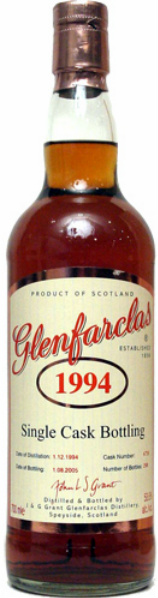 Color: Lively orange brown (like a Bourbon)
Nose: Nice creamy Sherry with quite some wood, of which more than half smells like new oak. Cappuccino or Tiramisu. Meaty like gravy. The longer you nose it the dryer it gets. Spicy, lavas and white pepper. Cardboard and ice cream. The wood is pretty raw as opposed to elegant. It’s new untreated wood (maybe some toast). Still I wouldn’t call this overly oaked. A sort of rural Sherried Whisky.
Taste: Initially it’s syrupy sweet that coats your mouth. When that coating is removed from your mouth by the alcohol, just as in the nose, a lot of wood emerges. Dried leaves. Apart from the wood, there is diluted licorice, with added bitterness. For the bold body this has , you could even say that the finish is rather mild. Also the wood makes the finish a bit sour and not of perfect balance. Nice coffee in here too. It does dry your mouth quite a bit, o there definitively is some wood influence. No sulphur.
Actually this is quite good. It’s not complex, but it does have character. It’s a nice young Sherried Whisky. It’s a bit on the edge considering the wood that’s in it, but I still do like it. It’s not over the top.
The best way is to drink it quickly after you pour it, since the mouth coating sweetness hides the wood a bit and makes it less dry and bitter, it gets when you take your time with it. When you are a quick sipper, than the score is even higher than mentioned below 🙂
Points: 86
 I used to drink a lot of reds and for the last six years or so I love to drink a lot of whites. Alsace was probably what set that off. But as you might have guessed, being the frequent reader you are, I drink foremost Scottish Single Malts nowadays. But it’s not all Scotch that lights our world, so I’ll definitely have to try some different things here too. This time the first red wine on Master Quill.
 Haut-Médoc is the large southern part of the Médoc district of Bordeaux in the south-west of France. The famous wines from this region are Margaux, Pauillac, Saint-Estephe and Saint-Julien. You might have heard of those.
 Wow, how quickly a week passes by. Already the last day of the Japanese Whisky Week. The last entry will be another Vintage Malt Yamazaki. This time a 1985. Will this be the best? But before I start reviewing this one, first a little comment.
 Color: Dark mahogany
 Color: Gold
 New Lochnagar was founded in 1845. New Lochnagar? Yes. First Lochnagar was built in 1823, and burnt down by “the competition” just three years later. The distillery was rebuilt, only to burn down again in 1841. So the distillery was rebuilt again in 1845 as New Lochnagar. Lochnagar became Royal in 1848 (it lies very close to Balmoral Castle). No more fires burning down the house, but still a lot of construction going on. In 1906 the distillery was rebuilt yet again and in 1963 completely renewed.
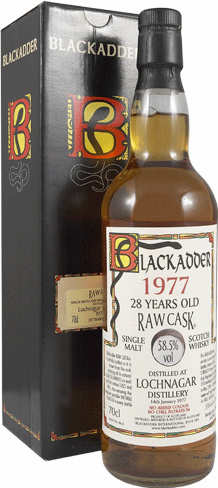 Here we will try an independent Lochnagar, again a Blackadder Raw Cask with cask sediment in the bottle. This time no powdered char, but only small chunks of charred wood.
 Again rummaging through my box with trophies collected on my travels, I found another Port Ellen. I like Port Ellen, so please forgive me, for yet another review. Port Ellen is the closed distillery from the immensely popular island of Islay, known for its peated whiskies. Always around in abundance, prices were ‘moderate’ for a closed distillery from Islay. Today stocks are depleting, and prices tend to rise sky-high, and it won’t be long untill there’s nothing left. Even if casks still lie around, Port Ellen isn’t getting better by ageing even longer. Maybe casks will be transferred into stainless steel holding tanks to stop ageing and fetching a lot of money when bottled is a few years’ time. Who knows. Since 2001 Diageo releases Port Ellen annually in their special release series. The first release fetching at least a 1000 Euro’s at auctions…
 Port Ellen was founded in 1825, and was sadly closed like many others in 1983. Although the distillery is dismantled, the site is still there. Today it’s home to Port Ellen Maltings. Where barley is malted and all the other distilleries of the island are customers…
 Cardhu is a very special distillery in the portfolio of Diageo, since it is their biggest selling malt (Spain and France mainly), but when talking to other enthusiasts the response isn’t all that…well enthousiastic. There is only talk of old bottles of Cardhu. Since 2006 a special cask reserve is issued, which isn’t welcomed with open arms, but since it sells so well, it must be the ultimate entry-level whisky. Personally I don’t like it.
 Founded in 1811 by the illicit distiller John Cumming, who became legal in 1824. In 1884 the old distillery is replaced. Purchased by John Walker & Sons in 1893. Then in 2002 a small revolution took place. Cardhu, the whisky was silently changed into a vatted malt. (Several single malts blended together). The bottle and the label stayed the same, just the word ‘single’ changed into ‘pure’. Well this didn’t last long, in 2004 the ‘pure malt’ was withdrawn. Luckily in 2005 this 22yo was issued.
 The Old Train Line series is probably the series with the most beautiful labels I know. The series is bottled by German bottler Jack Wieber based in Berlin.
 Clynelish is a very popular dram. There are several reasons why. First of all it’s a sister of Brora, which maybe the best malt of all. Second. Clynelish has a unique waxy personality and it’s spirit is always of high quality. It’s very hard to find one that is not up to par.
 Taste: Spicy and definitively from a sherry cask. Wood, beer and spice again. Sweet and tarry. Shortbread and gingerlike. Turkish delight and has some traits of a Riesling wine. Full bodied. Slight sour wood and licorice on the finish.
 Convalmore is one of those distilleries that is no more. Thinking of closed distilleries I alway think about Monty Pythons dead parrot sketch: It’s not pinin’! It’s passed on! This distillery is no more! It has ceased to be! It’s expired and gone to meet ‘its maker! It’s a stiff! Bereft of life, it rests in peace! If you hadn’t nailed it to the perch it’d be pushing up the daisies! ‘Its chemical processes are now ‘istory! It’s off the twig! It’s kicked the bucket, it’s shuffled off its mortal coil, run down the curtain and joined the bleedin’ choir invisibile!!
  Convalmore was founded in 1893. A large part of the distillery was destroyed in a fire in 1909. It was rebuilt with an added continuous still to make whisky at a lower cost. This didn’t work so the stills were discontinued in 1916. In 1962 the stills were heated indirectly with steam. Convalmore was mothballed in 1985 and the buildings were sold to William Grant & Sons in 1990, who use them for storing their own malts.
 The beer returns, with the wood, in the finish. Well its safe to say that this one is all about the wood. you don’t hear me say that it’s too much of overpowering. No. it is a woody whisky, but it is one of those that really should be woody. Wood is its strength. The rest of the body is firm enough to counterpart the wood. Again very interesting, but no easy dram. I hate the word, but this may be for connoisseurs only.
 Master Quill