Time to take a small trip and have a look around some European distilleries producing Single Malt Whisky. We’ll start our mini trip in Austria to have a look at Hans Reisetbauers flagship Whisky, the 12yo. Earlier I already reviewed the 1998 Reisetbauer 7yo. Hans matures his Whisky in casks that once held Chardonnay and Trockenbeerenauslese, one, a dry and the second a sweet White Wine. Hans doesn’t import barley, but grows four hectares of summer brewing barley himself.
“The barley was crushed and malted at 65° C before being cooled and fermented in stainless-steel tanks for around 70 hours. The fermented mash is then twice distilled in copper pot stills. At this pointed the distillate, which has an alcohol content of around 70 per cent, is aged until fully mature in four casks that the top Austrian wine makers Alois Kracher and Heinz Velich previously used for aging Chardonnay and Trockenbeerenauslese.”
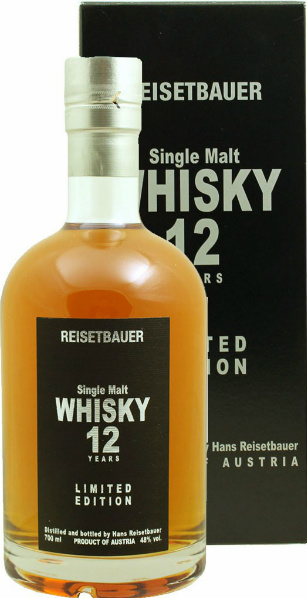 Color: Slightly copper gold.
Nose: Plastics and fruit. Orchard fruits. Hints of pear, apples. Ear wax. Extremely duty underneath and for a while the plastics dominate the nose. Some of the plastics are slightly burnt. The plastic note is very close to the waxy aroma, which probably comes from the wine casks used. Given some time to breathe, aroma’s of Grappa emerge. If I would venture a guess (and I can be completely wrong here), I would say the grappa note comes from the Chardonnay casks, and the waxy/plastics come from Trockenbeerenauslese (a sweet White Wine). Next up the woody notes, which are quite soft and slightly spicy. Mocha and Latte. The plastics give way, but the Grappa remains. Very interesting distillate. Nosed blind I wouldn’t have guessed this is a Whisky.
Taste: Plastics again and lots of wax. Polyester!That’s it! Have you ever repaired a polyester boat? WYSIWYG (What You Smell Is What You Get). The Polyester is there immediately, but luckily dissipates quite quickly, to give way to wax wood and a winey note. Coffee in the aftertaste. “Do-a-burp™” after drinking this and it’s all plastics again.
Just reading my note about the nose alone, its pretty obvious this is not a Scottish Malt, and reading it all it hardly seems to be a Whisky at all! In case of the 7yo Reisetbauer I reviewed earlier, I found that it already was dominated by the cask used. The 12yo we have at hand is so dominated by the casks, that it is difficult, if not impossible to detect that this is a Whisky at all! This is a Wine (and polyester) finished Single Malt Grappa. If you want a Whisky, you’re better off with the 7yo. Nevertheless, this distillate has a lot of good sides to it too, so maybe it is unfair to hammer it with its off-notes.
Points: 73
 And now for something completely different! An Austrian vintage Whisky made by Hans Reisetbauer. This Whisky was distilled in 1998 and matured for 7 years in Chardonnay casks but also in casks that once held Trockenbeerenauselese, a (very) sweet and syrupy white wine. Casks come only from Austrian wine makers Alois Kracher and Heinz Velich. When looking for information, Hans seems to win a lot of prestigious prizes for his Eaux-de-vie or brandy’s made with fruits, and is regularly awarded as the best distiller in Austria. Hans decided to have a go at making
  Color: Gold
 Grüner Veltliner is a white wine grape variety that stems from Savagnin and further down the line, Rotgopfler and Pinot Noir. Despite of the name Veltliner, the grape isn’t related to Roter Veltliner and Frühroter Veltliner. Most Grüner Veltliners are planted in Austria and to a lesser extent, Slovakia and the Czech republic, but more recently also in the United States and Australia. One-third of all the grapes planted in Austria is Grüner Veltliner. In Slovakia one-fifth and in the Czech republic “only” one-ninth of the planted grape varieties is Grüner Veltliner. Most Grüner Veltliners age well and accompany food excellently.
 Especially in the Wachau wine region on of the following terms can be found:
 Color: Straw
 Here in Holland the Asparagus season has started and nothing goes better with that, than a nice fresh white wine. This Berger Riesling was ogling at me for quite some time, since all Austrian wines have the Austrian flag on top, it is easily recognizable.
 This Riesling (12.5% ABV), is wine from
  They are on a stony soil dating from prehistoric times. From these parts you can have a dry, minerally Riesling or Grüner Veltliner. Second on the south of the Krems Valley on the south bank of the Danube, small vintners in ancient villages make local wines in their own old-fashioned way. Third, to the east of Krems, towards Rohrendorf and Gedersdorf, there is löss in the vineyards which is noticeable in the wine, its softer and more lavish in style. The best wines from this region are called reserves.
 Color: White wine.
 Master Quill