Grimbergen Optimo Bruno (10%, 33 cl)

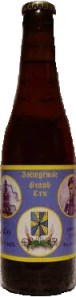
Erkend Belgisch Abdijbier logoGrimbergen is somewhat of a (commercial) giant amongst Belgian Abbey Beers. Only Leffe sells more beer. It already was big when Scottish & Newcastle were the owners but when that company was bought by Dutch Beer Giants Heineken, well… Next question, is Grimbergen any good? At this point I don’t know, but I picked this Optimo Bruno to find out. Optimo Bruno saw the light of day in 1988 as a beer specially made for easter. Grimbergen Beers are made by Alken-Maes from Waarloos, not to far from the abbey. The top fermented Beers are made L’Union in Jumet. (Top fermenting means that the yeast lies on top of the wort). Last but not least, the beer did not receive post fermentation in the bottle, so even extended ageing (2 years past its best before date) kept this beer “clean” and there is no deposit.

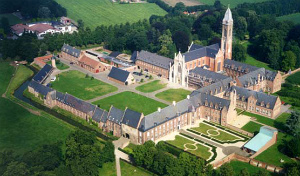
The order of the Premonstratensians (White Canons) was founded in 1120 by Saint Norbert. Saint Norbert also founded the Abbey of Grimbergen, and in that way the abbey is quite unique. In its history, the abbey was ruined four times! But every time the abbey was rebuilt, therefore the label of the beer has a Fenix on it and the credo: ‘Ardet Nec Consumitur’ (Burnt but not consumed).

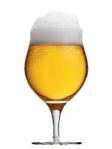
Grimbergen Optimo BrunoColor: Brown, a little bit of cream-colored foam.

Nose: Fresh and acidic. Candied sugar. Yeasty and absolutely murky! Not the nicest smelling beer around. Funky stuff, but not off-putting.

Taste: Deep and brooding. Again yeasty and some acidity. Nice warming taste. Hints of toast and burned sugar in the aftertaste. Dried plums and dates. When Belgian beer is called Belgium’s answer to wine, they probably had this in mind, or should I say, in their mouth. Very distinct beer. Quite bitter finish and especially in the aftertaste. A bitterness like this just fits the speciality this beer is. Unique stuff. Nice balance between the toasted Sugar and the acidity.

Again a well aged beer, so I can’t tell you how a fresh one tastes yet. Definitely not your every day drinker and maybe not for everyone, but when you choose the moment perfectly, you’ll know this is special. Best tasted in big gulps (again).

Points: 84
Mc Chouffe (8%, 33 cl)

Brasserie D'AchouffeIn the early eighties Pierre Gobron and Chris Bauweraerts (Brothers in law, and thus Brothers in Beer) started brewing beers as a hobby, and founded Brasserie D’Achouffe near Houffalize in 1982. Houffalize is in the Ardennes, where lots of stories are about elves (They call the leprechaun an elf).
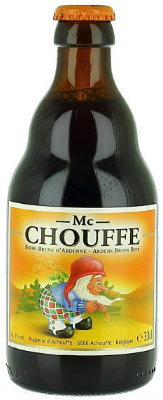
By now, I have to admit here to a fault in my character. It’s never to late to learn, and boy did I learn here! It’s this leprechaun and the immense availability of both beers made by Brasserie D’Achouffe that made me believe this was not much of a beer. Boy I was wrong! I haven’t tried the main beer by Achouffe yet, namely La Chouffe. But I did buy once a little bottle of its dark sister Mc Chouffe also called: ‘Scotch of the Ardennes’ by the brewery, and me being very fond of my Scottish Whiskies, who am I not to try this Belgian ‘Scotch’. By the way, I Aged the example of Mc Chouffe for 16 months past its best before date, and that is a bit longer than the makers recommend. They like to see their beers aged for 3 to 12 months.

Color: Brown. Not a lot of foam, but a lot of CO2
Nose: Fresh, citrussy, but also pretty murky, like a dirty sidewalk washed clean with the first rain after a long hot summer. Yeasty and sweaty with warming alcohol.

Taste: Wow, not as deep as the color suggests, but certainly what the doctor ordered! Quite full-bodied and very tasty. The carbonation ‘effect’ makes this half-heavy beer refreshing. Candied Sugar wine. Not bad, not bad at all.

I don’t know about the ‘Scotch’, but it reminds me more of an Belgian ‘Wine’. Take care not to pour the depot into your chalice. It’s better to consume that by itself. With this extended ageing I like to do, the depot left flakes floating in the beer, and that didn’t look very nice…(but tasted great).

Points: 84 (provisional, I might have aged my bottle for too long, as mentioned by the brewers, so I’ll try Mc Chouffe again in the near future, and will try it younger).

Tongerlo Prior Tripel (9%, 33 cl)

The Tongerlo beers are brewed by brewery Haacht, and they are doing so since 1990 (when they got the rights to this Abbey beer). I’m sad to report that a few years ago, brewery Haacht, in all its infinite wisdom, have decided to delete Tongerlo Tripel. That’s a sad thing since I really liked that one. To make up for it, they replaced it with another Tripel. It’s called Tongerlo Prior Tripel and the golden-yellow label is replaced by a brooding black one. Tongerlo Prior Tripel is made with Saaz hops and, compared with the old Tripel ,a new kind of yeast. They also upped the ABV from 8% to 9%. This beer is fermented (additionally in the bottle) and the brewery advises to pour the yeast depot in your glass for a bigger and bolder flavor, but it’s also possible to leave the depot in the bottle with a small amount of beer to be consumed separately. Advised drinking temperature is 7º C.
Even this new Tripel got the chance to age for 2,5 years after it’s best before date. You may think I’m mad, but with most Belgian beers it only adds to the character, don’t worry you, won’t get sick. Breweries are obliged to put a short-term on the label, but are starting to add the bottling date. Frank Boon decided to stretch the best before date far beyond the standard three years and easily puts best before dates twenty years into the future!

Tongerlo Prior TripelColor: Orange yellow with some flakes (due to ageing). Almost white foam.

Nose: Fresh and half-yeasty. Citrus acidity. Warm lemon curd. Linen and again some yeast. Pretty straightforward.

Taste: Estery and half bitter. Orange peel. The whole is quite warming. The whole taste seems a bit toned down, but when taken in a big gulp, it becomes quite chewy and gains a lot of character. An explosion of flavor so to speak. Nice, and not overly acidic. Lemon and oranges. Very fresh at first, but that fades into a heavy, syrupy sweetness. I would call this a winter warmer. Excellent stuff by the way.

I love tripels and this one (again) fits the bill. Compared to Westmalle Tripel this has less of the orange skins and definitely is less bitter. Candied sugar sweetness. I really don’t get the point why the Original tripel was replaced with this one. Although this one is also very nice, the original tripel was (very) different and could have easily kept its place under the stars. The original Tripel was quite fresh and appealing, this Prior is more warming en deeper. It’s like night and day, like summer and winter. They got the labels right too, summery yellow and deep as night black…

Points: 85

Rodenbach Grand Cru (6%, 33 cl)

More than a year ago I reviewed the “Original” Rodenbach and concluded I wouldn’t buy that one anymore since this Rodenbach Grand Cru is so much better. Obviously I had it before. Time to write a review about the “better” Rodenbach. And as I have said before, I like to age almost all of my Belgian beers, and this one is no exception (this time). This particular bottle was aged for another year and a half (past it’s best before date). Before my additional ageing, the beer was aged at the brewery for two years (in oak) and then mixed with young beer. 2/3 old beer with 1/3 young beer.

At this point I must give off a little warning. I was in a beer shop recently and overheard some clients talking about pouring the big bottle of Rodenbach Vintage down the toilet. The big bottle should even be better than this Grand Cru, but this is a Flemish Red Brown beer, it’s acidic, so probably not for everyone…
Color: Dark red with brown foam

Nose: Fresh, with a small hint of stale beer, acidic. Sour cherries. Deep brooding yeast (not a lot of it though). Spices. With time some raisins and plum, which adds another layer of depth to the beer. Beef jerky? wow!

Taste: Yeah! Acidic, but with extreme depth. Too much to comprehend all at once. This is so much better than the original Rodenbach! Cherries in alcohol (the alcohol taste is enhanced by the extra ageing). Black cherries, and even some other red fruits from the family of berries. Definitely a favorite of mine. Extremely refreshing. One bottle is not enough. Long finish, with a lemony finish.

This beer takes ageing very well, but also warnings are given off no to age for too long. I just don’t know how long too long is. Ageing add’s  a lot of complexity. Can’t wait to try a vintage Rodenbach! I’m pretty sure I won’t be pouring that one down the toilet!

Points: 88

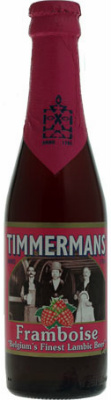
Timmermans Framboise (4%, 25 cl)

The sun is out, and it finally starts to look like summer. Just the right day to pull out all of my beers from storage and have a look what is still around. Time to pick a nice refreshment for our short-lived summer. Between all those Catholic Beers I have, protruded this pink bottle. This is a Timmermans Framboise or Raspberry flavored beer. Had they used real raspberries, the beer would have been priceless, so Raspberry juice was used in stead. Also Sugar and artificial sweetener was added.

Timmermans FramboiseTimmermans is part of Anthony Martin. Those of you that read my beer reviews know that I like to age my beers, but beers like this (fruit), hardly gain anything from ageing. That doesn’t mean you can’t but why should you. The beer I used for this review was hardly aged.

Color: Red and murky, not a lot of (almost white) foam.

Nose: Heated raspberry compote. Very, very fruity and sweet-smelling. It almost overpowers the Lambic beer, but if you try hard it’s there. Probably too much fruit syrup is used.

Taste: Again a whole lot of sweet raspberry. Sweet it is! Fruit syrup but with a nice acidic touch, I guess comes from the Lambic. After the initial sweetness the beer is still quite refreshing. I love Lambic beers, but still this is quite a simple beer, to enjoy with an empty mind, not caring ’bout notin’.

To sum up, Raspberry syrup (too much used), added Sugar and artificial sweetener (why so much), simple yet enjoyable.

Points: 77

Tongerlo Tripel (8%, 33 cl)

The last reviewed beer, Westmalle, was a Trappist beer. This Tongerlo is an example of an ‘Abdijbier’ or Abbey beer. Thus linked to a monastery, yet commercially brewed by Haacht. So no Authentic Trappist Product then, but still a beer in the same style. But hey, this beer has an official hallmark too. It’s a “recognized Belgian abbey beer”.

It turns out this hallmark is issued by the union of Belgian brewers and it seems there are some rules. The hallmark was issued for the first time in 1999 and the rules are slightly different for Abbey beers from before that time, and those that applied afterwards. Some rules are pretty obvious. There are more rules but here are a few: There has to be a link with an Abbey. Part of the proceeds must go to this Abbey and the beer has to be brewed there before (history taken in to account). In this case we are talking about the “Norbertijnen abdij” from 1133! Well my kind of marketing I guess.

Before we move on I (again) have to say that my beer is aged a little and has a best before date of 27/5/10. But this bottle can lie in your cellar much longer.

Color: Clowdy gold.

Nose: Fresh, lemons and oranges. Sour fresh. Not a lot of depot, only some hints of yeast. Still this has undergone a third fermentation stage inside the bottle.

Taste: Oranges and medium bitter. Despite the elevated bitterness also a very nice and fresh and sour note, that makes this extremely drinkable. Appetizingly fruity and it doesn’t even seem to be 8% ABV. Slightly sweet with hints of banana.

A very good beer. I like it a lot. Extremely drinkable Tripel with a very good balance. I would like to have another one please?

Points: 87

Westmalle Tripel (9.5%, 33 cl)

My good friend of “I think about beer” did a review of Westmalle Tripel recently, and I thought, I have that one too! Please check out his blog, it’s very well written, with a lot of passion for beer. It features tasting notes like mine but especially the in-depth stories are fantastic.

As with a lot of beers, I like to age them a little, and this beer’s no exception. I guess mine was aged for 4 years (best before date 30/07/10), but it is recommended to leave Westmalle alone for at least 5 to 10 years!

Westmalle is one of six Belgian breweries that are ‘protected’ by the Authentic Trappist Product logo. Achel, Orval, Chimay, Rochefort and Westvleteren are the others. The logo was presented to discern the trappist beers from the more and more widely available ‘abdij beers’ of Belgium and other countries. (Abdij = Monastery). Most of those beers aren’t even brewed near a monastery, but commercially brewed under a licence. Still, it’s the same style of beers. Usually with a blond beer at normal strength, a dark “Dubbel” and a heavy blond “Tripel”. occasionally a very heavy “Quadrupel” exists.

It is not only beer that falls under this logo, and not only Belgian beer to boot. Here is a list of all products that fall under this logo.
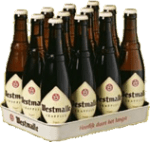
  • Trappist Beer from Achel in Belgium
  • Trappist Beer and Trappist Cheese from Orval in Belgium
  • Trappist Beer and Trappist Cheese from Scourmont-Lez-Chimay in Belgium
  • Trappist Beer from Rochefort in Belgium
  • Trappist Beer and Trappist Cheese from Westmalle in Belgium
  • Trappist Beer from Westvleteren in Belgium
  • Trappist Beer, bread, biscuits and chocolates from Koningshoeven in Tilburg, the Netherlands
  • Trappist Liqueurs from Echt-Tegelen in the Netherlands
  • Trappist Liqueurs from Stift Engelszell in Austria
  • Trappist Cheese from Mont des Cats in France

Info is from The International Trappist Association site, have a look here for more information.

Westmalle comes in 33 cl and 75 cl bottles. There is a selection made and the best output is bottled in the big bottles. Being already the best of the best it is further ‘bettered’ in the big bottle due to a better beer to air ratio. Thicker glass so less influence of light and foremost, more contact between the beer and the yeast that’s in the bottle. The third fermentation stage takes place inside the bottle. Add to this the ageing potential and you could end up with a fabulous beer! Now back to our little, slightly aged bottle.

Color: Murky Gold. Almost no yeast depot. Old fashioned yellow-orange. One centimetre of white foam. I tasted this beer in its original chalice.

Nose: Fresh, citrus, both lemon and orange peel and yeast.

Taste: Alcohol, quite bitter too. Refreshing. Creamy foam with half-sweet orange skin infusion. fantastic balance and a beautiful texture. Warming.

Nothing for the novice. The bitterness is quite a bit of the character. Beware because ageing makes this beer less fruity and more deep and bitter. The label, the bottle, the iconic WA-logo, the smell of it all. It breathes a time long forgotten, pré WW I. You consider yourself back in the thirties. A high score, but not necessarily your easy, every day choice. This is a classic.

Points: 88

Bunnahabhain 9yo 2001/2010 (46%, Daily Dram, for Bresser & Timmer and The Nectar Belgium)

Bunnahabhain was founded in 1881 and the first spirit trickled from the stills two years later. The distillery was closed two times. The first time in 1930 (for seven years) and the second time in 1982 (for two years). In 2003 the distillery was bought by Burn Steward Distilleries, and they really started to market Bunnahabhain. First of all a series of new bottlings saw the light of day, and in 2010 they started to upgrade the core range with the 12yo and the 18yo. The ABV was raised to 46.3% ánd the new versions are unchillfiltered and no coloring is added. Way to go!

Bunnahabhain is known for being the least peated of the island, still like a lot of others, raising to the occasion by answering the call of the public for more ppm’s. Burn Steward therefore started to bottle a “Moine” expression, with more peat, mimicking pre sixties Bunnahabhain.

Color: Warm Orange, slightly hazy.

Nose: Rubber like bicycle tyres, but also a floral note. Very strange. Almost a strangely burnt Cognac? It smells like a grape distillate. Burnt sugar and toffee. Skins of hazelnuts. First whiffs were ehhhh, lets say, very atypical. I can only hope this will not be one of those harsh tasting rubbery fresh Sherry bombs. Luckily it does get a lot better when aired for a while. I would say, leave the cork off for a short while, a week or two maybe 🙂

Taste: Ash and toasted wood. Burnt sugar again, with its bitterness. This must be a somewhat mistreated or bad cask. And/or very poor Sherry. Sweet grains and caramel. Burnt sugar and rubber. Hint of soap. Thick and chewy. Simple and rather unbalanced. Dark chocolate with burnt bitterness. Quite woody in fact, something you could miss by the overwhelming Sherry influence. Was the cask really empty, when the Bunnahabhain spirit entered the cask?

Little if any distillery character. This could have been any spirit, from any distillery. No merits at all for Bunnahabhain, because this is a Sherry influenced grape thing. This is all fresh Sherry cask. And for me not even one of the nicest casks around. Is this nice? I don’t know. There shall be fans of this, but I’m not one of them. If you like Loch Dhu, then please give this a try.

Points: 76

Thanks go out to Nico for handing me this sample.

La Guillotine (8.5%, 330 ml)

La Guillotine, a heavy beer, is made by brouwerij Huyghe from Melle, Belgium. It was first issued in 1989 to commemorate the 200th anniversary of the French Revolution. Huyghe is better known for their Delirium Tremens beer. La Guillotine is a multigrain beer, and one of their more bitter offerings. La Guillotine won a gold award in London at the Brewing Industry International Awards in 2011. Almosts 800 beers were entered in the competition, so we can have high expectations for this beer. Again this is an aged bottle.
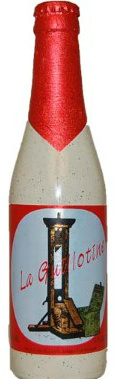
Color: Orange Gold with lots and lots of yeast.
Nose: Citrussy and perfumy. It smells rather clean and doesn’t have a lot of smell to it.

Taste: Again citrus. Orange and a bit of sourness that makes it a wee bit refreshing. Warming alcohol, in combination with the orange. There is a lot of light floating yeast in the depot, which makes it hard not to pour it into the glass. Luckily the yeast itself doesn’t have a lot of taste by itself, so it doesn’t overpower the palate. Overall rather fresh with some distant sweetness. The bitterness is confined to the finish only.

Well it’s not hard to imagine what happened over time. A new bottle is sweeter and has more bitterness. The sugar was fermented off, and even the bitterness isn’t all that present. Ageing gives this beer a more sour and refreshing edge and complexity. Since those beers are abundant, I guess it’s probably best not to age this beer for too long beyond it’s best before date.

Points: 80

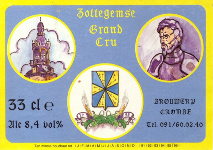
Zottegemse Grand Cru (8.4%, 33 cl)

Some time ago I reviewed Oud Zottegems Bier by Brouwerij Crombé and there I mentioned they also make a Zottegemse Grand Cru. On Oud Zottegems Bier there was the statement that it was a beer with an evolution in taste. This suggests a third fermentation in the bottle and for us ‘agers’ this also means that this could get better after some time (years) in the cellar. So time for me to have a look at this Grand Cru that was also aged and was best before 2009. So you’ll have to bear in mind that this bottle was aged for another three years.

Color: Murky gravy-brown.

Nose: Very yeasty. Candy-sugar. Just the sugary smell, not necessarily announcing sweetness. Murky, deep with some citrus shining through.

Taste: Deep, with roasted malt, but also fresh with orange peel. Great chewy body, which reminds me a bit of dark chocolate when added to chili con carne. Tasteful bread, with a slightly hoppy bitterness. This has great balance, with a slightly atypical sourness standing out. The sourness continues into the warming finish.

This is a great Belgian ‘wine’. This will be a perfect companion to the traditional Flemish stew. Great stuff. I guess the ageing made this a bit flat. Not much carbonation going on. But even after extended ageing, no off notes whatsoever.

Points: 83