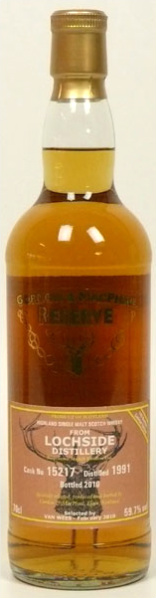
 Yet again we have one of the many 1991 Lochsides, and one of the many that were issued as a Gordon & MacPhail Reserve. This one was picked by Dutch retailer Van Wees. Gordon & MacPhail code for this one is JI/ACAC. The spirit was distilled on September 18th, 1991 and eventually bottled on October 15th, 2009. Picked by Van Wees in July 2009. Those of you that meticulously read this blog probably had a Deja Vu experience. We know this bottle, we know this lay-out. Well yes and no. February 4th 2013, I published a review of quite a similar Lochside, opened by Master Quill’s Apprentice (like this one). That was Cask #15217, here we have sister cask #15220, distilled and filled on the same day. This one was bottled some five months earlier, so here we have a chance to compare the two, to see what the effects are of another, but similar cask, and almost half a year of maturation…
 Color: Gold (ever so slightly fuller in color)
Nose: Clean and fruity. Distant wood. Clay and organic. Dusty with smoked ham. All in good balance, but nothing pops out. A very quiet Lochside. The esters I remember from the “other” Barrel, are here too. Vanilla from the wood. The yeast is way down in this one, and there is no peat, rubber or petrol. It’s easier on the nose (more balanced), more rounded out, but also less complex. When nosing this a long time, slightly more (sour) oak comes along, but still not a lot, and it gets fresher, but in a mint and menthol kind of way. Also cherry liquor bonbons. The chocolate from them are in this Whisky too.
Taste: Sweet and farmy, with a great sweetish attack. Definitely less woody, at first, than the other Barrel. A nice peppery bite, next to the sweetness and the fruity, farmy notes. Again a nice big body, aided by the ABV. Honey and a great balance. Here too a chocolate liqueur bon-bon. Big body with a matching long and balanced finish. The wood is a lot more contained within this Lochside. Less vanilla though, so the wood reacted differently, it gave slightly more color, but less wood and vanilla. If you let it breathe for some time, the wood does play a larger role, and overall this is less “deep”.
You can’t go wrong with these kinds of Lochsides. There are a lot of 1991 bottles around, but they all are slightly different. sure the family resemblance is there, but I’ve tasted more of the 1991 G&M Reserve, and they all are variations of a theme. I feel it’s safe to say that some four or five months of extra maturation has a smaller effect on the maturation of a whisky, than te particular staves that were used making the barrel. Maybe I’m wrong. I just can’t imagine that the differences between cask #15217 and #15220, come from the small difference in maturation time. Here the “younger” one is more balanced but also less complex. For me I prefer the nose of barrel #15220 over #15217. Considering the taste, this one is easier, and less complex, but it has a better balance. All in all it’s definitely the same family, but the easiness, better balance and containment of the wood, the added farmyness and the difference in fruityness, makes me score this even two points higher. I just like this one better!
Points: 88
Thanks go out to Erik for providing yet another Lochside sample.
 Last time around we had a stellar but also antique
  Color: Straw
 Hurray, we have another ‘week’ at Master Quills! No April fools! As you all know this sort of event is very nice to do. This is already the fourth time we’re doing a ‘week’. We started out with the Bourbon week, that was not all about Bourbon. The second time around we had a go at the tipple of Japan, and I’m not yet talking about Saké. The last one, up ’till now, was Rum. Now we’ll do the first about a Single Malt Whisky,
  Color: Gold
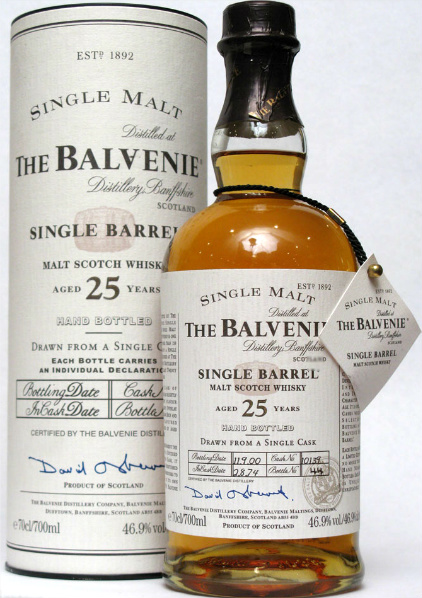 Color: Gold.
 It’s not only the bitterness that is obvious. Comparing these two there is infinitely more. That goes to show, how big the differences can be between two similar bottles, and how buying without tasting is so tricky. I would also like to point out that the reduction that obviously took place here isn’t a problem, this Whisky holds the fort. Actually it’s the best Balvenie I had in a very long time. Still no 90’s score though…
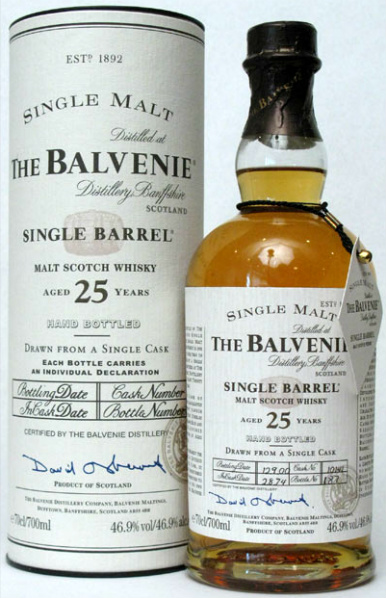 Color: Gold
 The fattiness dissipates quickly and the whisky breaks down in towards the finish. Wood attack! put this in your mouth and you think is pretty good (not great alas), but the vanilla fat is stripped, and you get hit by more bitterness than expected. The palate does lack complexity and balance. Aiii.
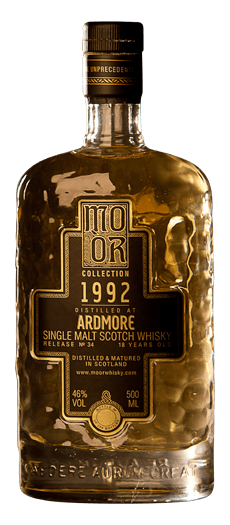 Color: White wine.
 And here is another Cadenhead’s, from the same kind of cask, from the same year 1987, with three years more ageing. Cadenheads call this Distilled at Dumbarton, made with Inverleven stills. Everybody else calls this whisky just Inverleven. To clear things up. The Single malt whisky that was made this way, was called Inverleven. Inverleven was made untill 1991. This was made with the ‘normal’ type stills. In the same building was also a Lomond type still that was installed in 1959 at the Dumbarton distillery and ran untill 1985 (With the malt being called “Lomond”, not Loch Lomond). Loch Lomond lies close by to the north. Only a few kilometres away, still Loch Lomond is a Highland Whisky, and Inverleven a Lowlander. To wrap things up. The Dumbarton Distillery was the spiritual home of the Ballantine’s Blend.
 Color: Light gold. (Darker than the 15yo Cadenhead).
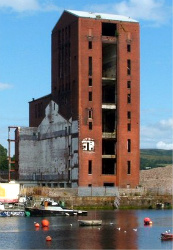
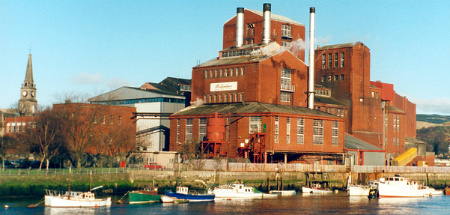 I ended the last post about Gordon & MacPhail’s Inverleven with the hope that they wouldn’t reduce the next issue (so much). Frolicking around in my stash of samples I unearthed this unreduced Inverleven bottled by Cadenhead’s. It’s from another year, so this may have a different profile, but still worth checking out. Dumbarton was foremost a Grain Distillery. The distillery was built in 1938. In 2002 the distillery was closed and demolition commenced in 2005. I’ve added a picture here, because I have always liked the big red brick industrial complex on the river. By the way, after stopping the production of the Inverleven malt, the Stills went on to Islay to produce Port Charlotte at Bruichladdich.
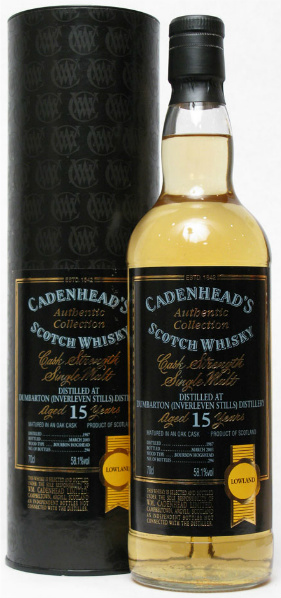 Color: White wine.
 Here we have one of the many 1991 Lochsides, and one of the many that were issued as a Gordon & MacPhail Reserve. This one was picked by Dutch retailer Van Wees. Gordon & MacPhail code for this one is AJ/JBEC. The spirit was distilled on September 18th, 1991 and eventually bottled on March 8th, 2010. Alas we don’t know exactly the date when Han van Wees tasted it and picked this ;-). Kudos to Gordon & MacPhail for all the information on the bottle and back label.
 Color: Gold
 Color: Full Gold.
