Geographically, the transit from The Netherlands to Belgium is a short one. The Belgians, when compared to the Dutch, are known to be more into the taste and smell of food and drink, and thus spend more money on it. So, as the human I am, (I’m no T-1000, although I do love my liquids, nudge nudge, wink wink), I would say, and I know this is a big assumption now, that the Belgian version should be better than the Netherlands one. Also, one doesn’t hear a lot about ex-Rye Whisky casks. However, I do know that in general the Whisky industry in general doesn’t discern between casks that previously held a Bourbon or those that held a Tennessee Whiskey. All are called ex-Bourbon casks, since the two are common in the US of A. I guess the same maybe true for casks that previously held a Rye Whiskey. All three forms of Whiskey are different especially the Rye Whiskey and now we have a chance to find out if Bimber from an ex-Bourbon cask is different from one that matured in an ex-Rye Whiskey cask.
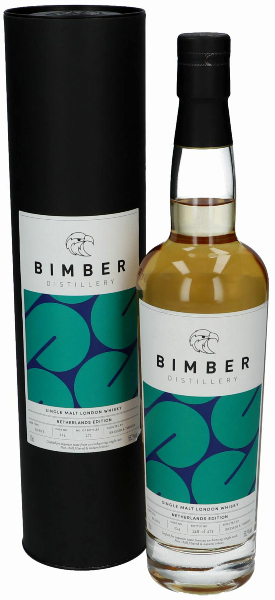 Color: Pale White Wine
Nose: Floral, perfumy. Old worn out dried flower pouch, pot-pourri would be to much, to describe the florality. Maybe it’s even slightly soapy, like an old bar of grandma’s soap in a closet full of linen. Malty and soft. Smells also ever so slightly sweet combined with some pencil shavings and cinnamon. Again a wonderful, friendly nose. Fresh and zesty now. Sometimes slightly farmy yet also clean. Warm mocha and creamy, with a hint of peanut and almonds. occasional whiff (a mere hint) of tea tree oil. Candied warm apple and a mixture of soft kitchen spices. Great balance again. Smells very tasty. Rye Whisky itself is in general more floral than Bourbon, and the same is applicable here as well. All of a sudden a whiff of fresher, almost virgin, oak. Again, when this gets some time to breathe, this one has a killer nose as well. It is slightly closed at first, so it does need some air. I pick up on some licorice notes out of the freshly emptied glass. The nose of the Bourbon expression is bigger, yet this one is similarly complex and wonderful as well, Even with this one being “thinner” it is equally as good. Again here we have yet another example of a Malt that needs to breathe. When it gets this time, it is an amazing nose. The nose of both belong to Whiskies that score in the 90 points range, an amazing feat for such a young Malt.
Taste: Short sweet onset, somewhat thin texture. Less sweet and creamy than the Bourbon expression for Belgium. Right out of the gate this seems to have been a less active cask, somewhat introvert so to speak. It gets leafy, green, paper-like and woody quickly. A bit dryer, spicier and more raw than the Bourbon expression, yet the fruity sweet bit clings on for dear life as well. After the first sip (quite hot going down), the nose shows a lot more cinnamon. Mocha as well, which pairs nicely with the cinnamon notes. After trying quite a few Bimbers over the last year, cinnamon seems to be a marker you can recognize it with. After the wood, fruity lemonade pops up. I’m sure that the nice play on wood masks the fruit a bit, but is it quite fruity (underneath). Even if the Bourbon-expression for Belgium turns out to be “better” than this Netherlands one, I feel this one is more unique. I welcome the different experience the Rye expression offers, and I’m having al lot of fun with this one as well. The finish is yet again a bit thin yet ever so slightly better balanced than the Bourbon one, and it is of medium length. The aftertaste is somewhat sweet and lacks a bit of staying power. No off notes, no bitterness.
I know Hans (Bresser) and Auke (Timmer) and these guys wouldn’t accept a “lesser” cask for a Whisky in their name. But I also know these guys enjoy their live better than the average Belgian, who most definitely enjoy the good things in life better than the average Dutch. Even though initially I found the Bourbon version to be slightly better, this Rye version differs a bit and as such is also a bit more adventurous. The Bourbon is more creamy, the Rye more floral and slightly more special if you ask me. It is nice though to have the two side by side and compare the two. Never ever did I regret to have them both open at the same time. It was definitely worth it. Now that they are nearly gone, I find myself leaning a bit more towards the Rye, yet on other occasions more to the Bourbon. Go figure. Both are actually equally good, so they get the same score. It was a good thing to have them both open at the same time, easier to pick up on the difference. Good stuff.
Points: 88
 Oh no, we’re already at the end of the Glengoyne week, quelle misère! This is always the moment with a little bit of melancholy. That moment when you’ve been with a good friend for a week and you know he or she has to leave. Waving goodbye at the train station or the airport. Going home alone with a little tear in the corner of your eye.
 Color: Sparkling gold.
 with an almost equally briljant and newer ‘summer’ edition in the runner-up position. Actually the odds were a bit uneven since this Glengoyne is from the seventies and therefore well older than the rest of the contenders, but who said it was a contest? Through the rest of the offerings reviewed in this Glengoyne week, it can be clearly seen that Glengoyne makes a high quality whisky with multiple facets to it. Keep up the good work!
 Bunnahabhain is known for being the least peated of the island, still like a lot of others, raising to the occasion by answering the call of the public for more ppm’s. Burn Steward therefore started to bottle a “Moine” expression, with more peat, mimicking pre sixties Bunnahabhain.
 Master Quill