Here an example of an independently bottled Springbank, well, not really, since the Springbank Distillery and Cadenhead (a Scottish poet) are owned by one and the same, J & A Mitchell. J & A Mitchell bought William Cadenhead Limited already in 1969. Obviously it’s easy this way to bottle some single cask Springbank. Let’s see if they have chosen a stellar Springbank for the occasion. I case you might wonder, it’s not unusual for this to happen, a lot of Springbank got bottled this way!
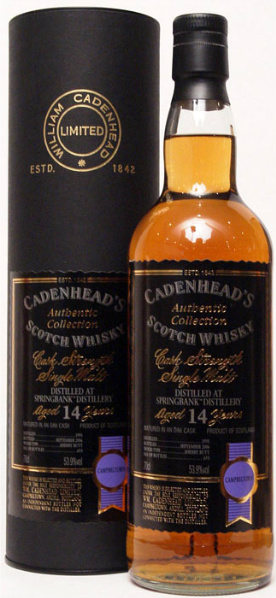 Color: Copper Gold
Nose: Sweet and floral. Very easy and likeable. A hint of soapy wood and even a hint of sowing machine oil. Hard raspberry candy. Lots of vanilla from the (toasted) wood. Old, almost dried out, lavender soap. Powdery and dusty. Lot’s of fresh air, but after that, the rest is light, but balanced.
Taste: A bit anonymous really. Initially a bit hot. Sweet and floral again, A little bit of toasted wood, woodspice. Also some fruity sourness (from the wood). Not your typical Springbank. Warm apple sauce and some acetone maybe. Diluted fruit salad syrup, from which the sweet pineapple sticks out. Initially a bit hot, but with a soothing, balmy and light finish, that is also rather short and is gone before you know it. Great contrast.
I’m very curious what kind of Sherry this cask held before. For me impossible to place. Refill Fino maybe? Not a very active cask, but nevertheless the whisky has a nice color. Do I like it? By itself it is and good whisky, but without a lot of Springbank character though. It’s very quiet and laid back. ‘nuf said.
Points: 83
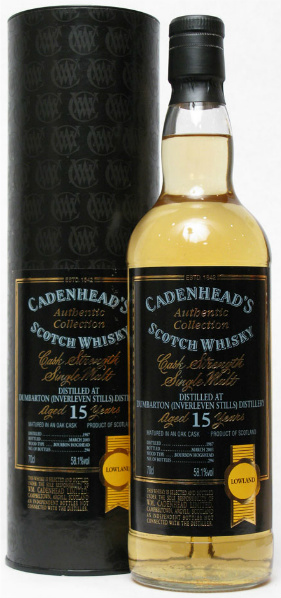
 And here is another Cadenhead’s, from the same kind of cask, from the same year 1987, with three years more ageing. Cadenheads call this Distilled at Dumbarton, made with Inverleven stills. Everybody else calls this whisky just Inverleven. To clear things up. The Single malt whisky that was made this way, was called Inverleven. Inverleven was made untill 1991. This was made with the ‘normal’ type stills. In the same building was also a Lomond type still that was installed in 1959 at the Dumbarton distillery and ran untill 1985 (With the malt being called “Lomond”, not Loch Lomond). Loch Lomond lies close by to the north. Only a few kilometres away, still Loch Lomond is a Highland Whisky, and Inverleven a Lowlander. To wrap things up. The Dumbarton Distillery was the spiritual home of the Ballantine’s Blend.
 Color: Light gold. (Darker than the 15yo Cadenhead).
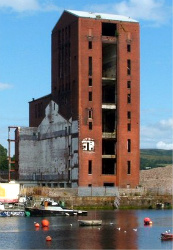
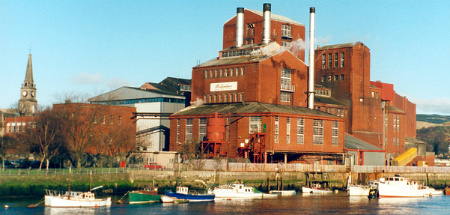 I ended the last post about Gordon & MacPhail’s Inverleven with the hope that they wouldn’t reduce the next issue (so much). Frolicking around in my stash of samples I unearthed this unreduced Inverleven bottled by Cadenhead’s. It’s from another year, so this may have a different profile, but still worth checking out. Dumbarton was foremost a Grain Distillery. The distillery was built in 1938. In 2002 the distillery was closed and demolition commenced in 2005. I’ve added a picture here, because I have always liked the big red brick industrial complex on the river. By the way, after stopping the production of the Inverleven malt, the Stills went on to Islay to produce Port Charlotte at Bruichladdich.
 Color: White wine.
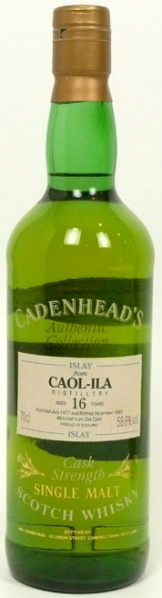 Color: Gold
 Caol Ila. This was recognizable blind. This has a nice full body with a perfect sweetness (slightly acidic) that matches the toned down peat a lot, combined with the smoke…a winner. Macaroons (made with almonds) and a slightly bitter finish (from the wood) and overall a tad too simple for a score into the 90’s.
 Belgium’s own, Bert B. came into the Cadenhead’s shop in Amsterdam (The Netherlands), with a tale of buying the ‘Winkeldochters’ in an old liquor store in a long forgotten town, near the coast. Howling wind and rolling bushes through the streets. Winkeldochters translates into shop’s daughters. It’s a great Flemish word for those items that are around for a long time in a shop which in fact never get sold.
 Well one of these bottles he bought was this Dufftown from Cadenheads. He opened it in the shop and we tried this. He didn’t like it then and exchanged it with Andries (The Cadenhead’s Shop owner) for a wedge of cheese, a cup of coffee and a wooden clothes pin. Andries was kind enough to pour me a nice sample of this (100ml) to take home with me. Cleaning out the closet, I stumbled across this sample, so here it is…
 Color: On the edge between copper gold and copper brown.
 Points: 92
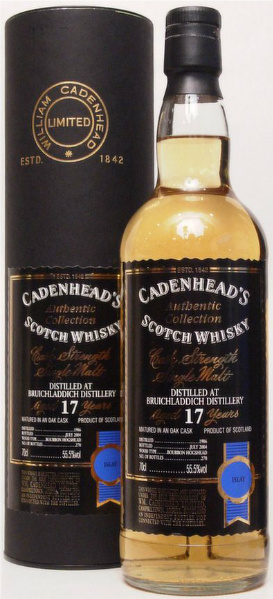 Also from 1986 but several years younger, a 13yo to be precise. Even though it was younger, this bottle showed more character to it. The 13yo was almost empty and maybe these Bruichladdich’s need a lot of air. Let’s have a look in my controlled environment and using my glass of choice, how this Bruichladdich really is. (This bottle, just open).
 The other day, I reviewed a reduced
  that means this Tormore was bottled around the time previous reviewed Tormore was distilled (1996). Both Tormore’s are about the same age too. Let’s see if thís Tormore is any feminine.
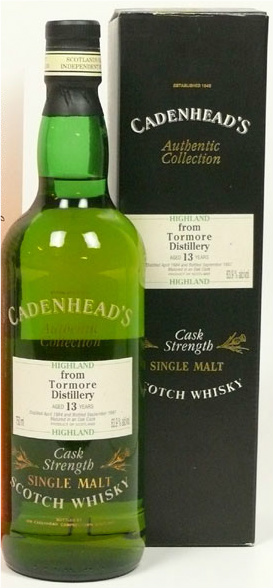 Color: White wine.
 Color: White wine, light gold.
 I once had a similar bottle of Tormore that was even stronger and older (13yo, 63.9%, 85 Points). There were many things wrong with it, like a very metallic taste, but still I had a lot of fun with it, when ‘enjoyed’ at the right moment. I found myself another bottle before it completely vanished of the face of the earth.
 Master Quill