 Guadeloupe is an overseas department and region of France and it consists of threes. It has three main islands and has three Bellevue distilleries. From west to east we first have the island of Basse-Terre, easy to recognize because of its mountains and an active stratovolcano called “La Grande Soufrière”. Last eruption: 1977 (phreatic eruption, steam). The last magmatic eruption was in 1580 (give or take 50 years, sice nothing was recorded). The soil of Basse-Terre, and this probably doesn’t come as a surprise any more, is volcanic and thus fertile, very suitable to grow many variants of sugarcane. More to the east lies the island of Grande-Terre, separated from Basse-Terre by a narrow body of water called Rivière Salée. Grande-terre is flat and has a limestone soil. A bit farther away to the east and more to the south lies Marie-Galante. Also flat with a limestone soil and thus akin to Grande-Terre.
 As said above, then there are three Bellevue distilleries. Don’t worry, there are many more distilleries on the three islands that are not called Bellevue. The first Bellevue is Bellevue au Moule better known under it’s Rum-brand name: Damoiseau, located on Grande-Terre. The second Bellevue is Bellevue Sainte Rose, better known under it’s Rum-brand name: Reimonenq, located on Basse-Terre. And finally Bellevue Marie-Galante located on…do you really want me to spell it out for you? So we have three islands and all three have their own Bellevue Rhum Distillery. How’s that for order in the universe?
As is often the case with R(h)um, some sort of estate comes into play. The Bellevue au Moule estate, sugar refinery and distillery was founded somewhere near the end of the 19th Century by the Rimbaud family, (although 1914 is also mentioned somewhere). So history is a bit unclear here. All Rhum from these early days was Molasses based. In 1942 Roger Damoiseau bought the, by then abandoned and dilapidated, estate and distillery and rebuilt it. My guess now would be leaning more towards late 19th Century, because if founded in 1914 and already dilapidated and abandoned by 1942, well that’s rather quick now doesn’t it? Also, it must have been run down rather badly since the price of rebuilding was quite steep. Nevermind, usually when a new (or extensively rebuilt) distillery sees the light of day, owners tend to make some quick money by selling unaged spirit like, Wodka and/or Gin. So Roger rebuilt the sugar estate and the distillery and he decided to make some quick bucks by selling, wait for it, candies and jam, both made at the site. Luckily Rhum quickly followed suit and of course soon became the main business. The whole output is Rhum Agricole now (based on sugarcane juice), but in the old days, in the sugarcane off-season, also Rhum Industriel (based on molasses) was produced. This was the schtick of Roger Jr, who took over from his father in 1968, to pay off the debts made by Roger Sr. when buying and rebuilding the site. Roger Jr. had to do that for a long, long time. To finish the story of Damoiseau, today the children of Roger Jr. are now running the show. Herve as chairman of the company, Jean-Luc overseeing production as master-distiller and Sandrine promoting the brand.
Last but not least, the distillery has three column stills allowing for a continuous distillation regime. The first one was bought second hand from a closed Micro-Distillery called Bonne Mere. Both others were newly bought. The distillery processes circa 30.000 tonnes of sugar cane and producing circa 1.64 million litres of absolute alcohol per annum.
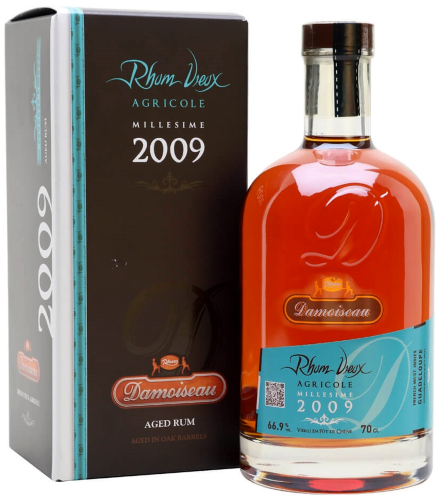 Color: Orange gold.
Nose: First thing that comes to mind when smelling this is that it doesn’t remind me of a Rhum Agricole from Martinique, or any Agricole for that matter. Don’t really know right now if this is because the Agricoles from Guadeloupe are much different or because this example is very high in ABV. Light acetone (glue-like) with thin toffee and caramel aromas. Chewy. Artificial orange as in Sinaspril tablets, some wood and some more toffee. Dusty and somewhat herbal desert wind. Slightly perfumy or soapy even, yet this dissipates quickly. Licorice pencil shavings with a nice ripe yellow fruit and vanilla note on top of it. If snorted vigorously, a minty sensation settles in my nose. No, this is not because of alcohol fumes from the high ABV this time. A layer of green and leafy aroma’s emerge next, well mixed in with a more sweet and chewy licorice note now. Some cigarette smoke. The whole smells rather elegant if I may say so, especially since I imagined this might be some sort of a brute, since the number of the ABV on the label is rather impressive. Some of the emerging aroma’s remind me of a Red Italian Wine. A fruity Amarone before settling back into toffee, caramel and almonds again. This must be its natural idle state I guess. Well balanced and very pleasing. The next day the empty glass smells a bit oaky, oily and industrial.
Taste: Yup, toffee, and caramel, and licorice, and some bitter sun toasted oak are right upfront here, what a treat! More oak and definitely a bit sharper and hotter than the nose. Spicy. The taste is not far away from how this Rhum smells. No mistake now to be made, this is definitely a Rhum Agricole, yet definitely not in the style of Martinique. The high ABV is in no way a problem and I don’t feel any need to let this swim for a bit. I usually don’t use water much, even with high ABV, although there are definitely some spirits out there that really improve by adding some water. I prefer to use a hypodermic needle even, as opposed to the plastic pipette so common to tasters of spirits. The needle ensures me to have the smallest droplets I can get. I know, I’m quite strange that way. A slightly soapy feel and a floral note emerges, I didn’t pick up on when smelling it. Still don’t actually, so it most likely isn’t there. The minty bit mentioned above, emerges here as well in the finish. Nice tasty and herbal oak. For me this is a hit. It might not be highly complex, but it is very rewarding nevertheless. Towards the end though, it is less outspoken of an Agricole than most Martinique Agricoles I know (and reviewed earlier).
This profile suits me, I have to get me some more Guadeloupe Rhum, if only to find out for myself how Guadeloupe Rhum differs from the Martinique ones and if I prefer, in general, one over the other.
Points: 88
 The old Rum community is enriched with Whisky people fishing in the pond of Rum and getting to know the product and a different kind of romanticism. Where Scotland is beautiful, but also cold and wet, Rum predominantly comes for the Caribbean and especially the image of paradise islands comes to mind. Older Rums are becoming scarce very quickly and just like Whisky, will become almost extinct, Prices are on the rise as well. Where have we seen this before?
 Thomas bottled a Rum from Guadeloupe from a distillery nobody has heard of, South Pacific (as stated on the label), not to be confused with the South Pacific distillery of Fiji, which is entirely different place altogether. Thomas explained to me he was offered a cask of South Pacific, which turned out to be Bellevue instead, so in this case the label is wrong. Casks like this are sold to bottlers through brokers, so it’s not a surprise there are a lot more Bellevue casks from 1998 bottled by different parties. And with brokers there lies a problem. Brokers only want to sell on casks, not really caring informing the buying party what really is in the cask if they have the information at all.
 Color: Orange brown.
 Master Quill