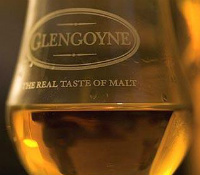
 Day three brings us another one of the three 2006 Mashman’s Choices. The first one being an American Oak Sherry Butt from 1991. That one was pretty special, since Sherry once only came from Spanish or French oak Butts and Puncheons. Today’s Glengoyne, comes form another atypical Sherry Cask, a Hogshead. No information this time where the wood came from. Charlie Murray, the Mashman, said the following about his choice:
 “In my time at Glengoyne this is the best cask I have tasted. Heaps of complexity with no rough edges.”
Color: Dark copper brown (murky).
Nose: Very spicy, old mahogany furniture. Lively, floral and elegant, and maybe a tad soapy. But altogether excellent. It’s not you usual stuffy dark sherried Whisky, nope, this is something else. Some tar, licorice and smoke! A ditch in the countryside after a nice fresh downpour of rain. Powdery and complex, it shows itself in layers, for me a sign of excellent whisky. Pencil lead and meaty. Nice expression of the wood. Elegant and refined. Smells like it was made with coal. Stunning nose.
Taste: Full and petrochemical (that’s a good thing here!). Nice wood and leafy, rotting leaves that is. Pencil shavings and tobacco. Licorice. The toast of the cask presents itself as smoke, quite unusual. The taste is bolder (than the nose), but keeps its elegance. After the full body the finish breaks down a little bit too soon. Warming alcohol. Some time after swallowing, leaves you with a beer like taste in your mouth. Did I say unusual already?
A great pick by Charles Owen Murray, it’s a great Glengoyne, but surely it couldn’t have been the best? Maybe Charlie was drunk at the time he was asked about this release, or Charlie didn’t get the chance to try a lot of Whisky 😉 It may not be the best, but very good indeed. It certainly is special, and a tad unusual to boot.
Points: 88
 Next up Glen Scotia, also a first on these pages. Glen Scotia hails from Campbeltown, once a big place for whisky with regional status (again). Try to imagine a place that has almost 30 distilleries working at one time in the 19th Century. Not so long ago this Glen Scotia was the ‘other one’ from Campbeltown after the well-known Springbank. Today Springbank makes also Longrow and Hazelburn. And from the same owners the recent ‘addition’ that is Glengyle Distillery (Kilkerran). Let’s say that Glen Scotia is the only Campbeltown distillery not owned by the people of Springbank. Owner today is Loch Lomond Distillery Co. and the place is fairly run down. When the distillery was mothballed in 1994, the staff of Springbank restarted intermittent production in 1999, not to lose the regional status of Campbeltown. A status lost eventually, but eventually reinstated.
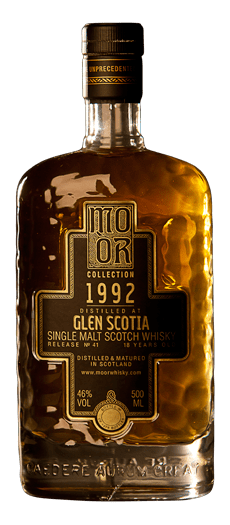 The distillery was founded in 1832 by the Galbraith family. For one reason or another the label on the bottles state 1835. Lots of changes of ownership during the years and even some closures in 1928 and 1984. Since 2000 Loch Lomond has taken over Glen Scotia and runs the distillery with its own staff.
 I was asked to keep an eye out for sulphur in this one. It’s there slightly on the nose (as a burning match). But it is more pronounced on the palate (the bite here comes not only from the wood, but also from the sulphur. Usually there is some sulphur in Sherried Glen Scotia’s. Lots of it in a 1991 Cadenheads offering if I remember correctly. It’s there on the palate and even more so in the finish (late). Is it ruining the balance or the palate? Does it disturb me? No, it’s some kind of good sulphur. it’s somewhat hidden. It’s there but not in the usual obvious way. That happens sometime, that’s why I called it good sulphur. Still, overall there isn’t a lot of sulphur in this one, so don’t worry. And hey, sulphur is good for the skin!
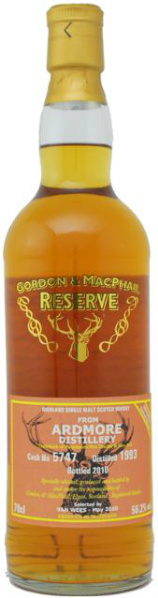 Let’s do another Ardmore and compare it to the day before yesterday’s offering by The Whiskyman. We all know that 1992 is somewhat of a good vintage for Ardmore. So let’s see what happened in the distillery a year later. This 1993 was bottled by Gordon & MacPhail and they were so kind to do that for Van Wees of The Netherlands.
