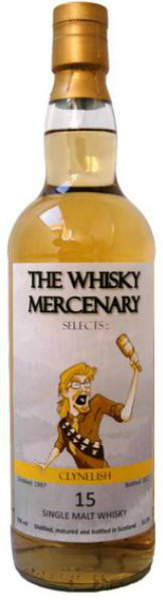
Clynelish 15yo 1997/2012 (51.5%, The Whisky Mercenary, Bourbon Cask, 59 bottles)

A few days ago I reviewed another Clynelish from 1997, and I just stumbled across this one, bottled by the Whisky Mercenary a.k.a. Jürgen Vromans. Since this is bottled in 2012, I guess Jurgen sent it to me a few years back as well. Only 59 bottles did once exist, but we know the Belgians to be enjoying life quite a bit, so I don’t think a lot of bottles of this have survived. I guess its will be even harder to find one of these today. I’ve reviewed quite a lot of Jürgen’s bottlings, and I have to give it to him, he has quite the nose for picking them, as well as being allowed to pick “dem Whiskies!” You might not know, but it’s not easy to be an independent bottler. You just don’t go into a warehouse trying all of the casks lying around and picking the best you can find, unless you have a bit of a reputation…
Clynelish TWMColor: White wine.

Nose: Buttery and malty. Fresh. Like a breath of fresh air, yet also citrus fresh. Creamy toffee barley. The cask seemed to be quite inactive, maybe the color also gives that away a bit already, but the sweetness is more like toffee and not big on vanilla you get from more first fill and more active casks. Another hint is the lack of a pronounced wood aroma. Cold apple compote with a bit of warm apple sauce, laced with a splash of calvados. All those apply associations are noticeable, but in no way overpowering. The fruity sweetness gets more and more dusty and dry, with a tiny bit of surface wood, oak obviously, with a little bit of mint. Apple pie, after some breathing the apple is joined by some freshly made dough. Nice balance with more than usual distillery character. Typical example where the wood did less to make the Whisky. It shows its other side. Fruity fresh, with shallow depth, dough aroma instead of wood, but at the same time lacking real depth and complexity. This isn’t a fault. It’s just different, and with this it shows another side of Single Malt Whisky in general.

Taste: Well, what a surprise. Sure it is fruity, but way more wood in here than in the nose. It starts with wood and paper as well as quite the peppery note. Sugary sweetness and creamy. I didn’t expect that at all. Toffee and bread. Caramel. The aroma’s grow a bit bigger with more breathing, so don’t be to hasty with this one. The lack of activity from the cask is noticeable by the weakness of the finish. It starts with a little attack, for a brief moment shows a nice body, but then it comes down very quick and leaves you a bit with a light, short and unremarkable aftertaste, which at some point in time even gets a bit bitter. Cedar wood bitterness. This bitterness even grows bigger, if you drink this Whisky after a prolonged time of breathing.

In my opinion, not the best of Clynelishes around, but there are many other who like it even better. This is from 2012, right at the start of his career as The Whisky Mercenary. Its hard then to get to pick the very best of casks, and it is a shared cask as well. Only 59 bottles was his share, but I guess at this ABV there was more Whisky in the cask, bottled or blended by others. Nevertheless educational, because here you can see that it’s more about the spirit, than it is about the wood.

Compared to the 1997 Wemyss Clynelish I reviewed a few days ago, the family resemblance is quite remarkable, but the Wemyss is definitely the more aromatic and polished expression of the two.

Points: 81

Clynelish 1997/2014 “Cayenne Cocoa Bean” (46%, Wemyss Malts, Hogshead, 373 bottles)

You get only one chance to make a first impression, and that is what he did, William Wemyss. Carrying around my bottle of Strathisla I ran into William in London and I offered him a dram. Talking about the Whisky Business in general and Wemyss in particular, he sniffed it for a while, and sniffed it some more, talked a bit, and then…chucked the whole stuff in a spittoon claiming that it was great stuff. He probably had to drive home later or was late for a meeting or something. People around me were shocked a bit, but I know this is how memories are made. Maybe just not right away!

Wemyss is known for naming their Whiskies. The Clynelish I’ll be reviewing today is called Cayenne Cocoa Bean, since it reveals bittersweet cocoa beans mingled with cayenne pepper.

Cayenne Cocoa BeanColor: Somewhere in between white Wine and light gold.

Nose: Sweetish and fruity. Definitely some barley, but also a dry grassy note. The color gave it away a bit, this is from a refill hogshead, so it lacks the in your face vanilla and toasted cask aroma’s. It’s more refined. It has a creamy and fatty element. Vanilla pudding, but it is all very restrained and well-balanced. Fatty not waxy, what it usually the marker for Clynelish. Dusty oak. Dry old vanilla powder. Dried peach and pineapple. Semi sweet black tea. Leavy and hints of a dying out small garden bonfire. Burning off old branches. The sweetness throughout is toffee not sugar. Lovely stuff.

Taste: Nice thick fruit with toffee. The toffee substituting the wax you’d expect to find in a Clynelish. It starts out almost chewy. The whole it held up by a toasted wood note, with the faintest hint of bitterness and tree sap. On entry very good, from the start a lot is happening. After that a mixture of mint, sugar and a small amount of licorice. It is big and holds up. Finish starts prickly, and swiftly whiffs away, only the toffee stays behind as well as some warmth. Medium finish with a warming aftertaste. A good Clynelish and I’m guessing for those of you who didn’t like it as much, the leafy quality is a bit off, and the finish is a bit too short. So it has its flaws and weaknesses. But it has its big aroma and the start is almost spectacular. The body starts well, but breaks down too soon. The finish should be better and the aftertaste has some pineapple but not much more. It is reduced to 46%, and maybe that’s the culprit for the finish and aftertaste. The beginning is great, and for that part of the experience the 46% ABV seems just about right.

I’ve encountered quite a lot of people on festivals who say they don’t like these names. They say it creates a certain expectation and with that they can’t taste it objectively anymore. A very anorak-y statement from people lacking humor? I for one, like the names, it gives them an identity, even though I might not encounter the aroma’s from the name in the Whisky. Everyone tastes differently, depending on time of day, upbringing and associations with tastes. Clynelish is an excellent example. I like Clynelishes just as the next guy, but I always seem to like different Clynelishes. When I was a member of the Malt Maniacs, I really liked a 12yo Clynelish bottled by Adelphi. I didn’t know it was a Clynelish, since it was part of a blind competition we know as the Malt Maniacs Awards. At another blind tasting session, at least a year later, I tasted another wonderful Clynelish, which turned out to be the sister cask of the first Adelphi Clynelish. I mention those since, a lot of people didn’t care for those two Clynelishes. Same with this Wemyss expression. I first encountered it at a Wemyss tasting, led by Ginny, and I absolutely loved it, where most of the public preferred other Wemyss expressions. So never take anyone’s word for it, make up your own mind, although I have to say that all the Clynelishes I mentioned above, were casks picked by Charles MacLean, even this Wemyss one…

I managed to forget the name during the writing process. I did get the bittersweet part, but couldn’t say if it’s from cocoa beans. Definitely didn’t get the cayenne though, but I still like the name. It’s only a name, nothing more.

Points: 85

Cragganmore 1988/2002 “Distillers Edition” (40%, OB, Double Matured in Ruby Port Wood, CggD-6553)

As could have been expected by reading the last review here is the Cragganmore Distillers Edition, and just like the 12yo this particular bottle, was also bottled in 2002. Cragganmore is seen by many as a top Whisky. Blenders see it that way, and especially Diageo see it that way too. Although it has been part of the original Classic Malts range from 1988, it never was the most popular of the six. I don’t have to spell them out for you don’t I? Well OK, the original six were: Lagavulin (Islay), Talisker (Skye: Islands), Oban (marketed as West-Highlands), Glenkinchie (Lowlands, which many thought it would be Rosebank, but economics decided otherwise), Dalwhinnie (Highlands) and Cragganmore (Speyside). Still some aficionado’s are very keen on Cragganmore because Cragganmore is said to be a complex malt by using hard water and have stills with flat tops. History also teaches us that Cragganmore used a lot of Sherry casks.

Cragganmore 1988/2002 "Distillers Edition" (40%, OB, Double Matured in Ruby Port Wood, CggD-6553)Color: Copper gold.

Nose: Creamy and waxy, this time with a winey note, which makes it instantaneously more interesting than the 12yo. Fresh air with licorice and black and white powder. The yellow fruits from the original 12yo have been replaced by the red (berry) fruits from the Port finish. Tiny hint of Calvados. Red apple skin. Creamy vanilla is still here though. Hints of Sinaspril (a children’s headache medicine I remember from the seventies). Fruity candy powder (synthetic).

Taste: Seems spicier, but still a bit too light. Watered down Ice-cream. Quite sweet. Sugar water with a tiny amount of forest fruit syrup. If this would have been cask strength, the harshness you get from Ruby Port finishes probably would have been easily noticeable. Instead, the reduction and the sweetness are able to keep the Ruby Port in check. Just like the 12yo I reviewed last, this has a pretty weak again and it has a finish with some cask toast thrown in for good measure, but it helps. Up untill the body, the Whisky has quite some good aroma, and then the finish comes which has the length of a snuffed out candle. It’s alight for one moment and gone the next. This really needs to be slightly higher in strength, as well as the 12yo. If 46% ABV is too much, at least adopt 43% as a minimum strength for Single Malt Whisky. Sure in the olden days a lot of Malts were 40% and held their ground, but today’s yield driven more modern Malts seem to need a higher strength than that…

Personally I find the choice for Ruby Port always very tricky. Whereas Tawny Port is easier to use and gives usually better results, because Ruby Port finishes can be very harsh and are easily overdone. Luckily here the finish seems to be OK. The 12yo was quite simple, fruity and sweet, but for me this Distillers Edition has something more to say, especially on the nose. Concerning the taste, the Port is not always good match for the sweetness of the Cragganmore Malt. The first time I tried it, it didn’t work, the next day I liked it, but maybe that’s saying more about me than the Malt. It still is an easy peasy Malt, not all that complex. It is quite interesting and I do quite like it. I prefer it over the 12yo.

Points: 84

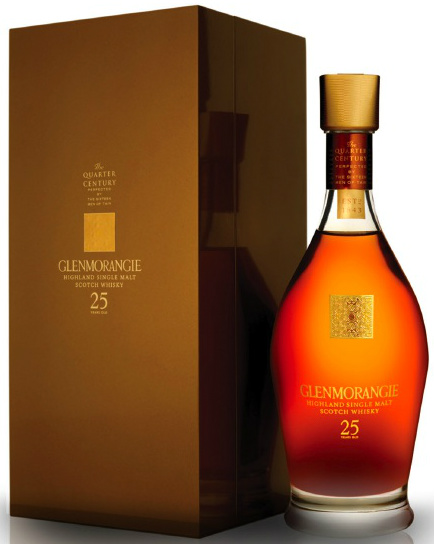
Glenmorangie 25yo “Quarter Century” (43%, OB, Circa 2012)

And here is another entry-level malt. Anyhow, it is when you give your wife a Luis Vuitton bag very month. If you’re more middle class, or like me, no class at all, you might want to get the 18yo “Extremely Rare” which isn’t actually extremely rare but compared to this 25yo is extremely affordable and quite nice. The 18yo scored a quite nice 87 Points. The 18yo has spent all of it’s time in Bourbon casks, save for 30% of the Whisky which was transferred into Oloroso Butts (or Puncheons) after 15 years, to get a three-year Oloroso finish. This 25yo is a blend of Whisky from Bourbon and Oloroso casks, but also contains Whisky from casks that once held Burgundy Wine. Pinot Noir (red) and/or Chardonnay (white). It is unclear if the Burgundy part is a full maturation or only a finish, well the same goes for the Oloroso Sherry as well.

Glenmorangie 25yoColor: Orange gold.

Nose: Waxy, dusty with old wood. Old bottle. Well if anything, this does show its age.  A sharpish winey note. Burnt oak and a distinct sweetish toffee note. Very creamy mocha and milk chocolate with hints of creamy latex paint. Duo Penotti. Hints of oak, cigarette smoke and wine acidity. paper dust. The aroma’s seem to weaken with time. Fragile.

Taste: Strong sweet entry. Red sweet and sugared cherries, so quite some wine influence. Toffee is in here too. Liquid candy. Light, slightly too low in ABV if you ask me. Similar burnt note to the nose. Old wood. Easily recognizable is the American oak ageing. Creamy vanilla and mocha coffee. Slight hint of oaken bitterness. Easily drinkable. Seems simpler that I initially thought and the finish has medium length.

This proves is for me. If you want a Glenmorangie from the current range, I prefer the ones with an age statement, the older ones that is, over the ones that are named after Hyundai cars. The secret here is that the 18yo is maybe a better and definitely much affordable Whisky than this 25yo. Sure, this 25yo is a great piece of work and compared to the 18yo is slightly more complex, but the 18yo seems to be the better balanced Whisky of the two. Did I mention the humongous price difference between the two?

Points: 86

Rhosdhu 12yo 1996/2008 (46%, Murray McDavid, Bourbon Cask, 2.000 bottles)

Murray McDavidNext we are going to have a look at three bottlings by Murray McDavid. Murray McDavid was founded in 1996 by Mark Reynier, Simon Coughlin, and Gordon Wright, naming it after Mark’s grandparents, Harriet Murray and Jock McDavid. The motto “Clachan a Choin” translates as “the bollocks of the dog”, so yes, the logo has a dog in it. Besides being an independent bottler, maybe their biggest claim to fame was acquiring Bruichladdich Distillery in the year 2k. In 2000 the distillery was still mothballed, but Mark and his mates quickly turned it into a working distillery. Less than 12 years later in the summer of 2012, Bruichladdich was sold to Rémy Cointreau UK Limited, as well as the independent bottler Murray McDavid. Rémy Cointreau didn’t know what to do with the bottler, so less than a year later they sold it to Aceo Ltd, a supplier of casked whisky and distillery services like cask storage, bottling and labelling.
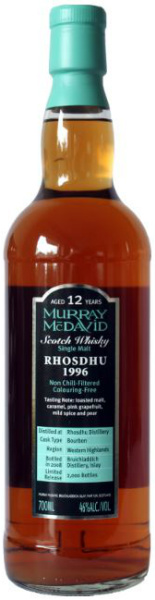
So the first of three bottlings from Murray McDavid will be a rendition of a Loch Lomond Whisky: Rhosdhu.

Rhosdhu 12yo 1996/2008 (46%, Murray McDavid, Bourbon Cask, 2.000 bottles)Color: Gold.

Nose: Spicy and briny. Funky, with some prickling cigarette smoke. Lots of grain, but also some traits I get from Rhum (of the Agricole kind) and Bourbon itself. Actually more like a Rye Whiskey. A dry and sweet fruitiness mostly. Definite cask toast. Vanilla and tangerine. Lots of saw dust and dare I say it (again), cardboard. It smells like an old (sweet) Single Grain, at the fraction of the cost. Dry powdery and again (citrus) fruity. Give it some air, and boy, does this need some air, and it’s even tarry sometimes.

Taste: Again quite grainy and fruity. A bit raw but therefore it needs the fruity sweetness it has. Vanilla powder and smelling like an old vanilla pod. Noticeable paper and cardboard again, but in no way is this disturbing in this one. Slightly weak in the finish, but otherwise a decent Whisky, helped by quite an active cask. Some acidity enters the fold when it’s time for the finale. The finale has great depth, with a toffee and caramel sweetness. Part of this caramel is even slightly burnt. The sweetness is just right, helped along by the leafy and spicy backbone.

I remember this when freshly opened and it didn’t do too much for me then (79 Points). This time around, with some more oxidation, this turned out nicely. This is a Whisky that needs a lot of air and really benefits from the heat of your hand. Keep it in the palm of your hand, don’t hold it by the stem. Knowing its secret, and if it was available today I would most certainly buy it. If you have it, remember how to treat it. Heat and air will do the trick.

Points: 83

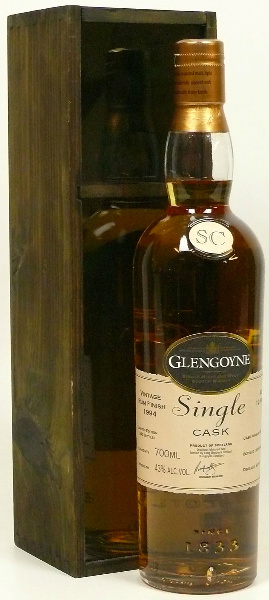
Glengoyne 12yo 1994/2006 (43%, OB, SC, Rum Finish, Cask #909310, 348 bottles)

Just like the 10yo Edradour I just reviewed, Glengoyne also has a 1994 vintage, which was used for a lot of different cask finishes. Claret, Madeira, Manzanilla, Muscatel, Cornalin and a lot of Rum finishes were released between 2005 and 2008. Some were bottled at cask strength, and some were reduced to 43% ABV. All the other Rum finishes have a cask number of 5 digits, so this one was probably cask #90931. Maybe they have added an additional “0” to distinguish this bottling from the rest since this is the only one that has been reduced. Maybe an administrative mistake was made…

Glengoyne 12yo 1994/2006 (43%, OB, SC, Rum Finish, Cask #909310, 348 bottles)Color: Gold.

Nose: Excellent full-on Rum smell. Spicy, fatty dirty. I’m guessing high ester Rum. Jamaican? Hard to tell. Sugar cane and very leafy. For some this may be finished too long, but I’m not one of them. I love the synergy between Rum casks and Single Malt Whisky, but I may have said that before. Extremely deep. What a nice combination of smells. Wonderful depth and a wealth of complexity with lavas and balsamic vinegar. Where did that come from? The Whisky, The Rum or the wood? If it’s the wood, the wood turns to a more cleaner oaky note. Fresh windy forest and some warm butter on toast (not burnt). Even a slightly soapy note.

Taste: Well this is less complex than the nose is. Where the nose explodes with aroma, the taste is much simpler. Most definitely a sweet Whisky. Sugar water and yes, some nice leafy wood influence. Paper and floral cardboard, whatever that is. The taste is built around some different wood flavours, sugared tropical fruit, dried orange skim and cold black tea. The finish is quite long, but again pretty simple a bit bitter and buttery.

Not so long ago I reviewed a few Rum finished Whiskies and I said I have always liked them. This one is no different. Fantastic nose, and the taste is good. However, this one is not a daily drinker. For that it is too fatty and sweet.

Points: 84 (but with a 90’s nose, if you like Rum)

Thanks go out to René for providing the sample (a while back).

Edradour 23yo 1983/2006 (52.1%, OB, Port Cask Finish, Cask #06/0554, 743 bottles)

Since Edradour is owned by Andrew Symington, this might as well have been a Signatory Vintage bottling. Lots and lots of Edradour have also been bottled as Signatory Vintage bottlings. 1983 is the oldest vintage of Edradour ever bottled by one of the owners, apart from two 1973 bottlings of which one was bottled by Andrew himself in 2003 (as an official Edradour). By the way, all the 1983 bottlings are Port Cask Finishes. Onder the flag of Signatory Vintage, Andrew bottled one 1968 Edradour and a small batch of 1976 bottlings, so the 1983 might not be the oldest Vintage after all.

Edradour 23yo 19832006 (52.1%, OB, Port Cask Finish, Cask #060554, 743 bottles)Color: Full Gold.

Nose: Dusty, flour and dry. Seems Sherried. Vanilla and cream. Powdered coffee creamer. Spicy oak. Spicy and fruity, but still with some hints of integrated wood. Cold butter, right out of the fridge and the fatty smell you get from a cold BBQ one month after its last use. So old fat and hints of burned stuff. Next are the first whiffs of baking white bread. Mixed with the odour of printed newspaper. Leafy and fresh. Small hints of (dark) chocolate with cherry liqueur, but not entirely black. This even has tiny hint of tar, giving the whole some depth. Not bad at all.

Taste: Much more fruity than the nose was. Creamy vanilla pudding with a red fruit acidic aftertaste. After that some bitter tree sap and bitter oak. The oak isn’t overpowering, but it’s there in broad strokes, making up the body of the Whisky. Quite complex wood, so it doesn’t come across as a young Whisky, which it in fact isn’t. Some hidden, fruity sweetness and again the paper of newspapers. Nice and well-integrated oaky bitters in the finish. It’s signature is carved in wood.

To sum things up. This is a wood driven old vintage Edradour finished in a Port pipe. The finish is done sparsely, since it isn’t an overpowering typical Port Finished Whisky. Nice, but not something I would go out of may way for to get it. Let’s call it an experience.

Points: 83

Edradour 10yo 1994/2004 (46%, Signatory Vintage, The Unchillfiltered Collection, Cask #349, 783 bottles)

In 2004, 2005 and 2006 most of the 1994 vintage were released by Signatory Vintage in the Straight from the cask series. You must remember the 50 cl bottles in the colored wooden boxes with all kinds of (fortified) wine finishes. However a few of those were rescued from that sometimes ill fait and released as is, under the unchillfiltered moniker, reduced to 46% ABV. Here we have one such cask that didn’t undergo a wine finish, simply because the Whisky at hand came from a Sherry cask.

Edradour 10yo Cask #402Color: Orange gold.

Nose: Quite creamy and already lots of aroma. Very dry with enough influence from the wood. It does remind me of cherry liqueur, without it being overly sweet. The Whisky also has a more vegetal side to it as well as some good Sherry funk. Fruity. Watered down red fruit juice, with toffee, chocolate butter and (milk) powder and some herbal smelling wood. Quite spicy when I come to think of it.

Taste: Paper, pepper and sometimes a bit hot. Artificial hard red candy juice. Remember those little raspberry ones? Warming and in the distance quite sweet. Candied citrus fruits (predominantly oranges) and the zestier note is provided by some lemon curd. After that the lengthy finish starts with some burnt newspaper ashes, cheap chocolate powder and some soft dark wood, not necessarily oak. Nutty coffee (Inca).

This is quite a Whisky, but I can’t help to feel that something is not quite right. That is probably personal, because I get that a lot with Edradour. Probably a typical Edradour marker, I still have to get used to. Still, this is quite quaffable. Go for one if you come across it. Maybe the 1994 vintage is sold out by now, but there should be still some 10yo’s from 2004 around. The picture is from one of the 2004 vintages, the 1994 looks the same.

Points: 82

Clynelish 14yo 1989/2003 (50%, Douglas Laing, Old Malt Cask, 6 Month Rum Finish, DL REF 3850, 312 bottles)

I’ve been reviewing more Rums lately, which is fun to do. back to Whisky for now, but I won’t have to let go of Rum altogether. To continue the Rum theme, my previous review was of a Teeling Blended Whiskey, finished in Rum casks. The Rum completely took over the Whiskey. Here is another Whisky, Scottish this time, that was finished in a Rum cask. Alas we don’t know where the Rum cask came from, nor do we know what kind of Rum it once held.

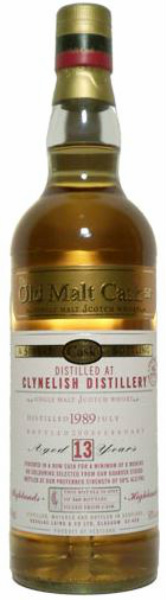
The title is correct, the picture is wrong. I found an old sample of this Clynelish on my attic, but it seems Whiskies were drunk in 2003 and not collected. I couldn’t even find one in an auction. No picture to be found of this particular 14yo rum finished Clynelish. All I could find was this picture of its 13yo sister bottling, also finished for 6 months in a Rum cask. For a brief time Fred Laing reserved the red lettering on OMC bottles for younger Whiskies in a time when  Douglas Laing was bottling almost only stellar and old bottlings. For one reason or another the red lettering, and the red tube, was soon abandoned. The bottle in the picture was bottled in February 2003, and the 14yo, I’ll be reviewing soon, later in that same year. It is therefore entirely possible the 14yo doesn’t even have red lettering.

Clynelish 14yo 1989/2003 (50%, Douglas Laing, Old Malt Cask, 6 Month Rum Finish, DL REF 3850, 312 bottles)Color: Light citrussy gold.

Nose: Wood and yes, it has some light golden Rum on the nose. This time the Rum didn’t overshadow the Whisky. You still can recognize a Single Malt Whisky in this. Flowery and soapy and hints of rhubarb. Soft young wood, leafy and fruity. Papaya, maracuja and a tiny hint of banana. In a blind tasting I would have said this was a Tomatin. Typical Bourbon cask notes and with tropical fruits, what else could it have been? Nice nose. Floral and fruity, but also damp earth and raisins. Hot butter. Sometimes whiffs of a Pinot Gris fly by. I like this. Well balanced and even though a lot can be picked up, the balance is so great and the aroma’s are so well-integrated it doesn’t even seem complex. The aroma’s show themselves in layers, but when an aroma is replaced by the next, it isn’t gone for good, everything comes back as a boomerang. Given some time a more burned note appears that wasn’t there before. I have always liked Rum finishes, maybe that’s where the interest in Rum comes from.

Taste: Recognizable as a Clynelish, with added yellow, tropical and red fruits. Quite hot, it bites back a bit. Sweet and more yellow fruits. Pineapple and white grapes, hints of unripe peach and unripe banana. After the initial sweetness, notes of paper and wood. Cheap wood, plywood maybe. This is less balanced than the nose is and the finish leaves a slightly bitter taste in your mouth. Burned wood and grape seeds. Nice stuff, just don’t expect a sweet Rum in this one.

Back in those times, it seems that Rum finishes were more common than today. Wine finishes were hardly available, and those that were around were not particularly good. Look around today, lots of finishes in casks that previously contained a Wine in all its guises. Rum finishes are still not done very often, apart from some Benriachs I guess. Speaking of which…

Points: 86

Glenmorangie 10yo “Traditional 100 Proof” (57.2%, OB, 1 Litre, 2005)

Next up an oldie from 2005. A cask strength Glenmorangie. We don’t see many of them these days, especially one that isn’t touched by any special cask. The back label mentions that this unchillfiltered Whisky came straight from the cask made from mountain oak. So what kind of wood is this? My guess is American Oak from the Ozark Mountains, Arkansas USA. Hinting that this is a 10yo Glenmorangie fully matured in Bourbon casks and bottled at cask strength. Nothing more and nothing less. My most avid readers will know that I am not a very big fan of Glenmorangie but got quite a surprise when I reviewed a recent 18yo

Glenmorangie Traditional 100 ProofColor: Light gold.

Nose: Aromatic and spicy yet closed, or maybe there isn’t a lot going on? Vanilla and typical bourbon cask notes. Slightly soapy and fresh and obviously high in alcohol. Vegetal and woody. It almost smells like it looks. It does smell a bit of sackcloth and oak. Dusty and powdery. Not very complex.

Taste: Sweet. Vanilla and pudding. Sweet alcohol. Mocha and vanilla pudding. Hints of Cappuccino and vanilla ice-cream. A woody bite, almost cigarette like, but also a short-lived fruity sweetness. Sugared raspberries and half-ripe forest strawberries. Thick toffee to hold it all together. Nice coffee-ish finish. Well balanced. This reminds me a bit of a young Bladnoch. That one has more butter, is softer and is a bit more vegetal, but that may very well be the only difference.

At first, a simple Whisky, but it grows on you. Give it time to breathe and it develops nicely. Nevertheless, this is actually an example of why I didn’t like Glenmorangie back in the day. (Let’s say, 10 years ago). It looks great, promises a lot, but this particular Whisky is simple and un-rewarding on the nose. It may very well be the reason I stopped buying Glenmorangie for a whole decade. The taste is a lot better though. I only picked up the fruity bits, when tasting this in the morning before breakfast. Last night after a very tiresome day, I didn’t pick up on the raspberry and strawberry at all.

The recent and “extremely rare” 18yo I tasted a while back, somewhat restored my faith in Glenmorangie and made me buy that very 18yo. Today, and tomorrow can be different, you can get three of those 18yo’s for the price of this cask strength Glenmorangie. A no brainer if you ask me.

Points: 83