Tomatin 15yo (43%, OB, Bourbon Casks)

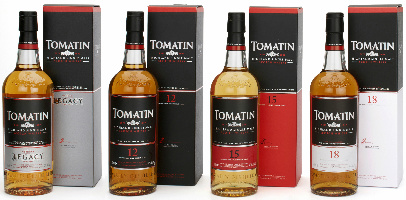
This is my last review of a Whisky from the standard range of Tomatins released by the distiller. The standard range comprises of Legacy, a 12yo, a 15yo, and last but not least, the 18yo. The age statement (or lack of it) not being the only difference. All are different in usage of casks:

  • Legacy – New Oak Casks and Bourbon Casks (82 Points).
  • 12yo – Bourbon & Sherry Casks (83 Points).
  • 15yo – Bourbon Casks (?? Points).
  • 18yo – Refill Bourbon Barrels with an Oloroso Sherry finish (87 Points).

So here we have the 15yo. This one is on paper the younger brother of the now sadly deleted 25yo. Both come from only Bourbon Casks. The new Tomatin is called Legacy, but the 25yo will turn out to be a Legend. But, and I can’t stress this enough, Tomatin 30yo, that’s even better imho!

Tomatin 15yoColor: Light gold.

Nose: Spicy and clean. Sweetish and creamy. Hints of toasted oak and crushed fresh leaves. Nice toned down fruitiness. Cookie dough. It does remind me a bit of the 25yo (and some notes of the fruitiness remind me of the 30yo). Fruity ánd perfumy. Very aromatic example of Tomatin. Good balance.

Taste: Clean and warming, warm wood and caramel. Hints of licorice, vanilla and toasted wood. Very creamy and half sweet. Again very good balance. Dangerously drinkable.

These four whiskies are absolutely family of each other. Brothers and sisters of one another. But just as with people, there is a family resemblance, but most definitely have different characters. It’s not merely an older version of the previous example, no, all are meant to be different through usage of different casks. I guess all of them will have different likers (or dislikers if you don’t like the mean Tomatin profile).

So time to come clean, which one would I buy? Well, according to points the 18yo is the winner. It has a stunning nose and taste to match, but there is always a candidate everybody likes, isn’t there. I scored the 15yo one point lower than the 18yo, but I think the 15yo is a true and honest malt (just look at its color), and is definitely easier to drink than the 18yo. I had problems writing tasting notes, because the glass seemed always empty, how is that for drinkability! So if you are new to whisky or just enjoy a good malt, I would buy the 15yo to start with, if you’re somewhat more seasoned and able to appreciate the added notes of the Oloroso finish , I would recommend the 18yo. Legacy and the 12yo are both alright, and dirt cheap to boot, but not my personal first choice. So for me the 18yo and the 15yo are the ones to buy, and differ strongly enough from each other to get both 🙂

Points: 85

Thanks to Jennifer for sending me this sample.

Tomatin 12yo (40%, OB, Bourbon and Sherry Casks)

Not so long ago, this was the new-look entry-level malt from Tomatin, but in the quickly changing Whisky-world and especially the trend of releasing Whiskies without an Age Statement (NAS), Tomatin issued Legacy and they priced thát one even lower than this already inexpensive 12yo. Names hardly add something to whisky and I would have loved to see Legacy being released as a 10yo or a 8yo. Now that would have been exciting! Together with the wind of naming Whiskies, I sense a wind that loves young whiskies!
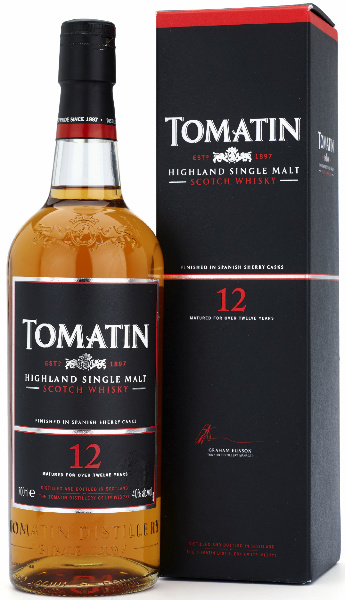
Legacy was made with new oak casks mixed with Bourbon casks. This 12yo is a mixture of Bourbon and Sherry casks, so there should be a lot of difference between the two. Besides this, the 12yo is bottled at 40% ABV, and Legacy gets three points more, 43% ABV.

Color: Ochreous gold (Chewbacca golden hairdo).

Nose: Creamy and alcoholic. Leafy and quite woody. Hints of Sherry mustiness and just a little bit of soap. Estery and thick. It smells chewy (how is thát possible), as if you could sink your teeth into this one, (do I detect a meaty touch?). Lots of vanillin from the cask, toasted cask and toast (bread). Behind the creamy vanilla a lot of sweetness (anticipated).

Taste: Thick and actually pretty good. Woody and spicy, but noting like wood in an old Whisky. To me the wood part is pretty similar to that of the Legacy and especially in the taste both are not worlds apart. The difference being some Sherry casks, that were used for the 12yo. It’s more “dirty”, more spicy and a has a different kind of sweetness to it. Leafy. I can’t imagine the Sherry part being more than 20 to 30% of all the casks used. For a sweeter malt, it is pretty drinkable and certainly well made and it has good balance to boot.

The 40% ABV is all right, it really doesn’t need more than that for the market it targets, but the Whisky doesn’t need it too. I tasted this 12yo a few times at festivals (Thanks Alistair), but never at home in my “controlled” environment. The score didn’t change, but it is nice to concentrate on this for a bit. Again bang for your buck from Tomatin!

Points: 83

Thanks Jennifer for the sample!

Ben Nevis 1986/2012 (58.2%, The House of MacDuff, The Golden Cask, CM 188, 111 bottles)

Here are a few firsts, and on paper a quite interesting one to boot. This is the first Ben Nevis on these pages. It’s also the first time I’m reviewing a Whisky that was bottled by The House of MacDuff. Now for the interesting part. Some of you might have read “Wort, worms & washbacks” The memoirs of John McDougall written by Gavin D. Smith. By the way, Gavin was “reviewed” once before, so he’s no first. The House of MacDuff is a venture of Jane MacDuff ánd John McDougall. John also picks the casks for bottling under the Golden Cask brand. For those of you who haven’t read this book, well it’s utterly entertaining and very funny. Recommended. John has worked at a lot of very interesting distilleries in all Scottish regions, so I’m assuming that all picks by John just have to be great. I got a few samples from the series, and I’ll start with this Ben Nevis from 1986.

Color: Pinkish gold

Nose: Fresh, sharp and fruity sweet. Black tea (dry leaves). Nice bourbon cask not dissimilar from the Cadenhead offerings (Bourbon Barrels). Warm apple sauce and quite thick. Condensed sweet apple. Not a lot of wood, but there seems to be enough vanillin going around in this. Sawdust. Slightly vegetal too. Hints only of ethanol.

Taste: Sweet, vegetal and slightly woody (multiplex). Quite full and round (sweet) mouthfeel. This is not bad, not very complex but very likeable. Taste is pretty balanced, for me it just goes a bit wrong in the finish. Slightly acidic and the vegetal part (fern) starts to play a larger role. Also, but very late, comes in some bitterness from the wood. Fern with the sweetness, and the slight bitterness, is maybe a strange combination, but hey it’s only part of the finish, so don’t worry.

The Golden Cask don’t disclose all the facts of the cask, but this is probably a Bourbon Barrel. This bottling has yielded 111 bottles, so I’m guessing the cask was shared and this is only half the output from the cask. The second half was probably bottled for the Whiskymesse Rüsselsheim. That bottling yielded 100 bottles. 100 bottles of whisky on the wall, was probably the original order with The Golden Cask buying the rest of barrel #133. Therefore this Ben Nevis should also be 26yo.

Points: 84

Tomatin Legacy (43%, OB, Bourbon & Virgin Oak Casks)

There is a new Tomatin in town, and they’ve called it Legacy. No age statement on this one. First of all what does legacy exactly mean? Searching on-line I find this: anything handed down from the past, as from an ancestor or predecessor. We know this “Legacy” is aged in Bourbon and Virgin oak casks, so is this the way Whisky was made in the past? I will have to ask, but surely my interest in this Legacy has been aroused. maybe it’s not about the casks, but the way the distillate shines through?

Second thing i noticed is that it’s 43% ABV, making the 12yo the only one in the standard range this is 40% ABV. The rest is higher with 43% and 46%. Having said that, Tomatin placed this Legacy before the 12yo, simply by making it cheaper. Pretty neat.

Recently The Glenlivet released the Alpha, of which in a weeks time the true contents will be released. The Glenlivet used a huge social media ad campaign to aid its sale, whereas Tomatin did not. By now we do know that is also is made using Bourbon casks (first fill) and new wood (second fill). Alpha is 50% ABV. and costs 4 times as much as this Legacy. Let’s have a look…

Color: Light gold.

Nose: Clean and youthful, hints of mocha, caramel, toffee, but the hints don’t smell sweet. Wet new wood, freshly cut-down tree. tree sap (not resin!) and some nuttiness. Very toned down, no sharpness and only some spiciness from the wood but no burning alcohol of very young distillate. Very honest. Some vanilla and warm butter. Not bad!

Taste: Malty and half sweet. Wood and cardboard. Again wet fresh wood and tree sap, and again a very toned down profile, laid back. A hint of licorice and even an even smaller hint of tar. Not a very long finish. The virgin oak isn’t omni-present in this one so it doesn’t dominate. It’s not very sweet, but the sweetness is sugary. Good balance.

In the nose very different and younger from the Alpha. Extremely drinkable. This would be the lemonade in my lectern. The last bottle opened, but also the first one finished.

Alpha has the same color and is higher in ABV, smells spicier (older) and definitely more mature, the wood on the Legacy smells like a freshly cut down tree. Tastewise the Alpha comes across as older, spicier and bigger bodied, aided by the ABV. Conclusion: incomparable, the Whiskies are quite different and aimed at different people. Legacy is one to give some time to and feel what and aged whisky distillate really is. One to analyze, but also the easiest drinkable malt around. And it costs next to nothing to boot!

Points: 82

Thanks go out to Jennifer for providing me with this sample!

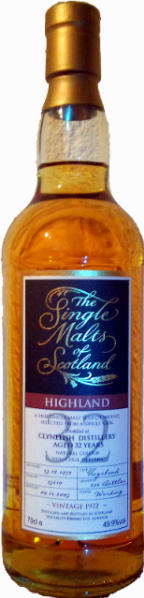
Clynelish 32yo 1972/2005 (49.9%, The Single Malts of Scotland, Hogshead #15619, 226 bottles)

Looking back, I see that two of the last four posts are old Clynelishes. One from 1974 and one from 1973. What could beat that? Well maybe another old Clynelish? Why? Because we can! And this time we’ll do a 1972! Exactly 1972, the year in which the adjacent (old) Clynelish distillery (a.k.a. Brora) reached the stellar quality we all (should) know by now. If you don’t know Brora 1972 by now, prepare to dish out some serious cash to do so, but then again, you might be a Sheik? Clynelish 32yo 1972/2005 (49.9%, The Single Malts of Scotland, Hogshead #15619, 226 bottles)But that’s Brora, here we have a 1972 Clynelish, so it’s distillate from the then newly built distillery next to Brora…
Color: Light Gold

Nose: Old once (painted) wood. The whole nose has a nice oldness to it. A smell you don’t encounter in more modern malts. Lots of woody caramels. The whole nose has some similarities to the 1973 I reviewed some days ago. This one is more leafy though, and less waxy. It’s not only sweets and woods. Pencil shavings and fresh air. Quite clean. Apple skins, nuts and some flowers. Freesia maybe?

Taste: Wood and a thin kind of waxiness. half sweet and a spicy bite of wood (do I detect a hint of smoke?). The wood doesn’t dominate. Also some hints from the animal kingdom. Something along the lines of a sweating horse. Again the added leafiness. Dry leaves and cold and wet black tea leaves. The body is medium to full, but with a lot of character. Orange skins. The finish is longer than I thought, but also thinner due to the lack of the big sweetness and waxiness a lot of Clynelishes have. Having said that I do like this one. It oozes Whisky from times long gone…

Brora’s from 1972 are special amongst others by the use of peat. This Clynelish lacks that peat. The cask itself didn’t do a lot for the whisky, apart from giving some woody traits to the Whisky. Wood, vanillin, that sort of things. This does allow us to have a glimpse at the distillate of Clynelish.

Points: 90

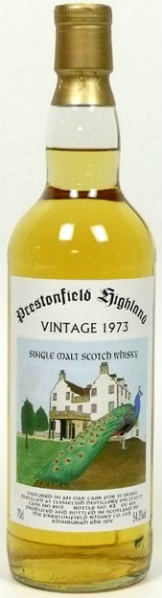
Clynelish 33yo 1973/2006 (54.3%, Signatory Vintage, The Prestonfield, Cask #8912, 405 bottles)

At last a new review at Master Quill! Some kind of throat infection and a Polish vacation stood in the way of writing some new reviews. But now all’s well and time to do some tasting again! I’m also happy to inform you that at last today was a day that made me forget about the half-year winter we had. First time it was really nice to sit outside in the sun, with even a nice cup of coffee and a little cigar, a Vegueros Seoane I reviewed more than a year ago.

Let’s get out some Clynelish. This Clynelish was officially bottled by The Prestonfield Whisky Company Ltd. which is just another moniker for the Signatory Vintage Company. There is also a second bottling of a 1973 Clynelish, of sister cask #8913. Under the Signatory label, Casks #8914 and #8915 were bottled in 2006 and 2007. These last two bottlings mention a Refill Butt, so this one here is probably from a Refill Butt as well. All four Butts were bottled as 33 year olds.

Clynelish 33yo 1973/2006 (54.3%, Signatory, Prestonfield, Cask #8912, 405 bottles)This Clynelish was distilled July 23rd 1973, a year Brora was still open but not very active, if active at all. As we all know, 1972 was Brora’s finest year, or so it seems. Time to find out what they did one year later at Clynelish…

Color: White wine

Nose: Farmy, with butter and old wood spice. Sweet and sweaty. Dusty and above all lots of beeswax. Typical Clynelish and a typical old Whisky. Also a fresh sea-air note. It has some hints that make me think this was a Fino Butt, but it could have been a Bourbon cask as well. Nothing is particularly Sherry in this one. It’s mainly oak (which here is a very lovely smell), and wax. It does tend to smell sweet, but not very fruity. Not fruity at all.

Taste: Sweet and again the spicy waxy wood. Great and elegant! Who said old whiskies are overly woody, and who said wood is a bad thing. Not in this one! This taste is a great example of how wood can taste when it’s carried by some sweetness and waxiness. It’s fat! Mocha, milk chocolate, toffee and again very Fino-ish. Later on a toasted not emerges accompanied by some sea weed and wait for it…It’s medicinal! The elegant wood lingers on and stays in the finish for quite some time.

A whisky of great balance, what you smell is what you taste (WYSIWYT). When I think of it, no, it’s still not very complex (but it is pretty sweet). Just like a Prestonfield Ben Nevis 1975. Also fabulous tasting whisky. That one is almost a Scottish Bourbon, yet also not very complex.

Points: 91

Clynelish 32yo 1974/2006 (58.6%, The Whisky Fair, Bourbon Hogshead, 266 bottles)

After the 1994 Clynelish I reviewed last summer, it took me a lot of months to return to Clynelish. As we all know, Brora 1972 (from the old Clynelish distillery) might be the closest thing to whisky heaven, I know there are more, but bear with me. The distillery built next to the old Clynelish distillery is the current (new) Clynelish distillery, so in fact what we heave here is a whisky made very close to heaven, close in space and close in time. Luckily to keep the legend sort of burning, Clynelish managed to keep up the quality and still makes a pretty decent Whisky. The 1994 reviewed earlier, was above average, now let’s have a look at this 1974 Clynelish.

Clynelish 32yo 1974/2006 (58.6%, The Whisky Fair, Bourbon Hogshead, 266 bottles)Color: Gold

Nose: Slightly farmy, leafy, clean and fruity. Old wax, but more wax off, than wax on. Rather fresh and lively. Dried apricots. Dusty paper, and  powdery. Vanilla. Bold (sour) wood, which is not up front. Naked oak, hence the sourness that sticks to it. It’s not particularly woody, but it ís the wood that keeps it together. Some grounded coffee. Cold cigar tobacco (Havana naturally). Musty clay and late vanilla. It’s not a Banff but I do ‘get’ some mustard here…

Taste: Wow! A nice attack of smoke, cannabis and hops. Creamy sweetness. Like true vanilla ice-cream with an apricot/mango syrup on top. Definitely a nice bite from the wood to accompany it all. The longer I keep it in my mouth the woodier it gets. It’s never too woody though. Quite strong, but it is almost 60% ABV. The finish lacks a bit of sweetness to round it all out. The wood makes it ‘pointier’ and dries out the lips. It does remind me a bit of the 1974 Rare Malts version, which was (also) no punishment to drink, but I liked that one a bit better.

This is one of many bottlings that are dedicated to one of earths finest Whisky festivals, or fairs, of all times. The Whisky Fair in Limburg Am Lahn in Germany that will be held at the end of this month. Of course this is long sold out, but new festival bottlings keep emerging as mushrooms on a wet forest floor, most of them pretty good, to say the least. It’s a very good Clynelish but the last part of the experience keeps it out of the 90 points range.

Points: 89

Lochside 18yo 1991/2009 (56.7%, Gordon & MacPhail, Reserve, Refill Bourbon Barrel #15220, 106 bottles)

Yet again we have one of the many 1991 Lochsides, and one of the many that were issued as a Gordon & MacPhail Reserve. This one was picked by Dutch retailer Van Wees. Gordon & MacPhail code for this one is JI/ACAC. The spirit was distilled on September 18th, 1991 and eventually bottled on October 15th, 2009. Picked by Van Wees in July 2009. Those of you that meticulously read this blog probably had a Deja Vu experience. We know this bottle, we know this lay-out. Well yes and no. February 4th 2013, I published a review of quite a similar Lochside, opened by Master Quill’s Apprentice (like this one). That was Cask #15217, here we have sister cask #15220, distilled and filled on the same day. This one was bottled some five months earlier, so here we have a chance to compare the two, to see what the effects are of another, but similar cask, and almost half a year of maturation…

Color: Gold (ever so slightly fuller in color)
Nose: Clean and fruity. Distant wood. Clay and organic. Dusty with smoked ham. All in good balance, but nothing pops out. A very quiet Lochside. The esters I remember from the “other” Barrel, are here too. Vanilla from the wood. The yeast is way down in this one, and there is no peat, rubber or petrol. It’s easier on the nose (more balanced), more rounded out, but also less complex. When nosing this a long time, slightly more (sour) oak comes along, but still not a lot, and it gets fresher, but in a mint and menthol kind of way. Also cherry liquor bonbons. The chocolate from them are in this Whisky too.

Taste: Sweet and farmy, with a great sweetish attack. Definitely less woody, at first, than the other Barrel. A nice peppery bite, next to the sweetness and the fruity, farmy notes. Again a nice big body, aided by the ABV. Honey and a great balance. Here too a chocolate liqueur bon-bon. Big body with a matching long and balanced finish. The wood is a lot more contained within this Lochside. Less vanilla though, so the wood reacted differently, it gave slightly more color, but less wood and vanilla. If you let it breathe for some time, the wood does play a larger role, and overall this is less “deep”.

You can’t go wrong with these kinds of Lochsides. There are a lot of 1991 bottles around, but they all are slightly different. sure the family resemblance is there, but I’ve tasted more of the 1991 G&M Reserve, and they all are variations of a theme. I feel it’s safe to say that some four or five months of extra maturation has a smaller effect on the maturation of a whisky, than te particular staves that were used making the barrel. Maybe I’m wrong. I just can’t imagine that the differences between cask #15217 and #15220, come from the small difference in maturation time. Here the “younger” one is more balanced but also less complex. For me I prefer the nose of barrel #15220 over #15217. Considering the taste, this one is easier, and less complex, but it has a better balance. All in all it’s definitely the same family, but the easiness, better balance and containment of the wood, the added farmyness and the difference in fruityness, makes me score this even two points higher. I just like this one better!

Points: 88

Thanks go out to Erik for providing yet another Lochside sample.

Glengoyne Week – Day 7: Glengoyne 37yo 1972/2010 (52%, The Nectar of the Daily Dram, The Nectar and Bresser & Timmer)

Oh no, we’re already at the end of the Glengoyne week, quelle misère! This is always the moment with a little bit of melancholy. That moment when you’ve been with a good friend for a week and you know he or she has to leave. Waving goodbye at the train station or the airport. Going home alone with a little tear in the corner of your eye.

We are going to see our friend from Scotland off with the only independent bottling of Glengoyne in this Glengoyne week, and the only distillate from the seventies, the rest being eighties and one fairly new Glengoyne on day one. Here we have also the only Glengoyne that was bottled by The Nectar from Belgium together with Bresser & Timmer from The Netherlands.

Glengoyne 37yo 1972/2010 (52%, The Nectar of the Daily Dram, The Nectar and Bresser & Timmer)Color: Sparkling gold.

Nose: Waxy and fruity, like an old Duncan Taylor Caperdonich from the same year. Honeysuckle, and lots of it. This is so good, it can be worn as a perfume, amongst Whisky drinkers that is. Floral. Given some time the Whisky noses more elegant. After the initial weight of the wax and yellow fruit (that dissipates), it becomes more fresh, like walking on the beach in fall. Clean, maybe. The wood kicks in too, I mean the wood is noticeable, also a slight toast to it. Spicy. This one has utter balance. Caperdonichs and Glengoynes from 1972, I you haven’t tried them already, do it! In a short while they’ll get extinct or priceless, and you’ll be the poorer for it, not having had the experience…

Taste: Sweet, fruity and full, I already don’t want to write more notes now, I want to enjoy my dram! Somebody has to do the job, so I’ll sacrifice myself yet again. Bugger! The syrupy sweetness goes smoothly into the spiciness of the wood. Lemon sherbet and more yellow fruits, some peaches, dried apricots? Cardboard and vanilla ice-cream. Just a slight imbalance in the finish, but who cares, putting this in your mouth again makes up for that, you’ll only finish the bottle a little sooner than you meant to do. The finish in fact is not that heavy too, a tiny flaw.

It is a great dram. I was only surprised that the waxiness together with the fruitiness are here in the beginning, just not here to stay in the nose. tastewise it does stay. Well picked by Mario Groteklaes.

So that’s it, we are done for the moment with Glengoyne, and we are done with the fourth ‘week’ on Master Quill. In the end this independently bottle of Glengoyne got the highest score, with an almost equally briljant and newer ‘summer’ edition in the runner-up position. Actually the odds were a bit uneven since this Glengoyne is from the seventies and therefore well older than the rest of the contenders, but who said it was a contest? Through the rest of the offerings reviewed in this Glengoyne week, it can be clearly seen that Glengoyne makes a high quality whisky with multiple facets to it. Keep up the good work!
Points: 92

Thanks go out to Nico for providing the sample!

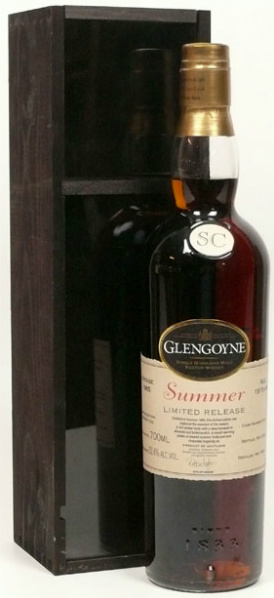
Glengoyne Week – Day 6: Glengoyne 19yo 1985/2004 ‘Summer’ (52.6%, OB, Cask #608, 606 bottles)

After the cold, cold winter we actually had (are still having), with lots of snow, I guess it’s time for a nice long hot summer! First day of spring went by some time ago, and it still was snowing on that day, so I guess we all need a bit of summer in our lives. Unlike yesterday’s 1984, 1985 is a year more common to find a Glengoyne from. In 2006 Glengoyne even bottled a sister cask of this ‘Summer’ edition, that was a Butt, so it’s probably safe to assume, that this is from a Butt as well.

Color: Dark orange brown.

Nose: Typical musty Sherry. Spicy and leafy. Butter, honey and raisins. Mocha coffee. Coal and tar. This is by far the best dark Sherry cask up untill now in this Glengoyne week. A slightly acidic freshness, like lemon pie inside a raisiny heavily sherried dram. Dusty old polished wood, with ageing lacquer on it. Dark fruits emerge afer a while, Blueberries! Perfect balance and lots of character.

Taste: Big body, spicy with just the right amount of wood, and almonds. Did I say wood? It’s not just any kind of wood, this is tarry wood, steam locomotive wood. Blueberries infused in honey, with some added acidity. Again very balanced stuff this. It reminds me a bit of the great Longmorn’s of the early seventies. Those are legendary, and Glengoyne were able to make this in the mid eighties! Were are it’s sister casks?!?!

This cask was bottled in 2004, so it wasn’t around anymore when the mashmen of Glengoyne made their choices, so let’s call this, this consumers choice.

Points: 91

Thanks go out to Erik (Master Quill’s apprentice) for providing the sample.