Two weeks ago I had a Talisker tasting and unofficially a Port Ellen aftertasting. Somehow one bottle got left behind by its owner. It’s leash bound to a great oak tree, and you can see its sad, not being surrounded by its usual brothers and sisters. I asked its owner if I could play a little with this lost bottle, and he said it was OK. Just to be sure I will bring it back in January. So yes, Master Quill is giving this stray puppy a refuge in Master Quills castle. Nice and comfy near the fire-place.
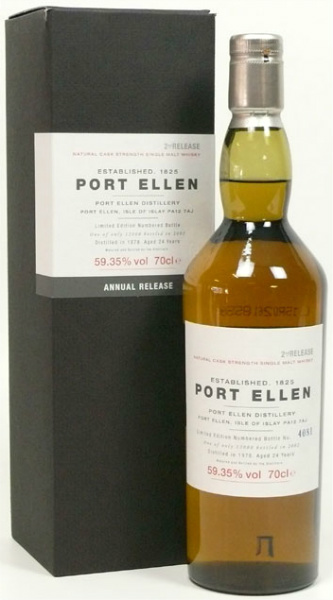 How nice it is to have another Port Ellen on these pages. This one in particular plays a strange role in the Port Ellen annual release series. First of al this strange ABV. 59,35%. New Japanese measuring equipment on loan? No it’s not that. This one is known to be a little closed. Very closed in fact. I had the chance to try this expression when it was freshly opened and it was really hard to taste this. Very hard to tell what is in there. It was nice, but nothing you’ve come to expect from such a Port Ellen. This time around the bottle is open for a while and less than half full. Is this, one of those whiskies that has to be put on the shelf without its cork, to maximize its breathing? Lets see…
Color: Light gold.
Nose: Leafy, nice liquorice laden peat. And the peat is not very bold mind you. Creamy ashes and some dust. Still it’s closed. I’m trying really hard, even warming the stuff in my hands, with a lid on my glass and without. Yes it does work a little. Doing this trick, brings out a big nice bonfire. Even though it is unbelievably closed it shows a lot of balance. Sniff hard on this one (and you’ll get a new layer of spicy sweetness).
Taste: Yeah! Leafy again, strong, and slightly bitter. Black tea with almonds. Rather sweet and seaside peat. Not completely balanced due to some sourness, from the wood, that takes over the palate straight into the beerlike finish, but the effect doesn’t last. there is a fruityness about it. Like pineapple (sour and sweet), with dried apricot and banana. The finish breaks apart a bit, but you’ll still see the quality. Long finish though.
 Well it does demand of you that you’ll work on it since it doesn’t give away its treasures easily, especially on the nose. Probably not the best from the series, but still it oozes Port Ellenness. It is an experience. Freshly opened bottle scored 87 Points, but after extensive breathing I’ll score this:
Points: 87 (sorry no change)
Heartfelt thanks go out to Jos for leaving this bottle behind!
 Earlier I reviewed a
  A week ago “Het Genietschap” had its first ever tasting at my house. I’ve been a member for quite some time, but it took a while to get my ‘location’ added to the agenda. Well finally it was my turn. The organizer gets to choose a ‘theme’, and mine was “Talisker”. When I sent out the E-mail I got a lot of Talisker 10’s as entries, and even some replies implying that there wasn’t a Talisker in the house. Well that got me worried for a moment. My guest of the evening, Erik, asked if he could bring his
  Best bottle in the tasting was a young Port Ellen 15yo bottled by Cadenheads in 1996, Stunning! It was just a tiny bit better, or better: different, than the also stunning Talisker 20yo 1981/2002 (62%, OB, Sherry, 9000 bottles). Also the pre Classic Malts Talisker 10yo was fabulous. Even today’s 10yo is pretty good, but can’t be compared to the taste of the old bottle. This ‘Tactical’ wasn’t bad either…
 Hello November! Looking outside, this month seems to bring us damn close to winter. Here we have a bottle of Brora 1981 bottled by indie bottlers Ian Macleod in their Dun Bheagan range. Ian MacLeod have a few other brands you might know. The Chieftains Range or “As we get it” for instance. The company is also the owner of the Glengoyne distillery, which is one of my favourites. Go!
 Color: Orangey Gold
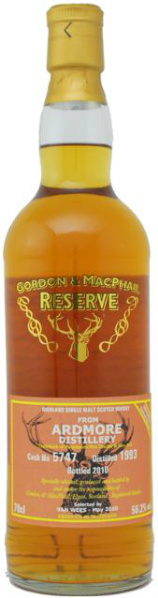 Let’s do another Ardmore and compare it to the day before yesterday’s offering by The Whiskyman. We all know that 1992 is somewhat of a good vintage for Ardmore. So let’s see what happened in the distillery a year later. This 1993 was bottled by Gordon & MacPhail and they were so kind to do that for Van Wees of The Netherlands.
 Dominiek Bouckaert is known for being the billionth ICT guy that does something in whisky. When I started with whisky I was an ICT guy myself and of course was introduced to the stuff by another ICT guy. In fact I was introduced to Whisky by two of them. One was partial to Laphroaig (eventually my first self bought Single Malt), and the other was more into Talisker (I’m something of a Talisker-collector now).
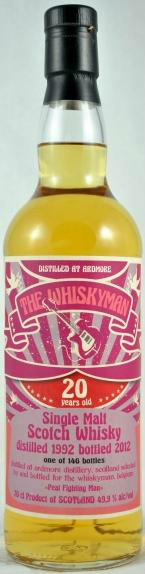 Besides ICT, Dominiek took it upon himself to dabble a bit with distribution of the Malts of Scotland (A german bottler) and play a bit with Luc Timmermans doing their Hand Written Labels. and last but not least, Dominiek has his own label now. The Whiskyman. Nice psychedelic colorful labels with a wink, wink, nudge, nudge to music. Beatles and Stones to start with, and this is an example of the latter called peat fighting man.
 Color: Full Gold
 And here is Ardbeg. Last of the Islay whiskies to feature on Master Quill. The first Ardbeg is also the last one being released. Ardbeg Galileo. A Whisky that in part was matured in Marsala Casks.
 Galileo Galilei was born on February 15th, 1564 and departed from this earth on the 8th of January, 1642. Galileo was an Italian physicist, mathematician, astronomer, and philosopher who played a major role in the Scientific Revolution [
 I hate to say it, but aren’t “Ardbeg” putting more money into marketing than in the actual Whisky? Don’t get me wrong, I love Ardbeg, just look at my
  Color: Light Gold
 Again we have here a distillery with a fire. But this fire forced the distillery to close for three years! This happened between 1917 and 1920. After that, like with many others, the years of expansion. Today Dailuaine is in the portfolio of Diageo and mainly used for the Johnnie walker blends.
