It’s almost a year ago I review my last Balvenie, and since there are lot’s of them around, why not have another look at a product from this distillery. Up untill now I reviewed some Balvenies with an age statement, this time I’m going to have a look at a Balvenie from a vintage, 1989 to be precise.
Those of you who know Balvenie, know that one of the best Balvenies around is the 21yo Portwood. yet in 2003, a vintage Portwood saw the light of day, this 1989 but also a 1991 exists. Two years later, in 2006, a 1993 vintage was released. I haven’t tried this 1993 yet, but earlier the 1991 was rather disappointing, still it fetched 78 points. Let’s have a look if this 1989 is any better, maybe even as good as the famous 21yo!
 Color: Pinkish gold.
Nose: Buttery, and creamy. Sweet cookie dough, but also a slight woody and winey note is present. The more this breathes, the more a spicy woody note comes to the fore. Red fruit hard candy. Quite dusty after a while. Vanilla and dough again. Also some candied sweet tangerine skins.
Taste: A sweet candy note, malty and quite dull at first. The Port even though is not heavy, dominates the palate, still it dominates in a transparent way, since it lets through the malty distillery character of Balvenie. All in all a funky battle between winey wood, (with a slight bitter edge to it), and it’s sweetness. Definitely some citrus in here, Tangerine or sugared orange skins.
Again a very nice and never misbehaving Balvenie. Nothing wrong with it, but it also doesn’t stick out either. This Balvenie will also never drive to fast or smoke a cigarette where it isn’t allowed. It obeys. It isn’t bad either, but for me a little bit boring. Still it’s a Portwood, and it isn’t harsh as some whiskies that came in contact with Port pipes can be. The aroma’s fit well together, so it has good balance. A bit weak with its 40% ABV, but it offers yet another variation on the Balvenie theme, again with a lot of reduction.
Points: 83
 Color: White Wine.
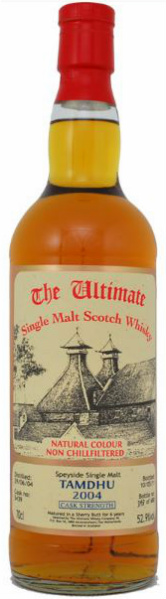 Color: Pale gold.
 Looking at the history of The Ultimate, most bottlings up untill 2005 were bottled at 43% ABV, and after that at 46% ABV. Sometimes however, a cask strength Whisky is released. Sometimes as a ‘Rare Reserve’ release, sometimes because a Whisky just doesn’t respond well to water and sometimes, being the Whisky lovers they are, they leave a Whisky be. It’s already good and it would be a shame to reduce it, let’s just bottle it.
 Color: Pale gold.
 Color: Light gold.
 Color: Honey gold.
 As I said, lots of discussion, since all casks are good, didn’t cost a lot and have some differences. So nice whisky to compare to each other. I still have some Sherry Butt #72315 left, so I can compare it to this Sherry Butt #72319. Word in the grapevine is that the first one (Sherry Butt #72315) is the “worst” of the three, all are very clear about that. Some consider Sherry Butt #72318 to be the best and some Sherry Butt #72319.
 Color: Copper Brown (less red/orange in color than Sherry Butt #72315)
 Color: Copper
 Color: Copper Brown.
 Well hello Blairfindy! Wait a minute, Blairfindy isn’t a real distillery is it? As far as I know, there isn’t a Blairfindy distillery, and there never was one too. No, Blairfindy turns out to be “another” name for Glenfarclas, used, when the bottlers weren’t allowed to use the real distillery name on their labels. Something like Tactical for Talisker, Leapfrog or Laudable for Laphroaig and so on. Blairfindy, amongst others, was the name of the farm, the Grant family (of Glenfarclas fame) originated from. Although the Glenfarclas name isn’t on the label, it most definitely is a Glenfarclas, and an old one to boot…
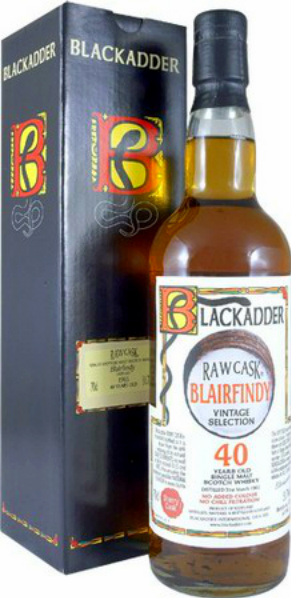 Color: Copper gold.
