 Santpoorts Bier is a very locally brewed and sold beer. It is made in Hillegom by Brewery “Klein Duimpje” (Tom Thumb) and made for the “community” of Santpoort (near Haarlem in The Netherlands). With the proceeds the instigators hope to fund their own brewery in Santpoort (2020). This first Santpoorts beer is called a Blond Tripel and boasts a hefty 8.5% ABV. Blond as in blonde or a lightly (colored) beer, and Tripel after the Belgian Abbey and Trappist beers. Looking at the list of ingredients: Pilsner malt, Carapilsner malt, Munich malt, wheat malt, Challenger hops, Saaz hops and yeast. It doesn’t seem to be a Belgian Style Tripel, since a lot of typical Pilsner malts are used, so somehow I’m expecting a more Pilsner style Beer that is higher in alcohol.
The beer I’ll be reviewing here is from the first batch (best before date: July 2014, I aged it a little). By now, a second batch has been released called ‘Reprise’ (orange label again) as well as a winter beer (blue label) and a just released Spelt Weizen Beer (green label), that isn’t even on their website yet!
 Color: Lively, yellow, almost orange gold. Murky, with a lot of yeast deposit. A lot of ivory foam.
Nose: Fresh and spicy, fruity (banana and peach without the sweetness). Very appetizing. A city after the rain and a distinct hint of warm plastic. The beer starts out fresh, lively and fruity, but quickly turns into something more broody. Can’t quite put my finger on it. Pretty “dirty” if you ask me. Fresh egg-white and new wood. Whiffs of cold dishwater. A very unusual nose. After half a year of ageing the nose didn’t change much (I’ve tried this beer when it was just released).
Taste: Dark, and a nice hoppy bitterness which almost seems woody. Pretty fruity, hot butter and has a lot of fresh (baker’s) yeast and a note of polyester. This polyester component is also easily recognizable in Hoegaarden White. Polyester is a maybe bad word here, but I’m using it for lack of a better word. Santpoorts Bier isn’t warming so it seems a lot lower in alcohol. This beer is advised to drink at 10 degrees Centigrade, but I like it better, when its colder. It finishes a bit like a Pilsener does, with its typical acidity, but the perfect bitterness this beer has, does a lot for balance. When freshly brewed, it was said to be nice already, and doesn’t need a lot of ageing. I tried it a few times and not a lot happened in half a year. The beer seems young (easily recognizable in the yeast taste, it has a lot of fresh yeast notes, ánd a lot of yeast in the deposit), but most definitely has it’s potential.
I’ve opened a lot of bottles of this to have people taste this and it is a very vigorous beer. You can’t Always open it without spilling some (and in some cases, a lot). In the glass the little yeast balls are moving around very quickly, like a speeded up lava lamp. Quite a stunning view. The beer is very lively!
Conclusion. To me, this first batch seems to be somewhat of a work in progress. It does have its charm, but it isn’t perfect yet. Overall I like the beer, but I didn’t care that much for the polyester notes and the “Pilsener” finish, but the start and the body (the middle part) are already quite good, as is the perfect bitterness of this beer. The brewers are on the right road, but in my humble opinion, some more work has to be done. By now a second batch has been produced, called ‘Reprise’ which I haven’t tried yet.
Points: 74
 The Tongerlo beers are brewed by brewery Haacht, and they are doing so since 1990 (when they got the rights to this Abbey beer). I’m sad to report that a few years ago, brewery Haacht, in all its infinite wisdom, have decided to delete
  Even this new Tripel got the chance to age for 2,5 years after it’s best before date. You may think I’m mad, but with most Belgian beers it only adds to the character, don’t worry you, won’t get sick. Breweries are obliged to put a short-term on the label, but are starting to add the bottling date. Frank Boon decided to stretch the best before date far beyond the standard three years and easily puts best before dates twenty years into the future!
 Color: Orange yellow with some flakes (due to ageing). Almost white foam.
 The last reviewed beer,
  My good friend of “I think about beer” did a
  Westmalle is one of six Belgian breweries that are ‘protected’ by the Authentic Trappist Product logo. Achel, Orval, Chimay, Rochefort and Westvleteren are the others. The logo was presented to discern the trappist beers from the more and more widely available ‘abdij beers’ of Belgium and other countries. (Abdij = Monastery). Most of those beers aren’t even brewed near a monastery, but commercially brewed under a licence. Still, it’s the same style of beers. Usually with a blond beer at normal strength, a dark “Dubbel” and a heavy blond “Tripel”. occasionally a very heavy “Quadrupel” exists.
 It is not only beer that falls under this logo, and not only Belgian beer to boot. Here is a list of all products that fall under this logo.
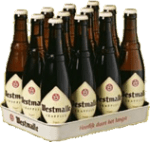 Nothing for the novice. The bitterness is quite a bit of the character. Beware because ageing makes this beer less fruity and more deep and bitter. The label, the bottle, the iconic WA-logo, the smell of it all. It breathes a time long forgotten, pré WW I. You consider yourself back in the thirties. A high score, but not necessarily your easy, every day choice. This is a classic.
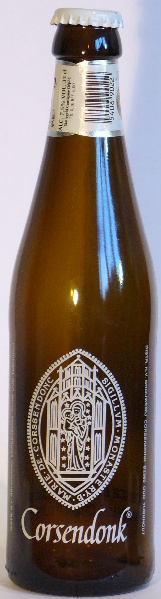 Let’s try another Tripel.
  As you know life is hard. For this review I had to drink three bottles of the Corsendonk Agnus. I bought a couple of bottles a long time ago that were brewed in august 2006. I tried one of those earlier when it was around three years old, and this time I’m trying two, of the same batch, that are now six years old. Yes you can drink Tripels well past their dont-drink-or-you’ll-die-of-food-poisoning-date. Finally I also bought a new one that was brewed in february 2012. Following notes are for the aged ones:
 Well first of all, after the prolonged ageing period, the beer turned a lot darker, than the same batch at a younger age. Originally it was radiant gold, now it turned a lot more copper. The meaty part on the nose disappeared, but it gained a lot of fruity esters. With this it gained a lot of complexity. The three-year old one was more refreshing (more lemon), but this still is refreshing. It gained more depth, but it didn’t even change that much, tastewise. It is easily recognizable as a Corsendonk Tripel. Personally, I find six years of ageing a bit too long. I think it is at it’s best, around three years old. The new batch was, in comparison, very light and really easy to drink, with an aftertaste you only know of your standard beers. After seeing it’s potential I would recommend ageing your bottles for three years. But if you’re interested, longer can be quite fun too. Drinking this right after you bought it is a waste of your money. Put it in your cellar and be patient!
 After the fabulous
  It’s all right. An example of a typical Tripel. I prefer other Tripels, which will be reviewed eventually. After the Pale Ale this is a bit disappointing. Maybe I had too high expectations for this? It reminds me a bit of a Duvel, but Duvel is better (for me). Don’t get me wrong, this still is a pretty decent beer, but for me it doesn’t add anything to the world of the Tripel. Actually, maybe this isn’t even an Abbey-style Tripel. But a heavy Blond Ale with a third fermentation in the bottle (which a lot of people call a Tripel). It just has to decide which one of the two it really is.
 Master Quill