Heaven Hill 9yo (61.5%, Cadenhead, Individual Cask, Bourbon Barrel, 192 bottles, 2006)

All that talk about soapy florality in the Millstone “100 Rye”, made me remember this bottle of Heaven Hill bottled by Cadenhead. Actually this is a very interesting bottle since it is from Heaven Hill’s previous distillery. Heaven Hill Bardstown FireThe Heaven Hill distillery was located in Bardstown (DSP-KY-31) and it burned down on the 7th of november 1996. With the distillery, also 7 of the 44 warehouses were destroyed by the fire, containing some 90.000 casks. Even the water supply caught on fire. Since this bottle is 9 years old and bottled in may 2006, it is distilled somewhere between may 1996 and may 1997. The new distillery, Heaven Hill bought, is the former Bernhem distillery (DSP-KY-1), which is located in Louisville. The Cadenheads label clearly states that the distilling was done in Bardstown, so this means that this particular bottle is yielded from a single cask that was filled just before the fire and somehow managed to survive the fire, assuming it was ageing on site. One question thus remains, is this Bourbon going to be smoky or did it sleep through the fire?

Heaven Hill 9yo (61.5%, Cadenhead, Individual Cask, Bourbon Barrel, 192 bottles, 2006)Color: Dark orange brown.

Nose: Initially very floral, but that somehow manages to escape. Typically high Rye mashbill florality, or is it wheat, since this does remind me quite a bit of the very special Old Fitzgerald 12yo, also distilled by Heaven Hill. Otherwise not very “big” but soft and dry, dusty even. Caramel. Toasted cask. Hints of gravy and toffee. Soft oak and a bit sweet. Promises some sort of chewiness. Pretty is probably a good word for it. Give it some time, or better, al lot of time to breathe the more classic notes emerge, like honey, which finally defines the sweetness. The honey is well-integrated with the woody nose. Burnt wood yes (cask toast), but not smoky.

Taste: Quite a woody bite and there you have it, quite the soapy, floral Rye experience. A lot of flowers pass over my tongue. Lilac, lily-of-the-valley, lavender and tulips. Wow I never got this before! Grannies laundry. Very unusual stuff. The florality disappears down my throat, leaving me with a less floral finish than I initially thought. The aftertaste is more centered around a burnt toffee and creamy soft caramel, wood and soft leather. Only a mere hint of florality. Very unique and layered Bourbon. Never tried anything like this before. Even the most floral Four Roses, is not as floral as this. This one needs some time to develop and definitely needs time get used to. In no way is it a bad Bourbon though, but this will never be your average daily drinker stuff. Very educational. I’m pleased I came across this one.

Again a very good reminder that many Whiskies, whichever kind, need time and air to breathe and compose themselves. A lot is said about using water with Whisky, but air is just as important as water. I prefer giving Whisky some time. Maybe I should be starting to decant my Whiskies some more?

Points: 82

Millstone 8yo “100 Rye” (50%, OB)

Millstone 100 is a small batch Dutch pot still distilled Rye Whisky (without an extra “e”). This is a review about one of the earlier bottlings, because by now the look is different. The glass bottle is the same, but the label is now black, more in line with the rest of the Millstone Whiskies, although across the line some different shapes of bottles are used. The new black label informs us of the many different guises of the number “100”. The whisky is a minimum of a 100 months old and is bottled at 50% ABV. (The American 100 proof), and the Whisky is made from 100% Rye and only filled into new American oak only (100% again). The use of the American proofing system and the use of American new oak casks makes it obvious what kind of style of Whisky to expect. 100 Rye is made from 49% malted Rye and 51% unmalted Rye.

Zuidam Distillers was founded in 1975 by Fred van Zuidam under the name Baarle International. Earlier, Fred worked some twenty odd years at De Kuijper in Schiedam after which it was time to start for himself. He bought a piece of land in Baarle Nassau and built his distillery there, starting with a range of high quality liqueurs, basing his recipes on the best ingredients he could buy. Next step was the distillation of the traditional Dutch drink: Jenever, the spirit Gin was derived of, both sharing juniper berries as an ingredient. 

Today the distilling is done by Patrick van Zuidam, the son of Fred. Gilbert, the other son is handling the business end of the distillery. Patrick had a passion for Jenever and Korenwijn and from that started experimenting with his dream drink: Whisky, resulting in the Millstone line of Whiskies. By now a lot of Millstone expressions have seen the light of day, of which this 100 Rye is a very succesful one.

Millstone 100 Rye 8yoColor: Copper orange brown.

Nose: Sweetish and thick in its aroma, straying away from the American Rye’s which for ma always have a sort of florality in the nose. This one is very clean and closer to a fruity nose. Initially maybe even sweet, with a lot of wood influence. Pencil shavings. The wood is easy and in no way overpowering. Small hint of soap. Well integrated aroma’s, but not very complex. The thick aroma from the starts dissipates a bit and dries out the whole, but memories of it come in and out. If smelled for a prolonged time, it reminds me a bit of Rum, or Rhum Acricole. Dry Rum obviously, including hints of red fruits and a fresh citrussy note. Lime and some delayed mint. Deep and fruity altogether.

Taste: Starts with wood and some sugary sweetness. Quite hot on entry with a nice bite. Here a little soapy florality is present. Rye it is then! Nice dusty wood. Sawdust and nuts. For those of you that also have tasted Patrick’s Jenevers and Korenwijn, there is some of that in here too, unmistakable. For me this Whisky has a special effect as well. After the big body, the finish seems a bit weak at first, but after that a bigger aftertaste emerges. And a very tasty aftertaste it is, with some sweet orange, nice. Over time the finish grows bigger too. This Whisky need some time to breathe to grow a bigger finish, but I have to say that more air also hurts the balance a bit, since the dryness and the wood really take over and the florality stays soapy.

Ain’t this something. It has hints of Jenever and Korenwijn, smells a bit like a Rum, but is a Rye Whisky with quite some evolution over time. Well done, I have to try a newer bottling to see if Patrick has dealt with the soapy florality, then again, maybe it’s just me.

Points: 81

Bushmills 12yo “Distillery Reserve” (40%, OB, Oloroso Sherry Casks, Circa 2006)

1608. The Old Bushmills distillery got its licence in 1608! It was King James I who then issued the licence to distill to Thomas Phillipps. As most of you very well know, this makes The Old Bushmills distillery the oldest licensed distillery…in the world (Jeremy Clarkson voice-over). Try to imagine how long the distillery may have even existed before that. Since then the distillery was in and out of production many times.

More recent history then: Diageo bought the distillery in 2005 for £200 million, only to trade it with José Cuervo (Tequila) for their 50% share in Mexico’s Don Julio Tequila brand, making Diageo the sole owner of Don Julio. Don Julio was founded in 1942 and is the eleventh largest Tequila brand in Mexico. For the time being I prefer 1608 over 1942…

Bushmills 12yo Distillery ReserveColor: Full gold, slightly “red”

Nose: Creamy with lots of vanilla ice-cream soaked into some shiny cardboard. You must know Vanilla ice-cream from a paper cup. Cheap milk chocolate or fake milk chocolate. Give it a minute and a more fruity note appears. Red forest fruit. Mint infused warm chocolate. Weak after eight. The mint fondant nose stays on. Hint of funky red Sherry. The whole is very restrained. It almost because the glass won’t let it go, or smelling the spirit through a neutral cloth. Molten ice-cream, weak milk chocolate and mint fondant, that this nose in a nutshell. Oh, and some cardboard…

Taste: Fruity and quite sweet. Fruity toffee, which should have been sticky, but tastes watery here. Again a Whisk(e)y that should have had a higher ABV. Remnants of fortified wine. Red berries and black currants I also get from Redbreast 15yo. Here also quite some vanilla. Tiny hint of burnt wood, but also the big paper note from the nose. Recognizable as an Irish Whiskey, but for me it’s also a bit flawed. It has a great side to it, but also a not-so-great side. Paper disturbs me, and takes away from the pleasure of drinking this. It wants to be a Redbreast 15yo or a Jameson’s 18yo, but falls rather short. Equally annoying is the finish, or lack thereof.

If you concentrate a bit, you can taste the sheer potential of this Whiskey. It could have been great since there are many likeable notes in here. Alas some off notes (paper) and the weakness of the whole ruin it for me. I hate to play the where-is-the-finish game. A damn shame, for I believe a potentially great Whiskey was ruined.

Points: 77

Glenfiddich 18yo “Ancient Reserve” (40%, OB, Circa 2003)

Glenfiddich. Often scoffed at, but never really disappoints. I’ve tried quite a few and all are decent daily drinkers. Older expressions (expensive!) can be really stellar. Sure, Glenfiddich is often reduced to the max, 40% ABV, but sometimes, some more alcohol is possible too, like the Distillery Edition that was bottled at 51% ABV. The higher alcohol, transports the flavours well, so I’m a firm believer in upping te ABV with Glenfiddich to show people with a prejudice against Glenfiddich, that it actually is not that bad. Sure, often not a super-duper malt as well, but surely nothing to scoff at. Today we’ll be looking at an 18yo that is no longer with us, but should still be available if you look closely enough. The 18yo “Ancient Reserve” is blended from Whiskies from Sherry and Bourbon casks, but in this case also from virgin oak casks. The tree are married in a large Solera Vat, using the Solera system.

Glenfiddich 18yo Ancient ReserveColor: Full Gold.

Nose: Waxy and extremely creamy, with definitely quite some Oloroso Sherry influence. Smells quite good. Traits of all casks are clearly noticeable. Vanilla and creamy Bourbon wood and some thick Sherry. Candied apples. I can’t say if the Sherry is from European oak or not. Not a lot of tannins happening on the nose. Sweet peach yoghurt. All aromas are nice and creamy and integrate very well. Waxy fruit. Candied fruit mixed with a hint of yoghurt like acidity and some fresh air. A mere hint of toasted cask in the background and even a tiny hint of waxy apple skins. With air it becomes more dusty and dry. Creamy vanilla holding it’s ground. Not the most complex of noses, but very pleasing nevertheless.

Taste: Very smooth and waxy again, but that dissipates quickly. Well even before I can write down what else I taste, it’s already gone, as is the finish as is the aftertaste. Wow, quickest Malt I have ever tasted, and no it’s not a bad sample. Will this be another story about reduction? Well let’s take another sip, and another, better keep focussed now before it’s all gone. Waxy, nutty and woody. The wood is slightly acidic. Sherry influence, and … Wait a minute, it’s gone again, will have to take another sip. Bare with me. Creamy Sherry and an instant of sugar. Sweetish, Sherried and fruity. The wax carries a woody bitterness towards the end. Smells better than it tastes, although the taste isn’t bad, mind you. Vanilla powder, candied fruit, dried apricots. Nice development. But very weak going into its finish. Funny enough, in the aftertaste some bitterness appears. New wood?

40% ABV is to low for this profile. For the US market this was bottled at 43% ABV. Still quite nice, and better than the current 18yo. Alas this Ancient Reserve was discontinued in 2008. If I could find it for a decent price, I would get it, but I fear it would also be quickly gone. A real shame this got discontinued, especially since the current 18yo is no match for this one.

Points: 85

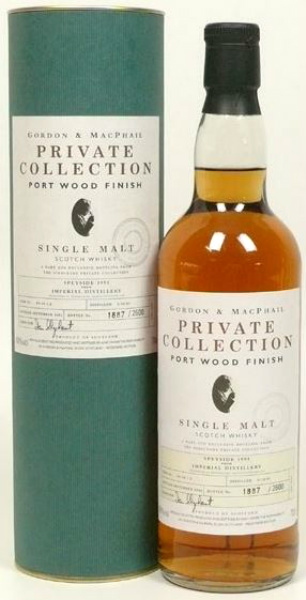
Imperial 9yo 1991/2001 “Port Wood Finish” (40%, G&M, Private Collection, Cask #99/48 1.2, 2600 bottles)

Back to some Whisky. This time around we’ll have a look at a distillery not only closed, but also torn down and already replaced. That happened quickly. In 2012 Imperial ceased to exist and just a few years later a new distillery was finished occupying the same very site. Many have thought that the new distillery would be called Imperial as well, when in fact it is called Dalmunach after a nearby pool of the river Spey. Imperial wasn’t hugely popular as a Whisky hence the new name maybe, but Pernod Ricard (the owners) never ceases to amaze us, by installing new stills replicating those of Imperial. Well in some time we can taste the replicated taste of Imperial, but for the time being let’s taste the original, shall we?

Imperial 9yo 1991/2001 Port Wood Finish (40%, G&M, Private Collection, Cask #9948 1.2, 2600 bottles)Color: Full gold with a slight pinkish hue.

Nose: Winey and candied red fruits. Easily recognizable as a Port finish. Barley, paper. New oak and some pencil shavings. Fresh-air notes, with some sugary sweetness following suit. Nice creamy vanilla mixed with fruity acidity. Typical American oak (the cask it was in before it was finished) but also some sandal wood. The Port integrated well and is used well. In those days experiments with Port finishes often went wrong since the Whisky was left in the Port cask for too long. The whole however is pretty simple and young. What you smell is what you get. Don’t expect a lot of development, if any, but keep in mind that even with the Finish, this Whisky is only 9 years old. Fruity Whisky. Smells nice. ’nuff said.

Taste: Sweet creamy vanilla and candy sweetness. Hard raspberry candy and sugar. A chunk of toffee, molten ice-cream and nice toasted cask that gives it a back bone. Milk-chocolate. Actually pretty tasty. You can taste the potential harshness of the Port. Winey yes, a bit, followed by a somewhat burnt synthetic aroma. The slightly burnt note from the Port cask stays around. If this was finished much longer it would have been over the top. It was arrested in its development just in time, which was quite unusual in those days, but I may have said that already didn’t I? Soft, smooth and tasty young stuff with a pronounced weakness in the finish-department.

Simple yet well tasting stuff. If only the finish would have been stronger. I mean the finish of the Whisky itself, not the Port finish. Still, even for a Port finish from the start of the new millennium, there is nothing wrong with this. Buy a bottle of this and expect it to be empty quickly. This time also nothing wrong with the low ABV of 40%. A higher ABV may have lengthened the finish a bit, but I’m OK with it as is…

Points: 81

Angostura 12yo “1824” (40%, Circa 2014, Trinidad & Tobago)

Are you mad? Reviewing the same Rum again? Nothing better to do? Well, at first I didn’t want to write two reviews about one Rum. I actually wanted to write one review about two Rums, expecting both to be the same, with just an upgrade in the presentation. When I was on my way writing the previous review, I grabbed this more recent bottling of the “1824” and was quite surprised about the difference when smelling it. I poured it back, without even tasting it, and right on the spot decided to break up the review and write two of them. So here is number two. By now we already know there is a difference in smell, but does it also taste differently? Let’s find out…

Angostura 1824 (2014)Color: Copper brown, ever so slightly lighter than the 2008 version.

Nose: Dry and woody with only a distant funkiness. Well balanced yet very laid back in the nose. Nice red fruity acidity kicks in. Dry vanilla powder and sugared almonds. Sugary in its sweetness as opposed to honey, caramel and toffee. There is vanilla. Smelling very smooth, almost elegant and sometimes perfumy. Sweet black tea with a tropical twist. Dried pineapple? It smells nice, smells like a decent brown Rum, but lacking something. It doesn’t smell like something special, but it does smell rounded out and appetizing. Also performs a bit poor in development. Altogether very middle of the road. Yes, smelling like an Abuelo, but that comes from a different place entirely.

Taste: Starts with red fruity acidity, sugary sweetness with some toffee. Warm diluted, but thin, caramel. Sugary with an herbal quality (cannabis), maybe that’s the influence of the wood. I imagine splinters taste like this. Quite simple with a short finish. Luckily this doesn’t remind me of the “1919” but this new “1824” isn’t one to be overly enthusiastic about as well. Bugger. At least Angostura was able to show its potential with the old “1824”. By the way, this Rum tastes better in big gulps. You need to concentrate it yourself to get the most out of it.

Well, there goes batch consistency. Quite worrying, the difference between a 2008 and a 2014 bottling can be so great, especially when the newest one isn’t the netter of the two. New and improved? nope, alas. Obviously they didn’t change the taste profile of this Rum with the new glass container it comes in, but if I were you, I would still seek out bottles looking like the one from the previous review. That one had a lot more going for it. This newer bottling is not a bad Rum, but the older one is a bit better better!

Tasting the old and the new “1824” side by side I now notice that the old “1824” is more akin to the old “1919” I tasted earlier. Having said that, the old “1824” is still a lot better than the new “1824” and both are better than the old “1919”. Capiche?

Points: 80

Angostura 12yo “1824” (40%, Circa 2008, Trinidad & Tobago)

A long time ago I reviewed the 8yo Angostura “1919” and to be honest, great quality, but it’s taste is not for me. Since then a long time has passed, tried the “1919” on many occasions and it still didn’t manage to grow on me. Well, sometimes that happens. Something like the saying about the organic matter and the personal-cooling-propellor-device…

As I said a long time has passed without the urge to try more Angostura and why should I, since the now defunct Caroni Rum also comes from Trinidad? I somehow liked all Caroni’s I tried better than Angostura “1919”. Finally time has come to try the older brother of the “1919”. A distinguished gentleman from the drinks business personally recommended me this 12yo “1824”, so I just had to buy it. Here goes…

Angostura 1824 (2008)Color: Copper brown

Nose: Initially sweet, but soon more funky, and dries out over time. Nutty start with nice wet outdoorsy clay. Like running with Wellington’s through the fields in autumn. A wonderful depth I didn’t expect, why? Just read the review of Angostura’s 1919 which turns out to be something completely different from this. Soft elegant notes of wood and even some red fruit scents. Red berries. After the Rum got time to breathe more and more vanilla surfaces, and for a moment I got scared this is developing into the vanilla I remember so well from the 1919. No, in this one it stays in check, it is under control, so to speak. A slightly burnt note appears as well, giving the whole some more oomph. The burnt note combines well with the dry woody notes that lies underneath.

Taste: A thin kind of sweetness to start with, with some burnt caramel and toffee combined with hints of red berries. Nice sugared fruity sweetness. At 40% ABV, it tastes a bit thin, but the aroma’s are lovely. Not overly complex, but it works well as a whole. Nice sweetish and warming. You can sense there is more to this Rum than meets the palate, but it probably is reduced too much, weakening that mystery. I’ve said it before, and I won’t say it again. (Hint: it’s about reducing too much), there, I’ve said it anyway! The funkyness from the nose is present again in the finish and aftertaste, where a sweet and slightly burnt not have the longest breath.

I scoffed a bit at the Angostura 1919. I can recognize the quality of that Rum, but after drinking the whole bottle over a prolonged period of time, I never got around to like it. In the world of Rum it is my main example of a decent Rum I really don’t like. It may work very well for you, but it is most definitely not my cup of tea. This 1824 however very much is my cup of tea. With nice Rum funkyness we know from Jamaican high ester Rum, and Borgoe 15yo to name but a few. Nice.

Points: 85

Dos Maderas PX 5+5 (40%, Spain)

Well after the fairly unusual rant of the last post lets leave the Whisky (business) behind and focus on some Rum. My other favorite distillate. A wonderful complement to the Whisky world. Oh yeah! This time around we” have a look at a Spanish Rum, although the Rums themselves come from Barbados and Guyana, places we know make excellent Rum, so if you can’t make top-notch Rum yourself, buy the best you can.

Dos Maderas is the Rum brand of Spanish Sherry producers Williams & Humbert. Williams & Humbert have a long history already, which, if you’re interested can be found all over the ol’ interweb. Remember, Google is your friend. Alexander Williams and Arthur Humbert started their wine-business in 1877. By 1972 the company was sold, and since then two times more. Current owners are the Medina’s who worked at the bodega and wanted it for themselves.

As I mentioned above, Williams and Humbert buy their Rums from Barbados and Guyana. Both Rums are approximately 5 years old. In Spain they are aged further for three years in cask that previously held a Palo Cortado Sherry. Part of this is bottled as the 5+3 expression. Another part is then further aged for another two years in casks that previously held PX Sherry, thus giving us the PX a.k.a. the 5+5. By the way both Sherries mentioned above, aged for twenty years in these casks, so these casks should impar a lot of aroma. Let’s see…

Dos Madeiras PX 5+5Color: Dark copper brown.

Nose: Smells extremely sweet. But also the liquid makes you believe that, since it is very syrupy. Hints of burnt sugar and definitely some Pédro Ximenez. Besides the depth this Sherry gives, it also impairs a fruity acidic note. Hints of paper and cardboard in the back and even some raisins. Not a lot of development and overall quite simple. Its like the sugar content this must have stopped its evolution and hides any possible form of complexity. Given the fact this contains 5 year old Rum from Barbados ánd Guyana, both highly aromatic Rums, the PX finish is a bit overpowering. That’s not bad, but its more about the PX, than it is about Rum. Altogether nice, but in a flavoured kind of way.

Taste: It starts with Rum, where the nose was more PX. Burnt sugar and Demerara qualities. Heaps of sweetness. It’s a light Demerara style which leaves room for the Bajan Rum as well. However, the PX takes the driver’s seat rather quickly and puts both Rum’s in the back to come along for the ride. Toffee, sugar and caramel, partly burned. Luckily there are some hints of vanilla and green olive (towards the finish). Hardly any wood. Finish is PX again. Aftertaste is PX as well.

I havent tried the 5+3 expression yet, and thus I don’t know if that one has some finesse to it. In this 5+5, the PX overpowers everything. I do like my PX’s, so I kind of like this, but it doesn’t have a lot to do with Rum. Maybe a shorter finish in the PX casks would have been better, and then they should be brave enough to call this 5+4 or even 5+3 1/2. But who am I to say so. Still good stuff though.

Points: 80

Talisker “Neist Point” (45.8%, OB, for Travel Retail)

Just a few weeks ago this new Talisker was released, not by Diageo, but by Diageo Global Travel and Middle East (GTME). What? I don’t know why, but why do I have the feeling I’m being more and more conned? First, lets back up a bit. Not so long ago you had Talisker’s with age statements like 10yo, 12yo, 20yo, 25yo and 30yo, I said, not so long ago. Longer ago we had a stellar 8yo as well. At a certain point, again, not so long ago, the 18yo was released. All of a sudden, the stocks were depleted and the owners saw that Whisky was fetching silly money all across the board. I get that, because you’re in business to make a lot of money, hopefully, so I get the prices that are asked today. It’s a question of simple economics, supply and demand. Supply, somewhat unknown, the demand high.

Screen-Shot-2015-04-09-at-9.59.34-AMConned I said. Now, we are getting NAS Whiskies, and I tell you why. We need a lot of stock of older Whiskies to make high-priced Whiskies with an age statement again for the future. Well the price I mention is uncertain, because you never know what we the public are willing to pay for our Talisker 18yo in ten years’ time. Thus a lot of young Whisky must be released with some added older Whiskies for taste, because Diageo found out that the traveller is mainly concerned with taste and not age.

So we saw a lot of young Whiskies enter the market place and top money is spent to convince us that it’s all about taste and not age, well, we are made to forget that age matters a lot when it comes to taste! As I said above, I understand that I have to shell out some serious money for my Talisker 18yo, 25yo and 30yo, but that’s my choice, since I do love those expressions, but I can decide myself if I want to spend that kind of money, now or in the future. Diageo doesn’t really care because if I won’t spend that money, someone else will, because we see a lot of people paying a lot of money for Whiskies these days. And it’s almost no use looking elsewhere (other distillates), since those prices are soaring as well.

So conned I feel (Yoda speak), because the latest Taliskers don’t have numbers anymore, but names. Storm, Skye, Dark Storm and now Neist Point. As I said before, there used to be a stellar 8yo, a stellar (Tomatin) 5yo, etc. Today those numbers are not wanted, not because they are low, lower than the modern standard, the 10yo, no. Those numbers are unwanted because they are still too high and still too much a restriction. And since we already made a leap in yield per field of barley, today’s young Whisky can’t be compared to the 5yo of yesteryear. The quality od Sherry cask today is also different from the old ones. So lots and lots of young Whisky is sold to us through NAS bottlings. Yes it’s about taste, but no, not that much young Whisky can be so good as is claimed, and that’s my conned feeling right there. I’m indoctrinated and I’m made feeling stupid by claiming that age doesn’t matter (never did) and hiding behind the statement that only taste matters.

Conned some more I say: Why the mystery? Making up a name, fine, give your Whisky the name of a lighthouse or a Hyundai car. It’s fine, I like the names and I like the screen printed lighthouse on the Neist Point bottle. We all know it’s mostly young Whisky, with some added older casks to meet a desired flavour profile. Diageo claims that the traveller doesn’t care for age, but does care for taste, but the traveler speaks some more, the traveller also wants smooth Whisky, the traveller wants smooth Talisker. But why? Talisker smooth? Laphroaig is also being made smooth. Why? Can’t we have anything not smooth anymore? Didn’t we like Talisker and Laphroaig rough? wasn’t Talisker called the lava of the Cuillins? Lava as in not smooth? Hot and peppery!

Even more conning: It was said that Neist Point (The Whisky, not the lighthouse) has a huge depth of flavour and showcases a wider range of Talisker characteristics. Combining precisely selected flavoured Whiskies with some of Talisker’s rarest and smoothest mature stocks. Yeah right. Will those of you that believe this raise their hand? Am I really to believe the rarest of all Talisker stock went into this and are not released as super-duper premium Whiskies now and especially in the future?

So instead of a nice rambling about the new Talisker I started ranting, sorry for that, it never happened to me before. Critical yes, ranting, nope. Why not try this new expression of Talisker and see if it still has some lava in it. By the way, in the past Douglas Laing bottled some smooth Talisker’s. Back then, these casks didn’t match the Talisker profile and were sold off to be used in blends, now they are especially sought out and used for Talisker Neist Point… [fanfare music is playing and curtain rises…]

Talisker Neist Point (45.8%, OB, for Travel Retail)Color: Gold.

Nose: Some light smoke. Barley sweetness, and some old Sherry wood. Tiny hint of cask toast, but very mellow altogether. Hints of citrus. There is some sweetish freshness in the back, lemon and unripe tangerines. Crushed fresh almonds, mixed with some sweet and fatty peat. Mind you not a lot. When you close your eyes and someone pulls the glass away, a more fruity note stays behind and not a peaty one. Slightly warming.

Taste: Sweet, barley and nutty, again lots of almonds. Sweet lovely peat. (Springbank style). Extremely drinkable, but even after the first sip it is lacking some power and doesn’t hang around in the mouth for too long. Fruity, but more about yellow fruits. Dried apricots and pineapple. A little bit of toasted wood. Thick clay in the finish, which is nice, but the rest of the finish is about immature and young Whisky. Young can be mature, immature just isn’t mature. No pepper attack, so how’s this a Talisker? Short and a bit unbalanced finish, with a beer like note and fresh barley as the last of the aroma’s.

After the rant above, some of you maybe expected I would hate this Talisker, but in fact I wrote the piece above before even tasting Neist Point. It is how I feel, maybe I’m wrong, who knows. Neist Point is what I thought it would be, nice, smooth, extremely drinkable, but also a bit immature, and the rarest of Talisker casks didn’t hide that. Maybe more of those casks should have gone in?

In the end it’s not bad, but not spectacular either. If they really want to sell this for 150 euro’s, pounds or dollars, I feel it’s too expensive. I paid half of that for my bottle and that would seem more than enough. Sometimes it reminds me of Springbank 18yo and obviously the smooth 1980 Tactical from Douglas Laing. Both are better Whiskies with much longer finishes. Spend your money on that I would say, although the Tactical is hard to get these days.

Points: 85

Glenrothes 1992/2004 (43%, OB)

Yeah, a Glenrothes cannonball! I may have mentioned earlier, but when I got into Whisky a long time ago, I really liked the looks of this. Didn’t care for the box though, just for the bottle. Second they are issued as vintages, like wines, so we have here an example of the 1992 vintage. Anyone remember how the summer and the harvest was in Scotland back then? So I quickly bought me something like this, and was a bit disappointed. Now many moons later I have tried quite some of these Glenrothes vintages, like this 1989, or this 1979, but somehow there never was one that really grabbed me.

Glenrothes 1992/2004 (43%, OB)Color: Gold

Nose: Creamy and funky. Definitely some Sherry influence. Vanilla and some disconcerting fruity acidity and spice. Weird combination, not all that well-integrated. Aroma of apples, Calvados. Every time you move the Whisky in your glass, the Calvados pops out first. Mild wood, hardly noticeable. More paper and lots of dust. Coffee creamer. The Sherry influence is also quite dusty and not entirely pleasant. Hints of burnt cask mixes with the Sherried funk. Meaty and ever so slightly smoky. Leaves. cold wet green tea leaves. When I let it breathe, some component, but not all, are coming together a bit. In the end not one of the best noses from planet Glenrothes.

Taste: Sweet and toffeed, quickly followed by woody spice, which combine rather well. No trace yet of the fruity acidity the nose suffers from. Dish water with some fresh coriander leaves and sweet dried basil. Paper and licorice. Medium finish with hardly any aftertaste. Although the taste of the toasted Sherry cask does remain for quite a while as well as some soapiness. A bit strange this one.

Where the nose had its faults, the taste is more likeable, but also rather simple. A typical everyday Glenrothes. Nothing special, faulty but with some good points too. A bit too simple on the taste and lacking some development. Since this is an older bottle, bottled almost twelve years ago, it manages to fetch quite some money at auctions, but that can only be collectors. Those people are definitely not paying that kind of money because this is so great or that special.

Points: 79