This is the last of the Mohicans. Tomatin updated the label in 2009 and shortly after, by 2011 replaced it with the excellent 30yo. So now there is a gap between the 18yo and the 30yo. Surely Tomatin will fill this in with something else? What about a new style 25yo? Maybe at a higher proof? Nudge nudge, wink wink Stephen. The reason behind the axing of the 25yo is that they aren’t confident in making a whisky like this in a constant manner anymore. This 25yo is solely matured in Bourbon casks. Shortage of bourbon casks from the first half through the second half of the eighties? Now I know why Macallan has a shortage of good Sherry casks… Having tried a lot of Tomatins recently I was wondering where the (tropical) fruit comes from. Is it from the Sherry casks? No better place than this bottle to find that out…
 Color: Full Gold.
Nose: Very waxy, and Peter Gabriel’s “Here comes the fruit”. Already some wood and toast. yes there’s the tropical fruit again, but in a different style than the new 30yo. This is darker, less obvious sparkling, happy fruit. No this has some added flavors. It has some smoke, toast and saltiness. Hidden wood. But through this darkness comes the estery and waxy fruit. It’s still the tropical stuff, just more heavy in style, maybe more masculine. After some breathing, the fruit is almost gone and it is more woody (cedar) and estery (and malts with a little smoke).
Taste: Pretty sweet at first with a lot of creamy chocolate, and perfect wood that has an aura of crisp fruits. In the background a little bit of acidity that gives this some liveliness. Passionfruit and mint in the finish. It’s passionfruit ice-cream to be exact. Also a slight hint of dried apricots and pear. Very elegant.
They were right to give this the black label, where the 30yo has a white label. It is a bit a stand-off between a devil (the 25yo) and an angel (the 30yo). This is a well-made, beautiful and very interesting brooding Tomatin. I’m very, very sorry to see this go, but at the same time I’m very happy to see the new 30yo coming. Still, I rather had them both into the fold.
Points: 89
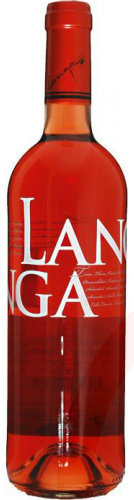 This is the Rosé wine Langa makes. This 2009 is made of Syrah and Cabernet Sauvignon. The newer versions are made with Merlot rather than Syrah.
 Erik Molenaar is the boss of this outfit. Did Erik source a tiny Hogshead of Ledaig? “Honey. I shrunk the Hogshead” maybe? Nope, Erik shared a cask with a shop in Maastricht. Slijterij Bams. The share of the shop was 218 bottles, Erik’s share was only 36. Funny enough the label of ‘the other’ bottle states 50.6%. The humor doesn’t stop here. Bams don’t have it on their list anymore. Sold out? But The Kintra version is still available! So I can’t wait to try this. I hear that modern Ledaigs can be pretty good…
 Color: White wine.
 Lot’s of ash in the finish. The lack of balance is a bit disturbing. There is also a bitterness like earwax and a hint of crushed bugs.
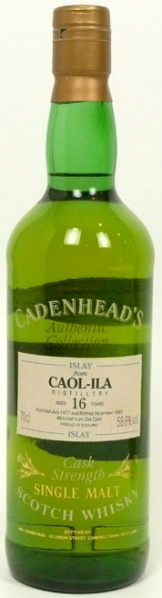 Color: Gold
 Caol Ila. This was recognizable blind. This has a nice full body with a perfect sweetness (slightly acidic) that matches the toned down peat a lot, combined with the smoke…a winner. Macaroons (made with almonds) and a slightly bitter finish (from the wood) and overall a tad too simple for a score into the 90’s.
 A few days ago my whisky club had a tasting of Aberlours. Quite a unique one to boot since these were almost all exclusively official bottlings. We only had one independent Aberlour. It was from a Bourbon Cask and did show the distillery profile for a while, but that was quickly gone. We had a few out of the standard range and a few from the standard ranges from the past. A few bottles stood out. We liked one old 12yo double cask matured for its high dark Oloroso Sherry content (and costing next to nothing). An old 21yo from 2000 was very good and this odd one out. The 1988 Distillers Selection, that was released exclusively in Spain. After this one 1988 came only one other Distillers Selection, the 1989. Again for Spain only. For Aberlour this is quite special. It is said that instead of the usual Oloroso, for this bottling Fino and/or Manzanilla is used!
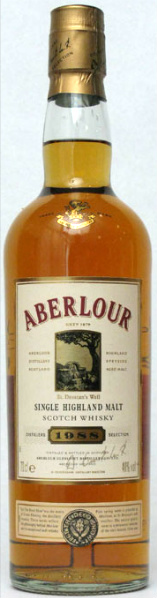 Color: Full Gold
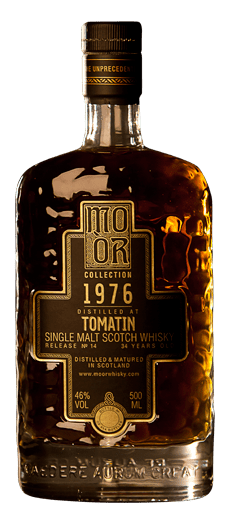 Color: Copper Gold.
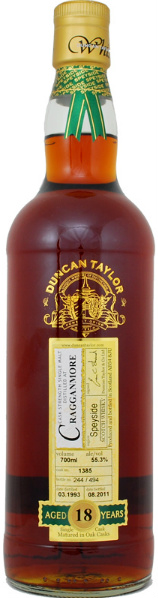 oday I have the chance to give this another go. First of all, I can look at this by daylight and I can’t see the red lemonade anymore. It has this orange brown color most Bourbons have.
 Happy new year! I wish all my readers a great year full of fulfillment, health and great drams. please don’t settle for mediocrity. Try to broaden your horizons for true beauty that can be put in your mouth, but do it in moderation, we don’t want to create modern drunks.
 Well what would be a better start, than with an old Strathisla! In the past I tried some nice old Gordon & MacPhail Strathisla’s from this series. The review for the 25yo can be found here, but together with this 25yo I tried the 21yo and that was similarly spectacular. Mind you these are the old 80’s bottlings for the italian market, and whiskies with these labels were issued for a couple of decades, so every batch will differ (massively). The 21yo and the 25yo were quite dark, and hopefully not colored, and being from the early eighties, the distillate is early sixties or maybe even late fifties.
 Short finish. The 21yo and the 25yo performed better in that respect. Treat this elderly Whisky with respect, but be bold and take bigger gulps. The whisky itself, maybe is a tad fragile and subdued, but hey, the stuff was made some 55 years ago and along the way was reduced to a mere 40%, so give it a break will you?
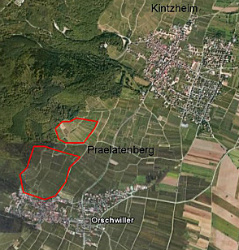 Above Praeatenberg towers the Koenigsbourg castle, built in the 12th century. The altitude of Praelatenberg slopes ranges from 250 to 350 metres and has an east-south-east orientation with a size of 18.7 Ha. The granite bedrock that underlies all Alsace vineyards is very close to the surface. The soil is heavy, covered with loose schist, and is rich with silicium. Dotted with stones rich with iron, quartz and other minerals. This helps the warming of the ground and lets water through easily.
 Color: Straw Yellow.
 Quite hard to figure out how to call this malt. On the label is stated: Säntis Malt, Swiss Highlander, Appenzeller Single Malt, Matured in Old Oak Beer Casks. On their
