Yes, it’s a Glenugie. long time overlooked and very popular the last few years. It’s a closed distillery (1983) and quite popular with whisky aficionado’s. Just as is the case with Banff today, connoisseurs discovered a closed distillery that has a special quality to it. I have to admit that all of the Glenugies I tasted scored at least 85 points and most well higher than that. Only one is lower than that. I scored the sister cask #5506, also by Signatory Vintage, only 81 points. So let’s have a look if all those 55xx casks are the same and if this one’s any better.
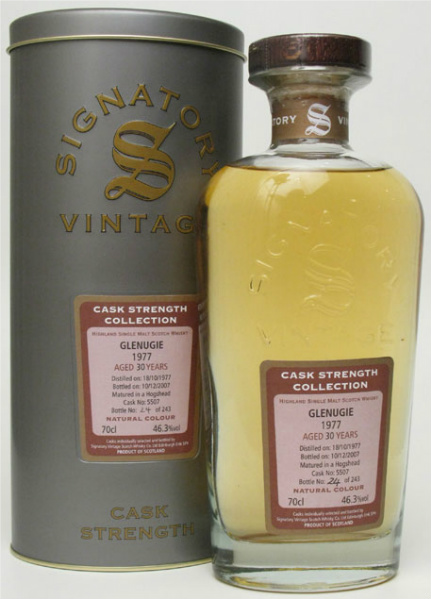 Color: White wine.
Nose: Estery and fresh. Green apple skin. Grainy and a slight hint of vanilla. You could have fooled me with the age of this one. Seems much younger and cleaner, than I would have expected, knowing what this is. There is also a hint of cask toast and wood. Sweet and fruity, peaches on syrup. Creamy toffee with a hint of coconut. I like the nose, it’s like candy. Great balance.
Taste: Sweet like sugar, icing. Vanilla, no wood whatsoever, not at first anyway. It has some spice from the wood. Apples, without the bitterness from the skin. Finish isn’t too long, and just a tad sour. The wood does show its face, late in the finish. Good drinking strength with enough oomph. Again, it seems much younger. The balance in the taste is also somewhat weaker than the very nice fruity nose.
It’s nice and likeable. Nice piece of history. Just not a lot happened in all those years. For me it’s better than it’s sister cask, but still no high flier. You’ll really have to be a buff to recognize the markers of an old Glenugie. But isn’t beauty in the details?
Points: 84
Thanks go out to Nico again for handing me this sample.
 It’s a rainy day today, grey and bleak and I am a little bit under the weather too. Luckily I have some notes lying around I can work with. Otherwise not actually a nice day to go out and have a smoke. But a nice day to put some Art Blakey on. I have A Night in Tunesia & Moanin’ to warm me up and write something about Le Hoyo du Maire.
 Hoyo de Monterrey Le Hoyo du Maire (30 x 100mm, Entreacto, Small Panatela, Box code FR NNSR)
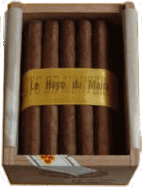 Taste: Oily wrapper and salty on the lips. Just lit and it tastes immediately great. Very woody, but a great overall taste. The wood becomes a little bit sour but the cigar still has good balance. The draw and the smoke are good. It’s a sour-woody and spicy cigar. Ash is light grey with some whites. As often, ash has tiny white spots. It’s very thin so it is stronger than your usual Hoyo. A cigar to ‘sip’, otherwise it will burn too hot. Sometimes you do get small whiffs of…fireworks. The development is linear, still it does have a lot of character for such a small cigar. The draw diminished in the second half, but rolling it between my fingers solved this minor problem.
 Lots of times I witnessed situations where an ‘old’ bottle from Gordon & MacPhail was opened and we all started guessing how old the whisky was, since only a distillation year was printed i.e. “1970”. I fondly remember the discussions when a particular bottle was bottled because the bottle had a ‘nipple’. Another situation could be when a particular bottle was distilled and/or bottled, because only the age of the whisky was printed i.e. “30yo”. Very annoying when you taste a Strathisla 25yo by Gordon & MacPhail that was made for several decades with the same label and different batches are very different. Lots of those ‘old’ bottles don’t have such information, or do they?
 In the case of Gordon & MacPhail, since 1988 a laser Code can be found somewhere on the bottle. Usually printed on the back of the front label, or on the back of the bottle, near the bottom, for newer releases. As can be seen on the picture to the left. Here an enlarged view through the back of the bottle, through the whisky. The code is IB/ABD.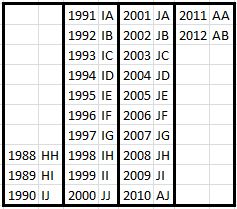
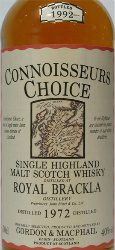 Of interest are the first two letters. IB in this case. The code used is like this: A=1, B=2, C=3, D=4, E=5, F=6, G=7, H=8, I=9 and J=0. IB therefore is 92. The bottle is very probably from 1992! The second series of letters are probably a batch code. On the right is a picture of the same bottle from the front, and indeed it is bottled in 1992.
 Sometimes the first part of the code comprises of three letters instead of two. This is very rare and when this happens two of the three letters match the table given here.
 In this case too there is a neck label with 1991.
 My good friend of “I think about beer” did a
  Westmalle is one of six Belgian breweries that are ‘protected’ by the Authentic Trappist Product logo. Achel, Orval, Chimay, Rochefort and Westvleteren are the others. The logo was presented to discern the trappist beers from the more and more widely available ‘abdij beers’ of Belgium and other countries. (Abdij = Monastery). Most of those beers aren’t even brewed near a monastery, but commercially brewed under a licence. Still, it’s the same style of beers. Usually with a blond beer at normal strength, a dark “Dubbel” and a heavy blond “Tripel”. occasionally a very heavy “Quadrupel” exists.
 It is not only beer that falls under this logo, and not only Belgian beer to boot. Here is a list of all products that fall under this logo.
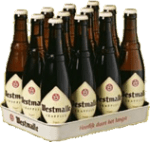 Nothing for the novice. The bitterness is quite a bit of the character. Beware because ageing makes this beer less fruity and more deep and bitter. The label, the bottle, the iconic WA-logo, the smell of it all. It breathes a time long forgotten, pré WW I. You consider yourself back in the thirties. A high score, but not necessarily your easy, every day choice. This is a classic.
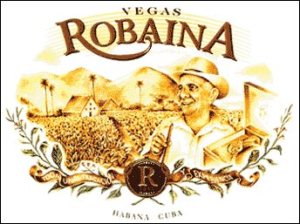 A very new brand, established just in 1997 by Don Alejandro Robaina, one of the best tobacco farmers on the island of Cuba. Don Alejandro lived a full life and died of cancer in 2010 being 91 years old. Who said the Cigars are not good for you? The major part of his crop was used for wrappers, he was thát good. Today this multi-local brand with minor market share has only three expressions left, since two of the five expressions were deleted.
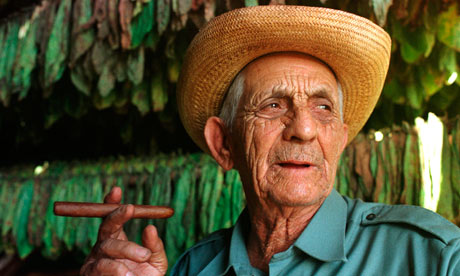 Taste: Already after a centimetre or so, it’s obvious that this isn’t a beginners cigar. Its tarry and very spicy. Hints of petrol. Wow, heavy cigar, that goes wonderfully well with water and this made my espresso taste like something for children. I guess that if you want this to accompany a drink, you should pair this with a very heavy rum, a sweet one perhaps. Lots of smoke. Some kind of industrial grade? It’s funny it’s so heavy-duty since it smelled so elegant a cru. Ash is gray, dark grey and black, with countless tiny light grey spots. No white ash whatsoever. Some plastics and popcorn in the finish.
 Bunnahabhain is known for being the least peated of the island, still like a lot of others, raising to the occasion by answering the call of the public for more ppm’s. Burn Steward therefore started to bottle a “Moine” expression, with more peat, mimicking pre sixties Bunnahabhain.
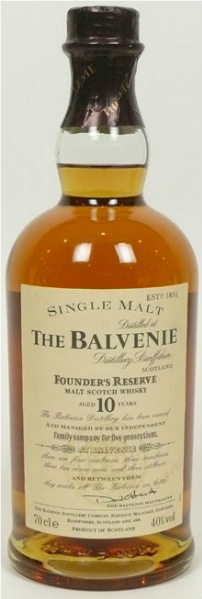 When looking around. and being new to Single Malts I almost fell in love by the shape of the bottle and really liked the way their labels looked. Not a lot to choose then. There was this 10yo (Founders Reserve), a 12yo (Double Wood), a 15yo (Single Cask), a 21yo (Port Wood) and a 25yo (Single Cask). And there was one limited oddity, the 17yo (Islay Cask). Nothing more. Today like with others there is more choice than ever. Lets have a look at the cheapest Balvenie, the 10yo “Founders Reserve”…
 Color: Gold
 Also from 2009 the second release became “Autumn 2009” next up was “Spring 2010” and after that the fourth release was this “Summer 2010”. Also in 2009 the first Single Cask releases were released at cask strength. From 2011 the Single Cask bottles were released with red labels. In 2012 a Sherry Cask release at 46% ABV was released with a black label. Also from 2012 a new addition to the core range was released called “Manchir Bay”. Last but not least there are a few releases of 100% Islay at 50% ABV, where all ingredients of the whisky were sourced form the island itself. Now it’s time for “Summer 2010” solely from Bourbon Barrels from Buffalo Trace.
 Kilchoman then. The newest addition to the immensely popular Islay Whisky family. This new small farm distillery was built in 2004 near Kilchoman in the west of Islay, and therefore named Kilchoman. Operations started in 2005 and their first disaster struck in 2005 also. No distillery can call themselves a real Scottish distillery without a big fire. Well history was in the making so let’s do the fire thing quickly, they might have thought. Not hinting at any foul play of course. In 2005 the kiln burned down. Rebuild in 2006 and operations recommenced. As of 2009 but foremost 2010, Whisky started to be released. In 2009 the first release in the new core range was the “Inaugural Release”. Next up was “Autumn 2009” Let’s try our “Spring 2010” that was the third release.
 Master Quill