Humala is a Spanish Beer brewed by The Nómada Brewing Company at Companyia Cervesera del Montseny in Catalonia, Spain. I don’t quite understand the workings of their website, but they have an interesting page on Facebook (if you can read Spanish).
Pale ale originally was an Ale that had been brewed from pale malt, lightly hopped and quite different from later pale Ales, with less smoking and roasting of barley in the malting process, and hence produced a paler beer. The East India Company requested a more strongly hopped pale ale for export to India. These early IPA’s, were only slightly higher in alcohol than most Beers brewed and would not have been considered to be strong Ales. In general more of the wort is well-fermented, resulting in fewer residual sugars, and the beer is more strongly hopped.
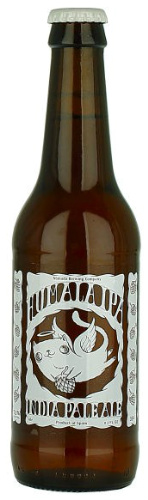 Color: Orange yellow, with heaps of shiny Sugar foam (peach yoghurt in color).
Nose: Very Sunny and fresh, very appetizing. I have to spoon out the foam to get to the Beer. Lovely fruity and very perfumy, but also a whiff of pee. This has really a great nose, and the pee-bit somehow seems to fit, although it would have been nicer without it. The whole comes across as refreshing, and does reminds me of half-sweet white wines.
Taste: Greatly balanced, all the flavours are behaving as a whole. Again a lot of fruityness and seems lighter in style than it is. Never would I have guessed this has more than 7% ABV. It seems so terrace in style, enjoying it watching people pass by, but it does have a kick, when you downed the whole bottle. Excellent, but when I sit down outside, in the city, with a beer to enjoy the sun and the people passing by I usually order a Duvel, which is widely available and also quite high in alcohol.
Well I have never looked at Spain as a country to look for beers, but that is probably a huge prejudice since most countries produce good beers. Don’t drink this too cold as you would miss a lot of great aroma’s. Not a perfect Beer but still I consider this a true find. Lovely stuff I wouldn’t mind drinking again and most definitely will order if I would find it in a bar.
Points: 86
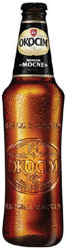 Here we have a beer from Poland. I visit the country on a regular basis, so it’s not that hard for me to come in contact with some of the Beers they’re making over there. Poland, of course, is better known for its Vodka, than for its Beers, but during the last few decades has seen a big shift away from the consumption of Vodka (even the tax on Vodka was lowered at some point) to Beer. A few moments later, brewers from the west saw this opportunity and quickly bought up all the large brands. Especially Heineken (f.i. Zywiec & Warka) and Carlsberg (f.i. Okocim & Harnas) were quick to snap up the Polish brewers. Lets have a look at this Okocim Premium Mocne then. I aged the Beer for an extra year (I love to do that), and this Beer can take some ageing.
  For me always a good sign.
 Moving on to a beer this time, and not just any beer, but a Guinness, you know the dry stout that is good for you! (especially for the heart, because the antioxidants found in the beer, battle cholesterol depositing in your body). Today it’s almost everywhere illegal to make such a medical claim.
 If you want to know more about the beer, I have found the
  And now for a completely different beer. This time something from the oldest brewer in Britain. Sheperd Neame from Faversham, Kent founded in 1698. Spitfire is a cask conditioned bitter that came onto the market in 1990 to commemorate the Battle of Britain. This bottle of britain is named for the famous fighter aircraft from the second world war. The beer also has a different
  kind of advertising than we are used to of which I only give you a few, but there’s a lot more. Let’s move on to the beer, shall we?
 Nose: Fresh, it almost has no scent at first, certainly malt but after that we’re in the twilight zone. Hard to tell what else there is.
 Taste: Thin (probably the low ABV). Fresh, summery ánd bitter. This bitterness once tasted, never leaves and dominates even the finish. The body is light, hoppy and malty. The middle and the finish make this less summery, although I guess this will do well as a thirst quencher on a terrace looking at people passing by.
 In the end I found this to be very easy, not to say very simple. For me even though it isn’t very bitter, still the bitterness dominates the light palate. Maybe that’s why they call this a bitter.
 Master Quill