 Sadly the Bourbon week is almost over. I had a lot of fun with it and (re)discovered some true gems of American Distilling. I’ll definitively do another Bourbon Week again. So, to close this week off, here is the first edition of the Parker’s Heritage Collection of Heaven Hill. Distilled in 1996 the year of the fire, so we can’t be sure where this is distilled. If it is from before the fire, than it’s from the original distillery in Bardstown. If it is from after the fire it can be sourced from anywhere or even distilled by Heaven Hill distilled in another distillery where they rented time to distill. It’s not from the new plant (the old Bernheim plant in Louisville), since they started to distill there from 2000 onwards.
 Color: Brown
Nose: Very deep slow-moving smell, that has to be force-sniffed out of the glass (a Glencairn). I’ll give it some time. On paper this seems to be a brute, and brutes can be very shy. Gravy with toffee, still very closed. Overall the gravy plays a big part as a component for this nose. Almost like it’s a syrup, a sense of foreboding. Like a giant, waiting to erupt. For now its still quiet. It smells of a caramel cain, or something we Dutch call “Hopjes” a kind of caramel, coffee, toffee candy. Yeah, that’s it. Slowly the wood comes out. Plain oak, no elegant polished mahogany, but slow-moving unpainted oak and sawdust. Mind you, the oak smell and the sawdust are two different  smells. Also a food-like sourness that seems to be partnered with the gravy and the Hopjes.
Taste: Wow, what a body. Again dry wood combined with a rum-like depth and virtual sweetness. Tarry and thick. Halfway through a short burst of wood and char, that moves away again, to leave room for the return of the rum. It’s maybe a tad unbalanced in the finish and the strength and the deep refined taste doesn’t make this for everybody, but if you’re into this, well it doesn’t get any better than this. For me this is a Bourbon that didn’t have a lot of rye in the mash bill.
 This is one where the word savoring was invented for. Just give this a lot of time, and you’ll thoroughly enjoy this. Just drink this when you have a moment alone for some contemplation. Don’t let it be interrupted by noise or by the feeling you still have to do something. A bedtime dram, when you’re the last one to go to bed. Top, have fun with it!
Points: 87
P.S. Reading around a bit, some claim this is a Wheated Bourbon made by Bernheim meant for Old Fitzgerald. others claim that it is made in the Original Heaven Hill Distillery (Bardstown) in April 1996, before the fire that was in November 1996. You decide what it is…
 In 1987 Jim Beam bought themselves National Distillers, and by doing that, they also acquired Old Grand-Dad. For all the Bourbons that were kept in production, all original recipes were changed to the ‘Jim Beam’ recipe. All but Old Grand-Dad. This recipe survived due to its uniqueness, and is the only other recipe that Jim Beam uses. This Old-Grand-Dad recipe uses a lot more of the, so-called, flavour or small grains i.e. rye and barley.
 Excellent! No wonder that they couldn’t replace this recipe. This is very, very good. At least I like it a lot at this strength. Recommended. I haven’t tasted all of the “Small Batch Collection” yet, but I can’t imagine Jim Beam making anything better than this. Yeah I’m ‘younger public’ now! Another example of the water of life, that preserves youth.
 Now for a whisky from the stables of Jim Beam in Clermont or Boston Kentucky. Yes Jim Beam have two distilleries and use them interchangeably. As you might have read, Jim Beam White is what it all started for me, but that days have gone. No Jim Beam White on my lectern anymore, or is it? Jim Beam is famous, and Jim Beam is famous for using only two recipes, two mash bills for everything, mostly only varying in ageing and proof.
 tiresome in comparison to the
  The ten recipes are called OBSV, OBSK, OBSO, OBSQ, OBSF and OESV, OESK, OESO, OESQ, OESF.
 Now, we have here a Single Barrel (100 Proof), do we know which recipe it is? Yes we do! It’s OBSV (60% Corn mash bill, Rich in Spiciness, Full Body). I’m very curious. I love the concept, and the looks of it. I once had the previous version of the Single Barrel (43% ABV), which I didn’t like too much. Too weak, very light and too floral and girlie for my taste. OK, let’s have a look at this new one and see if its more masculine 😉
 For me this is a work of high quality and more than one step up from the old Single Barrel. It seems to me this is like a sponsored bottle: for the quality you get it’s really dirt cheap, even without the discount I got, so I bought me a case of this. 50%ABV is excellent too. Again kudos, this time for the people at Four Roses. Excellent.
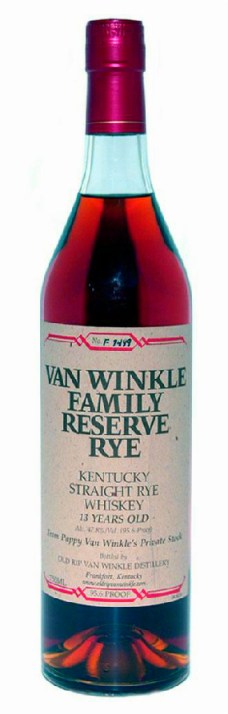 Just a shift in grains in the mash bill. By law its required to be made of a mash of at least 51% rye. The other grains of the mash are usually corn and some malted barley. Rye whiskey is called Straight, when it has been aged for at least two years. Now this 13yo Rye. Well first of all, this isn’t 13yo. Its called 13yo because Julian van Winkle bought the Rye’s in this whisky at 13yo. He nevertheless let the Whiskey age until its 18th year and at that age it was put in stainless steel tanks, to stop its ageing. Where does this come from? Van Winkle isn’t a distillery so they got their whisky from somewhere else. A lot of their Bourbons come form the sadly deceased Stitzel-Weller distillery, but this Rye is supposedly from Medley (Owensboro Kentucky) ánd Cream of Kentucky (Frankfort), and has an unusual high corn content for a straight rye.
 And that’s not all, the finish also has some honeyed caramel. Honeyed caramel with a bite. What else do you want…
 For this review I’ll use and oddity of Buffalo Trace, well it’s definitively and oddity for us Europeans. They already bottle a lot of different whiskies that also taste quite different, lot of different mash bills. Here we have a single barrel version of the regular Buffalo Trace. A single cask picked by Binny’s (from the Chicago Bay Area). So the bottle is the same as the regular one, except for an elliptical golden sticker. Issued in 2010.
 ose: Honey, and a lot of it! Even the waxy part is there, honeyed furniture wax. Hints of toasted oak. Fresh sea air and meaty. Like sitting on the porch of your sea-side cabin, and the smell of freshly made meatballs float by. Chocolaty and vaguely spicy. Very balanced. Nothing in this overpowers the rest.
 Yeah this is not bad, not bad at all. This will be no problem to finish, no problem whatsoever. Before finishing this piece, I already poured it four times. Very good standard bottling! Ok,ok, Single Barrel of a standard bottling. A shame really that I don’t have the standard version at hand…
 Here at Master Quill I’ve explored some Scottish Whiskies and I think it’s time to expand a little. There is a lot more out there and I feel it’s time for me to look into what America is capable of. The journey started for me with a Bourbon, as can be read
 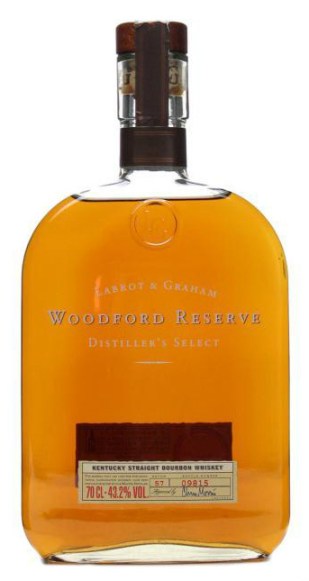 Lets move on to the next candidate. The first Bourbon we will explore is the small batch Kentucky Straight Bourbon Whiskey, Woodford Reserve. This bourbon is made by Brown-Forman, but marketed under the name of the previous owners from long long ago: Labrot & Graham. The Distillery was built near Versailles (Kentucky) in 1812, but distilling activities started as early as 1797. Brown-Forman owned this distillery previously from 1940-1960 and now owns it again from 1996 onwards. The first batches were distilled ‘elsewhere’. Whisky is distilled partly in Scottish Pot Stills and partly from Column Stills from their Early Times plant in Shively (Kentucky). Besides this there are also Woodford versions made for the Kentucky Derby at a slightly higher ABV (45.2%, I don’t know if there are more differences, besides the illustrations on the bottle). There is also a small Masters Collection series and now a new Double Oaked version.
 And even later than that the toast from the cask. This really unwinds slowly. Still its a bit unbalanced, and thin. I would have bottled this at a higher ABV.
 Master Quill