Christmas time is here again, and I needed a decent bottle of wine for Christmas dinner as a companion to sauerkraut and fish. I do like Alsace, so this time I pulled out a Grand Cru Riesling from Praelatenberg. Praelatenberg is one of 51 Alsatian Grand Crus, that got this status in the big expansion of 17 December 1992. It is located between Kintzheim and Orschwiller, and is the most southerly of the Grand Cru sites of the Bas-Rhin.
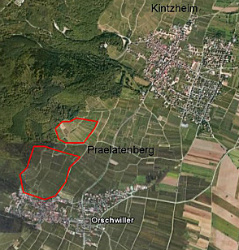 Above Praeatenberg towers the Koenigsbourg castle, built in the 12th century. The altitude of Praelatenberg slopes ranges from 250 to 350 metres and has an east-south-east orientation with a size of 18.7 Ha. The granite bedrock that underlies all Alsace vineyards is very close to the surface. The soil is heavy, covered with loose schist, and is rich with silicium. Dotted with stones rich with iron, quartz and other minerals. This helps the warming of the ground and lets water through easily.
Heim is now owned by Bestheim, a cooperation that was founded in 2000 by the merger of two smaller cooperations from the villages of Bennwihr & Westhalten, together with the house of Heim.
 Color: Straw Yellow.
Nose: Very clean and citrussy. Lemon. Through the freshness and the acidity there is another layer, that at first seems sweet, but also has a creamy peachy element to it. A sort of light non-fat whipped cream of lemon and peach. Very nice. Sweet as in coffee-caramel sweets we know over here as Haagsche Hopjes. Also a slightly meaty sensation.
Taste: It starts with a nice fresh and not overly acidic lemon and chalk. Do you know those little vitamin C pills by Roter? Well, that too. Again a tiny hint of peach. Really subdued and elegant. The finish comes quick and is soon gone, what really is a shame. Always there, is that little bit of acidity that makes your mouth water, and lest not forget that added creaminess. Not very complex.
The taste maybe a bit too simple, in the nose maybe a little bit too. Still it’s a nice wine. It does have a nice balance, but overall it could have done with some added depth and complexity. Easy to drink, and should hold well when aged. ABV is 12%.
Points: 82
Picture is for the Riesling Reserve. Our Grand Cru looks similar (brown glass).
 The Fino used for this finish is commonly a clean, vibrant, straw-colored wine. It has a complex and subtle nose. Delicate notes of predominantly yeast and almonds. Sometimes also tobacco and liquorice. The taste is dry, bitter, smooth and lingering. Also very nice olive oil comes from here.
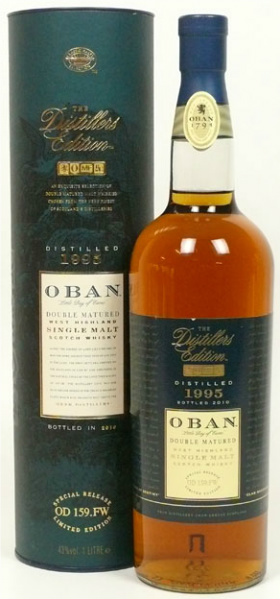 Color: Orange gold.
 And here is Ardbeg. Last of the Islay whiskies to feature on Master Quill. The first Ardbeg is also the last one being released. Ardbeg Galileo. A Whisky that in part was matured in Marsala Casks.
 Galileo Galilei was born on February 15th, 1564 and departed from this earth on the 8th of January, 1642. Galileo was an Italian physicist, mathematician, astronomer, and philosopher who played a major role in the Scientific Revolution [
 I hate to say it, but aren’t “Ardbeg” putting more money into marketing than in the actual Whisky? Don’t get me wrong, I love Ardbeg, just look at my
  Also from 2009 the second release became “Autumn 2009” next up was “Spring 2010” and after that the fourth release was this “Summer 2010”. Also in 2009 the first Single Cask releases were released at cask strength. From 2011 the Single Cask bottles were released with red labels. In 2012 a Sherry Cask release at 46% ABV was released with a black label. Also from 2012 a new addition to the core range was released called “Manchir Bay”. Last but not least there are a few releases of 100% Islay at 50% ABV, where all ingredients of the whisky were sourced form the island itself. Now it’s time for “Summer 2010” solely from Bourbon Barrels from Buffalo Trace.
 Day two of the Bourbon week on Master Quill. This time a bottle from Buffalo Trace simply called Buffalo Trace. Again a Kentucky Straight Bourbon Whiskey but this time from Frankfort, Kentucky. Buffalo Trace make a lot of different Whiskey’s. Bourbons, Ryes and Wheaters. Also a lot of different brands come from Buffalo Trace, and some are not the worst on the market. Just think of the Staggs and Sazeracs of this world. Wow!
 For this review I’ll use and oddity of Buffalo Trace, well it’s definitively and oddity for us Europeans. They already bottle a lot of different whiskies that also taste quite different, lot of different mash bills. Here we have a single barrel version of the regular Buffalo Trace. A single cask picked by Binny’s (from the Chicago Bay Area). So the bottle is the same as the regular one, except for an elliptical golden sticker. Issued in 2010.
 ose: Honey, and a lot of it! Even the waxy part is there, honeyed furniture wax. Hints of toasted oak. Fresh sea air and meaty. Like sitting on the porch of your sea-side cabin, and the smell of freshly made meatballs float by. Chocolaty and vaguely spicy. Very balanced. Nothing in this overpowers the rest.
 Yeah this is not bad, not bad at all. This will be no problem to finish, no problem whatsoever. Before finishing this piece, I already poured it four times. Very good standard bottling! Ok,ok, Single Barrel of a standard bottling. A shame really that I don’t have the standard version at hand…
 What catches the eye with this beer is the statement: “bier met smaakevolutie” thus stating that this is a beer with an evolution in taste. Great! I love that in my drink. Evolution.
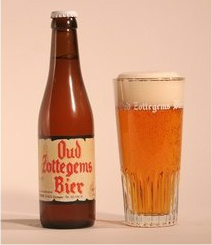 Color: Murky brown, not much foam.
 I would say. Drink this beer! It’s very nice ánd nearly extinct. It has become a very regional beer and deserves a lot of attention. Losing this would be a shame. I’m definitively buying this again, but sure am curious for the Grand Cru version of this. So thumbs up and a well-earned:
 Master Quill