 And here is another Master of Malt bottling. Earlier I reviewed a reduced Tomatin, that was a true disappointment. I didn’t even know it’s possible to ruin a Tomatin, since usually I like Tomatins. So with this one I do worry a bit. This also is a Bowmore of the eighties, which quite often turn out to be your better hand-soap (lavender and violets come to mind). I once tried a 1989 Berry Bros. & Rudd bottling that made me physically ill. That was a first for me, so I tried that one half a year later and it happened again.
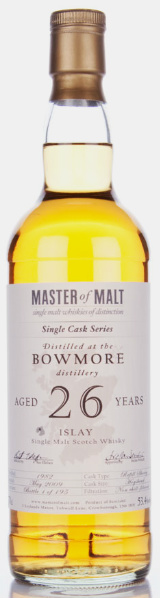 Color: Gold
Nose: Powdery and sweet. Not very Islay to be frank, hardly any peat or smoke. Lots of flowers though, soap, also some clay and thick, so it seems to have body. When freshly poured it is very closed. After a while some smoke trickles trough. Hey, waiting even longer there is peat too. All in minute quantities. Again not very Islay-ish. Is this really a Bowmore? Wet paper and a small hint of licorice. It’s not bad, but not very balanced either. Now we have sour oak. It’s fresh, fruity and floral, luckily not over the top lavender-soap eighties Bowmore.
Taste: Sweet and syrup, with ash and some wood. It actually attacks you in the beginning. The sweetness disintegrates quickly into something acidic. It’s like a syrup that shows, when stripped from your throat, some lemon. The attack is nice, and the middle is also quite nice, but bold tastes fade and leave you with a fairly dull and anonymous finish. What can this be, a strange and unusual Bowmore distillate in a Fino Sherry cask? Well, let’s leave it at that.
In the end it’s not a FWP-Bowmore from the eighties, but it also isn’t recognizable as a Bowmore either. It’s ok on the nose and when it enters your mouth is shows some promise. Halfway through though and especially the finish are a bit weak, which is a surprise after the bold body. But the most remarkable achievement is making and finding a Bowmore that has nothing to do with…Bowmore!
Points: 84
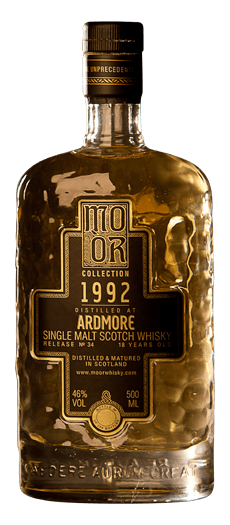 Color: White wine.
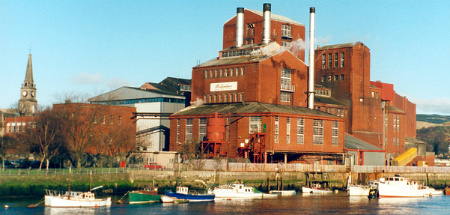 I ended the last post about Gordon & MacPhail’s Inverleven with the hope that they wouldn’t reduce the next issue (so much). Frolicking around in my stash of samples I unearthed this unreduced Inverleven bottled by Cadenhead’s. It’s from another year, so this may have a different profile, but still worth checking out. Dumbarton was foremost a Grain Distillery. The distillery was built in 1938. In 2002 the distillery was closed and demolition commenced in 2005. I’ve added a picture here, because I have always liked the big red brick industrial complex on the river. By the way, after stopping the production of the Inverleven malt, the Stills went on to Islay to produce Port Charlotte at Bruichladdich.
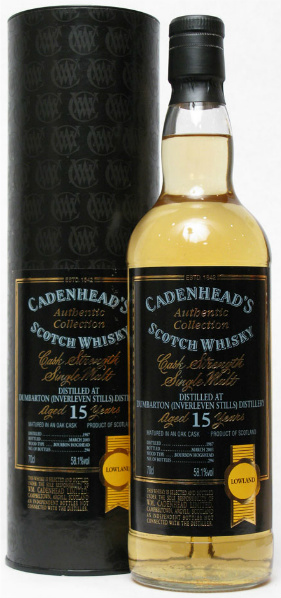 Color: White wine.
 Color: Full Gold
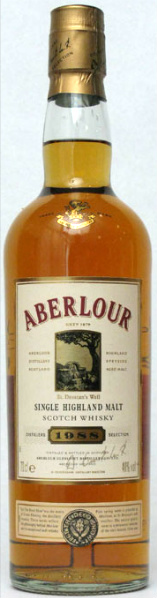
 A few days ago my whisky club had a tasting of Aberlours. Quite a unique one to boot since these were almost all exclusively official bottlings. We only had one independent Aberlour. It was from a Bourbon Cask and did show the distillery profile for a while, but that was quickly gone. We had a few out of the standard range and a few from the standard ranges from the past. A few bottles stood out. We liked one old 12yo double cask matured for its high dark Oloroso Sherry content (and costing next to nothing). An old 21yo from 2000 was very good and this odd one out. The 1988 Distillers Selection, that was released exclusively in Spain. After this one 1988 came only one other Distillers Selection, the 1989. Again for Spain only. For Aberlour this is quite special. It is said that instead of the usual Oloroso, for this bottling Fino and/or Manzanilla is used!
 Color: Full Gold
 Langhe is a hilly area to the south-east of the Tanaro river in the Cuneo province in Piedmont, northern Italy. The black grapes used for this wine is the Dolcetto grape that is widely used in this region, where wineries favour Nebbiolo or Barbera. These wines need a long time ripening. Dolcetto on the other hand is one that doesn’t require a long time ageing, two years will suffice.
 Color: Dark ruby-red.
 Next up Glen Scotia, also a first on these pages. Glen Scotia hails from Campbeltown, once a big place for whisky with regional status (again). Try to imagine a place that has almost 30 distilleries working at one time in the 19th Century. Not so long ago this Glen Scotia was the ‘other one’ from Campbeltown after the well-known Springbank. Today Springbank makes also Longrow and Hazelburn. And from the same owners the recent ‘addition’ that is Glengyle Distillery (Kilkerran). Let’s say that Glen Scotia is the only Campbeltown distillery not owned by the people of Springbank. Owner today is Loch Lomond Distillery Co. and the place is fairly run down. When the distillery was mothballed in 1994, the staff of Springbank restarted intermittent production in 1999, not to lose the regional status of Campbeltown. A status lost eventually, but eventually reinstated.
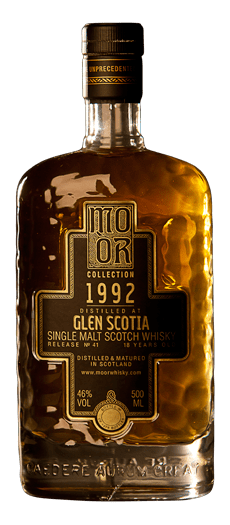 The distillery was founded in 1832 by the Galbraith family. For one reason or another the label on the bottles state 1835. Lots of changes of ownership during the years and even some closures in 1928 and 1984. Since 2000 Loch Lomond has taken over Glen Scotia and runs the distillery with its own staff.
 I was asked to keep an eye out for sulphur in this one. It’s there slightly on the nose (as a burning match). But it is more pronounced on the palate (the bite here comes not only from the wood, but also from the sulphur. Usually there is some sulphur in Sherried Glen Scotia’s. Lots of it in a 1991 Cadenheads offering if I remember correctly. It’s there on the palate and even more so in the finish (late). Is it ruining the balance or the palate? Does it disturb me? No, it’s some kind of good sulphur. it’s somewhat hidden. It’s there but not in the usual obvious way. That happens sometime, that’s why I called it good sulphur. Still, overall there isn’t a lot of sulphur in this one, so don’t worry. And hey, sulphur is good for the skin!
 Here’s an appeal to all. Start drinking Sherry. NOW! Because it may be too late already. Let’s face it people. We love our whisky and we particularly love it when it’s from a good Sherry Cask. But as can be seen, prices are soaring when a nice sherry casked whisky is released these days. I’ll be reviewing some Pedro Ximenez (PX) Sherries the following days, but there is a lot more out there. You might want to try a nice Oloroso (maybe the best performing casks for whisky).
 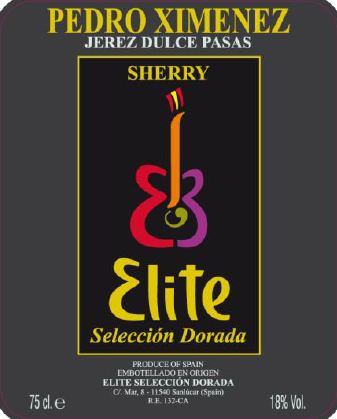 Some of you might like a dry Fino. But there is a lot out there, and a lot of differences in quality too. One thing is sure, when trying out some nice Sherries you won’t break the bank.
 Burned creamy sugar as in the top layer of Creme Brulée. The acidity is a very nice addition to the taste of this PX. It doesn’t seem to be as sweet as the competition, and it is certainly not as thick. The finish therefore, is not the longest in the business.
 When my interest into Single Malt Whiskies took some form, and all was looking fabulous, I hoped I would really like Balvenie and Glenrothes. I really like the way the bottles looked. Just have a look at these nice cannonballs! In the case of Balvenie, I didn’t quite get to that high status of being a favourite and alas the same is true, for me, for these Glenrothes. I tasted quite a few of these, but I never scored these cannonball bottles above 84 points. Blind and not blind. I still love the way these bottles look.
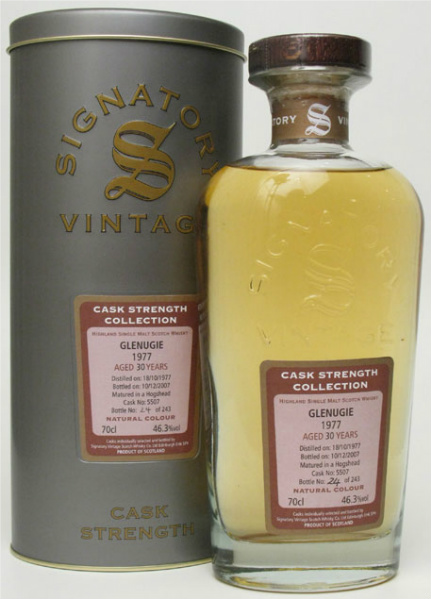 Color: White wine.
 Master Quill