Angostura 12yo “1824” (40%, Circa 2008, Trinidad & Tobago)

A long time ago I reviewed the 8yo Angostura “1919” and to be honest, great quality, but it’s taste is not for me. Since then a long time has passed, tried the “1919” on many occasions and it still didn’t manage to grow on me. Well, sometimes that happens. Something like the saying about the organic matter and the personal-cooling-propellor-device…

As I said a long time has passed without the urge to try more Angostura and why should I, since the now defunct Caroni Rum also comes from Trinidad? I somehow liked all Caroni’s I tried better than Angostura “1919”. Finally time has come to try the older brother of the “1919”. A distinguished gentleman from the drinks business personally recommended me this 12yo “1824”, so I just had to buy it. Here goes…

Angostura 1824 (2008)Color: Copper brown

Nose: Initially sweet, but soon more funky, and dries out over time. Nutty start with nice wet outdoorsy clay. Like running with Wellington’s through the fields in autumn. A wonderful depth I didn’t expect, why? Just read the review of Angostura’s 1919 which turns out to be something completely different from this. Soft elegant notes of wood and even some red fruit scents. Red berries. After the Rum got time to breathe more and more vanilla surfaces, and for a moment I got scared this is developing into the vanilla I remember so well from the 1919. No, in this one it stays in check, it is under control, so to speak. A slightly burnt note appears as well, giving the whole some more oomph. The burnt note combines well with the dry woody notes that lies underneath.

Taste: A thin kind of sweetness to start with, with some burnt caramel and toffee combined with hints of red berries. Nice sugared fruity sweetness. At 40% ABV, it tastes a bit thin, but the aroma’s are lovely. Not overly complex, but it works well as a whole. Nice sweetish and warming. You can sense there is more to this Rum than meets the palate, but it probably is reduced too much, weakening that mystery. I’ve said it before, and I won’t say it again. (Hint: it’s about reducing too much), there, I’ve said it anyway! The funkyness from the nose is present again in the finish and aftertaste, where a sweet and slightly burnt not have the longest breath.

I scoffed a bit at the Angostura 1919. I can recognize the quality of that Rum, but after drinking the whole bottle over a prolonged period of time, I never got around to like it. In the world of Rum it is my main example of a decent Rum I really don’t like. It may work very well for you, but it is most definitely not my cup of tea. This 1824 however very much is my cup of tea. With nice Rum funkyness we know from Jamaican high ester Rum, and Borgoe 15yo to name but a few. Nice.

Points: 85

Talisker “Neist Point” (45.8%, OB, for Travel Retail)

Just a few weeks ago this new Talisker was released, not by Diageo, but by Diageo Global Travel and Middle East (GTME). What? I don’t know why, but why do I have the feeling I’m being more and more conned? First, lets back up a bit. Not so long ago you had Talisker’s with age statements like 10yo, 12yo, 20yo, 25yo and 30yo, I said, not so long ago. Longer ago we had a stellar 8yo as well. At a certain point, again, not so long ago, the 18yo was released. All of a sudden, the stocks were depleted and the owners saw that Whisky was fetching silly money all across the board. I get that, because you’re in business to make a lot of money, hopefully, so I get the prices that are asked today. It’s a question of simple economics, supply and demand. Supply, somewhat unknown, the demand high.

Screen-Shot-2015-04-09-at-9.59.34-AMConned I said. Now, we are getting NAS Whiskies, and I tell you why. We need a lot of stock of older Whiskies to make high-priced Whiskies with an age statement again for the future. Well the price I mention is uncertain, because you never know what we the public are willing to pay for our Talisker 18yo in ten years’ time. Thus a lot of young Whisky must be released with some added older Whiskies for taste, because Diageo found out that the traveller is mainly concerned with taste and not age.

So we saw a lot of young Whiskies enter the market place and top money is spent to convince us that it’s all about taste and not age, well, we are made to forget that age matters a lot when it comes to taste! As I said above, I understand that I have to shell out some serious money for my Talisker 18yo, 25yo and 30yo, but that’s my choice, since I do love those expressions, but I can decide myself if I want to spend that kind of money, now or in the future. Diageo doesn’t really care because if I won’t spend that money, someone else will, because we see a lot of people paying a lot of money for Whiskies these days. And it’s almost no use looking elsewhere (other distillates), since those prices are soaring as well.

So conned I feel (Yoda speak), because the latest Taliskers don’t have numbers anymore, but names. Storm, Skye, Dark Storm and now Neist Point. As I said before, there used to be a stellar 8yo, a stellar (Tomatin) 5yo, etc. Today those numbers are not wanted, not because they are low, lower than the modern standard, the 10yo, no. Those numbers are unwanted because they are still too high and still too much a restriction. And since we already made a leap in yield per field of barley, today’s young Whisky can’t be compared to the 5yo of yesteryear. The quality od Sherry cask today is also different from the old ones. So lots and lots of young Whisky is sold to us through NAS bottlings. Yes it’s about taste, but no, not that much young Whisky can be so good as is claimed, and that’s my conned feeling right there. I’m indoctrinated and I’m made feeling stupid by claiming that age doesn’t matter (never did) and hiding behind the statement that only taste matters.

Conned some more I say: Why the mystery? Making up a name, fine, give your Whisky the name of a lighthouse or a Hyundai car. It’s fine, I like the names and I like the screen printed lighthouse on the Neist Point bottle. We all know it’s mostly young Whisky, with some added older casks to meet a desired flavour profile. Diageo claims that the traveller doesn’t care for age, but does care for taste, but the traveler speaks some more, the traveller also wants smooth Whisky, the traveller wants smooth Talisker. But why? Talisker smooth? Laphroaig is also being made smooth. Why? Can’t we have anything not smooth anymore? Didn’t we like Talisker and Laphroaig rough? wasn’t Talisker called the lava of the Cuillins? Lava as in not smooth? Hot and peppery!

Even more conning: It was said that Neist Point (The Whisky, not the lighthouse) has a huge depth of flavour and showcases a wider range of Talisker characteristics. Combining precisely selected flavoured Whiskies with some of Talisker’s rarest and smoothest mature stocks. Yeah right. Will those of you that believe this raise their hand? Am I really to believe the rarest of all Talisker stock went into this and are not released as super-duper premium Whiskies now and especially in the future?

So instead of a nice rambling about the new Talisker I started ranting, sorry for that, it never happened to me before. Critical yes, ranting, nope. Why not try this new expression of Talisker and see if it still has some lava in it. By the way, in the past Douglas Laing bottled some smooth Talisker’s. Back then, these casks didn’t match the Talisker profile and were sold off to be used in blends, now they are especially sought out and used for Talisker Neist Point… [fanfare music is playing and curtain rises…]
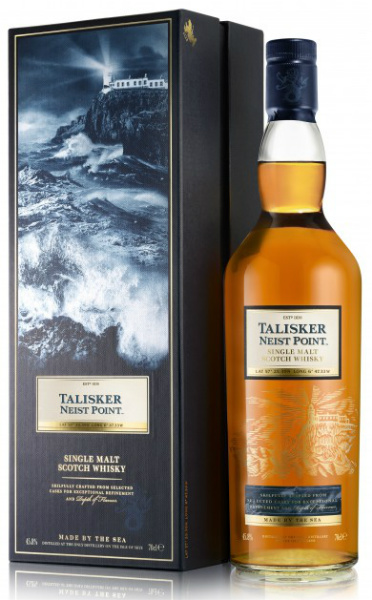
Talisker Neist Point (45.8%, OB, for Travel Retail)Color: Gold.

Nose: Some light smoke. Barley sweetness, and some old Sherry wood. Tiny hint of cask toast, but very mellow altogether. Hints of citrus. There is some sweetish freshness in the back, lemon and unripe tangerines. Crushed fresh almonds, mixed with some sweet and fatty peat. Mind you not a lot. When you close your eyes and someone pulls the glass away, a more fruity note stays behind and not a peaty one. Slightly warming.

Taste: Sweet, barley and nutty, again lots of almonds. Sweet lovely peat. (Springbank style). Extremely drinkable, but even after the first sip it is lacking some power and doesn’t hang around in the mouth for too long. Fruity, but more about yellow fruits. Dried apricots and pineapple. A little bit of toasted wood. Thick clay in the finish, which is nice, but the rest of the finish is about immature and young Whisky. Young can be mature, immature just isn’t mature. No pepper attack, so how’s this a Talisker? Short and a bit unbalanced finish, with a beer like note and fresh barley as the last of the aroma’s.

After the rant above, some of you maybe expected I would hate this Talisker, but in fact I wrote the piece above before even tasting Neist Point. It is how I feel, maybe I’m wrong, who knows. Neist Point is what I thought it would be, nice, smooth, extremely drinkable, but also a bit immature, and the rarest of Talisker casks didn’t hide that. Maybe more of those casks should have gone in?

In the end it’s not bad, but not spectacular either. If they really want to sell this for 150 euro’s, pounds or dollars, I feel it’s too expensive. I paid half of that for my bottle and that would seem more than enough. Sometimes it reminds me of Springbank 18yo and obviously the smooth 1980 Tactical from Douglas Laing. Both are better Whiskies with much longer finishes. Spend your money on that I would say, although the Tactical is hard to get these days.

Points: 85

Aberlour 12yo 1990/2003 “Warehouse No 1” (58.8%, OB, Single Cask Selection, First Fill Bourbon Cask #11552)

Time to follow up the Bourbon casked Aberlour from Warehouse No 1 with another one! This one is a few years younger and bottled more than ten years ago. Right off the bat the colour does seem quite light for something that is from a first fill Bourbon cask. I think it will be quite interesting to compare the two, so without further ado…

Aberlour 12yo 1990/2003 Warehouse No 1 (58.8%, OB, Single Cask Selection, First Fill Bourbon Cask #11552)Color: Light gold, white wine.

Nose: Typically ex Bourbon cask. If you don’t know it by now, you’ll never will. High alcohol, with vanilla. Clean wood and a bit sweet smelling. Toffee. Creamy and dusty. Fresh with a hint of lemon. Mildly spicy, but in a sticky kind of way. I know it does sound a bit strange. Wet dirt and dust. Big in its typical “Bourbon-ness” (the aroma combined with the high ABV.), but the rest is all details, meaning the rest are all mere hints. Fresh air. The wood itself releases quite some nice aroma’s. Slightly sugary wet paper even. Sometimes even whiffs of something meaty can be picked up. Stuff like this may all look alike, and in a way they are. But if you give it some time and attention, yes you have to work for it, the details will show, and sometimes you’ll be rewarded when it strikes a chord with you, like this one almost does with me.

Taste: Sweet, waxy, and nutty. Almonds. Quite hot, due to the high ABV, but the aroma is, again, quite big, so the aroma and the initial sweetness overpower the alcohol and that is quite a feat. Fatty butter, and mixed with that, a dry and leafy quality. Pencil shavings. It breaks down a bit towards the finish, where some bitterness comes to the front and an acidic note decides it doesn’t want to be part of this Whisky anymore. The finish itself is shorter than expected. The finish is gone, when the strength is still making its way down and warming you.

Compared to the 16yo I reviewed last, this one is more about the wood and the vanilla, and creamy toffee. This lack the fruit the more recent 16 yo has. So there is a difference. This 12yo is cleaner and has a more typical nose for a Whisky coming from a Bourbon cask. The 16yo in comparison is way more funky and fruitier and tastewise less balanced and softer. It also has a much longer finish. Who said all ex-Bourbon cask whiskies are alike, since these two alone are already quite different, and I’m not only focussing on the details. Same score though.

Points: 85

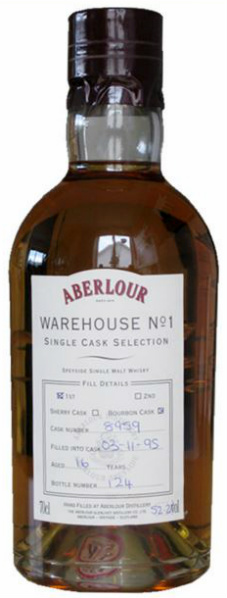
Aberlour 16yo 1995/2012 “Warehouse No 1” (52.2%, OB, Single Cask Selection, First Fill Bourbon Cask #8959)

Aberlour was one of the first Single Malts I’ve ever tried. Back in 2000 or 2001 I got the 10yo for my birthday (thanks Arthur!). Nice stuff. Especially for the novice I was back then, and maybe still am, since there remains an awful lot to learn. For me Aberlour was always more about the Sherried Whiskies than the ones aged in Bourbon barrels or hogsheads. The character of the Aberlour distillate is definitely easier to “get” when trying Aberlours from (refill) Bourbon casks, but this hand filled Aberlour from first fill bourbon will do just nicely too. However, I’ve never came across a Bourbon cask aged Aberlour that knocked me off my feet. Maybe this is the one, since it came directly off the distillery. Distilleries hold the best for themselves don’t they?

Aberlour 16yo 1995/2012 "Warehouse No 1" (52.2%, OB, Single Cask Selection, First Fill Bourbon Cask #8959)Color: Light gold.

Nose: Floral and leafy vanilla powder with some funky organics going on. Extremely fresh and fruity. Canned concentrated fresh air. Combinations of pineapple, dried peaches, peaches in light syrup. Sweet white grapes and cherry liqueur bon-bon. Very aromatic and dusty as well. You don’t get a lot of sweet and dusty, but here it is an evolution going on in the glass. It starts sweeter than it ends. It’s fresh and lively and I’m actually surprised this is already 16 years old. I expected a darker Whisky coming from a first fill Bourbon cask. Fresh and minty with small hints of lime. It has everything you can have from an ex Bourbon cask. Florality, vanilla and lots of fruit. In the background typical wet oak and slightly meaty. Sawdust and paper, and sometimes I smell the Bourbon itself. Reminds me a lot of the 1994 Golden Cask expression I reviewed earlier.

Taste: Soft and spicy and quite sweet right from the start. Almonds and very nice creamy vanilla and fruit, peach it is again. Wow, great Bourbon cask. A lot of the elements fall in its place. For me Whiskies with this profile need to be a bit sweeter (especially when the whole lacks a bit of complexity). Creamy toffee and fine powdered sawdust. Vanilla and fudge. Well you get the picture don’t you? Soft wet wood, like snapping off a branch. Hints of latex paint and sweet wood (with a walnut skin, bitter edge to it).

I like the sweetness and the softness of this Malt. Dry, cask strength Bourbon cask Malts can be quite sharp and hot. For instance. The 1997 Tomatin that was aged in a Refill Bourbon barrel is less sweet, and therefore drier but also a bit hotter and harsher. Again a decent Bourbon Aberlour, as I’ve come to expect by now

Points: 85

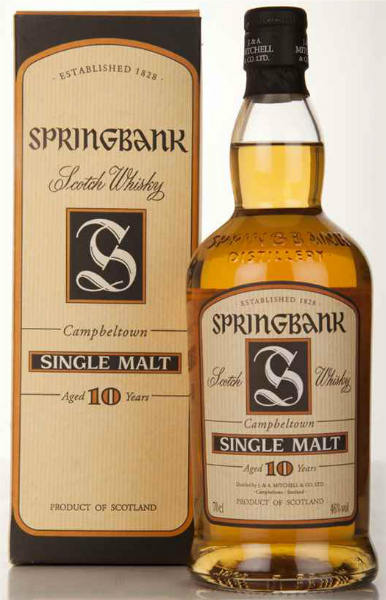
Springbank 10yo (46%, OB, Circa 2003)

So I guess you managed to survive Christmas, congratulations! Christmas is over, but the year is not. There are still a few days left before this year is over, so I dug up two Springbank Whiskies from some twelve years ago. It’s not long ago since I reviewed a more recent 10yo from 2010, so its nice to see how this older version “behaves”. Yes, I said two Springbanks, so the last review on these pages for this year 2015 will be its brother (or sister), the 15yo, from the same time as this 10yo.

Springbank 10yo (circa 2003)Color: Gold

Nose: Oily and fatty. Typical Springbank. Warm barley.  Creamy sweetness. Vegetal. Lots of vanilla, vanilla sugar, vanilla pudding. Nice soft wood. Warm sugar-water. Amazing how sweet this actually smells. Dusty and powdery, but again think creamy and vanilla. Sure it shows its typical Campbeltown profile, but believe me, this is nowhere near the complexity of the current 10yo. Almonds and slightly acidic crushed beetle (with a hint of banana and paper), combined with more and more dusty and dry oak. Tiny hint of smoke and maybe some freshly cut muddy peat, but in fact it is hardly peaty at all. Seems a bit simpler compared to more recent offerings of the same age.

Taste: Sweet it is. Oily, nutty and slightly industrial. Lots of clay. Sweet toffee. Chewy. Very big aroma. Typical Campbeltown. Sugared fruits and again quite a lot of wax (and clay). Warming with noticeable peat this time. After a while a citrussy and fresh note appears. Lemon curd, not sharp lemon by itself. Lemon captured in sugar. After the big and sweet body, I didn’t see the rather weak finish coming. The nose still oozes aroma of wax, clay and wood, then you sip it, and it is big and sweet, and then it starts to leave the building rather quickly. The aftertaste is slightly off with oaky acidity.

It different from the 2010 10yo, but both are great. If you can get this one for not too much money, I would say pick it up. It’s good and very educational compared to more recent bottlings. Where every other distillery try to manage some kind of consistency, Springbank is not that anal about it. The Campbeltown profile is pretty specific, so I don’t think its customers are seeking consistency, but rather welcome the evolution over the years as well as the batch variation that is clearly the with all of Springbank’s products. One of the Whisky nerds favorite distillery, and you are probably one of them, and just like me, proud of it.

Points: 85

Old Fitzgerald 12yo “Very Special” (45%, OB)

I finished the Four Roses single barrel as well as the Old Grand Dad 114, so it’s time to open some fresh bottles. One was very easy to pick, and  that was the Old Fitzgerald 12yo “Very Special”, the next, well you’ll see later I guess. Old Fitzgerald 12yo is a Wheated Bourbon made by Heaven Hill in Louisville Kentucky. If you happen to stumble upon a very old bottling of this, or even a “Very Very Old Fitzgerald”, you’ll have a distillate of the legendary Stitzel-Weller distillery, worth quite some money today. The Old Fitzgerald brand was created around 1889 by Charles Herbst maybe even as early as the 1870’s. Pappy van Winkle bought the brand during prohibition and changed the mashbill of the Original Old Fitzgerald by adding “a whisper of wheat”.

As you might know, the Bourbon mashbill must have at least 51% of corn, and usually Rye is used as a secondary grain with some malted barley. For Wheated Bourbon, the Rye is substituted by Wheat. Apart from these two, also Rye Whiskey (at least 51% Rye) and Wheat Whiskey (at least 51% Wheat) exist, and of course Whiskies with both Rye and Wheat.

Old Fitzgerald 12yo VSColor: Orange brown.

Nose: Dry and dusty, cold soft ashes. Hints of glue. Dry leather, honey and soft almonds. Tiny hint of apple skin, dried out orange skin and some unripe banana. The wood itself is quite floral, like old lavender soap mixed with cocoa powder. Not a lot of spicy wood or toasted cask, even after 12 years. Quite a surprise considering the color of this Bourbon. The age dulls out the fruity notes it probably had when it was younger. Still the nose is built around a dry and dusty wood and leather notes.

Taste: Wood most definitely is the first aroma you taste. Dark cocoa powder, with soft sweetish cinnamon comes next with an elegant sweetness (corn), meaning not too much. The sweetness was toned down by the time this Bourbon spent in cask. The Whiskey goes down like a syrup, very slowly, taking its time, giving a little heat and good length in the finish. Some unbalanced acidity from the wood shows itself in the aftertaste, especially on the tongue, but it’s easy to deal with, even though it has some staying power. Even later in the aftertaste the more powdered creamy notes emerge, buttered popcorn and toffee.

It’s rumoured that Heaven Hill wants to stop making this, but that really would be a shame. It’s good stuff and definitely one you want to try if your favourite wheated Pappy Van Winkle is getting worse a bit, or becoming to expensive to enjoy properly. Also a nice one to try against some of the Weller’s that are around, which are also Wheated Bourbons.

Points: 85

Arran “Batch 4” (52%, That Boutique-y Whisky Company, 1270 bottles, 2014, 50 cl)

After the Bruichladdich that was bottled more than ten years ago, we move on to a more recent bottling distilled on a different Scottish Island. It’s an Arran. Well that’s about it, we don’t know a lot more. OK, let’s try a little harder then. It’s obviously an NAS Arran, that was bottled at 52%. It might be cask strength or not. Anything goes I guess. looking at the whole range, some big names, like Macallan, have pretty low ABV’s. We also don’t know the distillery date, but we do know this was bottled in 2014. We also don’t know if it’s a single cask bottling or not and what kind of cask was used, but I understand that most, if not all come from multiple casks. We also know that this was bottled by That Boutique-y Whisky Company, yes that’s its name. We’ll call it TBWC to reduce the chance of getting RSI. TBWC can be linked to UK drinks retailer Master of Malt (MoM), just click on the link and you’ll see why. Since 2012 MoM started with their TBWC, issuing a lot of Single Malts and some other stuff in nice looking 50 cl bottles with comic book labels. This Arran reminds me of Tin Tin.

Arran Batch 4 (52%, That Boutique-y Whisky Company, 1270 bottles, 2014, 50 cl)Color: White wine.

Nose: Malty and unusually fresh. Sweetish and fruity. Yellow fruits you get from candy. synthetic pineapple. Grainy and gritty, which gets less over time. Some citrus, lemon and lime, mixed in with a more creamy vanilla note. Already thinking refill Bourbon, are you? The whole seems pretty light and a bit young, but not in a way it should remind you of new make spirit. It’s overall pleasant, but not very complex nor does it evolve a lot, but yes its nice. Given some time and movement, to aireate the Whisky, more spicy notes from oak presents itself, as well as some floral notes, so now its nice and lovely. Whiffs of alcohol you get from smelling a well made wodka, and that is not the same as the new make spirit I mentioned earlier. So no off notes, and also nog big bomb in your glass. Restrained and elegant. Feminine if you allow me to say it.

Taste: Again fresh and fruity, malty and fresh. Toffee and vanilla, but also a sappy and leafy vegetal quality. Young wood? Paper and dried peach with ice-cream. Licorice and hazelnuts, with a hint of Cappuccino and mocha. I like the strength of this, especially combined with the profile it has, but it is a bit hot. It reminds me a bit of old bottlings of young Lowlanders.

Sure this may be from re-re-refill Bourbon casks, hence the color. Hell, maybe even the casks were tired. Sure, in many ways its simple and smells of alcohol. It doesn’t show a lot of evolution and so forth, but it’s so damn drinkable! OK, I’ll stop swearing now. I especially like the fact it does remind me of old Lowlanders, that is something that took me by surprise.

The bottle looks great, but sometimes that means that what’s inside is not so nice. This time however, TBWC have managed to source a very interesting and different take on Arran. Highly drinkable and in a way reminds me of yesteryear. Maybe its a profile for aficionado’s since the lowland style is almost gone, and is getting extinct. Therefore I can imagine a lot of people not liking this. Having said that, this is also not a typical Lowland style Whisky. It lacks a more pronounced citrussy feel and especially the grassy notes to be a true Lowlander. To be on the safe side: yes I know Arran is an Island and not part of Lowland.

Points: 85

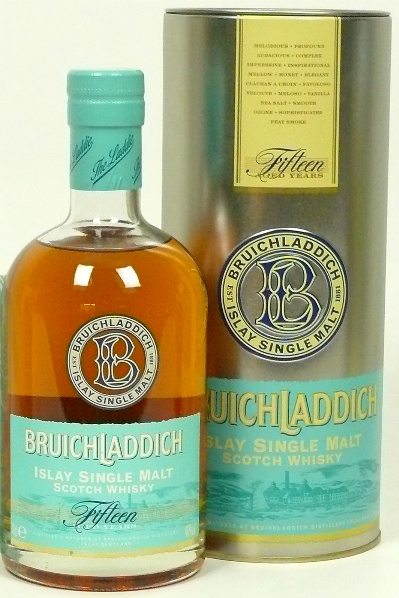
Bruichladdich 15yo (46%, OB, First Edition, 2003)

Earlier I reviewed the Bruichladdich 10yo. That was one from the first batches to be released, right after the distillery was sold to Mark Reinier & Co. The first releases were that 10yo, the 15yo I’m about to review and a 20yo. Ten years ago that is how a standard range looked. Age was everything back then. Today we’re not that far removed from an age, where age statements seem to be only for people with Lamborghini’s. Real ones, and I don’t mean the tractors too. It’s all about demand people. The 10yo I mentioned before didn’t float my boat, so I’m not sure what to expect with this 15yo. Let’s have a go shall we?

Bruichladdich 15yo (46%, OB, 2003)Color: Medium gold.

Nose: Reminds me of the 2003 10yo with just some more of everything, in fact, this one doesn’t want to stay in your glass! Fresh citrussy barley. Hint of peat and a little bit of smoke. Smells quite sweet for such a Malt. Garden bonfire. The sweetness is fatty and oily, or you can call these aroma’s well-integrated.  The more I smell this, and the more air it gets, the better it becomes. By now it’s already way better than it’s 10yo brother (or sister). Nice succulent wood, again integrated with the sweetness. Hints of vanilla, not much, and fresh, some distant fruitiness. I spoke too soon. The vanilla part grows bigger with more air and becomes creamy. Sweet yoghurt with peach. Lovely. Great balance and quite appetizing. I hope it tastes as good.

Taste: Quite sweet and very creamy with a woody, bitter edge to it. Again the sweet yoghurt with peach and toffee. Reminds me a bit of the great Bourbon casked Whiskies from the seventies. Great entry and a similarly great body. Not a lot of development though, but with something that tastes this great, who cares? Towards the end of the body the slightly peated toffee sweetness takes a step back and lets the wood through. It’s there, without taking over, barely though. You felt it coming: “but”. The flaw is in the finish. It breaks down a bit and is slightly shorter than the nose and the great body suggested. A wee bit too much reduced? Yes I know, its 46% ABV., but that doesn’t matter. This is how reduction with water, sometimes alters the finish. The aftertaste moves in to the territory of soap and stale beer and a minute amount of hops, but that sounds worse than it actually is, so don’t worry. Not a lot is left in the aftertaste, and there is only one remedy for that. Take another sip so it all starts all over again.

Points: 85

Mount Gay 1703 Old Cask Selection (43%, Barbados)

Now I’m getting sunburned, so I’m digging out the last Bajan Rum from the sand, for now, and find some shade. Last but not least, and a short trip of Bajan Rums wouldn’t be complete without an offering from the oldest distillery around: Mount Gay. And this is not the distillery’s entry-level Rum, mind you. Mount Gay Distillery had plenty of time to build up a nice stock of aged Rums. For this “1703” blend, casks were used that have been aged from 10, up to 30 years. So I’m expecting something different.

The history of Mount Gay starts with a man called John Sober (what’s in a name). John was fortunate inheriting a distillery on the Island of Barbados but didn’t know what to do with it. John asked for some help and got it from his friend John Gay (what’s in a name). John Gay died in 1801 and John Sober renamed the distillery in John Gay’s honor. John Gay managed the distillery well and perfected the distilling process thus producing a fine Rum, and making John Sober a lot of money in the process. Actually Gay was John’s middle name, his name was actually Alleyne, but there already was a Mount Alleyne on Barbados (what are the odds), so Mount Gay it became.

Mount Gay 1703 Old Cask Selection (43%, OB, Barbados)Color: Orange Brown.

Nose: Not your obvious sweet-from-the-start nose. No, this has already a lot of wood, but also elegance and presence. Definitely some old (woody) Rums have found their way into this “1703”. Wood, lots of orange peels, honey and wax. Wood comes in many guises and that’s not bad for the composition of this nose. Sawdust and spices. Vanilla as well (American Oak). Old roasted coffee beans and walnut skins, but also some creamy sugared yellow fruits, although they are well hidden. One thing is for sure, this Rum is all about wood, and lots of it. It works in the nose, but I’m already getting a little bit nervous, how will this work out when you sip it?

Taste: Luckily not as woody as the nose suggested, but the first thing that enters my mind is its relative lightness. It tastes diluted, as if I was nosing a cask strength sample and now am tasting a 40% ABV retail version. The entry of fresh, fruity (orange again) and sweetish Rum is short-lived, because the wood kicks in rather quickly. The old Rums that are in this blend play their part and give it a backbone of various wood aroma’s. The wood in the taste however seems to “reduced a bit” and that in itself is quite an accomplishment. The wood gives the medium length finish a walnut skin bitter edge, but in no way does it ruin it. It’s the vanilla from the finish that seems to linger on…

Quite a daring expression of Mount Gay, definitely for aficionado’s who are not afraid to “drink out-of-the-box”. For some more normal Rum drinkers this has too old stuff in it, bringing lots of wood. Don’t worry this very sentence contains the last reference to “wood” in this review. Considering the public this was, probably, made for, I find this a bit to weak. This Rum might have been better with a higher strength. I know 43% is more than the usual 40%, but I feel this Rum needed even more alcohol to do it justice, 46% at least maybe even 50% ABV. It would have aided the body and lengthened the finish a bit.

Points: 85

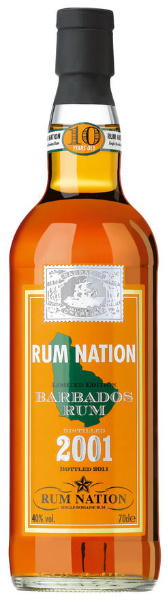
Rum Nation Barbados 10yo 2001/2011 (40%, Single Domaine Rum, Barbados)

After the peated Benriach and the chilly foreplay to winter, lets head back to a nicer climate and head towards Barbados. Although Scotland is a beautiful county, I’d rather be in Barbados right now. Edinburgh, not even 10° C. Barbados more than 30° C. What would you do? Remember my review of the Cockspur 12? Well the Barbados Rum I’m about to taste, actually comes from the same place. Both Cockspur 12 (not 12 years old though) and this Bajan Rum come from the same distillery: The West Indies Rum Distillery. You always hear about, location, location, location don’t you? Well, this distillery is located right at the beach, just like some of the best Scottish distilleries, with the one distinct difference I already mentioned above. I just image lying my tired bones on the beach, enjoying the sun, and then bubble up de gap to the distillery for some “refreshments” safe! This Rum was bottled by Italian bottler Fabio Rossi under his Rum Nation brand he founded in 1999. We maltheads already know Fabio as the man behind indy Whisky bottler Wilson & Morgan.

Barbados Rum 10yo 2001-2011 (40%, Rum Nation, Barbados)Color: Orange gold, amber.

Nose: Wonderfully complex smell. Oak and vanilla, short whiff of acetone with fresh air and clean alcohol. Most definitely not too to sweet. This is quite a breath of fresh air after all those sweet and sweeter Rums. Sure toffee and caramel, but this time with spicy wood, slightly burnt wood and without the sugary type of sweetness, although it does smell a bit like brown sugar. Hints of dark chocolate, bacon and even a pinch of cherry liqueur, salt and cola. It almost smells like an overly toffeed Bourbon, and I have to say the fresh and nutty smell of oak is just about right in this one. Maybe this is a Whisky drinker’s Rum. Well done!

Taste: Yes, this is no dud, in fact this is very good! Wonderful entry of sweet almonds and again wonderful oak. Long and warm caramel. The nuttiness, oak and caramel are aided by hints of licorice and orange rubber (lab rats will recognize it), to form the body of this Rum. It’s warming without ever being heavy. Great balance and quite a nice finish, with hardly any bitterness to it. Wonderful vegetal aftertaste too. It’s chewy and you just want another caramel from the bag, and another, and another. I love it and I will be sorry when it’s gone.

Well, dear readers, for me this is a hidden gem. I already thought Cockspur was nice, but this also is really something. Exceptional balance, all flavours are well-integrated and match up quite nicely. I even prefer this one over the Cockspur 12. Get it as long as its available. Today Rum Nation still bottles a 10yo Bajan Rum, but they have changed the bottle into a dumpy one. I haven’t tried that one yet, but I am sure it will be just as good as this one.

Points: 85