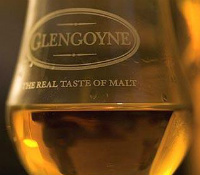
 Well here you go, day four and here is the third and last of the Mashman’s choices from Glengoyne. Hardly a surprise after the last two days, isn’t it? This time a Pedro Ximénez Sherry Butt. Pedro Ximénez or PX for short, is a very sweet dessert Sherry. Oloroso Sherry were always considered to be the best for maturing Whisky, but it turns out that PX Casks are very good too. Let’s see how this PX-Glengoyne will do.
This is wat Peter had to say about his choice: “sweet, rich, wonderful and moves beautifully when shoogled*, just the way I like my whisky and my women!” So Peter shoogles his women? I mush have a go and shoogle my granny then!
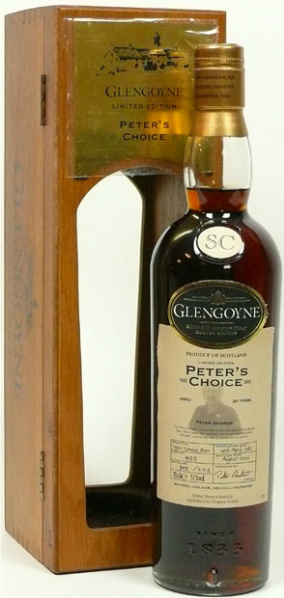 Color: Sparkling copper brown, almost with a red tinge.
Nose: Quite fresh and light, but also raisins and alcohol. Dusty powdery wood. Utterly balanced, but not very outspoken. Charlie’s choice was definitely more ‘heavy’, this is friendlier. Dry meaty and slightly woody. Very slick and elegant yet again. Not a sherry monster. Honey sweetness and leafy.
Taste: Again very elegant, and sweet, easily recognizable as a PX Sherry. There is wood, but not very much, also something hoppy, with a hint of soap. The body is firm enough to withstand the soap, so don’t see that as a problem. The whole is thinner than Charlie’s choice though. The finish here is again beer-like and a bit sour. If that had stayed more fatty and sweet, that this would have been a score into the 90’s.
A very nice pick by Mashman Peter, may the shoogle be with you! This is the last of the Choices from personnel of the Glengoyne distillery, tomorrow the choice is mine again! Nosing the three Mashman’s choices, I would say the best nose is on Charlie. Tastewise it is a tie between Charlie and Peter, where Charlie is more brutal, or sporty, and Peter is more dressed to the occasion, so to speak. Both score the same and which one is better is dependent on how you feel. So two ties here, one between Charlie and Peter and a second between Oloroso and Pedro Ximénez.
Points: 88
 * Shoogle is a Scottish word which means to gently shake or agitate.
 “In my time at Glengoyne this is the best cask I have tasted. Heaps of complexity with no rough edges.”
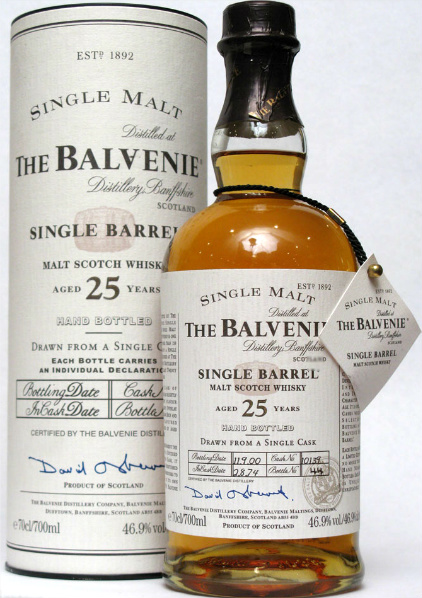 Color: Gold.
 It’s not only the bitterness that is obvious. Comparing these two there is infinitely more. That goes to show, how big the differences can be between two similar bottles, and how buying without tasting is so tricky. I would also like to point out that the reduction that obviously took place here isn’t a problem, this Whisky holds the fort. Actually it’s the best Balvenie I had in a very long time. Still no 90’s score though…
 Color: Light Copper Gold.
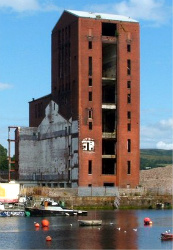 And here is another Cadenhead’s, from the same kind of cask, from the same year 1987, with three years more ageing. Cadenheads call this Distilled at Dumbarton, made with Inverleven stills. Everybody else calls this whisky just Inverleven. To clear things up. The Single malt whisky that was made this way, was called Inverleven. Inverleven was made untill 1991. This was made with the ‘normal’ type stills. In the same building was also a Lomond type still that was installed in 1959 at the Dumbarton distillery and ran untill 1985 (With the malt being called “Lomond”, not Loch Lomond). Loch Lomond lies close by to the north. Only a few kilometres away, still Loch Lomond is a Highland Whisky, and Inverleven a Lowlander. To wrap things up. The Dumbarton Distillery was the spiritual home of the Ballantine’s Blend.
 Color: Light gold. (Darker than the 15yo Cadenhead).
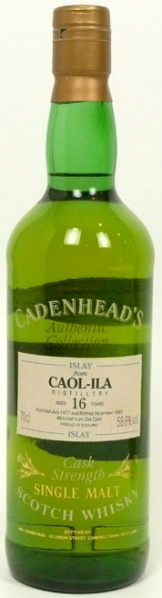 Color: Gold
 Caol Ila. This was recognizable blind. This has a nice full body with a perfect sweetness (slightly acidic) that matches the toned down peat a lot, combined with the smoke…a winner. Macaroons (made with almonds) and a slightly bitter finish (from the wood) and overall a tad too simple for a score into the 90’s.
 In the first weekend of October 2011 I went to the Whisky-Show in London with my friend Erik (both days). We liked the show so much that we went there again this year. Both years we tasted a lot of good whiskies. When we talk things over afterwards we always ask each other what surprised us. Last year we voted
  This Limited Edition 21yo is made out of 6 Bourbon Casks, since they don’t mention Barrels or Hogshead, I guess both are in the mix. For good measure also a Sherry Butt was thrown in. All casks were Refill casks. Casks were hand (or should I say nose and mouth) picked by Douglas Campbell. It’s called a Limited Edition since this is a one-off deal.
 Leaving Nikka for a while and now visiting Suntory’s Yamazaki. Yamazaki is the oldest working distillery of Japan being founded by Shinjiro Torii in 1923. It lies between Kyoto and Osaka. Shinjiro Torii also founded the Suntory company. As with Nikka founder Masataka Taketsuru, both men were pretty influential in the rise of Japanese whisky. Taketsuru also first worked for Torii as a distillery executive before embarking on his own adventures.
 Taste: Very dry and oaky. Toast and a hint of soap. The soap returns in the texture that otherwise is pretty thin. Sherried. Seems old. Red & black fruits, mocha and coffee. Dry teeth. Unfortunately this has a short slightly burnt, oaky finish. In this case it’s probably a good thing it got reduced, because if this would have been 55% ABV or even higher, with all these thick aroma’s and all that oak, it probably would have been very hard to drink. It’s a syrup (just not in the texture).
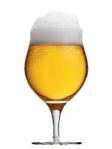 My good friend of “I think about beer” did a
  Westmalle is one of six Belgian breweries that are ‘protected’ by the Authentic Trappist Product logo. Achel, Orval, Chimay, Rochefort and Westvleteren are the others. The logo was presented to discern the trappist beers from the more and more widely available ‘abdij beers’ of Belgium and other countries. (Abdij = Monastery). Most of those beers aren’t even brewed near a monastery, but commercially brewed under a licence. Still, it’s the same style of beers. Usually with a blond beer at normal strength, a dark “Dubbel” and a heavy blond “Tripel”. occasionally a very heavy “Quadrupel” exists.
 It is not only beer that falls under this logo, and not only Belgian beer to boot. Here is a list of all products that fall under this logo.
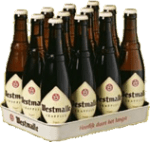 Nothing for the novice. The bitterness is quite a bit of the character. Beware because ageing makes this beer less fruity and more deep and bitter. The label, the bottle, the iconic WA-logo, the smell of it all. It breathes a time long forgotten, pré WW I. You consider yourself back in the thirties. A high score, but not necessarily your easy, every day choice. This is a classic.
 Color: Orange Gold.
 Master Quill