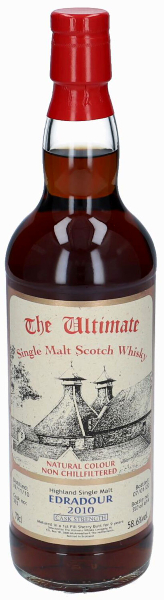
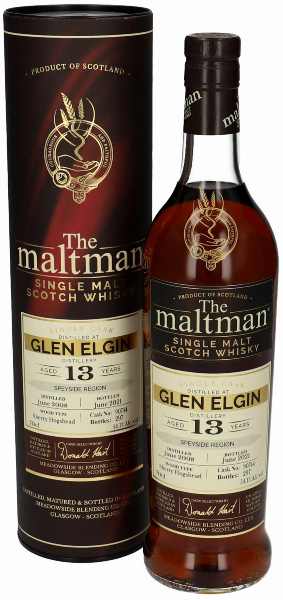
Glen Elgin 13yo 2008/2021 (54.1%, Meadowside Blending, The Maltman, Sherry Hogshead #90744, 297 bottles)

Seven years between the first review of Glen Elgin and the second one. That has to change, so what about two weeks between the second and the third review? Now, that’s a lot better now, isn’t it? Third review and again it is an offering by an independent bottler. The company’s name is Meadowside Blending, based in Glasgow, and specializing in Single Malt Whiskies, and run by the Hart Family. I don’t know why, but initially I thought this was a German outfit, probably because a lot of their bottlings are imported into Germany. My bad. This is a Scottish firm and they have several ranges on the market. Foremost is the range called The Maltman. These are all single cask releases. Next interesting range is The Grainman. Yes, you guessed it, all single cask, Single Grains. Other brands carried by the firm are The Granary (Blended Grain) and Royal Thistle. The bottle at hand, and this is no surprise if you are a regular on these pages, comes from The Maltman, yes a single cask, Single Malt Whisky from Glen Elgin. And yes imported into Germany by Alba Import, not sure if all of it went to the German market though…

Color: Orange gold.

Nose: Spicy sherry. Wood-spice and rather fresh and appealing, yet also some black coal with tar and right after that a more sharp and acidic fresh note. I have to say, all fits together quite well, so nothing wrong in the balance department. Lovely oak. The nose as a whole is thus rather appealing, fruity with half ripe sour cherries and maybe somewhere in there a more yellow fruit-note (indistinct). Breaths of fresh air run through the Sherry bits as well as some gravy? This is not a Sherry monster in the style you now often get with all these 10yo first fill Oloroso Sherry monsters. No, this is way more refined and still has quite a lot of colour to it. Tiniest hint of sulphur which I don’t even pick up on every time I nose this. Right after that some honey and maybe even some cigarette smoke. Warming and actually helping the whole of the nose. This has some fresh wood right from the start, but it’s not overpowering and actually very nice. Reminds me a bit of being outside near a sweet water lake on a nice and sunny day. Fresh winds, and the sherry bit could almost be some nice floral aromas blooming in nature. I guess this will not be a bad weather Whisky.

Taste: Half sweet yet also spicy (wood). Runny caramel or warm toffee. The coal, the tar and the wood are present right from the beginning. Sweetness seems building already. Quite some toffee now. All of this right before some fruit sets in. Warm apple compote? Nutty (yet different than in other Sherry bottlings), soft and supple leather. Leather as in belts and trousers, not thick saddle leather. Aftertaste is toffee and caramel again. Hints of plastic and warm wood. Again well balanced. I wouldn’t call the nose better than the taste of the other way around. No, this is one nice complete package indeed. Yet if I had to… yeah the nose is slightly better.

This one differs obviously from the Bourbon hogshead one by the Sherry influence. Apart from that, the Sherry influence didn’t actually overpower the traits of Glen Elgin, so there is still a family resemblance to be noticed between the two. I have to say, I like both Glen Elgins a lot, and both have their own moments. This one scores slightly higher (one point), because it is just a little bit more appealing and definitely better suited for a larger audience than the Bourbon hogshead one, which is more of an anorak-y Whisky. This one is also a little bit lower in ABV, which helps the drinkability. I like this one a lot, and would definitely it pick up again if I weren’t that adventurous and prefer to see what else is out there!

Points: 87

Glen Elgin 11yo 2009/2021 (58.8%, Elixir Distillers, The Single Malts of Scotland, Hogshead #807777, 238 bottles)

Actually, Glen Elgin is one of my favourite lesser known Whiskies. Being somewhat partial to the stuff, mostly from independent bottlers, I’m actually amazed this is only the second review on these pages. The only other review of Glen Elgin I did, was in 2017, being a 19yo Signatory Vintage bottling, that wasn’t as special as I expected, especially for its age. Hmmmm, never mind, I still stand with what I just said. Building started in 1898 just months before the Pattison Crash and it was also the last Distillery designed by Charles Doig (the foremost distillery architect of the time).

After the Pattison Crash, Whisky found itself in a sort of 50 year long slump, that more or less ended in around 1949 when William Delme Evans built the first distillery after Glen Elgin: Tullibardine. Fast forward a bit and cutting this history lesson short; Glen Elgin is now owned by Diageo and mainly used for its White Horse blend and currently is investing heavily in it by rejuvenating it. Back to the Whisky at hand, since this time around we have a bottling from Sukhinder’s outfit Elixir Distillers. Being a independent bottler foremost, I wonder what they actually distil. Elixir distillers is mostly known for their Single Malts of Scotland range of independent bottlings but also for their Port Askaig bottlings of undisclosed Islay bottlings (often Caol Ila).

Color: Pale White Wine.

Nose: Barley and biscuity. Cereal, crackers and bread. Dusty with hints of cardboard. Starts big and in your face. Good and honest Whisky, no frills, no funny business. The next wave is more fruity (dry citrus skins), with the tiniest hint of cask toast and pencil shavings. Warm wind in summer, slightly grassy and vegetal. Hints of rainwater. The third wave adds a more perfumy note as well as grandma’s old soap note, never losing sight of the fruits though. Quite fresh overall due to a slight minty and green nose. Well balanced and straightforward. A very effective and highly drinkable Glen Elgin. It may be somewhat simple, but don’t be fooled by this, since there is quite a lot happening in this one, and as said earlier, its also quite big. It’s layered, so it might be even more complex than I initially thought. I always liked Glen Elgin and this is definitely an example why. The fruity note becomes sweeter, not only ripe fruit sweetness yet also a more honey-like aroma. I know sweetness is something for the palate to discern, but I hope you know what I mean here. In the end this is quite a nice (not modern) nose. I like it a lot.

Taste: On entry half-sweet but easily overpowered by a spicy and woody note. Prickly oak, only ever so slightly bitter and soapy. Maybe an odd red chilli pepper found its way into the cask? Nah. Warming going down. After the first sip, the soapy note on the nose becomes more like cold dishwater. Second sip shows a more complex sweetness, fruity and honeyed. (The nose is now more old-skool and melancholic). Less syrupy than expected. Some peach emerges as well, retaining the relative hotness from the first sip. Lots of paper and cardboard comes next which does get in the way a bit of the fruity notes. Where this is a miss on the palate, the nose, even now, keeps developing further still. Hold on now, after a while it does become slightly more bitter and slightly acidic as well, which in the case of the paper and cardboard do less for the palate than it sometimes can do. It also shows some new make spirit notes now (that fit the colour of this Whisky well if I might say so). Next some sun-tan lotion, you didn’t see that one coming now didn’t you? Although not a biggy, this part of the palate is not the best. By the way, I get some cheese on the nose now, how is that? This turns out to be quite a surprising Glen Elgin. Definitely not boring this one. Still, this one has much nice things going for it, so the score is warranted. Peach yoghurt in the finish as well as a peppery note, some might call hot. The finish as a whole is of medium length and especially the minty bit seems to have some staying power here. It’s alright, it’s good, but the nose was better.

Yes the Mortlach I reviewed just before scores slightly higher, but in comparison this Glen Elgin is slightly more drinkable. Even though this one has a very diverse, unusual and layered nose it is even more accessible than the Mortlach. Mortlach has always been a more anorak-y kind of Whisky anyway. Still, I wouldn’t recommend this one either if you are a novice, just like the 19yo Glen Elgin I reviewed in 2017.

Points: 86

Mortlach 10yo 2011/2021 (57.3%, Signatory Vintage, Finished in 2nd fill Sherry Butt #3, A Farewell Dram bottled for Walter Schoberts Final Tastings, 527 bottles)

What can I say, Mortlach is a special distillate with a special profile. First of all, Mortlach is known for its unique distilling regime where the spirit has been distilled 2.6 times. Mortlach is also known for its big and meaty Sherry profile, like the 16yo Flora & Fauna bottling or this 10yo Wilson & Morgan bottling. But even the lighter (ex-Bourbon) versions of Mortlach always bring something special to the table, like this 11yo Provenance bottling, not a high scorer, yet very interesting indeed, or this small batch 12yo Signatory bottling from 3 Bourbon Barrels. This time around however, we’ll have a look at a Mortlach that has its initial maturation in, most likely, American oak Bourbon casks and a finish in a second fill Sherry butt. As usual, no info about the type of Sherry, and we all know there are a lot of different types of Sherry around. Oloroso is no Palo Cortado, ain’t it! Nevertheless, this Whisky seems to be more on the light side, so at this point I don’t expect a meaty Sherry expression.

Color: Light gold.

Nose: Nice entry. This immediately reminds me of good Whiskies I tried in the early noughties (if you let it breathe for a minute or so), definitely brings back memories. A slightly mineral and somewhat Sherried barley note. Wow, really old-skool nose. Quite organic at first with hints of sugary sweetness, cardboard and white bread. Slightly biscuity. Fresh and vibrant nevertheless, since bread is not a vibrant aroma. Very classy and well balanced for a 10 year old dram. Some fruity notes emerge next. Initially some unripe cherries. More fruits in general, more syrupy yellow fruits actually. Peach syrup and candied pineapple. Sweet peachy yoghurt. Together with this a fresh and warm barley wind bringing a Gin-like freshness. Warm old wood in the sun. Slightly dusty and powdery. Not floral at all although it is slightly perfumy. It has quite a lot of different aroma’s going for it. For me personally Mortlach often has this meaty quality to it (especially when aged in a Sherry cask), but I’m struggling to find that here. It is definitely more fruity than meaty. Don’t think the fruit is masking it, I feel the meatiness just isn’t here. The longer this breathes, the fruitier and sweeter it becomes. Very appetizing fruity fresh and vibrant Mortlach this time. After some time a more soapy note emerges as well as some more freshness. Not in a bad way though. Definitely a quality nose. Maybe a little bit light, and this might have been ruined (a bit) if it would have been reduced. All in all definitely a quality and classy nose.

Taste: Nutty first, almonds, hazelnuts and fruity second yet not far behind. Big, sweetish and balanced. Did I mention that its nutty? Notes of burnt or toasted oak, and some cold dishwater to be honest. Big aroma initially which quickly becomes somewhat thinner. Definitely a fruity Whisky with lots of ripe yellow fruits and some red berry acidity. After the layered and complex nose, the taste is simpler and more straightforward. Notes of a yellow fruity beer and ever so slightly soapy. Even though the nose is way more complex, the nose and the taste of this Whisky are well balanced and suit each other well. Since this was finished in a Sherry butt, I guess this initially aged in probably two or three ex-Bourbon casks (barrels and/or hogsheads), and where I struggled to pick up on the Mortlach meatiness, I also struggle to pick up on vanillin from the American oak, so, probably not first fill. A vanilla note or ice-cream note, yeah, maybe, gets lost a bit in the slight thin-ness of the body. And maybe somewhat overpowered by the fruity acidity. Let’s say this is a summer expression of Mortlach. The aroma’s are transported well, so 57.3% ABV, yes indeed, but it doesn’t really show this much alcohol. More woody towards the finish, warming, with a bonfire like toastiness, as well as some paper and cardboard notes. Dirty and fruity, yet not meaty.

A Good summery Mortlach. The nose is really good. Sometimes the taste seems thin, but that also depends a bit on you yourself. For this review I tasted it twice on different days, and the second time around it wasn’t as thin as the first time. Very good Mortlach again, and this particular expression has some similarities to Bimber that has matured in Bourbon casks, Like this cask #194.

Points: 87

P.S:(I). This one is very nice after a cup of coffee…

P.S:(II). In case you are not German and you want to know who Walter Schobert is:

Walter Schobert (* 1943 in Erlangen) is a German museum director and author. Schobert studied Protestant theology and theatre studies. He then worked as a priest and as a film speaker for three years each. From 1974 to 1985 he was chairman of the working group for community film work. From 1979 to 2003 he was the founding director of the German Film Museum in Frankfurt am Main. He is the author and editor of numerous writings on film and film history and has taught film history at various universities. Since 1994 he has been an honorary professor at the Institute for European Art History at the University of Heidelberg. In 1995 he was awarded an honorary doctorate from the University of Edinburgh. In addition to his work on film history, he has published numerous publications on the subject of Scottish whiskey and regularly conducts tastings. He is a member of the “Keepers of the Quaich”, an association that looks after the whisky culture in Scotland [Source: Wikipedia].

Ardbeg BizarreBQ (50.9%, OB, Double Charred Casks, Pedro Ximenez Casks & BBQ Casks, 15/2/2023)

The previous post, which was quite long to be honest, was about a somewhat experimental special release Ardbeg called Auriverdes. Auriverdes was released way back in 2014. More recently though, in 2023, Ardbeg released this BizarreBQ, and I thought, hey, why not do another, preferably shorter, review of a special Ardbeg. I’ll even post a minimalist picture of the bottle without the box, (because there isn’t any). The previous post is about Auriverdes alone and this one will be about BizarreBQ obviously, but also a bit of it in comparison to Auriverdes, since both Whiskies have quite some charring going on. I also thought, when selecting all Ardbeg’s on these pages, what a visually appealing look it is, to have all those beautiful green Ardbeg bottles lined up one after the other. This 2023 Ardbeg is most definitely experimental, because BBQ casks, really? What is that? Pssssst. Yes? These casks underwent yet another super-secret char, making the inside of the cask even more akin to the charcoal you’d use for BBQ-ing. Ahhh, OK. Amazing.

Color: Pale orange gold, with an ever so slight pink hue.
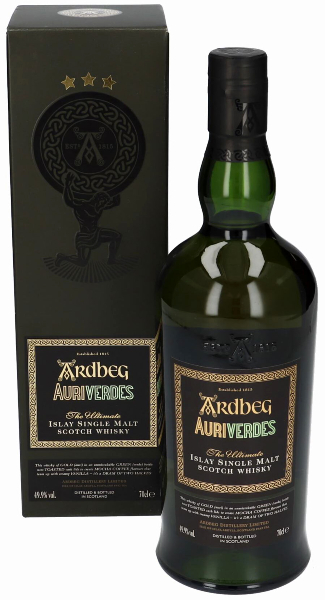
Nose: Thick fat peat with lots of smoke and iodine. More upfront and smells way younger than Auriverdes did. We’re definitely in NAS territory all-right, since a lot of the nose smells like a very young Whisky. Earthy, wet and dry tea-leaves, vegetal and even more iodine now (80’s Laphroaig style). Quite spicy and herbal. Warming and very well balanced. I like this nose a lot already, apart from the initial overtly youthful bit. Smoke from burning newspapers, burnt match sticks, mixed with the smell of a crushed beetle. Somewhat sweet smelling, but couldn’t say if this is the PX speaking, since Auriverdes was on the sweeter side as well. If smelled “blind”, I probably wouldn’t have mentioned PX-casks at all. I guess all the charring that was going on defines this nose, and the “sweetness” might be the newly released vanillin from the oak, especially if it’s American oak. After the bold bits wear off, (it is initially quite fresh and sharp), the nose becomes more friendly, Gin-like, with hints of Rye Whisky and yet it still is quite a balanced endeavour altogether. Slightly more wood now with black coal and licorice coming to the forefront, as you get in modern day Ardbeg. The smell reminds me of old steam trains, more than an actual BBQ, with or without meat on it. Based on the nose alone, a very nice Ardbeg indeed, makes me feel a bit melancholic again, yet less so than Auriverdes managed to do, which in comparison has a more classic nose.

Taste: Sweetness, accessible, likeable. Bigger than Auriverdes. Fattier and even sweeter. Like Auriverdes, again somewhat simpler than the nose, but very drinkable indeed, without losing the freshness and sharpness which is present in the nose. I would say, great balance again. Not really a PX sweetness here too, yet more so than the nose showed. This Sweetness, the feel of it might be somewhat closer to a Whisky from a PX-cask, but still not all that much. All good so far. Some sweet licorice, a whiff of polyester and horseradish. After sipping it now, I get the horseradish on the nose as well, as well as the hint of polyester. If you do your own boat-repairs, you know what I mean. By the way, the polyester bit is not as bad as it might sound. Chewy wet wood. After the big bold entry this Whisky has, it also falls short in the finish a bit and not a lot actually remains for the aftertaste. Maybe herein it shows its youth. Lots of upfront stuff because of the charring, but lacking some depth due to age of the Whisky. Alas this has quite a short finish and only some lonely, left behind, licorice in the aftertaste.

I feel the whole of this Whisky is (much) younger than is the case with Auriverdes. But hey, still not a bad Ardbeg again, fetching a decent score. Yet again it is a special release that scores lower than the batches of Corryvreckan and Uigeadail I reviewed. But it does offer another perspective on the Ardbeg theme. Of course there might be some batch variation with Corryvreckan and Uigeadail, since they are released regularly as opposed to the one-offs that are these specials. If you want to spend your money wisely and don’t mind staying with those two expressions alone, you will be fine. If you are more adventurous and are willing to spend a bit more on a variation of the Ardbeg theme, and mostly with a lower ABV as well, than those special releases are for you. Only if you believe, that since you spent a fair bit more money, you are getting a better Whisky, than those mentioned from the core range, you are likely to get disappointed and get a bit salty. That being said, there are obviously also special releases which are definitely better than the core range. Some of which will be reviewed on these pages in the future and by now are or have become quite pricey.

Points: 86

Ardbeg Auriverdes 12yo 2002/2014 (49.9%, OB, American oak casks with toasted virgin oak lids, 6660 bottles)

I have to say that many of Ardbeg’s “special” releases aren’t getting a lot of love. It almost seems to be in fashion to slam these releases. Maybe a combination of NAS and silly marketing or the combination of NAS and the pricing of these “specials”, because obviously these Whiskies could be containing pretty young stuff. Maybe people dislike the posh new owners LVMH. How can a leather bag and a mediocre Champagne be the owners of the mighty beast that is our Ardbeg. Whisky is romantic and better than all other alcoholic beverages! Another explanation might be that the core range is actually quite good. Especially Uigeadail and Corryvreckan if you ask me, both better than the 10yo, An Oa and the 5yo Wee Beastie. All five are more affordable than all these special releases. Most of which are often NAS Whiskies (Hence the funny names) and also are a bit more experimental in nature as well.

In 1997 Ardbeg was bought by Glenmorangie, so the experimental nature of these releases comes as no surprise when, since 1995, they have Bill Lumsden on the payroll (Head of Distilling & Whisky Creation at The Glenmorangie Company). For those who don’t know Dr. William “Bill” Lumsden (The Mad Scientist), he previously experimented quite a bit with Whiskies at Glen Moray before experimenting on an even higher level at Glenmorangie and Ardbeg. Online, two of the most disliked Ardbeg expressions are Perpetuum and the Auriverdes at hand. Perpetuum in fact wasn’t even very experimental. Old en Young Whiskies from Bourbon and Sherry casks. Still, I found it was a decent expression and I never had a dull moment with it. I scored it 86 points which is certainly not bad at all. But the two aforementioned cheaper ones from the core range: Uigeadail (2018 batch) scored 87 and Corryvreckan (2014 batch) scored a whopping 89 points, so both outdid the “special” release. As mentioned above , this time around we’ll have a look at another unloved Ardbeg: Auriverdes. Is it experimental? The Whisky matured in second fill Bourbon barrels. The original lids were removed and replaced with new virgin oak ones, which were toasted using a very special secret toasting process, which accounts for the experimental bit.

Color: Light gold, not pale.

Nose: Nice funky peat, soft smoke with some notes of crushed beetle. A fireplace in December. The smell of Christmas in a log cabin. Hints of black coal and glowing embers. Old bicycle inner tubes. Less salty and fishy than expected from a south shore Malt, even though more than enough organics are happening in this nose. After a while, a more fresher approach starts, with breaths of fresh air, and more citrus-like aroma’s without being overly fresh or acidic, just adding to the perfume. After this fresh phase, we’re back in the realm of black coal and chimney smoke in winter, preferably on a dark evening after a snowy day, only lit by street lights, by odd coloured sodium lamps. Tiny hints of sweetish licorice powder, a Licorice-Menthos combo and some dust for old-times sake. Ooooh, the rubber comes back. I think this is a really nice smelling Ardbeg. Maybe some experimentally and specially and secretively toasted cask ends, but other than that, no funny business and nose-wise quite a successful experiment. I really do like the nose on this.

Taste: Sweet licorice comes first, as well as the crushed beetle. Somewhat vegetal and tea-like. The texture seems a bit thin initially. An indistinct fruity note is also present. Citrus, only more sweet, more sugared, than it is acidic and maybe some other ripe yellow fruits as well. Warming going down. Somewhat sweet, somewhat peaty and more of the Menthos feel that came rather late in the nose. It tastes somewhat like a minty licorice powder. Whisky-candy. The sweetness works very well in this Whisky. After swallowing, a nutty note emerges as well as some distant vanilla. Initially not big-bodied at all, maybe this is what people dislike in this expression. It is definitely simpler than the nose. The nose is really good and melancholic, the taste is initially a bit watered down, or maybe not mature enough. Is this the youth a NAS Whisky allows for? Yet it has great balance. Everything fits and works together well. Mind you, this is still not bad, but the nose carried some sort of a promise of things to come, a promise that hasn’t been kept entirely. I expected more complexity. During sipping, the nose still keeps on evolving, and truth be told, the taste does collect itself, which makes for a highly drinkable Ardbeg. I’m not having a beef with this one at all. Well, well, well, the taste really does develop after a while. This needed some time as well, time I might have saved, if I had added some water (but why hurry). It did gain even more balance and the body and especially the finish are bigger now, still not very complex though.

If really analysed well, with more than enough time, it is much easier to pick up on the true Ardbeg underneath. Maybe these specials aren’t for casual sipping at all, and if you try to be patient and give it some time, these special releases might be better than I was lead to believe by the internet. Maybe you got to work them a little, and since you are reading this, you as an experienced taster, are very able to do so, so please do.

People can be so judgemental these days, living fast, judging fast, too self confident. That’s human nature in the 21th century Whisky world or maybe even the world in general. I’m actually amazed how negative some people are and how vocal about it as well, and a lot of less experienced people just run with this and claim the same, unsure about their abilities to smell and taste. I see around me that even experienced aficionados fall into this abyss. If this is you, maybe you should learn to relax a bit, sit back some more, take some more time to smell the roses, (or Ardbeg in this case). Don’t be biased that Ardbeg is trying to pull one over your eyes and dupe you, because they probably aren’t. Not from the Whisky makers perspective anyway. Marketing may be another story entirely. Bill may be a mad scientist who tries to explore, often with an idea and sometimes by trial and error. This is definitely not a bad Ardbeg and don’t believe anyone telling you this. I feel this is a decent malt if you only let it. Don’t fool yourself and don’t let yourself be fooled, make up your own mind, and if after this you don’t like it, it must be true. Only then.

Points: 87

Longrow 10yo 2007/2018 (56%, OB, Fresh Sauternes Hogshead, for The Nectar, Belgium, 258 bottles, 18/437)

Nico got a mention in the previous review of the Springbank 12yo Port. So this Nico dude once made me aware that he really, really likes a particular Longrow 10yo Sauternes. So here we are again, going to have a look at yet another Whisky from the stills at the Springbank distillery that has matured in an ex Wine cask. Sauternes is a sweet White Wine from Bordeaux, France. Do I really need to mention this is French? Isn’t Bordeaux already famous enough? Well, just in case you didn’t know.

Although Longrow is also famous enough, as is its distilling regime. Just in case you don’t know, I am still going to tell you that Longrow is peated Whisky from the Springbank distillery that has been distilled just two times, where Springbank is 2.5 times distilled. Half the spirit is distilled 2 times and the other half 3 times, so the Gandalf’s at Springbank call it a 2.5 distilled spirit, sounds like wizardry to me. Add to that some more peat than they use for “Springbank” and you have Longrow: the heavily peated expression, 50 – 55 ppm (parts per million) phenol content of the malted barley after kilning.

Color: Copper Brown.

Nose: Fantastic fruity and sweaty peat, really bold and amazing. Could Sauternes also be one of the best wine casks for Whisky? What a classic, big and utterly wonderful nose. Sweetish and fruity. Clay, dust, white pepper and some more earthy and peaty aroma’s. Rotting leaves lying in the garden. All the aroma’s here are perfectly integrated with the peat. It almost smells chewy as well. Where fruit aroma’s usually give off a summery feel, here it seems to be the opposite. Yes it is fruity, but in a dark and broody way. Nice soft and velvety peat leaps out. As I said, fruity, but in this dark and broody way. Its fruity yes, yet also very much industrial in its feel. This is an amazing smelling Whisky. After a while a smoky note pops up. The whole is dry and fruity at the same time. I think this might very well be very special stuff. I already like it a lot. The next day the empty glass still has some big aroma’s to it. Lots of peat and smoke and some hints of plastics and a fatty aroma, for that industrial feel.

Taste: Fruity, nutty at first and than some wood, with a nice spine tingling, spicy bitterness. Black coal and iodine. Chewy peat and the smoke itself is more upfront here. Big and bold again. Seems like the Wine underlines the peat somewhat more in this expression than in other Longrows. In comes toffee, so it has some sweetness to it, with lots of carbon and peat inside. Tasting this Whisky, I’m really missing some of the funkiness the nose showed. The taste is drier and less chewy. Fruit toffee. Nutty. Semi-sweet ripe red fruits, mixed in with a healthy dose of peat (and nuts). The taste of burning off garden waste. Even though there is enough fruit here, the whole is still quite dry. Towards the aftertaste this bitter note slightly coated my tongue and shows quite some staying-power. This bitterness is actually hindering a score into the 90’s. Sometimes a bitter note can work wonders, this is just not one of those cases. Nevertheless a very nice and special Longrow for sure.

Wishing you all a very good and healthy 2024!

Points: 89

Springbank 12yo 2003/2015 (58.3%, OB, Port Pipe, for UK Customers, 696 bottles, 15/177)

When the fifth release of Springbank Local Barley 10yo (2019) hit the shelf, I was offered a generous sample by Nico. In stead of money exchanging hands, it is always nicer and more adventurous to exchange it for a sample that hopefully can stand up to the Local Barley. Looking through my stock, I decided upon this single cask bottling for UK customers. I opened it, filled a sample bottle for Nico and when he got it, we had contact whilst he was trying it. Sort of an online tasting. I poured myself a wee dram as well. Well, what can I say, we both liked it. At first Nico liked it big time and appreciated it even more than I did, and I already did like it. Some time has passed since then, and with some air, and maybe even some more balance to it, it is time to have this more “official” look at this full time Port cask matured Whisky from the stills of Springbank Distillery.

Color: Orange gold. No red hue.

Nose: Funky Wine. Fresh and fruity smelling. Cherries (fresh and sour ones), sweet licorice, waxy and oily. Traces of peat, hints of dust and cardboard. Warm electricity cable and sometimes a whiff of hospital (ether). Funky organics and animalesk. Fruity and slightly sweet smelling. Nice warm wood notes with almonds and after a while a soapy note emerges, at times more resembling a lemon based dishwater soap. Sounds bad, I know, but it’s not, giving it a fresher, more zesty phase. If this soapy note comes back in the taste though, than it’ll be a problem! The winey bit is very present and almost overpowering, and it doesn’t remind me necessarily of Port. It was bottled just in time for it be be nice smelling and balanced in the nose as well. At times floral and perfumy. This is a nice smelling and highly complex Springbank, showing its provenance because of the oils and fats, not dissimilar to a (very) good batch of the 10yo. I see this as a Springbank “+”. It still is clearly a Springbank with just another layer added. Some light and subdued mixture of kitchen spices and sometimes some notes of hay and dry grass. Amazing balance and complexity in the nose. After a while a more fresh oak note emerges, and more grass, especially after sipping it. The nose becomes even better and more balanced after sipping.

Taste: Nice big entry. Again fatty, fruity and nutty, yet much less so than on the nose. Waxy and ever so slightly peaty, with a peppery and spicy attack (not yet from the wood it was aged in). Deep note of peat and red ripe fruit (and some plastic?). Big, big, big, yet somewhat less complex than the nose is. Black coal, maybe some tar and warm machine oil. More hints of wood, just like smelling fresh dried staves. Dried grass and definitely licorice. Honey-licorice with a slight bitterness and spiciness to it. Definitely more wood in here (eventually) than in the nose. Where the nose was almost overpowered by the fruity Port cask, here it is the other way ’round. The Springbank spirit overpowers the Port. Unmistakable Springbank here. Still enough fruit and sweetness now. You can’t call this sweet in any way, but there is some of it giving it even more balance, although I feel this is also less balanced than the nose was. More fruity wax, and the tiniest hint of clay. Fruity Port and some black coal in the finish. For this particular Malt, balance is very important. If the balance of the taste and the mouthfeel were just as good as the nose, than this would have scored (close to) 90 points.

A very good expression, yet not in the style of a daily drinker. A bit too demanding for that. Complex and big. In a way this doesn’t resemble a modern Malt. It has a rarely seen profile, that oozes the times of yesteryear. Also, to finish things off, if you want to catch some annoying fruit flies in your home, than this is your liquid of choice, even now that we’re well into autumn/fall.

Points: 88

Aberlour 8yo (50%, OB, Unblended all malt, EST. 1845, 75 cl)

So the last Aberlour review posted in October 2022 was of a modern 13yo officially bottled single cask. Modern, since it was distilled in the 21st century. This review of the 8yo was supposed to follow the 13yo right on its heels, but it didn’t. Autumn, or fall, started happening when I started to write the review, and it was suddenly time for peat. Fast forward to Spring. Winter has ended and although the time for peat still hasn’t ended, time has finally come for a nice old skool Sherried Speysider. No, it didn’t. Spring came and went and this review was again further postponed. When I picked up this review again it was summer, yet again the review remained in its draft state. Now finally when looking outside, summer is most definitely over. Maybe we’ll still get some days that look pretty good, but I guess autumn started happening. So no use any more for the desk fan and the air outside is cold. We might as well prepare ourselves, because winter is coming again, and peat already started lurking at me.

Never mind. After the Aberlour 13yo bottled in 2017, here we have an 8yo from the seventies, an oldie and hopefully a goldie, from a different century as well. There are a lot of permutations of this Aberlour bottled in the square bottle, and there can be quite some differences between the Whiskies, or so I’m told. Up ’till now I have only tried one other. Like with so many things in life, not all 8 year old Whiskies are created equal, I guess.

Color: Light orange gold.

Nose: Old skool Sherry nose. Waxy, toffeed, some fresh butter and funky. Like coal fired stills including some petrol fumes and exhaust gases from outside the still house. And like real petrol fumes and exhaust gases, they dissipate in the wind. Cola, cold motor oil and coal dust. Dusty old furniture. It seems as if some sugar sets down in the back of my throat, only from smelling it. Doesn’t smell like an 8yo Whisky at all. Initially some hints of Rhum Agricole, but this dissipates rather quickly and I also don’t pick up on it every time I smell this. We all have our better and worse days you know. Smells nothing like a modern 8yo Whisky as well. Much softer. Very mature for a standard 8yo. Things have changed since then, wasn’t everything better in the old days? Still dusty with this wonderful coal dusty Sherry nose, like we know from all the greats. Whiffs of sweet yellow fruit yoghurt and cookie dough. All is good. It smells nice and comes without any off-notes. After a while quite fresh for an old skool malt. Like a breath of fresh air (in an old earthen floor warehouse) and yet still sweet smelling.

Taste: Nutty and waxy sherry. Also some dry and active wood, slightly bitter as well. Drying my tongue and palate. Slightly spicy (cinnamon), fruity (dry bits of peach and apricot) and definitely old skool. Hints of cola and especially licorice. that wasn’t present in the nose. Besides that it is slightly prickly as well. Is this from the wood or some sort of liquid smoke? Crushed caterpillar (don’t ask). Slightly cloying Sherry,but I wouldn’t say this is all that sweet. I expected it to be way more sweet since this Whisky is so sweet smelling. All the specialness is in the beginning. It shows its age by halting its development halfway through and not being all that complex. Not in my glass nor in my mouth. It is a wonderful old skool Sherried Malt, but it is thus also a bit simple. At this age it was probably aimed at, amongst others, the Italian market, so no surprise here that it is highly and dangerously drinkable. Next some creamy and buttery notes are able to escape, albeit briefly, from the grasp of the Sherry. The bitterness shows some stamina with its staying power. It is not dominant yet quite noticeable. Well balanced though, since the taste matches the nose, and for me, it tastes slightly better than it smells, and don’t get me wrong it smells wonderful. By the way on some days I prefer the nose over the taste. On those days the taste seems a bit thin. Black coal and licorice in the finish and aftertaste. This actually works well, hiding the residual bitterness.

In the end this is a well made old malt, yet also a bit simple and regularly shows some fragility. Highly drinkable, definitely old skool, and there is no reason to keep this around for a long while, just enjoy it, since you never know what oxidation will do (or already did) to such an old Malt. By the way, the roof of my mouth is slightly anaesthetized, so definitely a higher ABV. Empty glass smells very nice by the way! Don’t sip it, bigger gulps are the secret to unlock this Malt to its full potential.

Points: 87

Ledaig 9yo 2005/2015 (56.8%, Signatory Vintage, Cask Strength Collection, 1st Fill Sherry Butt #900146, 664 bottles)

After Caol Ila and two cask strength Laphroaig’s, lets stay with peat for a while (winter is coming) and check out this peated offering from Ledaig. Yes I know, Ledaig isn’t from Islay. Why should it? You can distil with peat anywhere on the planet, or in this case, Scotland. There is already a lot happening on Islay, lots of distilleries, and isn’t Mull more unique? Not a lot of distilleries on Mull. Ledaig as we all know by now, is the peated Whisky made at Tobermory Distillery. You did read all my previous reviews on Ledaig, in preparation to this one, now did you? So you should know by now, yes? Tobermory distillery also releases unpeated Whisky, calling it…well…Tobermory, how did they come up with that! You could fool me sometimes with this statement though. Seems to me some Tobermory’s are peated as well, maybe less so than Ledaig, yet peated. Maybe they’re just not as good at line clearance as they are in making Whisky? Who knows, and who cares if the output can be this good. By the way, not even that long ago Tobermory did have some sort of a wonky reputation concerning the quality of their Whisky.

Earlier I reviewed a fantastic 11yo Cadenheads offering distilled in 2005 which has matured in a Sherry Butt. This time around I went for this 9yo 2005 Signatory Vintage offering, that also matured in a Sherry Butt, expecting and hoping for more of the same and wanting that all 2005’s are somewhat created equal. I just wonder why Cadenheads only managed to draw 450 bottles at cask strength from a Butt and Signatory 664 bottles. That’s quite a considerable difference. By the way, Cadenheads bottled two other casks from 2005, yielding 510 and 516 bottles. Still no 664 bottles though. Different oak with more evaporation or different warehousing conditions? Who knows.

Color: Orange gold.

Nose: Fatty, fragrant and delicious peat. Slightly Sherry sweetness. Full on sweet smoke with some toffee. A little dirty yet sexy. Licorice smoke. Salty and smoked licorice candy. Prickly smoke, with a minty side to it. Smoked menthos. Nom, nom, nom. I have to say, a peated spirit like this, aged in a Sherry butt, what a combination. The start was peat which morphs slowly into smoke. Hints of anise seeds and cumin. In the background dried beef, gravy and salty smoked fish. This has also an underlying fruity side to it, but again, just as in the Caol Ila I just reviewed, this is masked by the usual suspects of peat and smoke. What a wonderful smelling Ledaig again. Utterly amazing smelling Malt and it’s only 9 years old. Glowing embers, warm glowing charred wood. Hot barbecue before anything is put on it, burning off the last spots of fat left behind from the previous session, right before putting something on it again. Or imagine sipping this near the fireplace high up in the mountains. This nose never stops giving. Warm oil emanating from a steam locomotive (a fresh experience from two months ago in Quedlinburg, Germany).

Taste: Starts sweet and peaty, yet also somewhat unbalanced. The peat and the smoke have a bitter edge here right from the start, but also something fresh like a cola has. Nutty and some burnt fat from the barbecue. This note smells better than it tastes, by the way. Very warming and hot going down. Now I do notice quite some dry wood underneath, tucked away neatly between the peat and the smoke. So it might be a bit hidden, but the cask is quite active as well. More towards burning plastic now and again the minty note. The peat note is more bitter and together with the smoke, also less dominant. The Sherry comes trough some more. Dried salty fish. This one needs some time to breathe, but not too much. When standing around in my glass for a long time, the taste deteriorates a bit (the bottle is also nearly empty by the way, so I notice the air did play its part). This will be of no concern with a freshly opened bottle, because then, this Malt still does need a lot of air. Crushed beetle in the finish, and overall still warming. Also some caramel comes forth.

Are all Sherry Butt matured Ledaig’s from 2005 created equal? Nope they aren’t. The Cadenheads rose to the occasion much more than this Signatory initially, but, oh boy, when this got enough time to breathe in an open bottle, yeah man! The nose is up to par with the Cadenheads, alas on the palate, the Signatory falls apart a bit and the Cadenhead is the clear winner. Sure it’s different from the Cadenheads offering as well. That one was tasty from the first poured dram until the last, and this Signatory one did need some time to find its place, which luckily it did, although it never reached those highs of the Cadenheads, and deteriorated a bit when nearly empty. Nevertheless two big peated hits in a row from Tobermory. I’m suspecting an album of greatest hits now, so for the time being, I will be replacing every emptied Ledaig with another one. Can’t wait to open up the next one now. I have to look in my stash for one matured in a Bourbon cask after these two Sherried ones.

Points: 86

Laphroaig 10yo Original Cask Strength Batch 007 (56.3%, OB, 2015)

I have to admit, I bailed on Laphroaig for a long time when the first signs of considerable quality loss were visible in the regular 10yo. A marketing person would mention that it has been made with an “improved recipe”. Change of ownership and the decision to sell out the brand a bit, with issuing lots of mediocre bottlings. Some luckily turn out to be a bit less mediocre than I initially thought. Assumptions, assumptions. The mother of all…thanks Jane!

The 1815 Edition, Brodir and Lore, weren’t as bad as others led me to believe. So after the 10 Cask Strength “Red Stripe”, I somehow “forgot” about newly released bottlings of Laphroaig and turned my attention elsewhere. Little did I know, because, forgetting about Laphroaig made me also pass on all these wonderful 10yo Cask Strength batches for a long time. So rather late, I started to backtrack. At the time of writing, batches #006 through #015 are still “reasonably priced” and batches #001 through #005 are already quite expensive (at auctions). Nevertheless, I was also able to get some Batch #006 and used that one as a starting point and work my way up from there. I still have to figure out a plan for batches #001 through #005 though. I’ll probably have to throw some money at these or hopefully score me some samples of those. As could be read earlier, batch #006 was very good indeed, now let’s move on to batch #007 a.k.a. the “James Bond” batch, I wonder why…

Color: Light orange gold. Batch 006 is ever so slightly darker.

Nose: Top notch peat, prickly smoke, briny and sweet. Starts big, but after some breathing it softens up a bit. Gaining even more balance. Yes, this needs some air. Very, very nice. In the plethora of Laphroaig’s slightly less fantastic (travel retail) bottlings, this shines like a big sun! Chalk and paper and some warm asphalt. Tarred rope, dried fish. Sweet and creamy. Fireplace on a chilly evening. Hints of Christmas spices and even a cold sea breeze whiff by. Man, this smells so good. Brings back memories. Hidden away between all these hard hitting aroma’s is some nice fruitiness and the tiniest hint of chlorine, hidden away in a breath of fresh air. This bottling is a testament that Laphroaig still has what it takes and for me it also functions a bit as an apology for the rest of the aforementioned bottlings, which aren’t all that bad to boot, but still… This one is definitely for Islay aficionado’s. If you are a novice please turn to “Lore”, get a bottle of this as well, but open it only of you feel you can appreciate something like this.

Taste: Licorice and sweet black and white powder. Nice soft peat hinting at a higher age than the 10 years claimed. Soft cream and again some hints of acidic red fruits. The smoke and sweetness perform a delicate dance. Warming going down. Take this as a nightcap and you’ll sleep like a baby, or so I imagine. Don’t taste this carelessly or a lot might go unnoticed, This needs your attention like a faithful dog. This Laphroaig will love you back in the same way. Licking the insides of your face. Come to think of it, this does have a animalesk note, wet dog maybe too? Nice balanced finish, but the aftertaste doesn’t seem very long. It does leave a minty feel on my tongue though.

Amazing this is so much better than a lot of the Laphroaig’s I reviewed last. Considering the price, I have not really a use for a “Lore”, a “1815”, a “An Cuan Mor”, or even a “Brodir”. Sorry, but this one here, this is the one for me, I like it even way more than the 18yo, which is no “dog” as well. If I need Laphroaig-variation, I’m getting several different batches of the 10yo Cask Strength. that sounds like a sound plan! I really like Ardbeg Uigeadail and Ardbeg Corryvreckan, but these Original Cask Strength’s trumps both, it also costs a bit more, don’t forget about that. Luckily these three are different from one another, so this warrants me (and you) getting all of them. Yey!

Both #006 and #007 smell quite similar, and the difference, as well as the beauty, lies in the details. Batch #006 seems a bit more raw, more sea, minty, fresh salty air and less sweet, but also has a more perfumy note. Meatier even maybe and some more clay. Batch #007 has a meaty note as well, but it differs. Batch #006 has a black tea note that is absent from batch #007. Batch #007 is slightly sweeter smelling and has a herbal and spicy note which batch #006 doesn’t have. Batch #007 has a slightly more classic Bourbon cask note, and even hints of a fruity Sherry note. Batch 006 is dirtier and slightly “bigger”. I couldn’t say one nose is better than the other. As said above, similar quality, just some differences in the details. One moment I prefer a detail from one batch, and the next from the other…

Where the noses of batch #006 and #007 were quite similar, there is a slightly bigger difference taste-wise. Batch #006 is nicely sweet and very ashy, more raw and somewhat simpler maybe. Batch #007 tastes sweeter and more mellow, softer and fruitier, and slightly more polished and balanced as well, so I’m sure this taste profile would suit me better on other days. Batch #006 is more of a fisherman’s dram. Ashy, tarry and minty. Bigger, with more length and also slightly hotter, more powerful. Both are equally good and therefore score the same. But if I had to choose at gunpoint, today, I would prefer Batch 006 (the empty glass even smells bigger). If you aren’t an anorak or a completist, you don’t need both and either one of them will do, if you are an anorak you most definitely need both. Lots of them, for future reference!

Points: 92