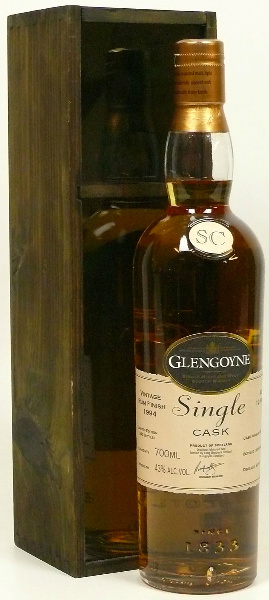
Glengoyne 12yo 1994/2006 (43%, OB, SC, Rum Finish, Cask #909310, 348 bottles)

Just like the 10yo Edradour I just reviewed, Glengoyne also has a 1994 vintage, which was used for a lot of different cask finishes. Claret, Madeira, Manzanilla, Muscatel, Cornalin and a lot of Rum finishes were released between 2005 and 2008. Some were bottled at cask strength, and some were reduced to 43% ABV. All the other Rum finishes have a cask number of 5 digits, so this one was probably cask #90931. Maybe they have added an additional “0” to distinguish this bottling from the rest since this is the only one that has been reduced. Maybe an administrative mistake was made…

Glengoyne 12yo 1994/2006 (43%, OB, SC, Rum Finish, Cask #909310, 348 bottles)Color: Gold.

Nose: Excellent full-on Rum smell. Spicy, fatty dirty. I’m guessing high ester Rum. Jamaican? Hard to tell. Sugar cane and very leafy. For some this may be finished too long, but I’m not one of them. I love the synergy between Rum casks and Single Malt Whisky, but I may have said that before. Extremely deep. What a nice combination of smells. Wonderful depth and a wealth of complexity with lavas and balsamic vinegar. Where did that come from? The Whisky, The Rum or the wood? If it’s the wood, the wood turns to a more cleaner oaky note. Fresh windy forest and some warm butter on toast (not burnt). Even a slightly soapy note.

Taste: Well this is less complex than the nose is. Where the nose explodes with aroma, the taste is much simpler. Most definitely a sweet Whisky. Sugar water and yes, some nice leafy wood influence. Paper and floral cardboard, whatever that is. The taste is built around some different wood flavours, sugared tropical fruit, dried orange skim and cold black tea. The finish is quite long, but again pretty simple a bit bitter and buttery.

Not so long ago I reviewed a few Rum finished Whiskies and I said I have always liked them. This one is no different. Fantastic nose, and the taste is good. However, this one is not a daily drinker. For that it is too fatty and sweet.

Points: 84 (but with a 90’s nose, if you like Rum)

Thanks go out to René for providing the sample (a while back).

Edradour 23yo 1983/2006 (52.1%, OB, Port Cask Finish, Cask #06/0554, 743 bottles)

Since Edradour is owned by Andrew Symington, this might as well have been a Signatory Vintage bottling. Lots and lots of Edradour have also been bottled as Signatory Vintage bottlings. 1983 is the oldest vintage of Edradour ever bottled by one of the owners, apart from two 1973 bottlings of which one was bottled by Andrew himself in 2003 (as an official Edradour). By the way, all the 1983 bottlings are Port Cask Finishes. Onder the flag of Signatory Vintage, Andrew bottled one 1968 Edradour and a small batch of 1976 bottlings, so the 1983 might not be the oldest Vintage after all.

Edradour 23yo 19832006 (52.1%, OB, Port Cask Finish, Cask #060554, 743 bottles)Color: Full Gold.

Nose: Dusty, flour and dry. Seems Sherried. Vanilla and cream. Powdered coffee creamer. Spicy oak. Spicy and fruity, but still with some hints of integrated wood. Cold butter, right out of the fridge and the fatty smell you get from a cold BBQ one month after its last use. So old fat and hints of burned stuff. Next are the first whiffs of baking white bread. Mixed with the odour of printed newspaper. Leafy and fresh. Small hints of (dark) chocolate with cherry liqueur, but not entirely black. This even has tiny hint of tar, giving the whole some depth. Not bad at all.

Taste: Much more fruity than the nose was. Creamy vanilla pudding with a red fruit acidic aftertaste. After that some bitter tree sap and bitter oak. The oak isn’t overpowering, but it’s there in broad strokes, making up the body of the Whisky. Quite complex wood, so it doesn’t come across as a young Whisky, which it in fact isn’t. Some hidden, fruity sweetness and again the paper of newspapers. Nice and well-integrated oaky bitters in the finish. It’s signature is carved in wood.

To sum things up. This is a wood driven old vintage Edradour finished in a Port pipe. The finish is done sparsely, since it isn’t an overpowering typical Port Finished Whisky. Nice, but not something I would go out of may way for to get it. Let’s call it an experience.

Points: 83

Edradour 10yo 1994/2004 (46%, Signatory Vintage, The Unchillfiltered Collection, Cask #349, 783 bottles)

In 2004, 2005 and 2006 most of the 1994 vintage were released by Signatory Vintage in the Straight from the cask series. You must remember the 50 cl bottles in the colored wooden boxes with all kinds of (fortified) wine finishes. However a few of those were rescued from that sometimes ill fait and released as is, under the unchillfiltered moniker, reduced to 46% ABV. Here we have one such cask that didn’t undergo a wine finish, simply because the Whisky at hand came from a Sherry cask.

Edradour 10yo Cask #402Color: Orange gold.

Nose: Quite creamy and already lots of aroma. Very dry with enough influence from the wood. It does remind me of cherry liqueur, without it being overly sweet. The Whisky also has a more vegetal side to it as well as some good Sherry funk. Fruity. Watered down red fruit juice, with toffee, chocolate butter and (milk) powder and some herbal smelling wood. Quite spicy when I come to think of it.

Taste: Paper, pepper and sometimes a bit hot. Artificial hard red candy juice. Remember those little raspberry ones? Warming and in the distance quite sweet. Candied citrus fruits (predominantly oranges) and the zestier note is provided by some lemon curd. After that the lengthy finish starts with some burnt newspaper ashes, cheap chocolate powder and some soft dark wood, not necessarily oak. Nutty coffee (Inca).

This is quite a Whisky, but I can’t help to feel that something is not quite right. That is probably personal, because I get that a lot with Edradour. Probably a typical Edradour marker, I still have to get used to. Still, this is quite quaffable. Go for one if you come across it. Maybe the 1994 vintage is sold out by now, but there should be still some 10yo’s from 2004 around. The picture is from one of the 2004 vintages, the 1994 looks the same.

Points: 82

Bruichladdich Classic Laddie Scottish Barley (50%, OB, 2014)

In the more recent past when Bruichladdich had different ownership, a lot of bottlings saw the light of day and a lot of bottlings comprised the standard range. Now that the distillery has changed hands and tries to be a fashion accessory, the stanf=dard range is reduced to only two NAS bottlings. Scottish Barley and Islay Barley. If my memory serves me well, all standard bottlings with an age statement have been dropped.

In 2013, this same Whisky was released with a somewhat different “label”. The first release had big lettering for “Scottish Barley”, whereas the 2014 release I’m about to try, has “Classic Laddie” in big lettering. I have tasted the 2013 version and scored that one 85 points. Let’s see if this newer version is equally as good.

Bruichladdich The Classic Laddie Scottish Barley 2014Color: Light gold.

Nose: Well this is a nose that screams Barley. Very young smelling and even has some Bladnoch-butter. Fatty, with a citrussy edge. Hints of new make spirit, and given some time to breathe, a more bread like, coffee and milk chocolate note appears. The whole is quite soft. Wet. fresh wood. Virgin oak. Nevertheless it is also recognizable as a Bruichladdich. It does remind me sometimes of the Cadenhead Bruichladdich 17yo I reviewed earlier.

Taste: Soft paper like wood and an extremely creamy taste. Coffee with a lot of milk. Chocolate milkshake. When the higher ABV flows down my throat a short flash of hotness flies by, but also dissipates quickly. Cream with a hint of ashes. Bourbon and vanilla, but also dark chocolate and a faint fruity note. Cherry liqueur bon-bon? Virgin oak again. Lots of barley (and sugar?) in the finish. Barley, oak and cream are the three words that describe this Whisky best I guess.

As consumers we are compensated. We get less ageing and less complexity, but we get more ABV. 50% to be precise.

Here we go again, another NAS bottling that will split the Whisky world in two. Definitely a young, crude and uncomplex Whisky, but at the same time a nice and designed sophisticated soft taste that a lot of people will like. The Bruichladdich spirit is a good spirit, but this spirit didn’t get a whole lot of time to develop. It’s like a child asked to drive a bus. Some would even say that this isn’t really Single Malt Whisky. If someone had invented this about a 1000 years ago, he or she, may have called it Barley Wine. Not bad, but not my NAS of choice.

Points: 81

Karuizawa 30yo 1983/2013 (55.8%, OB, Geisha Label, for The Whisky Exchange, Bourbon Cask #8606, 350 bottles)

Every time someone in the world dares to open a bottle like this, an earthquake occurs amongst collectors. Up ’till now lots of old bottles of Scottish Whiskies, particularly from closed or classic Speyside or Islay distilleries, fetched the highest prices. Today it may very well be Karuizawa, a Japanese Whisky, which is delicious and becoming extremely rare. These bottles are bottled, and hardly anyone opens them anymore. Well not Master Quill! I’m very happy to open my less than-half sample of this Karuizawa and share my thoughts with the world!

Karuizawa 30yo 1983/2013 (55.8%, OB, Geisha Label, for The Whisky Exchange, Bourbon Cask #8606, 350 bottles)Color: Vibrant full gold.

Nose: Wow, this emits heaps of aroma. Nice rubbery notes and extremely waxy. Fresh and vibrant and highly aromatic. It oozes a typical Japanese nutty kind of smell and cask toast. Fragrant green tea combined with the more obvious creamy vanilla note we know from casks made of American oak that once held Bourbon (or Tennessee Whiskey). There is some kind of sweet sensation underneath that reminds me a bit of hot sugar-water. The wood emits fresh oak and fresh tree sap, with whiffs of powdered coffee creamer. Quite floral and fruity. The fruity part are hints of fresh (thus not over-ripe) plums. The floral part is more about fruit trees in bloom rather than any kind of flowers. Elegant stuff.

Taste: Quite hot with ashes and an old oaky bitterness. Pencil shavings and some sort of hidden fruitiness. Lovely dusty nuttiness comes to the forefront too, making this a woody Whisky. Dark bitter chocolate and (ear) wax. If you can get past all the furniture and dark chocolate, there is some candied fruit behind all that.

Never owning a bottle myself I had some kind of luck having tried this one several times. Once from a freshly opened bottle, but also the last few drops from a bottle that had some time to let the Whisky breathe. I have to say that this particular Karuizawa is stellar when freshly opened, but with that the oxidation starts. Usually oxidation is not a bad this in Whisky, but sometimes oxidation changes or even ruins the Whisky. Here we have an example where oxidation really can change the Whisky. When this Karuizawa oxidizes the focus shifts more towards the (especially in the taste), whereas the freshly opened bottle is way more fruity. I don’t have a freshly opened bottle at hand, so this review is written tasting the last drops of the bottle, but I do remember the Whisky well when it was freshly opened. The score is for the freshly opened bottle. The last drops would score around 87 points so beware!

Points: 95

Chichibu 3yo 2009/2013 (53.5%, OB, Ichiro’s Malt, Chibidaru, Quarter Cask, 3900 bottles)

Chichibu is the first new Japanese distillery since the seventies, built near the city of the same name by Ichiro Akuto. Akuto started building the distillery in 2005 and in 2008 the first spirit ran off the stills. But 2005 is not the start of this story. No, this story starts in Chichibu in 1626 when the Akuto family started brewing Sake. In 1941 Ichiro’s grandfather, Isouji Akuto, built another distillery near the town of Hanyu, for making Sake and Shochu. Five years later a licence was obtained for distilling Whisky, initially a continuous still essentially making Grain Whisky. This still was eventually replaced by a copper still.

In 1980 Ichiro’s father, Yutaka Akuto, started to make Single Malt Whisky instead of the more common Blended Japanese Whisky (Scottish Malt Whisky blended with Japanese Grain Whisky). In 1983 the first spirit became Whisky but by 2000 Hanyu stopped making Whisky due to the severe lack of profitability. Ichiro, who worked at Suntory at the time, was brought in to save the company. He had to sell Hanyu to do just that. Hanyu was dismantled in 2004, but Ichiro bought the remaining Whisky stock as well as the distilling equipment. The equipment is still stored at Chichibu, but was never used since Ichiro´s new distillery was fitted with new equipment.

Chichibu Chibidaru 2009/2013Color: Full gold.

Nose: Fresh entry, elegant and flowery. Toned down, dried Jasmin leaves (tea and soap). Slight hint of powdery and spicy oak, alcohol and quite fruity. Pear and a hint of menthol and red fruit jello. Old dried ginger and sawdust. It smells pretty mature and complex for a 3yo Single Malt.

Taste: Quite woody, good aroma and even a bit sweet. Vegetal and much less fruity than the nose. It tastes even less complex than the nose, and with this it shows its youth. It’s easy to “see” that this one does needs its higher strength. Creamy vanilla, some candied yellow fruits enter the mix after (a lot of) air. Fabulous creamy custard paper pudding aftertaste with proper length. Lovely stuff especially considering its age.

This is an excellent 3yo Japanese Whisky, but it will only show its full potential if you let it breathe a lot. This is the kind of bottle you open and leave in the closet for a week or two without its cork. In the glass just let it sit around for half an hour before you even nose it. This needs air.

Now all the Karuizawa’s and Yamazakis are gone and Nikka struggles to release even a Whisky with an age statement I give you a glimpse of the future of Japanese Whisky. This is high quality stuff with massive potential, but as long as Ichiro is releasing Malts at barely the minimum age, that taste as well as this, it will tie us over as we wait for the Japanese Whisky to mature. My only fear will be that when a Whisky will reach its adulthood, it will be extremely expensive as the Karuizawa’s and the Yamazaki’s of today.

Points: 87

Benromach 1976/2012 (46%, OB, First Fill & Refill Sherry Hogsheads)

This is a 1976 Benromach, bottled in 2012. So it’s either 35 or 36 years old. Said to be from First fill and refill Sherry hogsheads. Just compare it to the 1969 vintage, which is from refill Sherry hogsheads only. The 1969 is much darker in color. So what kind of Sherry was this from? Sherries exist in lots of different styles, and just like a “normal” wine, Sherry has lots of different colors, and aroma’s, too.

Benromach 1976-2012Color: Gold with a slight reddish glow.

Nose: Oak and vanilla. Spicy, dry and vegetal. The smell you get when you break a fresh twig. Slightly burnt wood and a tiny hint of peppermint. It smells younger than it actually is and despite the 100% Sherry statement it is not far away from an older Bourbon matured Whisky (at first). The isolated oak flavour is there, but when this is not from American oak, there is less vanilla to go around. That seems to be the case. So European oak it is. Lovely wood notes, elegant and fine. The wood seems to hold some bitter orange skins in its aroma. Also noticeable is a slight (white) winey note, but also some nuttiness which leads me to believe these casks also held some Fino’s and/or oxidized white Sherries. Not a lot of fruitiness which sets it apart from the famous Tomatin’s from the same vintage.

Taste: Well hello there. This starts with the fruits the nose lacks, but also the wood plays a nice role in here too. Even at 46% ABV, this is quite hot and peppery. Dark chocolate. Nice. The initial fruits quickly disperse which leaves more room for the wood. Not a lot of sweetness, and the wood brings a slight bitterness that suits this exercise in wood (and the nuttiness of dry white Sherries) well.  The finish carries hidden notes of flor. This one needs lots of air to settle and to get the balance right (Depeche Mode), but when it does, it shows you its high quality. Still not an easy one and this one will only reward you if you keep an open mind and work at it a bit.

The contrast between this lighter Sherry bottling and the darker 1969 Sherry bottling probably isn’t a coincidence. They go together like the Glengoyne Summer (dark) and Winter (light). Sure this is high quality stuff, and you have moments in your life when you really need a Whisky like this. The aforementioned Glengoyne Winter is a similar Whisky. (The only differences being that the Winter is more funky and less elegant, but slightly sweeter and much higher in ABV). Having said that, in my case, there just aren’t a lot of days like that, so a Whisky like this lasts very long. Every time I need it, I thoroughly enjoy it, but when I have it at the wrong moment, it’s a difficult Whisky. So choose wisely, first when you buy it, it’s quite expensive, and second when to sip it. One thing for sure, or actually two, its great stuff and it will last long.

Points: 87

Clynelish 14yo 1989/2003 (50%, Douglas Laing, Old Malt Cask, 6 Month Rum Finish, DL REF 3850, 312 bottles)

I’ve been reviewing more Rums lately, which is fun to do. back to Whisky for now, but I won’t have to let go of Rum altogether. To continue the Rum theme, my previous review was of a Teeling Blended Whiskey, finished in Rum casks. The Rum completely took over the Whiskey. Here is another Whisky, Scottish this time, that was finished in a Rum cask. Alas we don’t know where the Rum cask came from, nor do we know what kind of Rum it once held.

The title is correct, the picture is wrong. I found an old sample of this Clynelish on my attic, but it seems Whiskies were drunk in 2003 and not collected. I couldn’t even find one in an auction. No picture to be found of this particular 14yo rum finished Clynelish. All I could find was this picture of its 13yo sister bottling, also finished for 6 months in a Rum cask. For a brief time Fred Laing reserved the red lettering on OMC bottles for younger Whiskies in a time when  Douglas Laing was bottling almost only stellar and old bottlings. For one reason or another the red lettering, and the red tube, was soon abandoned. The bottle in the picture was bottled in February 2003, and the 14yo, I’ll be reviewing soon, later in that same year. It is therefore entirely possible the 14yo doesn’t even have red lettering.

Clynelish 14yo 1989/2003 (50%, Douglas Laing, Old Malt Cask, 6 Month Rum Finish, DL REF 3850, 312 bottles)Color: Light citrussy gold.

Nose: Wood and yes, it has some light golden Rum on the nose. This time the Rum didn’t overshadow the Whisky. You still can recognize a Single Malt Whisky in this. Flowery and soapy and hints of rhubarb. Soft young wood, leafy and fruity. Papaya, maracuja and a tiny hint of banana. In a blind tasting I would have said this was a Tomatin. Typical Bourbon cask notes and with tropical fruits, what else could it have been? Nice nose. Floral and fruity, but also damp earth and raisins. Hot butter. Sometimes whiffs of a Pinot Gris fly by. I like this. Well balanced and even though a lot can be picked up, the balance is so great and the aroma’s are so well-integrated it doesn’t even seem complex. The aroma’s show themselves in layers, but when an aroma is replaced by the next, it isn’t gone for good, everything comes back as a boomerang. Given some time a more burned note appears that wasn’t there before. I have always liked Rum finishes, maybe that’s where the interest in Rum comes from.

Taste: Recognizable as a Clynelish, with added yellow, tropical and red fruits. Quite hot, it bites back a bit. Sweet and more yellow fruits. Pineapple and white grapes, hints of unripe peach and unripe banana. After the initial sweetness, notes of paper and wood. Cheap wood, plywood maybe. This is less balanced than the nose is and the finish leaves a slightly bitter taste in your mouth. Burned wood and grape seeds. Nice stuff, just don’t expect a sweet Rum in this one.

Back in those times, it seems that Rum finishes were more common than today. Wine finishes were hardly available, and those that were around were not particularly good. Look around today, lots of finishes in casks that previously contained a Wine in all its guises. Rum finishes are still not done very often, apart from some Benriachs I guess. Speaking of which…

Points: 86

Teeling Small Batch (46%, OB, Rum Cask Finish, February 2015)

Last month I reviewed a single cask bottling of a Teeling Whiskey for the Dutch market finished in a Madeira Cask. Nice stuff, but for some, hard to get. The most widely available Teeling should be this Small Batch. This is a blended Whiskey finished in Rum casks.  Since 2013 many batches were released and for some batches, if not all, casks were used that held Rum from Flor de Caña (Nicaragua). Flor de Caña is known for an accessible and rather dry Rum.

Teeling Small BatchColor: Gold. (Thick legs in the glass)

Nose: Sweet. Sweet and sugary and smells very much like the sweet, middle of the road Rums like Abuelo Añejo I just reviewed. Brown sugar. Its Rum and Rum, after a while some more notes are discernible. Toasted wood, and sugary wood. Vegetal and whiffs of sulphur. I’m working hard at it, but I can’t recognize any Irish Whisky in this yet, let alone a Blended Irish Whiskey. Leaving the glass to breathe for a while, yes you might say it has some traits of Irish Whiskey. Some dry, woody milk chocolate enters the fold and it gets more dusty.

Taste: Again lots of Rum, just here it is a little drier and more leafy than an actual Panamanian Rum I mentioned above. Sugar right from the start. Also the body is all about Rum. The finish is the only place where you can actually taste the Irish Whisky. Sweet grain. The finish is quite short, a bit thin also and again sugary and Rum-like. Wow, were the Rum casks really empty, when they were put to use finishing this Irish Whiskey? Given some time the Rum wears off a bit and Whiskey seems to shine through, although it also could have been a dry sugar cane distillate now. A bit gritty, vegetal and woody. Notes of sweet red fruits more common to some Rums than Whiskey.

Wow, this actually is closer to a Rum than Irish Whiskey! Blended or not. Just look at the legs in the glass. Just smell this and taste this. luckily I have the bottle here. because if this was from a sample, I wouldn’t have written this review thinking the sample was mislabeled! This Teeling isn’t very expensive, but if you want a distillate that tastes and smells like this, get yourself the Abuelo Añejo it’s even less expensive than this Teeling Rum finished in Irish Whiskey casks. This actually is pretty funny! Were all the batches like this?

Points: 77

After finishing this review I filled my glass with the Abuelo 7yo. It is thicker and fuller and way more vanilla to it, but in taste quite similar to the Teeling. Amazing. It should be even more similar to the Añejo, but I don’t have that one here anymore for a proper H2H same for Flor de Caña 12yo and Flor de Caña 18yo I reviewed earlier, both gone…

Glenfarclas 29yo 1979/2008 (50.6%, OB, The Family Casks III, Plain Hogshead #2216, 171 bottles)

In 2006 Glenfarclas started with an ongoing series containing lots and lots of single cask bottlings called the Family Casks. From the beginning, almost every vintage thinkable was released in very nice looking wooden boxes including a nice booklet. After a while, some vintages were not available anymore in the warehouses, and the wooden boxes were replaced by something a lot simpler. For the time being 2014 was the last year any Family cask was released, since 2015 saw no release of a Family Cask bottling (yet). Although Glenfarclas has a name to uphold with heavily sherried malts, just like The Macallan once did, and Glendronach does today, what was nice about the Family Casks was that any type of cask was released. This 1979 expression from the third run of Family Casks is from a Plain Hogshead and was bottled on the 17th of July 2008. Plain Hogshead could mean a rebuilt cask from staves that once formed a Bourbon barrel.

Glenfarclas 29yo 1979/2008 Family Casks IIIColor: Copper

Nose: Lots of creamy vanilla and coconut, what immediately makes me think about American oak. Very creamy and firm. Extremely fruity. Apricots, pears and ripe green plums. Hints of not yet ripe banana-skin and sweet ripe apples. It does have notes of a high quality Calvados. Almonds with dry powdered coffee creamer. Amazing how strong the aroma’s are, this is in no way a closed Whisky, no, no, no! Spicy, the wood kicks in a bit. Hint of latex paint. Lurking in the depth is a strange note, which is hard to describe. Old dried out cucumber with a tiny speck of acetone. You know how a cucumber smells, tone that down a few notches, and that’s whats in here too, underneath all those heavy hitting aroma’s from the highly active cask. I wonder what Bourbon it came in contact with. Wonderful old Whisky, with a perfect and endless nose. A true gem to smell!

Taste: Again extremely creamy and full of aroma. The power. Wonderful. Perfect stuff. Quite sweet upon entry. Creamy sweet and following quickly is a much drier woody sensation with just the right amount of bitterness. More wood than the nose had, but when the wood takes a step aside, wonderful aroma’s of ginger with jam made with red and black forest fruits present themselves, but not a lot of the fruit I mentioned in the nose. Amazing! Small hints of cask toast, slightly burned bread and candied cinnamon. Cloves and Christmas cake. Of course not a perfect Whisky, that does not exist, but this does come close. Wow! Warming and luckily a super long finish.

Here we have another super fruity old Bourbon Hogshead Whisky from the seventies. Reminding us of the stellar Caperdonichs from 1972, to name but one. I can only hope I’ll find me one of these sometimes.

Points: 93