Aberlour 16yo (43%, OB, Double Cask Matured, Circa 2003)

Here is another oldie from the archives. This time another big well-known brand with one of their succesful numbers. This bottling still exists, although it went through a few newly designed labels. As far as I know this was the first edition of this particular bottling. Double cask matured. Slap Double Wood on the label and you have a law-suit on your hands, but essentially it’s the same thing. Bourbon cask matured Single Malt Whisky with a finish in Sherry casks. Aberlour are well-known for heavy usage of Oloroso Sherry casks, but we already know from the 1988 bottling, that other Sherry casks are also used, and since this isn’t a highly priced expression I do suspect other than Oloroso casks may have been used with this one too. And why not?

Aberlour 16yo (43%, OB, Double Cask Matured, Circa 2003)Color: Copper gold

Nose: Sweet Sherry, and vanilla, which would already suggest maturation in Sherry and American oak casks. Sweet and slightly winey. Some hints of powder and dust and hardly any (tannic) wood, so definitely longer maturation in American oak than European oak. Just smell those vanilla and pudding notes. After a while more floral notes emerge. I’m not very good with flowers so I can’t tell you which flowers yet, but believe me it is floral right now. Together with the floral bit, elegant polished wood comes to the fore with some bad breath too. The Sherry part is getting less and less pronounced, so most definitely a finished Whisky all right.

Taste:  Sweet and again a combination of vanilla, pudding and a more winey note than a typical Oloroso Sherry note. Sweet and simple would sum this up just nicely. Creamy with a hint of bitter plain white oak, so at least the sweet vanilla body is given some backbone with wood. Slightly cardboardy finish as well as waxed milk chocolate. You know the shiny stuff. Leaving this in the glass even longer, a more candied fruit note emerges. Dried apricots and some honeyed almonds. It picks up more of a bite too. Not a very complex malt yet very likeable. Highly drinkable, but it wouldn’t be my first pick for a daily drinker, since it lacks some complexity and the finish seems to be not as well-integrated as should. Having said that, giving this some air to let it settle some more, does do wonders for this Malt and adds some nutty bitterness too.

In effect this does remind me of Bourbon matured Aberlours I’ve tasted in the past, but also the 1988 I reviewed earlier. When I come to think of it, it does also remind me a bit of Highland Park 12yo. Quite good, but also quite simple with a less than perfect finish. I haven’t tried them yet, but I expect later batches of this Whisky to be better in this respect, with hopefully more Oloroso casks used for finishing, but also a slightly longer finish in those casks will help it along as well.

Points: 85

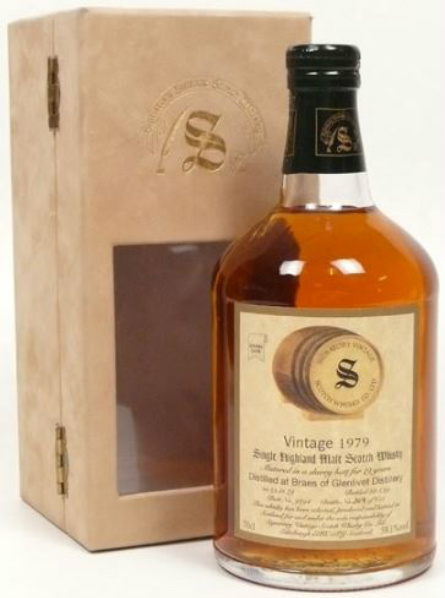
Braes of Glenlivet 19yo 1979/1999 (58.1%, Signatory Vintage, Sherry Butt #9294, 658 bottles)

The day before yesterday I reviewed the first Braeval on Masterquill.com, the domain I was finally able to acquire. Today we’ll have another first, this time the first Braes of Glenlivet. Well not really since both are one and the same distillery.

Braes of Glenlivet was founded just in 1973, so it’s not thát old. At that time Seagram’s was a company with only two distilleries: Strathisla (I love Sherried Strathisla’s from the 60’s and 70’s) and Glen Keith (equally so). Both distilleries are next to one another by the way. Chivas needed more capacity, due to huge demand of the Chivas Regal 12yo blend in the States and was looking for a distillery to take over. When that didn’t work, plans were made to “build” five distilleries in the same amount of time. Braes of Glenlivet was the first in 1973 and Allt-a-Bhainne the second a year later. The next three distilleries were brought into the portfolio by acquisition in 1978: Glenlivet, Longmorn and Glen Grant (now owned by Campari since 2006). Other noteworthy facts are that the name of Braes of Glenlivet changed to Braeval in 1994 (to allow Glenlivet to be The Glenlivet, as in “there can be only one”). Breaval was mothballed between 2002 and 2008 and is the highest situated distillery in Scotland. 1665 feet.

Braes of Glenlivet 19yo 1979/1999 (58.1%, Signatory Vintage, Sherry Butt #9294, 658 bottles)Color: Copper Gold.

Nose: Musty and a high quality Sherry note. Not a big heavily Sherried nose (hence the color). But dry and meaty. Slightly smoky (char) and vegetal (fern). Nicely oaky but also pencil shavings, which usually isn’t oak but cedar. Perfumy. This needs some air to balance itself out. Again the wood is playing a big role in this Braes/Braeval, just like the one I reviewed before. The vegetal part is developing into what I can only guess is a Japanese tea kind of note. Not floral, so it’s not the perfumy part of the nose, but very deep, profound, but also elegant and light. Having said that, next up is a hint of Velpon or Uhu (clear glue). Great herbal and earthy complexity (surely not only from the wood?), with a tiny hint of new make spirit. This is a very nice one to take deep breaths of. Stuff for connoisseurs I guess, so maybe not everybody’s cup of tea.

Taste: Strong, sweet and dry at the same time. Very nice. Lot’s of Beer and Hops, and not really Sherried for me. The hops doesn’t make this all that bitter. Quite some masked sweetness and again quite woody too. The bitterness is really a hoppy one. Interesting. Just like it’s younger brother, it’s coming undone a bit in the finish. The alcohol is really prominent, so most definitely a force to deal with. Finish with tea and wood, a hint of soap and rather drying. Beer and soap who would have guessed? The complexity of the nose isn’t really here in the taste. And I really miss the high quality Sherry I smelled initially. Beer and Sherry who would have guessed?

What really caught me by surprise were the similarities between the 1991 Braeval bottled by The Whisky Mercenary and this particular expression from 1979. Especially on the nose. One was distilled in 1991 and this one in 1979. Both have a similar full on smell and a woody part that plays a big role in the bigger picture. This Signatory has a more pronounced Sherry derived full and sweetish body, whereas the 1991 was more fruity.

Points: 85

Braeval 21yo 1991/2013 (47.7%, The Whisky Mercenary)

Some of you may have already noticed, but as of yesterday I finally managed to get MASTERQUILL.COM. Not long after I started publishing my tasting notes, someone was very quick to snap up this domain. Once I had a look around, what buying this domain would cost, but I thought the $1.800 was a bit too steep, I’d rather buy me some Whisky for that, thank you very much. Yesterday I had another look around and it was available! This time I was quick to snap it up myself, and anyone of you who have registered their own domain (that is available), know that this doesn’t break the bank. Great! Back to Whisky now, and back to Jürgen…

Time for a Whisky that hasn’t been featured before on these pages. A new name on my new domain so to speak. Braeval as it is called today, Braes of Glenlivet was its old name. Not an old distillery though, but more on that next time…

Braeval 21yoColor: Gold.

Nose: Clean buttery vanilla, caramel and lots of toffee. Promises a lot of sweetness. Dry vegetal notes. Nutty but also slightly perfumy. Sinaspril (a Paracetamol tablet for children, with a powdery orange flavour). This reminds me a lot of Sinaspril from the seventies. Somehow I don’t use it a lot today anymore. Got older you know, need veterinary strength Paracetamol now. Let’s get back to the Braeval shall we. Very creamy and dry, but not a lot of wood yet. Definitely some laid back fruity notes and cookie dough and almond paste. Orange obviously, just not the freshly pressed kind, but also succulent and with hints of over ripe kiwi. Yes that’s a first. Behind the fruits also a meaty component is present. In the end it’s all about fruit and cream. Quite complex, there seems to be happening more that I have mentioned. For instance, it takes the wood quite a long time to assert itself.

Taste: Sweet and again very fruity. Thinner than I thought with an ABV of 47.7%. Very fruity (cherry bon-bon) and nutty and yes, quite sweet, but also a nice touch of acidity to prevent this one from being overly sweet or cloying. Creamy vanilla and cheap milk chocolate is present. Definitely a woody backbone now. Unpolished edges of oak. Watch out for splinters! Oaky sourness in the finish, and speaking of the finish, the big body this Whisky has, does fall apart a bit in the finish, where the oak starts to dominate. A shorter finish than expected, so you want your next sip quite soon after the previous one, but you wouldn’t mind because you already developed a craving for the great fruitiness of this malt. Prominent oak though.

Actually this could have been better, because towards the finish the oak plays and ever-growing role. You do need to like your oak with this one. Luckily this Breaval has a nice nose and a body full of thick toffee and fruit. In the end, this is a very enjoyable dram and thus rightly picked by Mr. V. Not the best of the bunch though.

Points: 84

The Glenlivet 18yo (43%, OB, Circa 2003)

When thinking of the middle of the Whisky road, for me, two distilleries somehow stick out. Glenfiddich as the daddy of Single Malt and Glenlivet. There may be others. Both have a big reputation, huge sales and lots and lots of versions. Most encounters with Malts from the standard range of these distilleries will be in hotel bars and such. Here we’ll have a look at (The) Glenlivet 18yo. This is already the fifth Glenlivet bottled by Glenlivet themselves on these pages, but only the third from the standard range. Earlier we had a look at the 12yo and the 15yo “French Oak Reserve”. The 18yo is another step up from both predecessors. By the way, just recently it was announced that Glenlivet are discontinuing the highly popular sales hit: the 12yo. A decision Diageo say they could’t make when everybody is fearing the discontinuation of their Talisker 10yo. Diageo think that would be stupid…

The Glenlivet 18Color: Amber gold.

Nose: Waxy and fruity. Quite nice, but also pretty simple. Can’t imagine the recent version of this 18yo smelling this “old”. Burnt paper and a slight hint of Sherry. Some vanilla mixed with a more organic note. Quite dusty, but it somehow seems to be a sweet dust. Fruity Sherry with hints of meaty Sherry. Also some hints of Bourbon casks, especially the vanillin and creamy pudding.

Taste: Quite sweet, but when that dissipates more fruity notes appear. Also the slightest hint of tar and a burnt note similar, but not the same as the burning paper note I got in the nose. Sweet Sherry and cookie dough. Very likeable and highly drinkable. Great fruitiness. I even have some cooked banana in here but also some maracuja and dried apricot.

This tastes way nicer than the Macallan 1986 Sherry I reviewed last. This tastes more like an old Whisky, with a bigger body and kind of sweetness that is acceptable due to its balancing with the burnt notes. Quite nice, but slightly too sweet to be a daily drinker, although maybe it is. Good standard bottling from a decade ago. Now I’m curious how a more recent 18yo will taste.

Points: 85

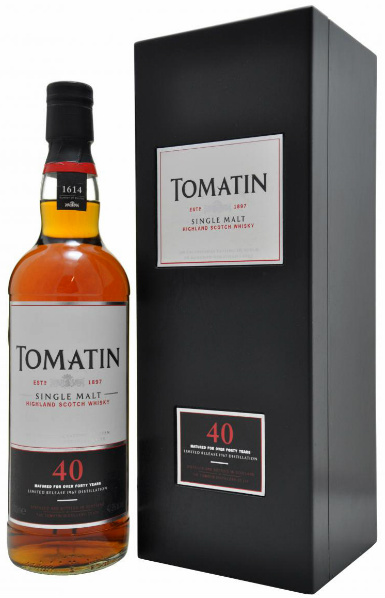
Tomatin 40yo 1967/2007 (42.9%, OB, Seven Bourbon Hogsheads, 1614 bottles)

As can be read on these pages, Tomatin rarely disappoints. There is always room on my lectern for a tropical Tomatin. Especially older Tomatins quite hit the mark with fabulous aroma’s of tropical and citrus fruits for which it is known. Tomatin has a high reputation with bourbon cask only bottlings like the 15yo that has been discontinued to be replaced with the 14yo port finish. The 25yo has been discontinued too, which also was made with Bourbon casks only. Now, here we have a 40yo Tomatin formed from seven Bourbon Hogsheads with distillate from 1967. You may have heard of The Beatles and Sgt. Pepper? Yes 1967. And this is still available. How is that possible? Is this bottling a dud of some sorts? Time to find out…

Tomatin 40yo 1967/2007 (42.9%, OB, Seven Bourbon Hogsheads, 1614 bottles)Color: Copper brown gold.

Nose: Sweet and fruity, quite typical for older Tomatins. Lots of vanilla and quite thick. Highly aromatic. Quite syrupy too. Hints of mint and black coal and even some tar and sweets. Complex with lots of development. Give it time. Almonds are coming through after a while. Great nuttiness, rarely seen in Tomatin. Fruity, dusty and dirty at times. Great.

Taste: Fruity again, but also some bitter hops, waxy bitter wood. Elegant. Sweet and brittle at the same time. Lovely waxy stewed and candied fruits towards the finish. Lovely vanilla, with memories of old wood in the back. Apricot and vanilla pudding with fresh and acidic red berry sauce on top. Hints of mint are here in the taste as well. Fabulous development built up in layers and a lovely finish to boot. At the end of the finish the expected woody bitterness (and pencil shavings with almonds) appear or stay behind when the momentarily overpowering waxy fruitiness dissipates. Sweet almond cookies are all over this Malt. The taste is less complex than the nose and shows a surprising fruity freshness and youthfulness.

Malts like this were reasonably expensive when they came out and prices have been rising ever since. However, modern malts can never be like this anymore. So why dish out 300 euro’s for a modern 12yo generic special edition when you can pay a measly 100 more and get yourself a museum-piece still readily available on the market today. This is history in a bottle. Isn’t that worth something?

Points: 89

The Macallan 18yo 1986 “Sherry” (43%, OB, 2004)

Macallan 1986 18yo (old)In 2004 Macallan officially released two Sherried 18yo’s. The one on the right, we know very well, that was the one with the old labels that have been used for decades. (For reasons science cannot wholly explain…). Around 2004 Macallan also started to release a new bottle design we all know from the Fine Oak series and later bottlings. Here we’ll review the 2004 18yo with the new design. The label states that this is Whisky distilled in 1986 and earlier years. We know the “other 18yo” to be very good, now lets see if this is any better or maybe it’s the same stuff…

Macallan 18yo 1986 Sherry (43%, OB, 2004)Color: Orange gold.

Nose: Pretty laid back and toned down nose. Sweetish Sherry. Hints of wood, dust and cardboard. Not a full on sherry we know from the other 18yo’s. Very floral and even some orange fruitiness. Some whiffs of this even smell like someones bad breath. Strange hints of cooked vegetables. So bad breath, cooked vegetables, but a moment later also a breath of fresh air emerges. Very strange indeed.

Taste: Sweetish (sugar water) and thin. Fruity and slightly waxy, but the wax comes through as fruity and it’s only a hint. So definitely and older cask found its way into this. Hints of sweet apples and pears come through, which makes me think this is not from Olroso Butts. Fino maybe? This also lacks complexity, and the sweetness somehow stays on top. I expected more development from this. Well, it’s nice, pretty simple and easily drinkable, but this is not a Macallan as we knew it. This could have been anything.

This bottling really marks the end of an era. The era that was dominated by the Sherried Macallans with the old labels. I Always thought the beginning of the end for Macallan was with the release of the Fine Oak series, but would I have tasted this one back then, this would be it. Who would have known that almost never again we would get a Macallan like we used to. In hindsight the Fine oak’s may have not been that bad, since after that the likes of Macallan Gold, Amber, Sienna and Ruby, to name but a few, were released. Costs a lot of money these days. bit tastes like a good standard bottling that you can get for 40 or 50 euro’s…

Points: 81

Aberlour ‘A’bunadh’ (59.8%, OB, Batch No. 13, 2005)

By now, batch no. 50 is the latest A’Bunadh released and when you are reading this, the number will be even higher. Saying that the A’Bunadh is a pretty popular bottling. Whisky always was intended to age in Oloroso Sherry butts. Today however, in general, there seem to be more Sherry butts available than the consumption of Sherry seems to warrant. Saying? There are some nice NAS Sherried Whiskies around, Glendronach, Benromach, The new Tomatin, but none of those are so heavy as this powerhouse from Aberlour. On average around 4 batches of A’Bunadh are released every year. Furthermore what makes A’Bunadh exiting, from my anoraks point of view, is the batch variation. Most batches are great and definitely worth the money. Sometimes something less interesting pops up like the notorious batch no. 40 from 2012. A few others from the 40’s range, were slightly less than perfect. I hope that’s not a trend. To be sure not to encounter another dud, let’s try an older version of A’Bunadh, with this lucky batch no. 13.

Aberlour ‘A’bunadh’ (59.8%, OB, Batch No. 13, 2005)Color: Copper gold. Not extremely dark.

Nose: Creamy raisins and vanilla. Creamy with a little backbone provided by toasted oak and maybe from the Sherry. Some more wood, typical oak, and some dust. A lot friendlier than I remember batch no. 33 was. pencil shavings. This is a tale about wood, just without the rawness of batch no. 33 (which actually came from the Sherry, not the wood). Creamy, raisiny and sweetish. With wood. That’s it. Not a lot of complexity, but also lacking some red fruits, Oloroso butts can give off. Nevertheless a very nice smelling dram.

Taste: Chocolate, Ferrero Rocher cherries, than wood, fresh oak and pencil shavings (cedar) and some hints of coal. Quite hot (not raw) when sliding down my throat. A classic combination of aroma’s from soft Oloroso. (It lacks the meatiness batch no. 33 had). Nice hints of mocha and whipped cream. Tiny hint of bitterness gives the finish some oomph.

I haven’t tried it myself yet, but I understand this takes water very well. That is an indication of a high quality cask (and Sherry it held), since more recent bottlings can get very hot, very hot indeed when water is added.

OK, why not. With water the whole softens up a bit, and brings the aroma’s closer together. The wood seems to stick out a bit more, which isn’t a problem. It momentarily also enhances the fruity part, and the bitterness of the finish. Toffee, caramel and oak.

Points: 88

Bruichladdich 10yo 2003/2013 (56.3%, Malts of Scotland, First Fill Sherry Hogshead, MoS 13051, 285 bottles)

Almost two years ago I reviewed a Glen Keith bottled by Paderborner outfit Malts of Scotland. Being an indie with quite a reputation it took me quite a while to review another bottling of theirs. A sample of this very Bruichladdich was bestowed upon me by the former owner of this very cask. MoS renames the cask numbers so we do not know the original cask number. I hate it when Thomas does that, just like Bert does with his Asta Morris bottlings. Something to hide guys? Well nothing more to say really, (I’m a bit distracted by some nice live music by Primus), so let get on with it…

Bruichladdich 10yo 2003/2013 (56.3%, Malts of Scotland, Sherry Hogshead, MoS 13051, 285 bottles)Color: Orange brown.

Nose: Mellow Sherry of the Oloroso kind. Soft wood, dry forest plants like fern and slightly sulphury. Freshly baked bread. Chocolate, brown sugar, honey and fruity acidity from red fruits and berries. Vanillin and a distant bonfire in the woods. Wet earth and mocha. Raisins. Nice and pretty laid back. Mint in the finish (when warm).

Taste: The fruity acidity from the nose. Waxed chocolate sprinkles, cola and some wood. Again some sulphur, but not a lot. Extremely warming. The acidity stays on well into the finish and deep into the finish the sulphur gets more room to play, but still it is not a lot and never overpowering. It’s in the background carrying the aroma along with black tea leaves and a hint of woody bitterness. Not a very long finish though. Reminds me a (more than a) bit of the Bunnahabhain and to a lesser extent of a Bruichladdich I reviewed earlier. A quieter version of both I guess.

I have to say this one needed warming up. Even at room temperature I found it pretty closed, but when I held it in my hand for a while it showed a lot more of itself. Honey in the body and mint in the finish for instance. When I finished it, I poured myself a fresh dram, and again, very closed. This is an example of a closed and dry heavily Sherried expression as opposed to a fruity one. Bottled at the right time. Ready for another strange remark? The empty glass smells better than the full glass…

Points: 85

Thanx Andy!

Caol Ila 21yo 1981/2002 (58.2%, Signatory Vintage, Cask #465, 364 bottles)

Just recently I reviewed a 21yo Caol Ila from Signatory Vintage Cask #467. When rummaging through some sample bottles I collected over the years one of its sister casks popped up. This time it is Cask #465. How’s that for luck. And as luck would have it, I still have a wee bit of cask #467 left, so a comparison can’t be avoided. Again no picture available for this particular cask, seems to me this is very obscure stuff. I’ll use the ol’ picture of cask #470 again. So without further ado…

Caol Ila 22yo 1981/2004 (59.0%, Signatory Vintage, Cask #470, 281 bottles)Color: Light gold. The color of this one is ever so slightly lighter than cask #467.

Nose: Grassy and vegetal. Citrussy. Fresh and actually young smelling. Even the wood smells sappy. Powdery. Hints of soft, fatty, and creamy smoke. Appetizing. Milk chocolate (with sugared citrus in it) and a tiny hint of latte. All very friendly smelling, and although this is not a heavily peated Caol Ila it is very attractive. Good balance.

Taste: Sweet and fruity. prickly smoke with some late development in the licorice department. Light licorice. also a tiny hint of cannabis, so probably a lot was allocated to the Netherlands. Alcohol and again a small hint of coffee and fern. Milk chocolate again. Small amount of woody bitterness starts the finish and lingers on the back of my tongue. Not the most expressive of Caol Ila’s but quite nice in its own way. Not a very long finish. The high strength is obvious on the tongue, but not a lot of aroma is left in my throat. It’s not what you would expect from a Caol Ila like this, but when you let that go, it’s pretty rewarding.

Comparing the two, the noses of the two are obviously pretty similar. Cask #465 has the better nose, more balance to it. Aroma’s seem to fit together better and has more depth and complexity. Still the difference is not great. The taste is very similar too. Cask #467 seems to be somewhat more raw at first, and less balanced.After a while it is also softer and sweeter in the finish. Cask #465 is for me the better pick of the two, with even a slightly better finish, so overall it performs better. Still they are really twins and the differences are in the details and easier to pick up on when doing a H2H.

Points: 86

Thanks go out to my mate Michel for providing this sample (a long time ago).

Glenmorangie Signet (46%, OB, White Oak, Oloroso Sherry Finish, Circa 2012)

I never was a big fan of Glenmorangie. Early on in my explorations of Single Malt Whisky I came across the litre bottle of the 10yo. Good value, looked great. Wow a litre bottle even. I didn’t like it. I had bought some other expressions but when I had the chance to taste them elsewhere I was quick to sell them off. Never regretted it since and in fact never came across a Glenmorangie I really liked. Well one I did like, a 30yo 1972/2004. Rare stuff. Ten years I didn’t look back and never got interested in Glenmorangie again. Just one of those malts that didn’t suit my tastes I thought. Recently I got a sample of the extremely rare 18yo and yes, that one was so nice and drinkable that I got myself a bottle of that. Great golden box too. If you ever going to bury a small pet, look no further than Glenmorangie 18yo. After that I accidentally had a blind tasting of the new 10yo and again didn’t like it. Back to the Whisky. Glenmorangie’s Dr. Bill (Not Dr. Phil) was experimenting a lot at Glen Moray, and when all lessons were learned, Glen Moray got obsolete (and sold off). Maybe not entirely for that reason. Glenmorangie started to churn out great designer Malts. Maybe not the 18yo, which still has an age statement and is more old school I guess, but probably true for this Signet. Just look at the design of the packaging here! Signet is a NAS Whisky and besides the white oak and the Oloroso finish, is known for the usage of heavily roasted chocolate malt. Glenmorangie SignetColor: Light copper gold. Nose: Malty and fresh. Citrus lemonade with a burnt caramel twist. Fruity and very likeable. Am I going to be surprised with another decent Glenmorangie? The white oak is discernible, but not very up front. Also some toasted wood, or maybe the toast comes from the chocolate malt? The white oak is masked just like the peat in good old Laphroaig 10yo was masking the heavy sweetness of the Malt. The masking agent in this Glenmorangie being sweet-smelling Oloroso Sherry. I have to say it is what you would expect considering “the ingredients”. Well crafted stuff. I hope this is what it is by design then and not trial and error at Glen Moray. Wink, wink, nudge, nudge. Taste: Sweet Sherry, petrol and nice warming wood. Fresh untreated oak (not the toasted oak from the nose). Vanilla creaminess grows stronger in the finish and has great staying power, where the body seemed to be light at first. Silky burnt notes or silky tannins, are accumulating in my cheeks and are a pretty nice complement to the creaminess. Better finish even as the 18yo, which should have been bottled at 46% too. Both the nose and the taste are nice and both are about aroma. However if you are looking for development and/or complexity, not the case. You quickly understand how this Malt tastes and that’s where it stays. probably the reason this is a NAS bottling. Don’t get me wrong, Dr. Bill did a great job making this, designing this Whisky. It is really good and a must try if you get the chance. Its different from the 18yo and twice the price. I hope one day a Signet with more age will see the light of day. A version with more complexity and foremost more development in the glass.

Points: 88