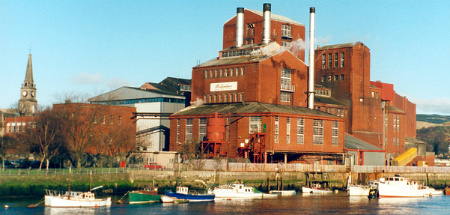
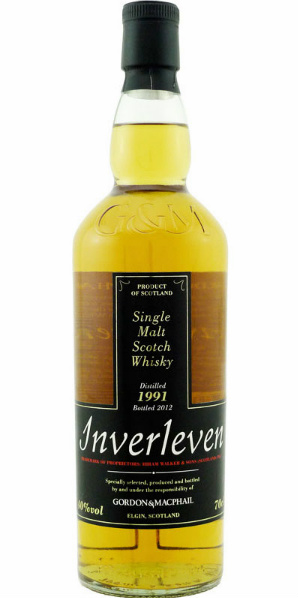
 I ended the last post about Gordon & MacPhail’s Inverleven with the hope that they wouldn’t reduce the next issue (so much). Frolicking around in my stash of samples I unearthed this unreduced Inverleven bottled by Cadenhead’s. It’s from another year, so this may have a different profile, but still worth checking out. Dumbarton was foremost a Grain Distillery. The distillery was built in 1938. In 2002 the distillery was closed and demolition commenced in 2005. I’ve added a picture here, because I have always liked the big red brick industrial complex on the river. By the way, after stopping the production of the Inverleven malt, the Stills went on to Islay to produce Port Charlotte at Bruichladdich.
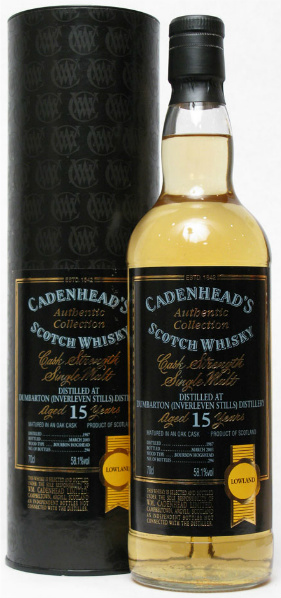 Color: White wine.
Nose: Grassy and murky, like sitting next to a ditch in summer, not bad, but certainly not lovely as well. A lot of citrus fruits. Lemon, lime, tangerines, but over this a lot of dried grass and hot butter. A slightly meaty or gravy like component emerges from all this. Quite fresh and slightly estery. Hints of mint when nosed vigorously.
Taste: Sweet and fresh. Lively, leafy, slightly woody and again lemons. Some underlying caramel and this type of whisky at this strength makes this hot, but that’s not a bad thing. Caramels, vanilla and toffee, are the main markers here. Not very complex. After some breathing, the bite of the wood enters, but luckily not a lot of bitterness.
Compared to the 1991/2012 G&M, this has even less than half of the wood the G&M. So this is more grassy, lemony and much sweeter to boot. This one lacks complexity, and even though the G&M was on the brink of becoming a log of wood, that one was more complex and therefore more interesting. This Cadenheads is easier to drink (as long as you like cask strength whiskies), sweeter and fresher. Still I like this type of Lowlander profile. Sadly gone.
Points: 84
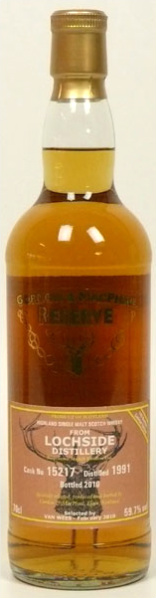
 Color: Gold.
 Here we have one of the many 1991 Lochsides, and one of the many that were issued as a Gordon & MacPhail Reserve. This one was picked by Dutch retailer Van Wees. Gordon & MacPhail code for this one is AJ/JBEC. The spirit was distilled on September 18th, 1991 and eventually bottled on March 8th, 2010. Alas we don’t know exactly the date when Han van Wees tasted it and picked this ;-). Kudos to Gordon & MacPhail for all the information on the bottle and back label.
 Color: Gold
 Erik Molenaar is the boss of this outfit. Did Erik source a tiny Hogshead of Ledaig? “Honey. I shrunk the Hogshead” maybe? Nope, Erik shared a cask with a shop in Maastricht. Slijterij Bams. The share of the shop was 218 bottles, Erik’s share was only 36. Funny enough the label of ‘the other’ bottle states 50.6%. The humor doesn’t stop here. Bams don’t have it on their list anymore. Sold out? But The Kintra version is still available! So I can’t wait to try this. I hear that modern Ledaigs can be pretty good…
 Color: White wine.
 Lot’s of ash in the finish. The lack of balance is a bit disturbing. There is also a bitterness like earwax and a hint of crushed bugs.
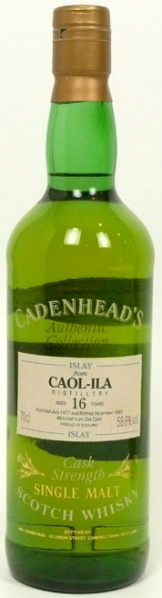 Color: Gold
 Caol Ila. This was recognizable blind. This has a nice full body with a perfect sweetness (slightly acidic) that matches the toned down peat a lot, combined with the smoke…a winner. Macaroons (made with almonds) and a slightly bitter finish (from the wood) and overall a tad too simple for a score into the 90’s.
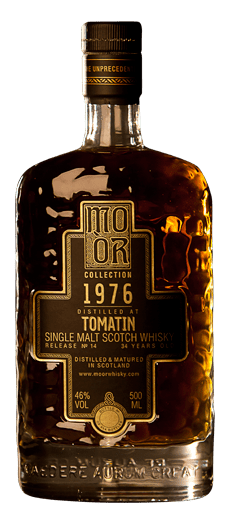 Color: Copper Gold.
 Quite hard to figure out how to call this malt. On the label is stated: Säntis Malt, Swiss Highlander, Appenzeller Single Malt, Matured in Old Oak Beer Casks. On their
  Belgium’s own, Bert B. came into the Cadenhead’s shop in Amsterdam (The Netherlands), with a tale of buying the ‘Winkeldochters’ in an old liquor store in a long forgotten town, near the coast. Howling wind and rolling bushes through the streets. Winkeldochters translates into shop’s daughters. It’s a great Flemish word for those items that are around for a long time in a shop which in fact never get sold.
 Well one of these bottles he bought was this Dufftown from Cadenheads. He opened it in the shop and we tried this. He didn’t like it then and exchanged it with Andries (The Cadenhead’s Shop owner) for a wedge of cheese, a cup of coffee and a wooden clothes pin. Andries was kind enough to pour me a nice sample of this (100ml) to take home with me. Cleaning out the closet, I stumbled across this sample, so here it is…
 Color: On the edge between copper gold and copper brown.
 Points: 92
 So there are quite a lot of official Wine finishes by Glen Moray themselves. Now Ian MacLeod decided to add their wine finish of their own, or maybe bought it straight from the distillery.
 I caught a cold last week, which is very unfortunate when you try to write tasting notes. Fortunately my nose is back in business now, and in the process ‘got a rest’. Let’s start whisky reviewing again, with an example of a whisky that should be light and is ‘low’ in ABV.
 Master Quill