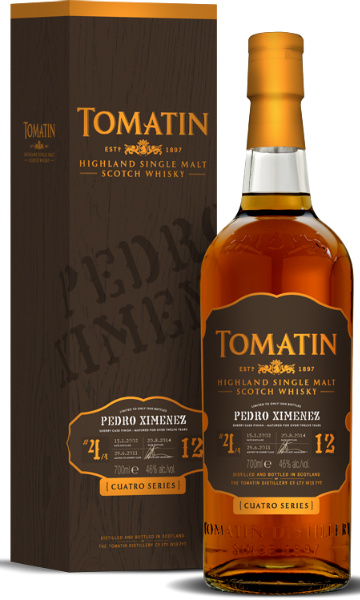
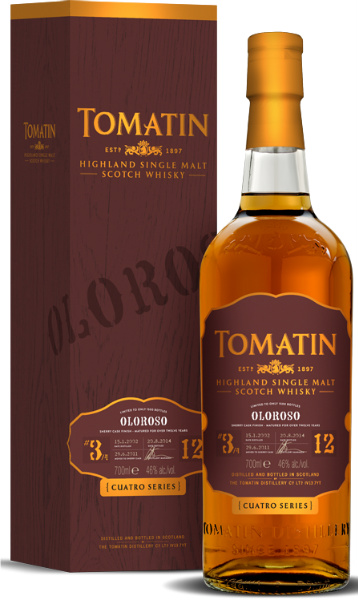
Tomatin 12yo 2002/2014 “Fino Sherry” (46%, OB, Cuatro Series #1, 3 years Fino Sherry Finish, 1.500 bottles)

It’s Monday, vacation is over, September is already visible at the horizon, so back to “work”. Time to pick up again with a nice box of four Tomatin’s, the highland distillery known for it’s Whisky with tropical aroma’s…

In 2014 Tomatin released a box with four full-sized bottles called the “Cuatro Series”. All four Whiskies were distilled on Tuesday the 15th of January 2002. All four were matured for 9 years in American oak, however, all received a final maturation of three years in four casks that previously held different kinds of Sherry. An excellent way to show the adventurous public the differences between finishing with four different Sherries. A novel idea and the pricing was reasonable as well. Just releasing it as four full-sized bottles in one box made for slow sales. Who wants to buy four more or less similar bottles of Tomatin where the difference lies in the details? Learing from the experience, Tomatin released several similar ideas since, but always in half sized bottles. Nevertheless, the “Cuatro Series” did sell out eventually, although the odd single bottle seem to be still available.

The four Sherries used in this series are, Fino, Manzanilla, Oloroso and Pedro Ximénez. The first expression, as numbered by the distillery, is the Fino expression. Fino Sherries are very dry and very pale. What makes Fino stand out, is the fact that maturation in the cask happens under flor. Flor is a layer of the Saccharomyces yeast strain, that lies on top of the liquid. The layer of yeast prevents the ageing fortified wine from oxidizing too much, making for a fresher Sherry. In the Wine-world Sherries like this are considered the cream of the crop, as opposed to Scotland’s favorite, Oloroso.

Tomatin Cuatro I - FinoColor: Gold.

Nose: Very musty on entry, which is not very pleasant. Luckily the mustiness dissipates rather quickly. So you really need a glass for this one. Underneath a nice note of olives, burning coal, some charcoal and lots of fruit. Yellow fruit, overripe or sometimes even candied. Some pineapple, mango and maybe even some nectarines. This nose is exploding with aroma. Dusty and creamy vanilla and nice soft oak, so the original cask did it’s work well. The Fino cask also seems to be of high quality, since it did impair some wonderful aroma’s to the Whisky. This one is wonderfully balanced and eventually smells rather nice. The fresh oak bit turns floral. More vanilla but this time with a touch of jasmine and, dare I say it, a hint of paracetamol. Wonderful nose for a 12yo. It has the tropical fruit traits Tomatin is known for. Reminds me a bit of a Fino Glenfarclas I once had.

Taste: Sweet and spicy. Beer-like hops, and again lots of fruits carried by the beer-like bitterness. Is it the yeast from the flor that does this? Again, like the nose, wonderfully balanced, but not as complex as the nose. Here the Fino impairs a nice nutty flavour as well as some italian laurel licorice (sweet). Creamy with a note of buttery vanilla. Strange enough there is an acidic top-note now. Finish has some length, with again some bitterness that carries it. And beyond that a nice lingering and fruity/nutty aftertaste. This may not turn out as the easiest of the four, but if you have mastered tasting Fino (finished) Whiskies, this is certainly no dud.

For those of you who also read my Rum-reviews, you’ll know, that I found Rhum Agricole to be wonderful stuff as long as you give yourself the time to grow into. More or less the same goes for finishing in Fino Sherry. There are examples of Whiskies with a Fino finish that work exceptionally well, but I also found Fino finishes, something I had to get used to.

Points: 85

Glenfiddich 21yo “Havana Reserve” (40%, OB, Circa 2003)

And here we have an old, and somewhat controversial, Glenfiddich that was totally matured in boxes that once held cigars. Oops, I mean, casks that once held Cuban Rum. Cuban Rums is a light Spanish style Rum which doesn’t mean it doesn’t have a lot of aroma. Rum casks weren’t used much for finishing Whisky, and even today distillers and bottlers tend to prefer the obvious Bourbon and Sherry casks. Especially today, other casks are used as well, from fortified wines like Port and Madeira and red and white, sweet and dry Wines. So a Rum cask you say? Yes, we have had more of those on these pages. A fairly recent Benriach comes to mind, to name but one. Controversial? Yes. Problems arose when Whisky like this was sent to the US of A. They still had an Cuban Embargo, so more cigars for us, as can be read on these pages as well, oops I slipped up again. There still was an Cuban Embargo back then, so no Whisky with the word “Havana” on the label was allowed into the country.

Glenfiddich and The Balvenie have the same owners, William Grant & Sons. Yup, those from Hendrick’s Gin as well. Bad boys down there! Bad boys since they also decided to sue our beloved New Zealand Whisky Company for blatantly stealing the “Double Wood” words and misguiding the poor public, who now must believe that Balvenie Double Wood is the same as the NZWC’s Doublewood, and New Zealand is somewhere in the Speyside region…

William Grant was looking for the perfect Rum casks for their Glenfiddich and considered casks that once held Rums from Venezuela (Spanish style), Guyana (Demerara Rum a heavy English style Rum) and some others. Finally Rum from Sancti Spiritus was chosen to fill up the casks for two years, After two years the Rum was replaced with Whisky for a six month finish.

If I’m not mistaken, the first release was called Havana Reserve and the second was called Gran Reserva. Rumour has it, that for this second release the same casks were re-used, thus explaining reports of the Gran Reserva being lighter than the initial release. A third version was released. Just to be absolutely sure, this Whisky was not finished in Cuban Rum casks, but in casks that once held Dominican Rum. The label now mentions Carribean Rum finish in stead of Cuban Rum finish. Later, subsequent batches simply were called Rum cask finish, so absolutely nothing could be misunderstood and when changing Rums the label can stay the same.

Glenfiddich 21yo Havana ReserveColor: Full gold.

Nose: Very aromatic. Creamy, toffee, nutty, thick and chewy. Next a floral layer which at times is quite perfumy, with great earthy undertones (given by the Rum cask). Vanilla and restrained wood. Half dried grass is noticeable, but covered under a thick semi-sweet layer of aromatics. Fruity, baked banana and dried sweet apricot. In the distance there is even a hint of licorice. But the Rum, is the Rum noticeable? Yes If you know the style of Rum the Cubans make, and you know this Whisky is finished in Cuban Rum cask, than yes, its noticeable, otherwise you must have some experience in tasting to smell and taste it. The Rum upped the aromatics and the chewyness a bit, as well as the sweetness. Great nose.

Taste: Sweet with lots of toffee. Earthy and “green”. Broken off branch and fresh tree sap. The baked banana returns. It’s a big Malt. It is overwhelming in fruit and floral notes. Has some bitter wood and slightly burned edges to it. Wood obviously. Oak, fresh oak and even some pencil. The body of the Whisky already shows it will not be as complex as the nose. However the biggest problem, relatively speaking of course, is the partial disintegration towards the finish. It’s like a band just before breaking up. Some aroma’s don’t want to work with each other anymore, and get separated from each other. Still in the fold though, but more apart. Underneath the woody bitter note and on top some acidity. Short finish, which surprised me since it’s a bigger Glenfiddich than usual, and this has aged for a whopping 21 years, you know. Not a lot happening in the aftertaste. So on entry I was quite happy with the performance of the 40% ABV. but the finish needed some more.

This is a beauty. Excellent smelling Glenfiddich. Tastewise, well, not at the same level of greatness as the nose, then again, it was (since it was bottled some time ago, and since has been discontinued) a mass-produced Whisky aiming at the public already gained by the rest of the Glenfiddich bottlings, without scaring them away. With this in mind, they did what they could, to keep this public and at the same time be a bit more adventurous.

Points: 84

The New Zealand Whisky Collection 18yo 1993/2012 (51.9%, The New Zealand Whisky Company, Cask #21)

After one blend and three reduced bottlings from their standard range, here is finally the first example of an “untouched” New Zealand Whisky. A 1993 expression bottled at cask strength and from single cask #21. That’s more like it. This way we can finally find out what the distiller intended. How did the spirit interact with the wood from the cask. No information about the cask itself has been given so we aren’t handicapped with information this time, and can just dig in…

The New Zealand Whisky Collection 18yo 19932012 (51.9%, The New Zealand Whisky Company, Cask #21)Color: Light gold.

Nose: Fruity and dusty, carried with an undertone of fresh wood. I would say this came from a Bourbon cask. Not hard to tell since the wood impaired quite a lot of vanilla-flavours. One with green fingers too, since it has more traits from the kingdom of plants, than the wood alone. It’s easy to admit, this one is driven by wood. Even the spices are wood related, and what about the whiff of pencil-shavings and the aroma of freshly broken off twig? Does this mean this one is dominated by wood? Not at all. The wood gave of various elements of itself, without overpowering it. All in good measure. It has a promise of sweetness (toffee) and the big wood-vanilla synergy makes this a fruity and creamy nose with some backbone and character given by the wood. Slightly oriental (Indian) and floral. Restrained, elegant and wonderful.

Taste: Nice spicy, prickly and woody entry. It starts out with fresh oak and a quite big, nice vegetal sweetness. Tiny hint of bitterness. Right from the start it is obvious this one is carried by the cask strength. Good this wasn’t reduced. It doesn’t seem to have as many woody traits as the nose. Definitely simpler in design than the nose. The fruity bit I taste is a bit peculiar. To me it seems, the mixture of yellow and red fruits don’t combine perfectly here. More cereals and bread tones towards the end. The finish is shorter than expected and it’s the grainy, bread-like and slightly bitter bit that has the biggest influence on the finish.

The strength of this malt is the wonderful nose, as well as well on entry in the mouth. From there it goes a bit downhill. The body sort of disintegrated in my mouth and although the cask strength is noticeable, it doesn’t carry the aroma’s into the finish in a big way. This is a Malt that needs to be tasted, taking big sips. Good stuff nevertheless, easy drinking Whisky, but probably not the best single cask bottled by the NZWC. We’ll see because I have two more hidden away somewhere.

Points: 85

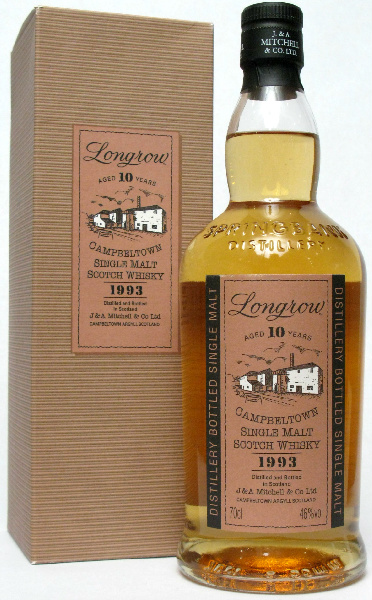
Longrow 10yo 1993 (46%, OB, 2003)

Another peated whisky in the summer? Has Master Quill gone completely crazy? Yes, because who wants to be “normal”! If you feel like it, just do it… By the way, it’s raining like crazy outside, so it only seems fitting.

2001 saw the first release of a 10 year old, with a vintage. Remember the classic brown paper Longrow label on the tall bottle? The first two releases, both in 2001 and both distilled in 1991 were a “normal one” said to be only from Bourbon, but also, for one time only, a Sherrywood. The series was short-lived, and was discontinued in 2006 after the 1996 vintage, in favour of the 10yo without a vintage statement. Throughout the series I don’t believe all normal ones were from Bourbon casks only, if any. You know Springbank, they tend not to repeat themselves. Just compare the last two releases of the Longrow 18yo (with the white labels), since the 2016 release contains Rum casks. Never a dull moment with Springbank and all of their other brands. Today we’ll have a look at the 1993 vintage of the 10yo, that was released in 2003.

Longrow 10yo 1993Color: Light gold.

Nose: Nice fresh peat. Fatty and smoky. The peat is smelling three-dimensional. It’s not only just there, it goes deep, and seems without end in complexity. Peat mixed with hints of lemon, waxy apple skins and vanilla. Cookie dough. Whiffs of warm apple pie. Burning leaves, sugared yellow fruits and even hints of sweet-smelling sweat, crushed beetle and slightly burned herbs and even has a quaint nuttiness about it. Very balanced stuff, with only a mere hint of wood. All seems to fit in together nicely. This is the best peat I’ve smelled in quite some time. I must admit, it had plenty of air to work with. Love it.

Taste: Quite sweet on entry. Heavy on licorice and the peat is shoved into the background, by the sweetness. The sweetness dissipates and leaves more room for a sort of herbal fruitiness. Prickly licorice and the nuttiness from the nose. Alas the peat never really makes it to the top and the wonderful depth it has on the nose doesn’t really blossom tasting it. Long finish, built around the caramel sweetness and with a larger role for sour oak. Coffee and chocolate in the aftertaste. It still is a wonderful Malt. Just if the complexity of the nose would have shone through in the taste, it would have been a truly exceptional Whisky.

Well this might not be a Whisky from the seventies, but it does remind me of the quality of that decade. I’m actually amazed a bit that many of the vintages are still available, although somewhat more expensive than the new 10yo.

Points: 88

Glenrothes 1987/2002 (43%, OB)

Here is another vintage Glenrothes. After the 1992,  the 1989 and the 1979, this 1987 is the fourth of these vintage bottlings on Master Quill. All were nice, but never scoring very high. All were nice, with enough difference to warrant buying more than one, but also none of them blew me out of the water. Just look at both other Glenrothes I reviewed earlier. One bottled by Wilson & Morgan and one by Douglas Laing. Both managed to score higher than the official bottlings. By now I can say that I expect this one to be nice, but again I don’t think it will blow me out of the water.

Glenrothes 1987/2002 (43%, OB)Color: Gold.

Nose: Dusty, definitely Sherried. Spicy and tickles the nose. Also some burnt elements. Next some aroma’s you get from an old (dry) cellar or attic. Funky but not the funky damp notes you sometimes get from cellars. More like the odours of stored old stuff. Old paper, old cardboard and old wood. Old, worn out vanilla pods. Later a breath of rural fresh air, coming to you over water. Let it breathe some more, and it becomes more like a “normal” Whisky. Vanilla, wood, fruity Sherry notes and spicy oak and cask toast. Hints of butter and dry grass (not hay), and even some toffee.

Taste: Short attack of (fresh) oak and a more waxy note, quickly succeeded by cherries and sugared yellow fruits. Fruity sweet toffee, alas a bit diluted. Über-fruity sugar-water. Warming. Apart from the initial wood, this is quite a fruity expression of Glenrothes. Hints of soap and paper from the nose and a growing aroma of burnt wood. At best a medium finish with a note of Beer and burnt wood. Yes, a bit bitter, which adds to the character of the Whisky after the initial sweetness and fruitiness. The aftertaste matches the nose exactly.

Although the nose isn’t one of the most balanced expressions of Glenrothes, the taste is way better that way, helped along by the sweetness it has. It’s all right this one. It may be a bit simple, diluted and lacking complexity. It does some across as balanced and tastes nice. Maybe it’s time to up the strength a bit?

Points: 83

Glencadam 30yo 1975/2006 (54.4%, Dewar Rattray, Cask Collection, Bourbon Cask #7588, 216 bottles)

Why not make it a double bill, and review our third Glencadam. Both Glencadam’s I reviewed earlier managed to score a nice 85 Points, so let’s see if this one does better. This particular on is 30 years old, and by itself it’s older than both previous examples put together. This is another one from the attic, since it was released back in 2006. The difference couldn’t be greater when comparing it to the Glencadam I just reviewed. It is twice the age and this one comes from a Bourbon cask, surely it will do better?

Glencadam 30yo DRColor: Full gold, and only slightly lighter than the 15yo.

Nose: Half sweet and nice biscuity barley. Slightly spicy and reminds me of old Dutch Jenever. Definitely some Bourbon influences. Some waxy elements, but not much. In fact the Whisky smells quite young and vibrant and not at all would you expect it to be 30 years old. Fresh, hints of citrus and only mere hints of vanilla. Dusty wood completes the nose. That’s it, not much more is happening. After a while more fruit comes to the fore. Sweetish yellow fruits. Some unripe banana skin. Adding to the structure of banana comes powdered coffee-creamer, in the smell a creamy variant of vanilla. Dusty and slightly dried out ice-cream after you spilled it and didn’t clean it right away. Given some time the freshness takes a back seat and the whole is nice but also rather dull. Not a very active cask I’m afraid. Having said that, it does smell like something from the past.

Taste: Wood, paper and cardboard and after that a short, sharp attack, quickly followed by a short sweet note. After the sweetness comes some woody bitterness. Distant dull vanilla. Waxy again. Cold candle wax. So the body is present and almost chewy, yet surrounded by dry paper and woody notes. A nice old Bourbon matured Whisky, but not a stellar one like 1972 Caperdonich or 1976 Tomatin, to name but a few. Here also some fruit emerges, but again a bit dull. Dried bits of pineapple and some old broken almond bits, you sometimes find in the couch. Luckily the sweetish and fruity note dominate the body, not leaving much room for the woody bitterness. The finish has medium length, but there isn’t much happening afterwards. What stays around for the longest, apart from general (cardboardy) creaminess, is a sour note you get from (new) oak.

Not bad, quite nice, but also not spectacular as well. No real off notes and nothing (bad) overpowering the whole. Still a nice one to pick up when all of its distant relatives are sold out. Definitely a lot better than most of the modern Whiskies though. I’ll have fond memories of this nevertheless.

Points: 85

Glencadam 15yo 1989/2005 (58%, Signatory Vintage, Cask Strength Collection, Sherry Butt #6014, 578 bottles)

Another one I found in the attic. Although this hasn’t been bottled ages ago, this time around I have a Signatory Glencadam bottled back in 2005. That’s already 11 years ago. Time flies. This is just the second Glencadam on these pages and it seems not to be a Malt with a big reputation. Having said that, the “new” 10yo I reviewed last time around, was something of a nice surprise for me. Quite impressive for an officially bottled 10yo. However, I have seen it before that the first release of something is better than most subsequent releases. Just sayin’…

Glencadam 15yo SigVColor: Copper gold.

Nose: Creamy and strictly Sherry. Smells like a Red Wine cask actually. Whiffs of stale Beer. Wow, where is this going? Hints of caramel and licorice. Creamy and perfumy. Definitely more floral than most Whiskies I recently tried. Floral pudding. Sure some dried apricots underneath, but not enough to call this fruity as well, although the fruit aroma becomes stronger with prolonged breathing, so it may be more fruity then I initially thought. Hardly any wood. Fruity and floral it is and dry warm wind blowing over the top. After even some more time the floral part seems to have disappeared. Interesting effect. It’s all about what evaporates the first. It becomes nicer over time, and better balanced as well.

Taste: On entry again the feeling this comes from a Wine cask. Apart from the slightly harsh winey note, a lot of paper and cardboard notes. A Beer-like carbonation taste (not saying there are bubbles in this one, an effect I know from a certain Teaninich, also bottled by Signatory (not reviewed yet, but I do have a bottle of that somewhere). Lots of pronounced Italian laurel licorice. Cumin and slightly minty. Hidden sweetness and a nice bitter (hoppy?), and slightly soapy, edge well into the finish. Well this one seems to have it all doesn’t it?

If you work on this a bit it is quite nice and wonderfully complex. For some it may be an acquired taste. You need to let this breathe for quite some time though, although seeing it change with time is quite nice as well. Interesting Malt. Recommended for aficionado’s. I liked the feel of the 10yo I reviewed earlier, and this one doesn’t disappoint as well. However, I’m not that positive about some of the other regular releases by the owners themselves, so be careful with buying those without trying.

Points: 85


Bushmills Irish Single Malt 1991/2015 (52.2%, The Whisky Mercenary, for Whiskysite.nl and The Single Malt Whisky Shop)

Usually, independently released Irish Malts are sourced from Cooley, especially the peated ones. This time it’s not. Many 1991 peated Irish Malts that were released independently in 2015 were from a batch of peated Bushmills, although you won’t find the name Bushmills anywhere on the label. This particular bottling was done for the Dutch Whisky-shop Whiskysite.nl and Belgian outfit The Single Malt Whisky Shop. let’s see what Jürgen offers us now…

The Whisky Mercenary IrishColor: Gold.

Nose: Nice elegant peat, which rules out Cooley right of the bat. Cooley has a more fatty and rough kind of peat. This smells more refined and a bit sweet. Fruity (yellow). Sure there is this clay element in the peat, that is also present in Cooley, but it still is different. Hardly any smoke although the first sniff was quite sharp. If it’s there it’s already gone. This is a wonderful smelling Malt. The wood shows itself next and it reminds me of pencil-shavings combined with some fresh oak. Again, all kept very much in check. Vanilla is present but again, not in a big way. Deep underneath the hints of red fruit, is also a sweaty element. Animalesk and organic, which only adds to the complexity of this Malt. Well integrated. On top a more heavy aroma emerges, fresh butter. So we have some peat, some wood, some vanilla and some butter and all is nicely held together with a very appetizing fruitiness. If this will taste anything like it smells we’ll have a winner here.

Taste: Ahh my favorite red berry flavour is there. I also find it, and love it, in the 2005 batches of Redbreast. Quite funny since Redbreast isn’t produced at Bushmills, but rather at Midleton. Maybe its Irish. The fruit combines really well with a warming, but still fresh peat. Creamy and with some vanilla, but also a slight hint of burned kerosene, mixed it with the toffee. Pencil-shavings are in here as well. The peat is again light and elegant. Great. Almonds and some wax are next. Almond-milk, mixed with latex,quickly followed by red fruit juice. What a wonderful Malt this is. It smells great, tastes great, up ’till now this is so good that I would even forgive a short finish. Short it is not, but it is of medium length. The aroma’s leave my mouth one by one. The aftertaste is about fruity wax and, a little bit of peat and the memory of red fruit and a light bitter edge to hold it all up.

This is wonderful stuff and yes, Jürgen has done it again. What a wonderful selection. By now long gone, but can be found at different auctions across Europe. Just be ready to dish out quite some money for this, since most aficionado’s know this is excellent. It was quite expensive to boot, and even more now, but it also is quite excellent, so this time you will get what you pay for, and in today’s market, notwithstanding the origin of the Malt, you get more quality out of this for this kind of money, than most other Malts. So a no brainer for me (and I don’t sit on heaps of money)…

Points: 90

I had to do a H2H with a 2005 batch of Redbreast. The Redbreast smells oilier and somewhat less fresh. I would almost say, more Rum-like. It seems to smell a bit of petrol and exhaust and overall seems less complex. Caroni anyone? Don’t underestimate the power of H2H’s. The Bushmills smells more organic and definitely fruitier. Although the difference in ABV is only slightly more than 6%, it makes the Redbreast much softer than it actually is. Again in comparison, the Redbreast has some gout de petrol (like you can find in excellent Rieslings). I scored the excellent Redbreast, 86 points, but today I would score it higher…(but not 90).

Glenugie 1966 (40%. Gordon & MacPhail, Connoisseurs Choice, Old Map Label, 75cl, 4699)

Up next a blast from our collective Whisky past. This is only the second Glenugie on these pages, and rightfully so. It’s closed and it’s today, bottlings like this moved into the realm of collectors (who don’t drink it) and anoraks (who do). So what do we have here? A few years ago an anorak posted an article about what clues can be found on a G&M bottling to date it. We see that this bottle doesn’t have a neck label to date it, so it’s not from the 1991 batch, but earlier. We do know it is an 75cl bottle and on the bottom the glass code 4699 can be found. This particular glass container was used in between 1982 and 1991, which isn’t really helping, but narrows it down a bit. I’ve seen this bottle with different cardboard boxes though, so that isn’t helpful either. The box in the picture isn’t necessarily the box the bottle was sold in. Second we do not know if only one bach was released, looking like this. There may be different batches with different boxes who look exactly the same filled in exactly the same coded bottles. I’m guessing the one I’m about to taste is more form the second half of the eighties than the first half, but that’s only speculation. Let’s try it then shall we?

Glenugie 1966Color: Slightly orange gold.

Nose: Very dusty and old smelling. Funky dry Sherry. Deep grassy, slightly waxy and old soft oak(y). Time capsule. Some faint red berry fruit in the background. Add to that a more creamy, vanilla note and some burnt wood. It’s a mere hint that burnt note though. Adds to the character fo the Whisky. If you let it breathe for a while, more and more of this red fruit comes to the fore, cloaked in the wood and creamy notes. Diluted warm caramel and slightly dusty as well. This is an old gem, and needs to be treated as such. It’s fragile at 40% ABV. Don’t be hasty too. With even some more air, hints of licorice and a floral note emerges. Floral but not soapy. Elegant and distinguished florality. Vegetal (with some wood), floral and fruity, that sums it up.

Taste: The wax, diluted caramel and the wood are up front here. Diluted sweetness. It’s slightly sweet at first, but that is quickly gone. It’s so obvious that I do feel that some caramel colouring has been done. Yep, toffee, hard candy coffee bon-bon. More wood, slightly sappy and bitter. It has some creamy nuttiness to it. Does warm hazel-nut milk make any sense? Disappears rather quickly, hence it has a short finish. The finish is made up of toffee and it’s actually almost the only thing that is noticeable in the aftertaste (as well as a hint of paper…).

Wonderful old malt, that has been diluted too much and might have seen some caramel colouring. You know it’s there, but it lost its battle trying to show it to us, since it has been hindered by too much water. Bummer. I have to report this to the Whisky police and hopefully the culprits will be brought to the Whisky-tribunal. Smells great though, that’s where the potential is still noticeable, or should I say that’s where you can still get a glimpse of what could (should) have been…

Points: 83

Angels Envy “Port Cask Finished” (43.3%, Batch #113)

The Story of Angel’s Envy is, in part, also the story of Lincoln Henderson, whose signature is conveniently placed upon the bottle. Mr. Henderson used to be Master Distiller at Brown-Forman and was in part responsible for creating Woodford Reserve (personally not one of my favorites), and Gentleman Jack, as well as Jack Daniel’s Single Barrel. Since I don’t really like Jack Daniel’s Old No. 7, I never was in a hurry to try the rest. I hope this Angel’s Envy will be more to my liking.

Lincoln HendersonIn 2004 Mr. Henderson retired from Brown-Forman and in 2006, joined his son Wes(ley) and grandson Kyle in their Louisville Distilling Corporation, experimenting with finishing Bourbons in casks that previously held other distillates. The Bourbon itself is said to be made by MPG in Indiana, which is very odd for a Kentucky Bourbon, as stated on the label. The Bourbon is around 4 to 6 years old, obviously first aged in American oak, as all Bourbons are, and finally finished for 3 to 6 months in 225 litre Ruby Port barrels made from french oak. It’s a small batch Whiskey each time made from 8 to 10 barrels only.

The first Angel’s Envy saw the light of day in 2012. Sadly, Mr. Henderson’s lights went out in September 2013, aged 75, becoming a spirit himself. Angel’s Envy itself, the legacy of Mr. Henderson,  was finally sold off to Bacardi in 2015.  It is said that Mr. Henderson, throughout his career, tasted some 430.000 barrels of Bourbon. Who said Bourbon is bad for you?

Angels Envy PortColor: Light copper gold.

Nose: Chewy sweet Bourbon smell with indeed an added winey note. The finish seems to be done with taste, since in no way does it dominate the profile. If tasted blind you’d still call this a “normal” Bourbon. The Bourbon part reminds me a bit of Four Roses actually, (the low rye mashbill). Nice, soft and creamy. Some worn saddle leather combined with the smell of a cold cob of corn, Give it some more time to breathe and the finish becomes more apparent as well as a different kind of oak. Honey and an appetizing fresh leafy note. I’m amazed at the wonderful balance achieved. Lovely stuff to nose.

Taste: Aiii, a bit to sweet and thin on entry. A short flash of fresh oak, with milk chocolate and honey, quickly followed by red fruit aroma. The oak returns for a moment delivering a nice balancing bitterness, Nice jammy note as well. Creamy vanilla. Again the Port finish has been done with taste and works extremely well. It is a Bourbon, but in part it has a “new” edge to it. The Finish is of medium length at best, but if you have a moment to spare you can wait for the aftertaste which leaves a nice creamy mixture of honey, and vanilla with again some hidden elements of the Port. As was the entry, the finish is a bit too sweet as well. Nevertheless, a job well done, even when reduced too much.

Probably made for a hip market, and not to scare to many people off, it has been reduced to 43.3% ABV, At this strength the Bourbon is also dangerously drinkable, which in my case would mean the bottle would be finished sooner than later. As I am based in Europe, prices here are much steeper than across the big pond. I understand the US pricing of this, but over here for such a drinkable Bourbon I find it too expensive. Pricing aside, this may look as a designer Bourbon, and it probably is, but it still carries a lot of quality and good taste from the makers. There is also a (Plantation) Rum finish, Rye with a Rum finish, as well as a cask strength edition, also finished in Port barrels. Depending on availability, these seem to be extremely expensive.

Points: 83