The Benriach 17yo “Septendecim” (46%, OB, Peated, 2013)

Last summer I already reviewed The 18yo Benriach “Dunder”. A peated Benriach finished in high ester Rum casks. This “Septendecim” is a 17 year old peated Whisky. Well, I may be wrong, but maybe this “Septendecim” is the basis for all those 18yo Limited production’s of late? Up untill now there are already three releases in this series. It started with “Albariza” which was finished in PX Sherry casks, the second was the aforementioned “Dunder” and last month the Benriach “Latada” was released. Again a peated Whisky finished this time in Madeira casks.

The Benriach SeptendecimColor: Gold.

Nose: Fatty, fatty, thick peat. The peat is instantly recognizable from the Dunder I reviewed earlier. Bonfire in the woods. Tiny hints of electrical fire and molten plastic. Sounds terrible, but it doesn’t harm the overall smell, so easy yourself back into your chair. Quite clean and smoky. Kippers, salty and tarry. But it’s not Islay I’m getting. I still get a secondary feeling of a forest. Clairvoyant? Who knows. After some air, the whole gets even more cleaner, smokier and shows hints of citrus. Lemon, not lime. Quite nice. I would have never given this 17 years if I had tasted it blind. Hints of coffee, but not dark roasted stuff, more Cappuccino. Last one to show itself is the wood. Fresh oak.

Taste: Sure, fatty, a bit fruity and obviously peaty, but also much lighter on aromatics. Cold chocolate milk and coffee again. It has some sweetness too, but that is more hidden. Just like the nose, I wouldn’t have given this 17 years. Even at 46% ABV. it doesn’t seem to be heavy on the alcohol, I’m actually amazed how light this actually is. The lightness (and the coffee with milk) makes this dangerously drinkable for a richly peated Malt. I keep wanting more, and want to sip it more. Having said that, It would have been nice to try this one at 50% ABV and see a bit more complexity at this age. Medium finish with a buttery, vanilla and smoky aftertaste.

The “lightness” in the taste made me believe this is the Whisky they use as a basis for the “Limited Production Series”, especially when its 17 years old and that leaves some room for finishing.

Points: 85

The Glenlivet 12yo (40%, OB, 2012)

About a year ago I already reviewed The Glenlivet 12yo, but that one was bottled around 2005. Now I stumbled upon an example of the same stuff, this time bottled in 2012. We all know the big boys want consistency, so now we have a chance to find out. For those of you who don’t know already. Due to the enormous rise in popularity of Single Malt Whiskies, a distillery can’t afford anymore, to wait 12 years to make an entry-level Malt. This 12yo will be replaced in most markets, apart from Asia and the USA, where I’m informed, the consumers like “numbers” more than the consumers in other markets. The replacement is The Glenlivet “Founders Reserve”. Yes, a Whisky described by only letters, no numbers anymore for us Europeans.

The Glenlivet 12yo (40%, OB, 2012)Color: Gold.

Nose: Malty with sweet fruit and quite some wax. Nice aroma. One thing if for sure. The aroma of the 12yo never holds back, its vibrant and wants you to drink it. Definitely not a closed spirit. Vanilla and oak, parts of it even new oak, since the wood smell is a little bit sharper. Sweet and candied. Fruity. No pineapple this time, but I do get some apricots. Powdered coffee creamer (the initial smell of it, not the fatty part). At least this nose lives up to its earlier brothers (or sisters if you like).

Taste: Strange enough, this starts with wood, partially bitter and partially burnt. Then a quick passing by of some (sugared) fruit and some soapy (ear) wax, which is quickly overtaken by paper. Diluted red fruits and the bitterness never moves an inch. Not as sweet as the older versions. Quite a difference from the 2005, 12yo, I mentioned above. Not a long finish and the aftertaste isn’t all that pleasant as well.

When reviewing the 2005 version and comparing that to the new “Founders Reserve” I was quite shocked by the difference in taste. The “Founders Reserve” tastes as a very young and immature Whisky, almost as if it wasn’t ready, but the marketing department wanted it out anyway. Now that I have tasted this 12yo from 2012, and do remind yourself how much the Whisky world has changed between 2005 and 2012, the difference in quality isn’t all that great, although the taste is quite different. My advise would be, get yourself an old 12yo, but do not pay too much for it, and be surprised how nice it was.

Points: 76

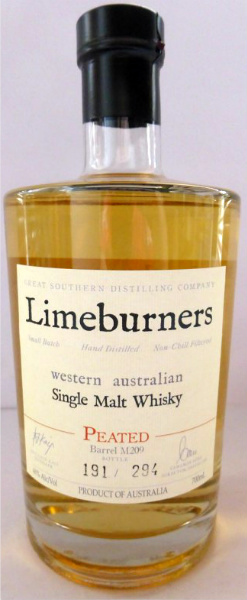
Limeburners Peated Single Malt (48%, Great Southern Distilling Company, Bourbon Barrel M209, 294 bottles)

After the funky mushroom Whisky from France, let’s try another ‘World Whisky”. This time we will look at a peated Limeburners single cask Single Malt Whisky. Limeburners is the brand name for the Single Malt Whisky from The Great Southern Distilling Company from Western Australia. They call themselves a boutique distillery with a focus is on quality. The plan is to source all ingredients locally. Nice touch is that the distillery is powered by the Albany wind farm and the Whisky is reduced with filtered rain water. How’s that for sustainability?

Limeburners M209 aColor: White wine.

Nose: Softly smoky and peaty. Fatty with lots of vanilla. Creamy. Leafy, vegetal and the oak almost smells freshly cut. The peat quickly takes the back-seat and lets the cask drive. The wood drives slowly listening to Lana Del Rey on the car radio. Hints of new make. Judging by the nose alone I would say, bottled slightly too soon and not as peaty as I expected. Given some time to breathe it seems like all of the aromas introduced themselves one by one, and now work together for a more balanced feel. More citrussy too, distinct aroma’s of soft (sugared) lemon. Am I still objective when I pair the soft lemon with lemongrass. Nice, but where has the peat gone? It’s almost a lowlander in style.

Taste: First entry is definitely new make, with its distinct alcoholic and sweet taste. Beer, hops, lots of paper, woody bitterness and again very green, leafy and vegetal. Fresh tree sap. Virgin oak cask? I also get some raspberry hard candy and creamy vanilla. Typical american oak vanillin. The peat only shows itself in some sort of spicy pepperiness. Not bad but nothing special yet too.

The nose already gave it away, but especially in the taste it is noticeable, this is a bit too young. Also the notes of virgin oak are quite “there” so I think at least this cask has some more to give to the next distillate that will enter it.

Points: 75

Lascaw 12yo (40%, Distillerie du Périgord, Fûts de spécialité à la truffe)

Next up a French Whisky, that seems utterly French, since it was finished in casks that once held truffles, yes a fungus! The Whisky itself (before it is finished) turns out to be a 12yo Scottish Single Malt brought in by the Perigord distillery to finish for several weeks in the aforementioned special casks. Alas the source of the Whisky is confidential. Just to clear one thing up, the casks previously didn’t hold truffles, but were used for ageing a spirit (Vodka) with truffles infused in them. Distillerie du Perigord has a website, at the time of writing, only in French, which show the distillery is known mainly for its fruit spirits and liqueurs and some French specialties like Pastis and Poire William, and now this French-Scottish Whisky.

Lascaw 12yoColor: Orange gold.

Nose: Creamy and fresh. Light and fruity. Lots of yellow fruits with hints of menthol. Fruity sweetness with hints of oak. I braced myself for so thick and earthy fungus smell, but nope it’s not like that at all. Its fresh and fruity, Light and quite elegant, with a tiny hint of burning candle and pine. That part reminds me of christmas. Simply a nice smelling Whisky. Give this some time to breathe (believe me, this does need a lot of time to breathe) and yes, a whiff of mushroom does pass by. Remember the smell when cleaning champignons? It may not only be the smell of the mushroom itself, but also from the earth its growing in. Sure it has that, but don’t expect to get a lot of it. I already used more words about the mushroomy bit, than is actually noticeable, but it is noticeable. If nosed blind, the mushroom would be considered a part of the wood aroma I guess. Remarkable change when it breathes, more and more towards the christmassy bit I described above. Even more earthy, dry and more and more candle wax, boiling water and dry pine. Mocha coffee. The pine is integrated, it’s not overpowering the smell at all. Very interesting nose.

Taste: Light, creamy, watered down oak and cardboard, no yellow fruits but there are some red fruits in the finish. Quite malty and in a way it has aroma’s of porridge and old beer. This probably has been reduced too much to show off its aroma’s in the taste. Slight hint of oaky bitterness in the finish, and for me there is no truffle in the taste. It’s all in the nose. Tastes like a blend.

The nose is more than all right. Give it time and it will show you its special. A good nose you get from wood aged spirits. Not really a mushroom Whisky though. Taste wise it’s too thin with quite a short finish. Not something I would run out to buy, but an education and experience nevertheless.

Points: 70

Merci à Richard pour la bouteille.

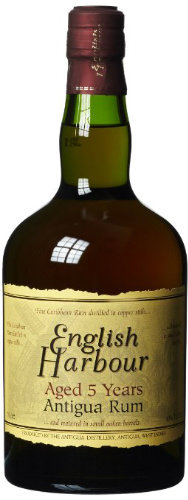
English Harbour 5yo (40%, Antigua, West Indies)

And here is another Rum in a dumpy bottle. This time, just like the El Dorado, we have a Rum with an age statement that really does mean that the contents have been aged for that period of time. Where the El Dorado is 15yo, this English Harbour only has 5 years under its belt.

Antigua Distillery Ltd. is established in 1932 with a 3-column Savalle still from France placed one year later. In 1943 Antigua Distillery Ltd. buys the Montpellier sugar estate with 2500 acres of cane field. We have to wait until the fifties to see the first Rum called Cavalier Muscavado Rum. The first Rum that was called English Harbour was released in 1990. Today the portfolio holds the 5yo we’re about to review, a 10yo, but also a 1981 vintage. This 1981 Vintage is the last of the Rum distilled on the original Savalle Still from 1933, which was eventually decommissioned in 1991…

English Harbour 5yoColor: Light orange gold.

Nose: Sugary sweet, nutty, fresh and fruity. Appetizing. Slightly dusty and some woody dryness. Fresh sugarcane-juice and hints of Bourbon. Typically vanilla, toffee, caramel and a hint of roasted coconut to finish it all off.

Taste: On entry first quite thin, but just right after that a slow, caramelly, sugary sweet sip slides down my throat. lots of toffee and creamy notes. Nougat (with hazelnuts). A distant laid back fruitiness emerges, which I can only describe as the marriage of sweet sugared cherries with dried apricots. It’s neither of the two but some sort of marriage of the two. Half long finish with a light backbone of oak, leaving a very pleasant, and slightly hot, after taste.

For the cost a very good Rum you can do anything with. The work-horse of your collection. It’s a very nice un-demanding sipping Rum, but will work excellent in cola and cocktails. Yes is may be slightly simple due to its youth, but it is highly drinkable, not too sweet, not to woody. Everything seems in its place and has no off notes whatsoever. Good stuff.

Points: 83

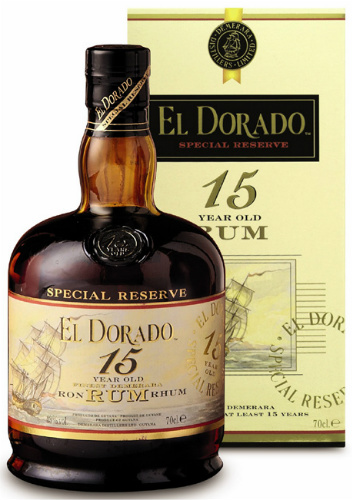
El Dorado 15yo “Special Reserve” (43%, Guyana)

Almost three years ago I reviewed the 12yo El Dorado, and it’s time to move up a bit. This 15yo “Special Reserve” is not simply a three year older version of the 12yo, no, it’s a different product altogether. A long time ago Guyana had lots of distilleries, but today only once remains. It’s called Diamond. Every time a distillery closed, it’s still(s) were carefully removed and placed at another distillery. This went on for some time untill only Diamond remained. Diamond thus has lots and lots of stills from distilleries that are closed, and they are not the least known names in Rum, with Enmore, Uitvlugt, Versailles and Port Morant among them. This gives Demerara Distillers Ltd. (DDL) a lot of possibilities in blending their Rums.

For instance. The 12yo contains Rum that was made predominantly in a Two Column Metal English Coffey Still (SVW), a still that was originally at Diamond. Added to that is a Rum made in the Enmore wooden Coffey still (EHV).

The 15yo also has predominantly SVW with an addition of EHV, but the 15yo has more, it also has a large amount of Rum made with the double wooden pot still from Port Mourant (PM) and little bit from the Versailles single wooden pot still (VSG). Doesn’t that sound like a match made in heaven?

El Dorado 15yo (43%, Guyana)Color: Caramel copper orange brown.

Nose: Less sweet and it has more oak than the 12yo. The sweet part also has more depth to it. Caramel and toffee obviously with a tiny hint of latex paint. Cloves. It may sound crazy but the sweetness seems drier and has a slightly burnt note to it. Tarry maybe or even meaty. Smoked dried meat and salty and dusty Caribbean winds. On top a wonderful elegance. Add to that the spicy and vegetal note of oak and we have a winner here, well wait, I haven’t tasted it yet, but the nose is wonderful.

Taste: The oak and spiciness are the first aroma’s you’ll encounter. Burnt Sugar, slightly tarry and a faint hint of sugar itself, but yes, it’s sweet. Silky sweet. Cask toast and reminiscent of Cognac. Give it some time and the oak is not only dry, spicy, vegetal with wet wood, no, it also releases the aroma of waxy vanilla pods, which emerge like the sun coming up in the morning. Wonderful combination of flavours. Complex and entertaining. Long finish with a wonderful balanced aftertaste, with a shift in time towards vanilla. Before the vanilla aftertaste, the finish gets a bit of the fruity acidity that reminds me of the Abuelo 12yo, which I don’t care for too much. It distorts the balance a bit, but in this case the rest of the components are so strong, this El Dorado knows how to deal with that. Just sayin’. Sure, this has added sugar and it is too sweet (it dominates the finish and aftertaste). Luckily the Demerara Rum, this is, knows how to deal with it, making this 15yo a Rum worth your time and money.

No, this surely is not an older version of the 12yo. This 15yo is so good it makes the already great 12yo and simple entry-level Rum. Not true. If you want a sweet and supple Rum, get the 12yo. If you want a more woody and spicy Rum, get this 15yo. Or better, get both! This must be one of the secret hidden gems of the Rum world. This is something I will have around as long as its available and tastes like this. Excellent. Don’t get it, please leave everything for me!

Points: 88

Willett Family Pot Still Reserve (47%, OB, Single Barrel #82028, 283 bottles)

Just like the Noah’s Mill I reviewed earlier, Willett is a brand name of Kentucky Bourbon Distillers from Bardstown, Kentucky, or KBD for short. At first not really a distiller, but an independent bottler sourcing barrels of Bourbon from other parties and in some cases for other parties. In written media about the subject the name of Heaven Hill keeps popping up, especially since Heaven Hill is a few blocks down the road from KBD. However, on the 21th of January 2012 KBD started tests distilling at their Willett Distillery in Bardstown, so in the end KBD finally became a distiller again. I say again, since the Willett distillery was already founded in 1935 by A.L. Willett and the decommissioned distillery was already bought in 1984 by Even Kulsveen (the founder of KBD).

The Pot Still Reserve I’m about to review come from single barrels, said to be 8 to 10 years old and reduced to 47% ABV, so all are slightly different. Well, they might be from different distilleries altogether as far as I know. Remember that the Whiskey is older than the three years that have passed since starting up the distillery, so these Willetts are still made elsewhere.

Willett Pot Still ReserveColor: Orange gold.

Nose: Waxy, latex paint with lots of new wood influence. Honey. Very vegetal with hints of many plants, even lavas and dry grass. Heavy note of bad morning breath, but also dusty and smooth. Hints of old dried orange skins. The whole isn’t very “big”, although full of aroma.

Taste: Sweet entry, woody, and dry right after that and spicy. Big note of watered down honey (as to say that it is not too sweet). Again quite sappy new wood and very warming. Sawdust from wet wood. Chocolate. Great balance. The ABV works very well for this Whiskey. Slightly bitter and soapy finish, but I guess we have to live with that, since I feel the Bourbon has been designed for its entry and body. A Bourbon with a bite.

For some it may be a bit to raw, harsh and outspoken, like unsanded wood. If that’s the case I can steer you towards more polished Bourbon’s like Woodford Reserve and Bulleit. I really like this Bourbon. Sure, the finish let’s it down a bit, but the rest of the experience is a very nice one. For the time being I can live with it. It is what it is.

Since this is a single barrel product, it is very much possible, other bottles are (slightly) different and have another finish. We’ll see over time when I get to taste other Willett pot Still Reserves, because I’m already looking forward to the next one.

Points: 84

Evan Williams 10yo 2003/2013 (43.3%, OB, Single Barrel #654)

Whisk(e)y certainly is a very global thing. Just read back a few posts and we have already been in Speyside, Scotland, Bangalore, India, and for this review we’ll cross another big Pond to have a look at a Bourbon called Evan Williams Vintage 2003 from Kentucky. This is a single barrel bottling. The barrel was filled on the eleventh of february 2003 and bottled on the last day of July 2013. Evan Williams himself, was a character who at the time of choosing the name, was supposedly the first person to distil Whiskey in Louisville Kentucky. In the end we may never know who was the first since not a lot is known from that time. Evan Williams Straight Bourbon Whiskey is made by Heaven Hill Distillery in Louisville, Kentucky, but bottled in Bardstown, Kentucky. Today the range consists of a Black Label, a Bottled in Bond (White Label) a 1783 (small batch) and we will have a look at this 2003 vintage single barrel. In the past also a special 23yo was released.

Evan Williams Vintage 2003Color: Light orange gold.

Nose: Nicely sweet and toffeed. Good wood notes. Nutty and organic. Very spicy, balanced with quite some vanilla from the virgin oak. Pencil shavings, sawdust and quite a lot of honey and hot bees wax. It also carries hints of grass and cherries. Smells strict and modern.

Taste: Initially light and vegetal. Dry leaves, soft oak, but quickly followed by a nice mixture of wood and sweetness, with a hint of licorice. Very appetizing and likeable. Short finish, and the its way to light too. The watery finish drowns the plethora of aroma’s that are still there. Bummer. Luckily it does leave a pleasantly sweet, sawdust and honeyed aftertaste.

What baffles me the most is the strangely low ABV for a super premium bottling Bourbon, especially since there are quite a few other expressions of Evan Williams around that are also low proof. Maybe this is Heaven Hills low proof Bourbon brand? This is a very nice Bourbon, but still seems to be marketed as an easy drinking Bourbon for the masses despite its super premium status. I would like to see a single barrel bottling like this, (with this mashbill and ageing plan), to be bottled at barrel strength. Not necessarily replacing this reduced version though. I would like to see it as an addition.  I’m hoping that cask strength vintage Evan Williams can be really a stunner. Sure Heaven Hill has other brands, but I like the taste and the flavor profile of the Evan Williams and would like to try it at cask strength. Please?

Points: 84

Compass Box “20th Anniversary of Delilah’s” (40%, OB, 6324 bottles)

Well here is a novelty from the Compass Box Whisky Co. This Blend was made for the 20th anniversary of Delilah’s, a Chicago based punk rock whisky bar Delilah’s in 2013. It was meant to go well with Beer and was intended to let it “think” it’s a Bourbon.

Compass Box Delilah'sThis Blend was made by John Glaser with the help of Mike Miller, the owner of Delilah’s. On The website of Compass Box they mention that the Whisky used has aged in a mix of experimental new American oak barrels and rejuvenated American oak hogsheads.

Color: Almost gold.

Nose: Grainy and fruity. Candy and waxy too. Very light. The nose is dominated by American oak, as I suppose John was aiming at. The (paper like) grain smells nice, and the fruitiness is nice too. Obvious vanilla from the American oak. Quite a simple offering and for me it is exactly what you would get blending Grain and Malt Whiskies, matured in American Oak. Pudding, custard. Yes all vanilla.

Taste: Sweet vanilla Ice cream, with a backbone of oak. Very tasty. Light, sweet and simple, but very, very pleasant and highly drinkable. Clotted cream. Towards the finish the oak plays a greater role, and dries the whole out a bit. The wood actually moves into the realm of pencil shavings. The finish itself is quite short, no surprise there, and leaves a light and pleasant aftertaste. It’s almost too drinkable. Well made stuff and pretty good for a modern blend.

As I mentioned above, the Blend should be close to Bourbon, and in a way it is. It is pretty sweet, yes, but Bourbon-y, no, not really. For me it is a typical mixture of a lot of grain Whisky and (fruity) Malt Whisky. It’s all about grain, malts and wood. Giving notes of wood, vanilla and cream. Sure it is sweeter than most other Whiskies, but not too much. It’s not overpowering.

Points: 83

Campbeltown Loch 30yo (40%, Springbank Distillery, 09/507)

I get this all the time. “You always write about Single Malt Whisky, as if there is no other Whisky”. Yes, those people might have a point, but I do prefer Single Malt over today’s Blends, but forgetting about blends altogether, would be a mistake. Just have a go with a blend from the olden days to convince yourself. Mind you, most of them still are very inexpensive at auctions, so it doesn’t cost a lot to be adventurous.

Here we have a Blend that was brought to you by the good people of Springbank. Hence the use of the standard Springbank bottle. For now, let’s give this 30yo blend a go, and more about the ingredients of this Blend later…

Campbeltown Loch 30yoColor: Gold.

Nose: Grainy, dull at first, with some paper notes. Cola freshness. The whole is very malty and light, so there probably is a lot of Grain in this Blend. Not a lot of old Whisky aroma is oozing out of my glass. Hints of old Sherried Malt, yeast and cardboard. Next some old wood emerges with dusty and, slightly smoky, notes of very dried out apricots. So slightly fruity and waxy, typical for old Bourbon casked Malt. Oak spice and some woody mint, but not as much as you would expect after 30 years.

Taste: Grainy, Malty and sweet. Very light. Light mocha and milk chocolate notes. Nice cookie dough and waxy depth and although quite thin, it has a bit of chewiness to it. Still, the body remains very light and fragile, grainy and lightly fruity. Towards the end a vegetal and a soury note from the oak leads into the weakish and quite short finish. It comes across as watered down, and hardly seems 40% ABV at all. You know what my next remark would be…

Before we continue, here is what Springbank had to say about this Blend: “Around 45% of the Campbeltown Loch 30yo is made up of the old 25yo, which was allowed to mature on. That 25yo blend was almost 100% malt and contained some 1964 Springbank along with other single malts including 1977 Ardmore, 1977 North Port, 1978 Tomatin, 1977 Imperial, 1976 Glengarioch, 1976 Ardbeg and 1976 Glen Grant. 30yo grain from Girvan was added to that, to complete the new 30yo Campbeltown Loch.“ Well I couldn’t have said that any better myself.

The old 25yo they mention was made from almost 100% Malt Whisky, so it almost was a Blended Malt, or Vatted Malt we used to call it back then. This 30yo however, contains only 40% Malt Whisky, so a lot of that Girvan was added to the old 25yo.

Yes it’s nice, but also very light. This Blend has a lot of fans and why not, just read the list of its contents again. Check out the age again. Personally, I don’t really get a lot of the old malts in this blend and I don’t think the Girvan was matured in very active casks, that mask the old Malts even more. Nevertheless, nice stuff and I won’t have a problem finishing this, but I can’t help but feel this could have been even better by adding less Girvan and bottling fewer bottles, since there weren’t any more old Malts available. I do hope I get to try the old 25yo Blend someday…

Points: 85