Glenfarclas 35yo 1971/2006 (51.4%, The Whisky Fair, Oloroso Sherry Butt, 534 bottles)

Well why not, why not try another Glenfarclas from a bottle without the distillery’s name on the label. This time a Glenfarclas again, but now from 1971, especially bottled for The Whisky Fair in Limburg Germany. For many the mother of all Whisky festivals on the planet. This Glenfarclas is definitely darker in colour than the previous one I reviewed. I’m guessing the 1965 should be from a Fino Sherry Butt, and we know this 1971 is from a new and fresh Oloroso Sherry Butt.

KnipselColor: Copper Brown.

Nose: Wow, perfect dry Sherry nose, with mint and a lot of elegant wood. Lacquered mahogany furniture. You always get this from old dark Sherry casks. Dried meat, bacon and chocolate, lovely. Extremely spicy, licorice and old shelved books. For the die-hards of old dry Sherry, a stunning nose. Exactly what I like. Menthol in the finish, including its cooling effect in the nose.

Taste: Again heavy Sherry. Fruity and the promise there once was more sweetness to this. Like cold tea, drying with a lot of wood influence. Still its so “firm” the woodiness doesn’t deter me. Whiskies like this should have this elegant wood. It’s a distinguished old gentleman. Coal and steam, not a lot of tar, maybe the smallest of hints of tar. The finish is dry, very dry and the wood shows it’s acidity here, but hey, it’s not bitter. Now it does show its lack of sweetness, or roundness if you like. This usually hides this woody acidity. So yes its fabulous but has it’s flaws. If this would have been perfect this would have been an 1971 Longmorn (Scott’s Selection).

Although Fino’s are quite different from Oloroso Sherries (and PX Sherries), both works very well as a cask to age Whisky in. Both have different characters and both will have a large following. In this case I wish I could have tasted this alongside a 1971 Scott’s Selection Longmorn (the dark ones), that should have been a blast. Not having that, I still wish I had a bottle of this Glenfarclas too.

Points: 92

Glenfarclas 40yo 1965/2006 “Blairfindy” (51.7%, Blackadder Raw Cask, Sherry Cask #1850, 194 bottles)

Well hello Blairfindy! Wait a minute, Blairfindy isn’t a real distillery is it? As far as I know, there isn’t a Blairfindy distillery, and there never was one too. No, Blairfindy turns out to be “another” name for Glenfarclas, used, when the bottlers weren’t allowed to use the real distillery name on their labels. Something like Tactical for Talisker, Leapfrog or Laudable for Laphroaig and so on. Blairfindy, amongst others, was the name of the farm, the Grant family (of Glenfarclas fame) originated from. Although the Glenfarclas name isn’t on the label, it most definitely is a Glenfarclas, and an old one to boot…
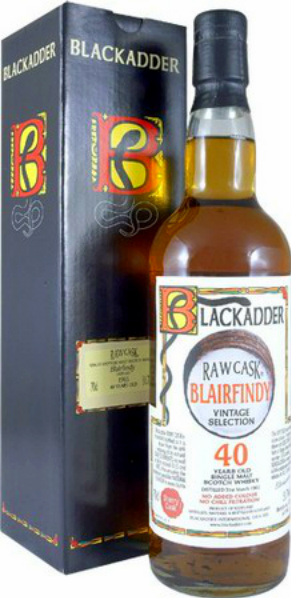
Color: Copper gold.

Nose: For me a typical perfumy Fino Sherry nose. Definitively a wine note up front, quickly chased by quite some wood. Toffee and caramel, with a hint of sweat (no typo). It gets more fresh after a while. Hints of car-wax and even later some black fruits. The smell of burning off dry leaves in the garden combined with a small hint of licorice. It all comes across a bit harsh, dry, dusty and powdery, but nice. I hope this doesn’t translate into the palate. Lets see…

Taste: Yes, not very sweet, but luckily not as woody and dry the nose suggested. Earwax and wood. Some drying tannins on the tongue, but hey, it was on a cask for forty years! The wood then becomes spicy. Although some people might consider this too dry, for me the wood isn’t that dominant. It is dry, but it definitely has a charm to it. Elegant stuff. No bitterness whatsoever. The finish is half long, and breaks down a bit into some sourness, toast and tar. The body is strong so it can take this sourness very well, and the light toast and tar add to the character of the Whisky.

Despite everything, this still is an easily drinkable Whisky. Great old Glenfarclas that fetch enormous amounts of money these days. Yes, the market is rapidly changing…

Points: 88

Tormore 14yo 1998/2013 (50%, Gordon & MacPhail, Exclusive for the Whisky Mercenary, First Fill Bourbon Barrel #1586, 277 bottles)

Easily the longest title for any of my blog posts. Finally summer is over, and the urge to drink some Whisky is back with a vengeance. Not that I’m happy about summer being over, especially when the last five years we hardly had a summer over here…

Next up to warm us up is a Gordon & MacPhail bottling of a 1998 Tormore, they bottled for The Whisky Mercenary a.k.a. Jürgen Vromans. Jürgen tries to pick some great casks for his own hobby-brand of Whiskies. Up ’till now Scottish and Irish products have been bottled under his own label. This time he picked a cask from Gordon & MacPhail. Gordon & MacPhail take their own casks to various distilleries and after they are filled, take them to their own warehouses for ageing. Gordon & MacPhail never sell a cask without it being bottled in one of their series.

Color: Light Gold

Nose: Floral, fresh and sweet, easily recognizable for a Tormore from a Bourbon Cask. They’re always a bit metallic, but in a way I like it. Just have a look here. It’s great to see, ehhh, smell the consistency, or distillery character. There are a lot of similarities between the Cadenhead 1984 and this 1998 Tormore. Nice balance between the sweetness of the nose and the wood spice from the cask. Quite perfumy, with a touch of smoke from the toasted cask, and floral (which is not soapy). Under this all some ginger and sugared yellow fruits, like dried apricots, which add to the complexity of the sweetness. This is how Tormore’s are and this is another fine example.

Taste: Less sweet than the nose let on to believe. Nice darkness with ginger, vanilla, paper and wood. The spiciness in combination with the brooding half-sweetness doesn’t let the finish become sour (from the oak). There is a fruitiness to it, and it seems to me to be from the black fruit department, blackberries? A little bit of mocha, toffee and/or unburnt caramel to round the Whisky off. Long nutty finish with a hint of mint. Pretty well-balanced stuff. I like it and I most definitely want it.

Nice Tormore by Gordon & MacPhail and for sure a great pick by Jürgen. A connoisseurs Whisky, otherwise Gordon & MacPhail wouldn’t have Jürgen take this away.  If you like the profile, this is a very nice Tormore, ánd I have to stress that I am a fan of whiskies @ 50% ABV. Excellent! I really love the Cadenhead but this is equally as good.

Points: 86

Santa Cristina Umbria IGT 2011

Somehow this is the end of some sort of trilogy. Earlier I reviewed a rosé and a red by Santa Cristina, and now here is a white, or Bianco. Way back in time I was told that Santa Cristina has a pretty good red in the shops, so I started buying some different vintages and was actually never disappointed. Much later I got hold of a rose wine by Santa Cristina and that one I didn’t like that much. Now here we have a chance to have a look at a white wine by Santa Cristina. By the way, this white wine is made with the Grechetto and Procanico grape varieties.

Color: Light White Wine.

Nose: Sweet and fresh, with hints of creamy and sugared apricots, but also hints of flowers. After the sweet apricot yoghurt I’m a bit struggling to get any more from this nose. The nose of this wine is appealing like a lemonade is, so probably a summery wine.

Taste: Very light, and not as sweet as I initially thought.Very anonymous. Slightly acidic and austere. Almost metallic. Actually this lacks a bit of sweetness to round the flavour out. Not very complex, which is no problem for a summery wine, but also lacks in the balance department, if you ask me.

For a light summery wine this could have been more appealing with some added sweetness. One-dimensional. Extremely simple wine. It does taste like a wine with an ABV of 12%, but when drunk like a lemonade, you will get a kick in the head, especially in the sun. Altogether not very interesting.

As said before, I was tipped some time ago about Santa Cristina wines (the reds). Now that I have tasted all three colours of Santa Cristina, I’m sticking to the reds. Santa Cristina red is good for pizza!

Points: 72

Longmorn 17yo 1996/2013 (57.5%, The Ultimate, Sherry Butt #72315, 606 bottles)

Suddenly this Longmorn appeared on the market. It’s color resembling Longmorns from the early seventies that were near perfect. This Ultimate bottling gained a very quick reputation of being a very good Sherried Longmorn. This sold out very quick, so Ultimate owners van Wees decided to bottle a second cask from this series: #72318, and is said to be even better than cask #72315. Alas Cask #72318 sold out rather quickly too, so Van Wees bottled a third one: #72319. That one should still be available, but already I heard a fourth cask is being bottled. If my information is correct there still are two casks left from this series, to make six in total. Let’s have a look at the series first one, cask #72315.

Color: Deep orange brown.

Nose: Raisins, musty and dusty. Typical Oloroso I would say, but it could also be a PX Cask. It smells very balanced and nice, no off notes whatsoever. Paper and some sawdust, and a little hint of lavender soap.

Taste: Thick sherry, almost syrupy, but again, only added bonuses, without any off notes. Spicy and there is some creamy wood, but nothing you would expect from a first fill Sherry bottling. Milk Chocolate, and some toasted wood. Very rounded out and easy even with its high strength. Never really harsh. Late in the finish an unexpected kind of acidity shows itself.

Overall the roundness and creaminess is great since a lot of those first fill bottlings can get woody and harsh, but this one is not. If there is a flaw than that’s the simplicity of it all. Is that a problem? It lack a bit in the complexity department is probably a better way to put it. Lovely stuff, taste, don’t analyze. A winner also due to the price of the Whisky. (around 60 Euro’s).

Points: 88

Antonin Rodet Chablis 2011

Two months ago I reviewed the first Chablis on these pages, and here is already the second one. Already, considering I mainly review Single Malt Whiskies that is.

Chablis is the northernmost part of the Burgundy Wine region. Chablis lies some 15 to 20 kilometres to the east of Auxerre. The Grand Crus all lie on one southwest facing slope just north of Chablis. The ‘terroir’ is clay with outcrops of the same chalk layer that runs from Sancerre to the White Cliffs of Dover. Chablis is made with Chardonnay Grapes and is famous for its clean, acidic, flinty and dry White Wines. Chablis Wines are more acidic due to the cool climate, compared to other Chardonnay growing regions. Not a lot of ageing in wood is done in Chablis, and this example I’m about to review has no wood ageing whatsoever.

The Chablis by Louis Moreau was pretty good, so let’s have a look, what Antonin Rodet did with his Chardonnay grapes.
Color: White Wine.

Nose: Sweet and fruity. Lychees and hints of peaches. Very fresh and lively. Wow, I always get happy smelling a white wine with a nose like this. It smells sweet and flinty. Chalk even. Also some floral notes like geraniums and it promises a nice acidity. Nice balance too. Very nice and typical Chablis nose. I like my Chardonnay. This nose, compared to the one by Louis Moreau, is cleaner, more elegant and lovely.

Taste: Zesty and acidic (Vitamin C). Very clean, fresh and likeable. I get the chalk from the nose again, but not a lot more. Not very complex, maybe even simple, but also without faults. Appetizing and easy drinkable.

As said above. The nose of Antonin Rodet is better than the one by Louis Moreau, but beauty is in the eye of the beholder, so it may depend on your mood, which one to choose. Taste wise I guess the Louis Moreau offering was a tad more interesting and had a finish with more meat on its bones, making that one slightly better in my opinion, but still, differences are small and I liked the Antonin Rodet Chablis a lot too. By the way the ABV is 12%.

Points: 84

Château La Clotte-Fontane Crémailh 2007

After quite some Beers, time for another Red Wine in what turns out to be my 250th post. I’ve noticed that a lot more Whites got a chance on these pages than reds. Yet after this Château La Clotte-Fontane the next Wine will probably be a White (again) from one of my favorite regions, but more about that later. Let’s not get ahead of ourselves and have a look at his Red Wine from Languedoc. Languedoc is a Wine region in the southernmost part of France. It probably is the region that is the fastest growing in popularity by improving itself annually. Not so long ago, it was probably known only by the vast amounts of Wine produced and not especially for its quality. But as said before, that is rapidly changing.

The domaine is situated near Salinelles, between Nimes and Montpellier and spreads over 130 ha and has two types of soils. One, on the sunny eastern side, contains large pebbles. The second is rather flat and is made up of clay and limestone.
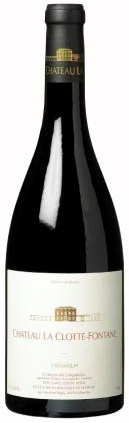
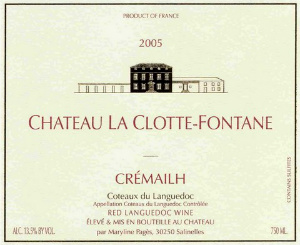
Château La Clotte-Fontane Cuvée Crémailh AOC Coteaux du Languedoc is a Red Wine with an ABV of 13.5%. It is made with two grape varieties: 60% Syrah and 40% Grenache. The Wine ages for 12 months in new French oak barrels in an underground cellar. Next to this Crémailh, the domaine also produces two other reds: Mouton La Clotte and Mathierou, but also one Rosé and one White.

Color: Intense deep red, almost black. Lets only sunlight through.

Nose: Deep and brooding, dry earth, from the clay and limestone soil. Quite modern, stylish. It presents itself as heavy, with its almost black color, but it really isn’t. Some hints of cacao and vanilla. Some fresh oak. It is almost like sharpening a pencil. The fruits are deep and sugared (not meaning sweet), plums come to mind, dried ones too. Excellent.

Taste: Full but not intense. It will probably accompany a red meat dinner perfectly, but drinking this on its own will most certainly do. Not heavy on the tannins, slightly acidic and warming. On the back of my tongue some hints of black pepper ánd clove, which gives the wine a nice ‘effect’. Fruits are more the usual reds: raspberry and essence of cherry.

After this Crémailh I’m definitively interested in the other two reds La Clotte-Fontane produces. This Crémailh is very tasty and well made. The added bonus is in the complexity (not overly complex, but there is a lot happening here) and the detail of the wine. Well done. Drink it now, it’s at it best.

Points: 87

Grimbergen Goud 8º (8%, 33 cl)

Grimbergen Goud 8º, together with Grimbergen Optimo Bruno are the specialities in the range of Grimbergen Beers. The other beers in the Grimbergen range are the usual suspects in Abbey Beers: Blond, Dubbel & Tripel. Recently I already reviewed Grimbergen Optimo Bruno, so I’m happy to review this Grimbergen Goud 8º to complete (already) the Grimbergen Specialties. Goud 8º is a strong Blonde Beer that has an additional fermentation in the bottle, also some aromatic hops are used.
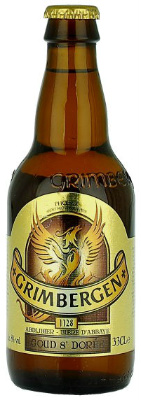
Color: Orange Gold with light yellow to white foam.
Nose: Light and fresh. Yeast, as in white bread. The nose has a summery feel to it. Also some hops, but not a lot. Dust and unlit cigarette tobacco.

Taste: Well, this tastes like a Tripel really. Fresh with slightly warming alcohol. Nice and unpretentious. Hints of esters, dried apricots and orange skin. It’s a bit of a shame, this does not continue into the finish. The finish itself is a bit sour and light. This does have a small hint of cannabis on the taste though! Although the brand is owned by Heineken, the beer does not come from Amsterdam. It is unknown how the Cannabis got into the mix 😉

Not a lot to add about this Grimbergen really. It’s not bad at all. A nice beer to drink outside or by the waterside and see people go by and enjoy. Nice Belgian Beer.

Points: 82

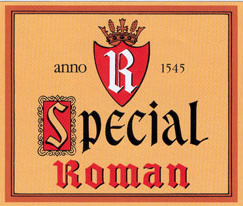
Special Roman (5.5%, 25 cl)

Special Roman is made by Brouwerij Roman from Mater, Belgium. Mater is in the Oudenaarde municipality, a region where Flemish Brown Beer is made. Brouwerij Roman was founded in 1545 as a farm brewery and inn, and has an impressive portfolio of beers. Amongst others the Ename Abbey Beers are made here as well as Sloeber and the Adriaen Brouwer Beers. In the list of products Special Roman is absent, but the page about Special Roman does still exist. Maybe it’s discontinued?

Color: Dark Brown, coffee-colored foam.

Nose: Murky, dark but also fresh. Candied Sugar, putty and hints of acidity.

Taste: Candied Sugar and unexpectedly only lightly acidic. Maybe some acidity fell victim to the additional ageing? Likeable. Malty (roasted) and hints of burnt sugar. Definitively some hops are in the mix. Not a lot of yeast is noticeable. It seems light and the finish is short. Nice stuff nevertheless. Elegant and perfumy and half-sweet. The sweetness isn’t dominant at all.

This beer is less acidic than other Flemish Brown Beers due to the use of hops. It is a top fermenting beer, and this example was aged 10 months past it’s best before date, and it aged well. 8ºC is the advised drinking temperature.

Points: 83

Grottenbier Bruin (6.5%, 33 cl)

Pierre CelisThere are a few “rock-stars” amongst the Belgian brewers and one of them surely is Pierre Celis, who unfortunately is no longer with us (1925-2011). Pierre Celis was born and lived in Hoegaarden, famous for its white beer. As Pierre saw the his beloved white beer disappear in 1955, he decided in 1966, to remake the white beer under his own name. His uninsured brewery burned down in 1980, after which he reopened his brewery in Austin, Texas, USA.

GrottenbierAfter he sold his brewery to the Michigan Brewing Company, Pierre returned to Belgium to add a new notch on his stick. He developed a dark Belgian Beer to age in caves. Grottenbier roughly translates into Cave-Beer. Pierre favored caves for their constant temperature in which the beer could mature. At first the caves of Folx-les-Caves were used, but soon the Enterprise was transferred to the marl-caves of Kanne.

Since 2001 the beer is made by the St. Bernardus brewery (in Watou, Belgium). The beer is then cave-aged 42 meters under the ground, at a constant temperature of 11ºC. The bottles are regularly rotated, the same as Champagne.

Color: Orange-brown.

Nose: Fresh and acidic. Citrussy, yeast and hops. Caramel and some kind spice. But then dish water, with some added lavender. Quite strange if I may say so.

Taste: Vitamin C. Some lemon a pretty acidic. Little hints of burnt Sugar, that makes the beer quite bitter. Leafy. lacks balance. Not soapy on the palate, but it has soapy texture. Leaves quite a sour and stale impression. The warmer the beer gets, the more bitter it grows, and less entertaining it becomes.

It is something in between. It’s quite bitter and it has Lambic like acidity. I feel this beer doesn’t quite know what it is. It has the refreshing acidity, but also some burnt Sugar bitterness and hops. Don’t drink this too cold. 10ºC and up. It gives off more aromatics and shows more character. It ages well (I aged this for an additional 10 months), but this beer just isn’t for me. Still I do recognize this is a beer of quality.

Points: 75