Glenkinchie can be good, but despite the efforts of the proud people working there, Glenkinchie will always be known as the distillery that Diageo saved by adding it in the Classic Malts range and thereby closing Rosebank.
 Earlier I reviewed a Single Cask Glenkinchie bottled by Signatory Vintage and that was pretty good! This time around let’s see how the entry-level 12yo bottled by the owners will do. This 12yo replaces the 10yo that was available earlier.
Color: Gold.
Nose: Malty and quite big. Should that be surprising for a Lowlander? Guess not, since the Glenkinchie mentioned above was quite big too. Cardboard and vanilla ice-cream. It may be simple, but it smells quite nice. Sour spices. A strange kind of sawdust vanilla. Also some thick sugary yellow fruit sensation. Passion fruit. Weak peppermint candy and a slight hint of plastic.
Taste: Sweet wood and a hint of urine. Beer and wood. A drop of liquorice water on cardboard. The beer is there in the finish too. Not a very strong finish. A bit anonymous actually and very simple and subdued. Luckily the initial taste is good.
Hmmm I wouldn’t choose this as my daily drinker, but it does show you what Glenkinchie can be. It does have potential, but it barely shows itself in this one. It’s decent and dirt cheap, but it’s a silent partner, it doesn’t say much (to me). There was also a Cask Strength version made for the Friends of the Classic Malts and that one was very good. One problem only. That version is four times the price of this Glenkinchie, and that’s a bit of a shame really.
Points: 83
 A week ago “Het Genietschap” had its first ever tasting at my house. I’ve been a member for quite some time, but it took a while to get my ‘location’ added to the agenda. Well finally it was my turn. The organizer gets to choose a ‘theme’, and mine was “Talisker”. When I sent out the E-mail I got a lot of Talisker 10’s as entries, and even some replies implying that there wasn’t a Talisker in the house. Well that got me worried for a moment. My guest of the evening, Erik, asked if he could bring his
  Best bottle in the tasting was a young Port Ellen 15yo bottled by Cadenheads in 1996, Stunning! It was just a tiny bit better, or better: different, than the also stunning Talisker 20yo 1981/2002 (62%, OB, Sherry, 9000 bottles). Also the pre Classic Malts Talisker 10yo was fabulous. Even today’s 10yo is pretty good, but can’t be compared to the taste of the old bottle. This ‘Tactical’ wasn’t bad either…
 Why not try another Balmenach. Earlier I tried a
  I used to drink a lot of reds and for the last six years or so I love to drink a lot of whites. Alsace was probably what set that off. But as you might have guessed, being the frequent reader you are, I drink foremost Scottish Single Malts nowadays. But it’s not all Scotch that lights our world, so I’ll definitely have to try some different things here too. This time the first red wine on Master Quill.
 Haut-Médoc is the large southern part of the Médoc district of Bordeaux in the south-west of France. The famous wines from this region are Margaux, Pauillac, Saint-Estephe and Saint-Julien. You might have heard of those.
 Here’s an appeal to all. Start drinking Sherry. NOW! Because it may be too late already. Let’s face it people. We love our whisky and we particularly love it when it’s from a good Sherry Cask. But as can be seen, prices are soaring when a nice sherry casked whisky is released these days. I’ll be reviewing some Pedro Ximenez (PX) Sherries the following days, but there is a lot more out there. You might want to try a nice Oloroso (maybe the best performing casks for whisky).
 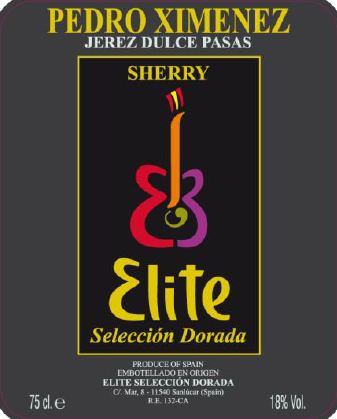 Some of you might like a dry Fino. But there is a lot out there, and a lot of differences in quality too. One thing is sure, when trying out some nice Sherries you won’t break the bank.
 Burned creamy sugar as in the top layer of Creme Brulée. The acidity is a very nice addition to the taste of this PX. It doesn’t seem to be as sweet as the competition, and it is certainly not as thick. The finish therefore, is not the longest in the business.
 Hello November! Looking outside, this month seems to bring us damn close to winter. Here we have a bottle of Brora 1981 bottled by indie bottlers Ian Macleod in their Dun Bheagan range. Ian MacLeod have a few other brands you might know. The Chieftains Range or “As we get it” for instance. The company is also the owner of the Glengoyne distillery, which is one of my favourites. Go!
 Color: Orangey Gold
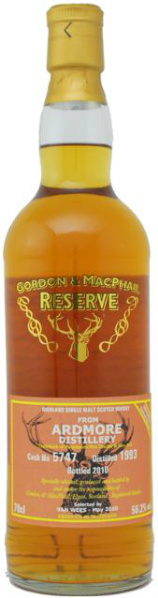 Let’s do another Ardmore and compare it to the day before yesterday’s offering by The Whiskyman. We all know that 1992 is somewhat of a good vintage for Ardmore. So let’s see what happened in the distillery a year later. This 1993 was bottled by Gordon & MacPhail and they were so kind to do that for Van Wees of The Netherlands.
 Dominiek Bouckaert is known for being the billionth ICT guy that does something in whisky. When I started with whisky I was an ICT guy myself and of course was introduced to the stuff by another ICT guy. In fact I was introduced to Whisky by two of them. One was partial to Laphroaig (eventually my first self bought Single Malt), and the other was more into Talisker (I’m something of a Talisker-collector now).
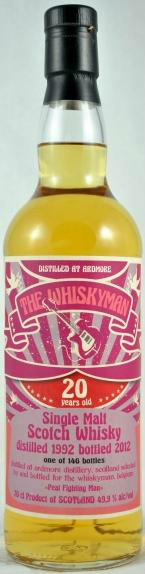 Besides ICT, Dominiek took it upon himself to dabble a bit with distribution of the Malts of Scotland (A german bottler) and play a bit with Luc Timmermans doing their Hand Written Labels. and last but not least, Dominiek has his own label now. The Whiskyman. Nice psychedelic colorful labels with a wink, wink, nudge, nudge to music. Beatles and Stones to start with, and this is an example of the latter called peat fighting man.
 Ahhh, yes, Gordon & MacPhail never cease to amaze me! Next up is this Glencraig 1970/1996 (40%, G&M, Connoisseurs Choice, Map Label, IF/CCC), but now it turns out that the exact same bottle with the exact same code (IF/CCC) was also released with the Old Map label too. Why? Can we conclude from this that 1996 was the year the labels got changed?
 Color: Full Gold
 Color: Full Gold
 Master Quill