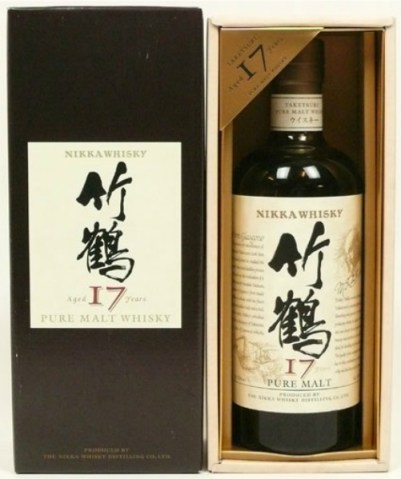
Japanese Whisky Week – Day 3: Miyagikyo 15yo (45%, Nikka)

Next up in our Japanese Whisky Week is one of the two components of the previously reviewed Taketsuru Pure malts. Miyagikyo. Miyagikyo was built by Masataka Taketsuru in 1969. Miyagikyo is also known as the Sendai Distillery and is located in northern Honshu. Quite close to the Fukushima nuclear power plant (30 minutes by car).

Equipped with only one pair of stills in 1969, a second and third pair were installed just six years later. All stills are steam-heated. Miyagikyo also has Coffee stills that were moved here from Nishinomiya distillery in 1999. With these stills Nikka Coffee Malt is made. The coffee malt is made with 100% malted barley.

Color: Orange gold.

Nose: Fat, muddy, spicier than Taketsuru. Very nice smoke. Meatier too. Almonds, vanilla ice cream, fern and sherry. Perfumy wood. Balanced and clean. Elegant with the spice coming late. Complex and balanced. There’s more to it…

Taste: Thick. Sweet clay. Sherry and it has substance. Vanilla ice cream. Spicy wood. It’s quite woody. Green, cardboardy but still great altogether. (I have to say the nose was slightly better).

I’m a big fan of Miyagikyo. Every time I taste one of its expressions it always ticks all of my boxes. It just clicks with me. Even this ‘standard’, large batch and reduced whisky. This is great stuff! Even though I scored this the same as Taketsuru 21yo. Both do deserve the same score. But if asked to choose, I would choose this. It has just two more points in ABV, and it shows (a little), but I still feel that Japanese whiskies are at their best at cask strength. We should find out if that’s true…

Points: 87

Japanese Whisky Week – Day 2: Taketsuru 21yo (43%, Nikka)

Moving on into day two of this Japanese Whisky Week. The next one might not come as a complete surprise, because this time we’ll have a look at the elderly brother of Taketsuru 17yo, namely Taketsuru 21yo. Did they make this just an older version of the 17yo or did they do a completely different profile for this one? If you want to warm up to Taketsuru 21yo, please have a look at the review of Taketsuru 17yo.

Color: Full gold, almost copper.

Nose: Ahhh, this is more. Clay and musty, wow! Gravy laden with almonds. Dirty and fruity. Not überfruity but there are some hints of yellow and red fruits in here. Also some peat (Yoichi) and oak. More sherry casks I would guess. Nice!

Taste: Sweet with sherry. Slightly winy even, yet warming. Cannabis and clay. Gravy. Again this one is too low in ABV. Still I’m having a lot of fun with this one. Malty, honest and it has a bit of a beer like finish.

It’s slightly different, but easily from the same family. It just has more of everything and for me a shift into more clay like sherried malt. For me a no brainer if you have to choose between the 17yo and the 21yo. This has more character to it. Just beware, this one suffers from even more batch variation than it’s 17yo brother.

Points: 87

Japanese Whisky Week – Day 1: Taketsuru 17yo (43%, Nikka)

In june I did my first ‘week’, called the Bourbon Week. Lot’s of Bourbons yes, but not all were actually Bourbons. I threw in the odd Rye as well. After the success of that week, and I have to admit, the fun I had by doing such a ‘week’, I thought it was time to do another week. So here is the first day of the Japanese Whisky Week! Again I’ll try to review seven Whiskies in seven days, and this time they are all from Japan. I thought that Japan was untill now a bit underexposed on Master Quill’s pages having reviewed none! But that’s about to change…

In 1918 one Masataka Taketsuru went to Scotland to learn the whisky trade at Longmorn, Ben Nevis and Hazelburn distilleries. During this time he met his soon to be wife Rita, and both returned to Japan. There Taketsuru founded Nikka with the building of Yoichi Distillery on Hokkaido Island in 1934.

Yoichi was built on the north island of Hokkaido considered by Taketsuru to be close to the natural environment of Scotland. Also copied was the way of distilling, two times in copper pot stills. In contrast to their Scottish counterparts is the use of new wood and slow-growing Japanese oak.

A lot of years later the Nikka company named a small series of pure malts after it’s founder. The series comprises of a 12yo, a 17yo and a 21yo. All Pure Malts are made up of only two components. Yoichi and Miyagikyo. The latter was founded in 1969 in Honshu. Both singles are great, so this Taketsuru should be no lemon.

Color: Full Gold (slightly pink).

Nose: Musty gravy. Nice slightly burnt wood. Sweetish fruits with pineapple. Sweat ánd men’s cologne. Powdery, almost like sawdust. Greenish. It smells a bit like those hard candies made out of fruity powder pressed into little pills. Sometimes a whiff of soap. All in all, very nice.
Taste: Spicy esters. Toast and a hint of tar. Tastes a bit dirty actually. Grainy with vanilla ice cream. Reminds me a bit of vodka. Greenish hints here too. Definitively not as sweet as the nose predicted. Half long sour wood finish which is a bit unbalanced. The toast and tar stay on for the, therefore bitter, finish. Alas too low in ABV.

Although this is quite a nice Pure Malt, for the money you can get a Yoichi or a Miyagikyo, that are (marginally) better. Still I do like this Taketsuru, and combining the two is an experience of its own. Just beware, because there is talk about batch variations.

Points: 85

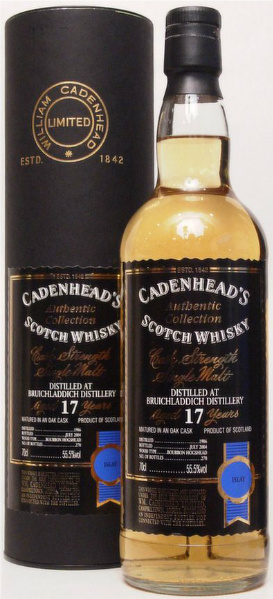
Bruichladdich 17yo 1986/2004 (55.5%, Cadenhead, Bourbon Hogshead, 270 bottles)

This Bruichladdich was my entry for the September Genietschap session. I bought this some time ago after a tasting and rather liked it then. At the Genietschap this bottle actually didn’t do so well at our Bruichladdich tasting (we tasted it outside). It was compared to another Cadenhead Bruichladdich that was from a Bourbon Hoggie as well. Also from 1986 but several years younger, a 13yo to be precise. Even though it was younger, this bottle showed more character to it. The 13yo was almost empty and maybe these Bruichladdich’s need a lot of air. Let’s have a look in my controlled environment and using my glass of choice, how this Bruichladdich really is. (This bottle, just open).

Color: White wine.

Nose: Sweet and grassy. Butter and green malts. Little hint of oak. Clean. Crushed bugs with dry black tea. Even though it’s from a Bourbon hoggie, it does have some characteristics of a Fino Sherry cask. Lemons (as in lemonade) with a hint of smoke. Not a lot of evolution in the nose. Rather easy and simple. Unoffending.

Taste: Sweet. Licorice (as in the twigs you can chew, probably something we only have here in The Netherlands). Spices from the oak. Ear wax. Green and beer like. Great half-long finish though, where the finish tends to turn sour, but luckily it doesn’t.

This may not be very complex, but it does have nice balance, and I do still like it. Still I can understand why it didn’t do well. It may be simple, and maybe a bit of a whisky lemonade. Very easy drinkable.

Points: 85

Bruichladdich 13yo 1986/2000 (57.9%, Bourbon Hogshead, Cadenhead, 270 bottles), scored 86 points

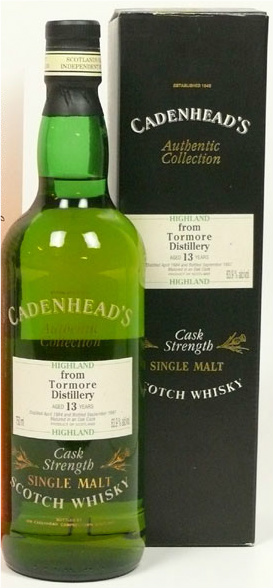
Tormore 13yo 1984/1997 (63.9%, Cadenhead, 750 ml)

The other day, I reviewed a reduced Tormore by indie bottlers Mo Ór, that I called feminine. It was Floral and fruity, very easy accessible. I said other Tormores were more metallic and industrial. Luckily Master Quill has a vault where a whisky archive is kept, so I was able to find a Tormore fit for comparison. Here we’ll have a look at this Tormore bottled by Cadenhead. This particular offering was bottled for the good people of the U.S. of A. Hence the 750 ml bottle from 1997. 1997, that means this Tormore was bottled around the time previous reviewed Tormore was distilled (1996). Both Tormore’s are about the same age too. Let’s see if thís Tormore is any feminine.
Color: White wine.

Nose: Well this does start floral again. How consistent, but soon caramel and wood and yes, a metallic touch. Clean and very toffee like. Compared to the Mo Ór this isn’t all that fruity. Dry. Still very floral and sweaty maybe. Great stuff.

Taste: Well strong, it’s almost 64% ABV. Half-sweet, and the metallic part returns. Still that’s no bad thing here. Lots of caramel and toffee notes. This finishes a bit sour, from the oak, but no big problems here. Otherwise quite un-complex.

Tormore’s are definitively the odd ones out. Rather unpopular and who is surprised when you taste the official 12yo. But when you get your hands on a clean ex bourbon cask at cask strength, you might be in for a pleasant surprise. Even though they may not be the high scoring Whiskies, they do have something in them I particularly like. There’s a potential here that isn’t used. The stills have purifiers on them, that makes the spirit very clean. Most of the Tormore spirit is put in Refill Bourbon barrels and hogshead and most of it doesn’t even age on site. So you’re bound to have something ultra clean.

Still I consider myself lucky I got my hands on a second bottle of this. Great stuff.

Points: 86

Tormore 14yo 1996/2011 (46%, Mo Òr, Bourbon Hogshead #6868, 500 bottles, 500 ml)

Tormore. One of those distilleries, you don’t hear about too much. Tormore was founded in 1958 by Long John International, and distilling started in 1960. It was the first distillery that was built after the Pattison crash of 1898, and thus the first to be built in the 20th century. Today Pernod Ricard is the owner of Tormore and is already the fourth owner in its short history. Tormore was originally built with 4 stills and in 1972 that amount was doubled. In 1984 the heating system for the stills was converted, so that it could be heated with… woodchips to heat the stills. Officially only a 10yo was released, later replaced by the current 12yo. For a short while also a 5yo and a 15yo existed. So mostly independent bottlers issue Tormore Single Malt today. Still, over the years not a lot was issued this way, nor does it usually score very high. I guess it’s time to have a look into Tormore. First a Tormore bottled by Dutch bottlers Mo Òr, who’s Macduff and Miltonduff started this blog to boot.

Color: White wine

Nose: Nutty and soapy. Smells very floral. Fresh and exuberant. Sour spring fruits. Creamy and a bit sweaty as well. Toffee. I can imagine why they bought this cask. It seems to me this is a happy and positive Whisky. Absolutely a young Whisky. Very likable. Maybe they should sell this in a spray as an eau de toilette.

Taste: Creamy and nutty. Very simple and seems younger than it actually is. Again very likeable and sweet. Vanilla ice cream and some caramel, and mint. No extremes in this. Hardly any wood. There is some wood noticeable in the finish. Hints of Belgian beer in the finish. Hops. Given some time in the glass, some spiciness does come through. Short finish though.

There seems to be a nice and unpretending balance to this. For me it’s very feminine. It’s easy and has a lot of fruits and flowers going on. Not a typical Tormore though, it doesn’t resemble the other Tormore’s I know, which were more industrial, or even metallic. This is nothing like that, this is organic summer garden. Biological Whisky maybe? Give it some time to breathe, it will enhance the character a little, by shedding its initial sourness.

Points: 83

Thanks go out to Henk for handing me this sample.

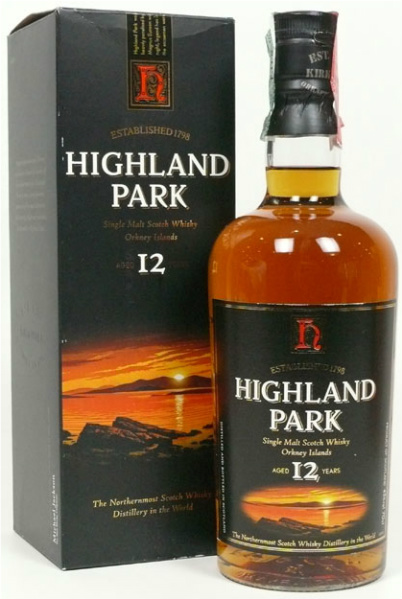
Highland Park 12yo (43%, OB, Circa 2003)

Remember this one? Before this came the nice broad-shouldered bottle with the big knob cork. And somehow they changed it into this. We hated the looks of it back then, but looking at it today it doesn’t look that bad. Well this version of the bottle is also no more and again they changed the looks completely into something that looks oval from above.

For me the ditching of the wide neck bottle also seemed to be the ditching of the plain old good quality. With this bottle came the downfall of the standard Highland Parks. The 12yo, the 18yo and all the others that came after that. A lot of single cask versions were released around that time, so we all can take a guess why the standards got pretty weak don’t we? Well let’s have a look back and see if this was any good.

Color: Slightly Orange Gold (Caramel)

Nose: The obvious heather and honey. Nicely floral. Almonds. Quite sweet (sherried) and nice balance. Sometimes dusty and powdery. Nice balance, still a good recognizable Highland Park. Lovely.

Taste: Sweet, nutty, slightly sour, chewy, with small hints of smoke and tar. Yeah, this still is very good whisky. Creamy mocha, green apple and a little bit of wood. Alas it breaks down a bit in the end, and the finish is a bit weak. Gone quickly. That’s a shame, but I’m happy it still is a Highland Park, and taste wise that’s very good news. Still if you want an even better one, have a go at a wide neck bottle. Still a lot of those around.

I’ve already claimed this isn’t as good as it once was. Actually compared to a lot of official bottlings they are churning out today, this was pretty good, but still the downfall is marked. This one got weak in the finish and later releases also suffered in the taste department. This brings tears to my eyes because Highland Park used to be fabulous, please come back!

Points: 85

Tongerlo Tripel (8%, 33 cl)

The last reviewed beer, Westmalle, was a Trappist beer. This Tongerlo is an example of an ‘Abdijbier’ or Abbey beer. Thus linked to a monastery, yet commercially brewed by Haacht. So no Authentic Trappist Product then, but still a beer in the same style. But hey, this beer has an official hallmark too. It’s a “recognized Belgian abbey beer”.

It turns out this hallmark is issued by the union of Belgian brewers and it seems there are some rules. The hallmark was issued for the first time in 1999 and the rules are slightly different for Abbey beers from before that time, and those that applied afterwards. Some rules are pretty obvious. There are more rules but here are a few: There has to be a link with an Abbey. Part of the proceeds must go to this Abbey and the beer has to be brewed there before (history taken in to account). In this case we are talking about the “Norbertijnen abdij” from 1133! Well my kind of marketing I guess.

Before we move on I (again) have to say that my beer is aged a little and has a best before date of 27/5/10. But this bottle can lie in your cellar much longer.

Color: Clowdy gold.

Nose: Fresh, lemons and oranges. Sour fresh. Not a lot of depot, only some hints of yeast. Still this has undergone a third fermentation stage inside the bottle.

Taste: Oranges and medium bitter. Despite the elevated bitterness also a very nice and fresh and sour note, that makes this extremely drinkable. Appetizingly fruity and it doesn’t even seem to be 8% ABV. Slightly sweet with hints of banana.

A very good beer. I like it a lot. Extremely drinkable Tripel with a very good balance. I would like to have another one please?

Points: 87

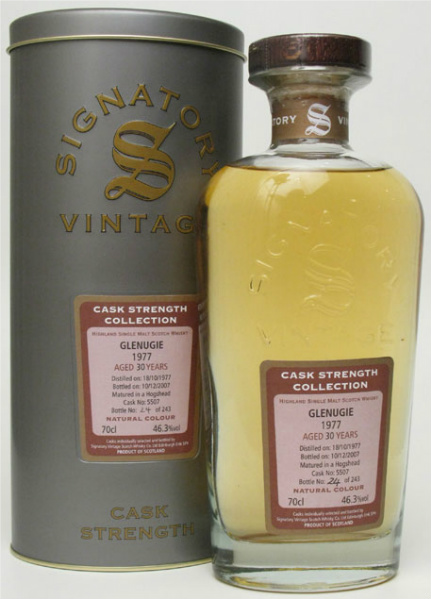
Glenugie 30yo 1977/2007 (46.3%, Signatory Vintage, Hogshead #5507, 243 bottles)

Yes, it’s a Glenugie. long time overlooked and very popular the last few years. It’s a closed distillery (1983) and quite popular with whisky aficionado’s. Just as is the case with Banff today, connoisseurs discovered a closed distillery that has a special quality to it. I have to admit that all of the Glenugies I tasted scored at least 85 points and most well higher than that. Only one is lower than that. I scored the sister cask #5506, also by Signatory Vintage, only 81 points. So let’s have a look if all those 55xx casks are the same and if this one’s any better.

Color: White wine.

Nose: Estery and fresh. Green apple skin. Grainy and a slight hint of vanilla. You could have fooled me with the age of this one. Seems much younger and cleaner, than I would have expected, knowing what this is. There is also a hint of cask toast and wood. Sweet and fruity, peaches on syrup. Creamy toffee with a hint of coconut. I like the nose, it’s like candy. Great balance.

Taste: Sweet like sugar, icing. Vanilla, no wood whatsoever, not at first anyway. It has some spice from the wood. Apples, without the bitterness from the skin. Finish isn’t too long, and just a tad sour. The wood does show its face, late in the finish. Good drinking strength with enough oomph. Again, it seems much younger. The balance in the taste is also somewhat weaker than the very nice fruity nose.

It’s nice and likeable. Nice piece of history. Just not a lot happened in all those years. For me it’s better than it’s sister cask, but still no high flier. You’ll really have to be a buff to recognize the markers of an old Glenugie. But isn’t beauty in the details?

Points: 84

Thanks go out to Nico again for handing me this sample.

Hoyo de Monterrey Le Hoyo du Maire

It’s a rainy day today, grey and bleak  and I am a little bit under the weather too. Luckily I have some notes lying around I can work with. Otherwise not actually a nice day to go out and have a smoke. But a nice day to put some Art Blakey on. I have A Night in Tunesia & Moanin’ to warm me up and write something about Le Hoyo du Maire.

Compared to the picture below, my Hoyo du Maire is much older. Just have a look below at the ancient box code. Mine is without band. Bands on the Hoyo du Maire were placed somewhere around 2005. Another difference that is very obvious is that my Hoyo du Maire is a lot darker than this one and looks less rustic. It looks a lot smoother. Another thing you don’t get from the picture below is how small it really is. For me it’s almost cigarette-size, and you will never believe how small the wooden box with 25 cigars is. It’s unbelievably cute! Today it comes in Sliding Lid Boxes (SLB’s) with 25 or 50 cigars or in cardboard pack’s with 5 cigars.

Hoyo de Monterrey Le Hoyo du Maire (30 x 100mm, Entreacto, Small Panatela, Box code FR NNSR)
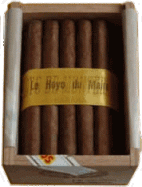
Color & Looks: Maduro and looks very elegant and well-built. Oily.

A cru: Mocha, dry and chocolaty. Hints of paper and altogether mild.

Taste: Oily wrapper and salty on the lips. Just lit and it tastes immediately great. Very woody, but a great overall taste. The wood becomes a little bit sour but the cigar still has good balance. The draw and the smoke are good. It’s a sour-woody and spicy cigar. Ash is light grey with some whites. As often, ash has tiny white spots. It’s very thin so it is stronger than your usual Hoyo. A cigar to ‘sip’, otherwise it will burn too hot. Sometimes you do get small whiffs of…fireworks. The development is linear, still it does have a lot of character for such a small cigar. The draw diminished in the second half, but rolling it between my fingers solved this minor problem.

I don’t know how newer versions hold up to this, since this is really well aged. I can’t tell you what ageing did for this cigar untill I can taste a new one. I don’t think such a small cigar will have to age for a long time, to get to a decent level. In the end it seems somewhat stronger than Hoyo’s usually are, but this is never overpowering. Ideal very short smoke.

Points: 77