Cragganmore is next. This one was cracked open on the last day of 2012. First of all some funny business about this one. When we opened it late at night (with artificial light) it seemed red, just like a lemonade. Second it smelled like a lemonade too, very sour. It started out as a Bourbon smell. The taste was even worse, ultimate sourness. Erik, it’s owner was already on his way to pour this one into the sink. I didn’t like it either that evening. Luckily I was able to save it and take it home with me. T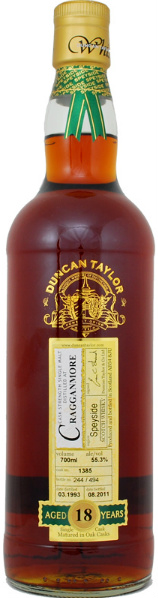 oday I have the chance to give this another go. First of all, I can look at this by daylight and I can’t see the red lemonade anymore. It has this orange brown color most Bourbons have.
Color: Orange Brown.
Nose: Lots of wood and some acetone. Perfumy varnished wood and spicy. Seems dry. Dark chocolate and toffee. The whole should smell like a Sherry bomb, but actually this smells like a Rye Whiskey. As much as I didn’t like this last year, it’s great now. What have I done then to ruin my palate that much? After some airing, the sherry notes trickle through, as do the vanilla and fresh, somewhat soapy notes. It’s pretty good! Wow, what an experience.
Taste: Thick, sweet Sherry and wood. Dark oaky chocolate. Its great. It’s the wood without the bitterness and it’s not overly dry. Just right. Utter balance. What nice stuff. Old fatty smoke, coal fire. Near the end, and into the slightly bitter and woody finish, some small hints of red and black fruits, accompany the coal and maybe a hint of a well-known brown soft-drink to make this a special dram.
Well, that’s why on the last day of the year I do not bring my little black note-book with me. Strange things can happen, and now I have the proof to show it. This Cragganmore is excellent Whisky, or Whiskey, or Rhum or Bourbon…no doubt about it? Thumbs up!
Points: 90
Thanx Erik for the sample!
 Next up Glen Scotia, also a first on these pages. Glen Scotia hails from Campbeltown, once a big place for whisky with regional status (again). Try to imagine a place that has almost 30 distilleries working at one time in the 19th Century. Not so long ago this Glen Scotia was the ‘other one’ from Campbeltown after the well-known Springbank. Today Springbank makes also Longrow and Hazelburn. And from the same owners the recent ‘addition’ that is Glengyle Distillery (Kilkerran). Let’s say that Glen Scotia is the only Campbeltown distillery not owned by the people of Springbank. Owner today is Loch Lomond Distillery Co. and the place is fairly run down. When the distillery was mothballed in 1994, the staff of Springbank restarted intermittent production in 1999, not to lose the regional status of Campbeltown. A status lost eventually, but eventually reinstated.
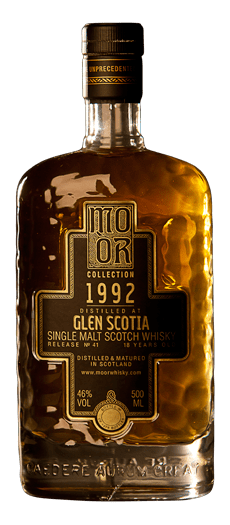 The distillery was founded in 1832 by the Galbraith family. For one reason or another the label on the bottles state 1835. Lots of changes of ownership during the years and even some closures in 1928 and 1984. Since 2000 Loch Lomond has taken over Glen Scotia and runs the distillery with its own staff.
 I was asked to keep an eye out for sulphur in this one. It’s there slightly on the nose (as a burning match). But it is more pronounced on the palate (the bite here comes not only from the wood, but also from the sulphur. Usually there is some sulphur in Sherried Glen Scotia’s. Lots of it in a 1991 Cadenheads offering if I remember correctly. It’s there on the palate and even more so in the finish (late). Is it ruining the balance or the palate? Does it disturb me? No, it’s some kind of good sulphur. it’s somewhat hidden. It’s there but not in the usual obvious way. That happens sometime, that’s why I called it good sulphur. Still, overall there isn’t a lot of sulphur in this one, so don’t worry. And hey, sulphur is good for the skin!
 Well living in the low-countries and doing a Auchentoshan review without pointing at the site of the A toshan man is impossible. So
  For now I will do a short intro to Auchentoshan. officially the first word of Auchentoshan is in 1823 when a guy named Thorne got a licence. But there is reason to believe that Auchentoshan started in 1800 named Duntocher. In the past the Germans didn’t like Auchentoshan too much and bombed the place already in 1941. Smart as the Scottish are they waited for the end of the war, rebuilding Auchentoshan. Just to be sure, they started rebuilding in 1948. In 1984 Stanley P. Morrison buys the place and sells his own company to Suntory ten years later. In 2008 Morrison Bowmore starts with the new packaging we know today. But first this expression by indie bottlers The Cooper’s Choice (actually The Vintage Malt Whisky Co. Ltd.) The people behind Finlaggan.
 Founded in the year of the Pattison crash 1898 and located on the outskirts of the ancient market town of Forres. Mothballed between 1931-1937 and 1983-1998. Since 1993 the distillery is owned by Gordon & MacPhail. Yes, the bottlers. The first Benromach that was released and made by the new owners is Benromach Traditional, that was released in 2004. The year they started with the new look and bottles in tin tubes we know today. During the G&M years more and more new released see the light of day. Today the distillery is known to be Speyside smallest working distillery and is operated by just two people…
 Master Quill