Here we have a rather “young” Linlithgow, a.k.a. St. Magdalene. I really, really loved the extremely layered St. Magdalene 19yo, that was released three years prior to this one, so when this came out in 2001, I snapped up a few, expecting a similar experience to the one year older and cask strength expression mentioned above. Hey it was reduced a bit, and only one year older, so it could happen, and it was half the price of the 19yo! At the time, Whiskies from the Vintage Collection were never expensive, as was the case with this one. They sold this at the price of what a Springbank 10yo sells for today. Remember, even in 2001 this was already a closed distillery, so go figure. It was a different Whisky world back then. If I look around the net today retail price for this one is £699,-, and if you read this in 2025 it will probably be even higher, or have we all moved on to something else? If that is the case, why are you even reading about an old Whisky nobody cares for anymore?
 Color: Pale gold, straw.
Nose: Extremely malty. hints of sugar-water and ear wax. Fruity and grassy. A Lowlander alright. A breath of fresh air. Toned down, almost shy, but don’t think this is light, because it’s not. It shows quite some aroma. The quiet (big) guy in your class, but you already know there is more to it than meets the nose. Yellow fruits and whiffs of American oak, It is definitely something from the past. Somehow Whiskies today aren’t like this anymore. Its like sitting alone in a field, middle of summer, nothing more than crickets and almost inaudible distant sounds of the rest of the world. Life is beautiful. Hints of cold butter and hay. Warm wood and a bit of old vanilla. Definitely not as multi-layered as the Rare Malts bottling mentioned above, and it hasn’t its evolution either. This is more straightforward and shy (again). Perfectly balanced nose. It got plenty of time to breathe and it can handle the air. No worries then of oxidation. By the nose alone another great example of the variety of St. Magdalene. Closing this distillery is a real loss, and this one is not coming back, so what you are holding in your glass is a piece of history, hence the hefty price-tag.
Taste: Sweet on entry. Malty, barley sugar. Slightly warming. Paper and cardboard. Creamy, with toffee on entry but it gets thinner towards the finish. Lots of fruits emerging at different moment when you keep it in your mouth, making for a sweetish, fruity, friendly Whisky. Only a slight bitterness reminiscent of toasted wood emerges. Less “big” than the nose suggested. In comparison to other Whiskies from this distillery, this might be a rather simple expression, (is it?), but still it oozes something special. Memories of black coal, and motor oil. If so, this can only have trace amounts noticeable, because in essence it is a sweet fruity Whisky. Simple, maybe, but it rewards you with aroma’s from the past, coming from a distillery like no other. Near the end of the body a somewhat burnt note emerges, burnt wood, hot machine (oil). Very nice industrial edge after the friendly fruitiness.
I spent a lot of time with this Whisky over the years, and I remember, when freshly opened, it showed a lot more of the waxy notes and even quite some bitterness. So don’t be afraid of oxidation, even when this is a reduced Whisky, because it will only get better. In the end it turns out much better than I have always thought it was…
Points: 86
 For those of you who didn’t know already, there have been some changes within Douglas Laing company. Brothers Fred (father of… & father in law of…) and Stewart Laing parted ways and divided the old Douglas Laing firm between themselves. Fred retained the ‘Douglas Laing’ name, ‘The Provenance’ series and ‘Big Peat’ and last but not least acquired the help of daughter Cara, who had to be bought back from Bowmore.
 Color: Almost copper gold.
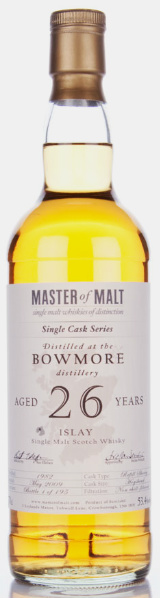
 And here is another Master of Malt bottling. Earlier I reviewed a reduced
  Color: Gold
 Color: Copper Gold
 For the Douglas Laing brand, It all started in 1998 with the Old Malt Cask series, to commemorate their 50 years in business. Therefore if possible the series is bottled at 50% ABV. Later a more luxury series was introduced called The Old and Rare series. Although it is better known as the Platinum Series.
 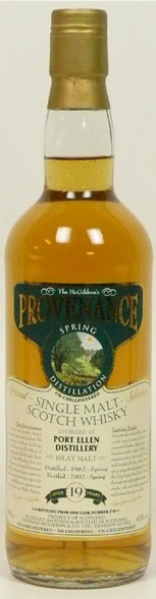 In fact there are a lot of ‘names’ on their labels. The third series I would like to mention here is the Douglas McGibbon’s Provenance series. A series placed under the Old Malt Cask series, also with lower ABV, usually 43% or 46%, but also cask strength and small batch versions exist. There are also some newer series, like the Director’s Cut, introduced in 2011 with cask strength single cask single malts and single grains. Other series by Douglas Laing are the Premier Barrel and Douglas of Drumlanrig.
 Old Bothwell is a company from Bothwell, Lanarkshire Sur near Glasgow Scotland. It’s a company that specializes in bottling their own stock of wines and spirits with the possibility of personalized labels. In the whisky-world they became quite famous for bottling a series of great Port Ellen’s. Alas Old Bothwell just bottled their last cask of Port Ellen, so now they will move into other whiskies. First up are a Tormore 1988/2012 and Macduff 1980/2012.
 Cardhu is a very special distillery in the portfolio of Diageo, since it is their biggest selling malt (Spain and France mainly), but when talking to other enthusiasts the response isn’t all that…well enthousiastic. There is only talk of old bottles of Cardhu. Since 2006 a special cask reserve is issued, which isn’t welcomed with open arms, but since it sells so well, it must be the ultimate entry-level whisky. Personally I don’t like it.
 Founded in 1811 by the illicit distiller John Cumming, who became legal in 1824. In 1884 the old distillery is replaced. Purchased by John Walker & Sons in 1893. Then in 2002 a small revolution took place. Cardhu, the whisky was silently changed into a vatted malt. (Several single malts blended together). The bottle and the label stayed the same, just the word ‘single’ changed into ‘pure’. Well this didn’t last long, in 2004 the ‘pure malt’ was withdrawn. Luckily in 2005 this 22yo was issued.
 This Port Ellen is from Dutch retailers
 Don’t smoke or eat. Just you with this Port Ellen. It has balance and complexity, but seems so fragile.
 And here is another whisky from my lectern. This time an old (bottled in 1999) Craigellachie from Scott’s Selection. The people who brought us the fabulous Longmorns from 1971. Therefore I always have a soft spot for these guys. This Craigellachie was opened on our
  Color: White wine.
 Its raining like crazy outside, and I have this Port Ellen on my lectern, so probably no better moment to have a go at this. Seize the day, the moment is now! There may be no tomorrow! Heed the call of the elements!
 Color: White Wine.
 Master Quill